
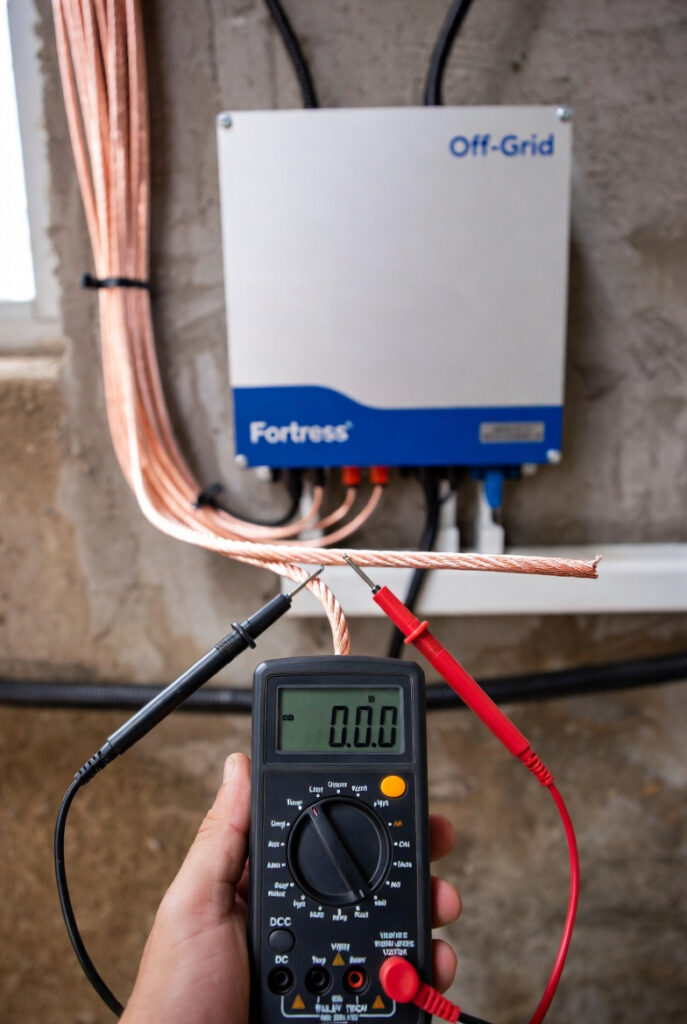
DC voltage drop off-grid is the invisible failure mode that makes a full battery look like a dead one. I’ve seen the service drive version: a car that coughs under hard acceleration, fuel pump tests clean under no load, but under load the wiring is corroded or undersized and the pump isn’t getting full voltage. The pump is starving, not failing. In your off-grid Fortress the parallel is exact your 48V LiFePO4 bank is fully charged, your solar array is producing, and your Victron MultiPlus-II is throwing a low voltage error and shutting down. The battery is full. The wire is the problem. DC voltage drop off-grid is not a component failure. It is a restriction. And like a pinched fuel line, you will not find it by testing the components at either end. Before sizing any cable run, make sure you understand how much solar power your system actually needs the full-load current that determines your wire gauge starts with the total system wattage.
Why DC Voltage Drop Off-Grid Happens and What It Costs You
Electrical resistance is present in every conductor. Every foot of copper wire, every lug, every terminal connection adds a measurable resistance to the circuit. When current flows through resistance it produces a voltage drop the voltage at the far end of the cable is lower than the voltage at the source. The formula is Ohm’s Law: V = I × R. For a high-current DC circuit this drop is not theoretical. It is measurable with a multimeter and it accumulates with every foot of cable and every connection in the run.
For a 48V system running a 3000W inverter at full load the DC current is: 3000W ÷ 48V = 62.5A. That 62.5A flows through every inch of cable between the battery bank and the inverter input terminals. The resistance of the cable determines how much voltage arrives at the inverter. The inverter does not know the battery is full. It only knows what voltage it sees at its input terminals. If that voltage drops below the low-voltage shutdown threshold typically 44-46V on a 48V LiFePO4 system the inverter shuts down. The battery was never low. The wire starved the inverter.
The DC voltage drop off-grid calculation is straightforward: Voltage Drop = (2 × L × I × R) / 1000, where L is the one-way cable length in feet, I is the current in amps, and R is the cable resistance in ohms per 1000 feet. The factor of 2 accounts for both the positive and negative conductors in the round-trip circuit. This is the calculation that determines wire gauge not a rule of thumb, not a distance estimate. As covered in the low voltage cutoff guide, the LVC threshold is set for battery protection not for voltage drop compensation. The LVC cannot distinguish between a genuinely low battery and an inverter starved by undersized cable.
The DC Voltage Drop Off-Grid Calculation: Real Numbers for a 48V Fortress
Cable resistance values for pure copper conductors:
- 2/0 AWG: 0.081 Ω per 1000 feet
- 4/0 AWG: 0.051 Ω per 1000 feet
Scenario 1 – 12-foot one-way run, 3000W inverter, 48V system (62.5A):
2/0 AWG: (2 × 12 × 62.5 × 0.081) / 1000 = 1.46V drop → 2.8% of 52V marginal, within code, at the edge of the GridFree Guide 2% standard under heavier loads
4/0 AWG: (2 × 12 × 62.5 × 0.051) / 1000 = 0.92V drop → 1.76% within the GridFree Guide 2% standard ✅
Scenario 2 – 20-foot one-way run, same system:
2/0 AWG: (2 × 20 × 62.5 × 0.081) / 1000 = 2.43V drop → 4.6% over the NEC 3% code limit, over the GridFree Guide 2% standard ❌
4/0 AWG: (2 × 20 × 62.5 × 0.051) / 1000 = 1.53V drop → 2.9% within the NEC limit, marginally over the GridFree Guide standard at full load ⚠️
The GridFree Guide standard for high-current DC runs is 2% maximum drop more conservative than the NEC 3% code limit for the same reason the inverter terminal torque standard exceeds manufacturer minimums. The code limit is the floor. The target is the standard that keeps the inverter out of low-voltage territory under any realistic load condition.
I was on site outside Rockwood with a client whose Victron MultiPlus-II had been throwing low voltage shutdowns for two weeks. The 48V LiFePO4 bank was reading 52.4V at the terminals under load fully charged. At the inverter input terminals the reading was 49.1V. A 3.3V drop across 12 feet of 2/0 AWG at 62.5A load. The inverter was seeing 49.1V and interpreting it as a battery approaching low-voltage cutoff. We rewired the run with 4/0 AWG. Under the same load: 52.4V at the battery, 51.8V at the inverter. 0.6V drop. The shutdowns stopped that afternoon. The battery had been full the entire time.
CCA vs OFC: Why Cable Material Matters as Much as Gauge
Not all cable sold as “2/0 AWG” is equal. Copper-clad aluminum (CCA) cable uses an aluminum core with a thin copper coating. It is sold at a significant discount compared to pure oxygen-free copper (OFC) and it is widely available online. In a high-current DC off-grid application it is a documented hazard.
Aluminum has approximately 61% of the conductivity of copper. A CCA cable sold as 2/0 AWG carries the same current as approximately 3 AWG pure copper. In a 60A+ DC circuit this does not just produce extra voltage drop it produces heat. Aluminum also expands and contracts at a different rate than copper under thermal cycling, which loosens connections at lugs and terminals over time the same thermal feedback loop covered in the inverter terminal torque guide. CCA is suitable for low-current AC applications where it was designed to be used. It has no place in a high-current DC off-grid system. Use pure oxygen-free copper solar cable for every DC run in your Fortress. Verify OFC construction before purchasing the product listing must specify oxygen-free copper, not simply “copper cable.”
The Multimeter Test: The Field Diagnostic for DC Voltage Drop Off-Grid
The multimeter test is the field verification that confirms your cable sizing is performing as calculated or reveals a problem that the calculation did not predict because of corroded lugs, loose terminals, or CCA cable masquerading as pure copper.
The procedure: with the inverter running a known load a microwave at full power or an electric kettle works well, both draw a consistent 1200-1500W measure DC voltage at the battery terminals. Without moving, measure DC voltage at the inverter input terminals. The difference is your actual voltage drop under real load.
Interpret the results against the GridFree Guide standard:
- Under 0.5V drop (under 1%): excellent – cable sizing is correct and connections are clean
- 0.5V to 1.0V drop (1-2%): acceptable – within the GridFree Guide standard
- 1.0V to 1.5V drop (2-3%): marginal – within the NEC code limit but investigate connection integrity at every lug and terminal
- Over 1.5V drop (over 3%): cable upgrade required – measure the run length and recalculate for the next gauge up
The crimping standard governs lug integrity at every connection point. A cold-welded crimp on an otherwise correctly sized cable adds resistance at the lug that will show up in the multimeter test even if the cable gauge is correct. The busbar standard addresses resistance at the busbar connection points. Every joint in the DC run contributes to total voltage drop cable gauge is the largest variable but not the only one.
NEC and CEC: What the Electrical Codes Actually Say
NEC 210.19 recommends a maximum 3% voltage drop for branch circuits and 5% total from the service entrance to the load. For DC circuits in photovoltaic systems NEC 690.8 requires that conductors be sized for the maximum current the circuit will carry with appropriate ampacity derating for temperature and conduit fill. The NEC 3% recommendation is not a hard maximum for all DC circuits it is a guideline that the GridFree Guide 2% standard intentionally exceeds for high-current inverter feeds where a low-voltage shutdown is the consequence of exceeding the threshold. Installing a correctly calculated cable run that stays within 2% drop at full inverter load satisfies NEC 690.8 ampacity requirements and exceeds the NEC 210.19 voltage drop guideline simultaneously.
CEC Section 8-102 sets the voltage drop limits for branch circuits in Canada at 3% and total system drop at 5%. For renewable energy systems CEC Section 64 applies the same conductor sizing requirements as the general wiring rules with the additional context that DC circuits in off-grid systems operate at continuous high current for extended periods a condition that makes the 3% limit a floor, not a target. In a Rockwood barn installation where the inverter-to-battery cable run is determined by physical constraints rather than design preference, the CEC Section 8-102 limit defines the maximum acceptable run length for a given wire gauge. If the calculated drop exceeds 3% at full load the installation is not code-compliant regardless of how clean the terminations are.
Quick Reference – DC Voltage Drop Off-Grid Wire Gauge Selection
| Wire Gauge | Resistance (Ω/1000ft) | Max One-Way Run at 62.5A (2% drop, 48V) | Max One-Way Run at 62.5A (3% drop, 48V) | Notes |
|---|---|---|---|---|
| 1/0 AWG OFC | 0.102 Ω | 6 ft | 9 ft | Minimum for any inverter feed on a 48V 3000W system |
| 2/0 AWG OFC | 0.081 Ω | 8 ft | 12 ft | Adequate for short runs under 10 ft — calculate first |
| 3/0 AWG OFC | 0.064 Ω | 10 ft | 15 ft | Good for runs 10-15 ft on 48V 3000W systems |
| 4/0 AWG OFC | 0.051 Ω | 13 ft | 19 ft | GridFree Guide standard for most barn installations |
| 250 MCM OFC | 0.043 Ω | 15 ft | 23 ft | For runs over 20 ft or systems above 3000W |
Run the multimeter test at full inverter load not at idle and not at 25% load. Voltage drop scales with current squared in the resistance formula. A cable that shows 0.3V drop at 20A idle will show over 1.5V drop at the same 62.5A full load. The test is only valid when the inverter is pulling its maximum realistic operating current. A microwave at full power is the easiest consistent load source in most off-grid installations. Turn it on, wait 10 seconds for current to stabilize, then take both readings simultaneously. That number is your real operating drop.
The Verdict
DC voltage drop off-grid is a calculation, not a guess. Every cable run between the battery bank and the inverter has a correct wire gauge determined by the distance, the current, and the acceptable drop threshold. The battery state of charge is irrelevant if the cable is starving the inverter.
Before energizing any DC cable run:
- Calculate the voltage drop using (2 × L × I × R) / 1000 use the actual run length, the actual full-load current, and the resistance value for the gauge you are planning
- Verify OFC construction on every cable before purchasing CCA is not acceptable for high-current DC runs regardless of the gauge label
- Run the multimeter test at full load after commissioning if the drop exceeds 1% investigate, if it exceeds 3% upgrade the cable before leaving the installation
The fuel line cannot restrict the horsepower. Size the cable for the current it will actually carry.
Disclosure: This post contains affiliate links. If you purchase through our links, we may earn a small commission at no extra cost to you.
Questions? Drop them below.