
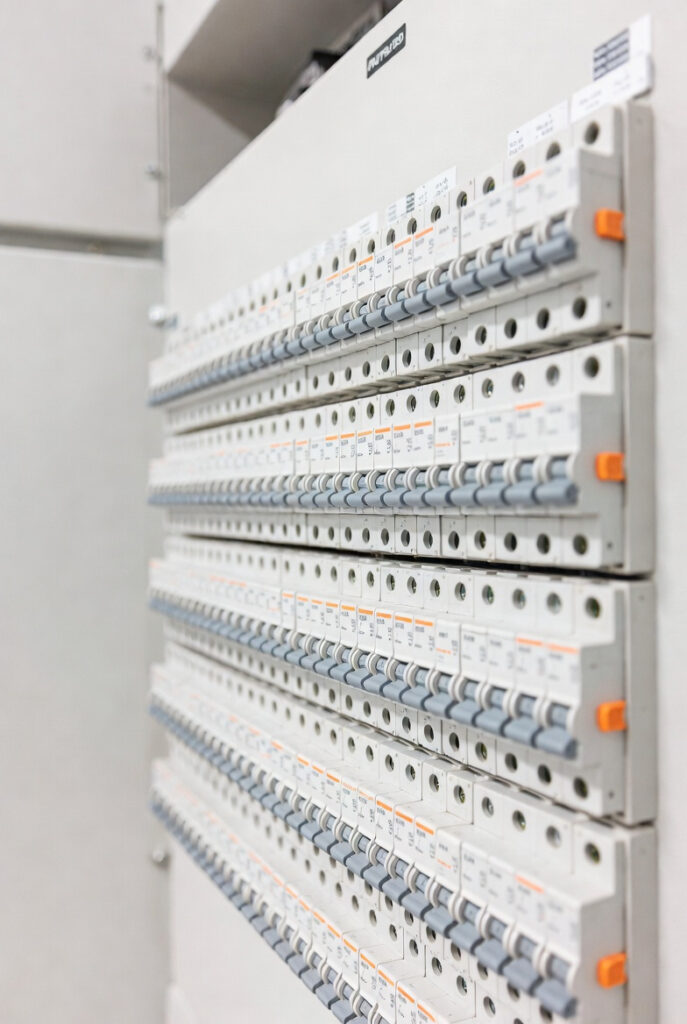
If you install a solar system without proper dc fuse sizing for solar between your battery bank and the inverter you have not built a power system. You have built an incendiary device. DC fuse sizing for solar is not an optional upgrade it is the firewall that prevents your electrical system from becoming a structural fire. Before anything else make sure you understand how much solar power you actually need so your protection devices are sized for a real system not a guess.
DC current behaves differently from AC. An AC breaker trips and the arc self-extinguishes. A DC arc once started is a miniature lightning bolt that wants to keep burning. It does not self-extinguish. It finds fuel. In a solar system with a LiFePO4 battery bank that can deliver 20,000+ amps into a dead short the consequences of missing or undersized protection are catastrophic and fast.
I found a wire on a system in Rockwood last spring that had rubbed through its insulation against a mounting rail probably from wind vibration over two winters. The copper was bare and touching the aluminum frame. The only reason that system did not have a structural fire was a properly rated ANL fuse that opened the circuit before the arc could sustain. Safety is not a suggestion. It is the foundation.
DC Fuse Sizing for Solar: Why DC Is Different From AC
AC vs DC fault behavior: When an AC circuit develops a fault the alternating current naturally crosses zero 120 times per second providing natural arc interruption opportunities. AC breakers are designed to exploit these zero crossings to extinguish the arc and open the circuit.
DC current has no zero crossing. It flows continuously in one direction. A DC arc once initiated does not self-extinguish it sustains and grows. The ionized air from the initial arc becomes conductive allowing current to continue flowing even after the contact points separate. This is why DC-rated fuses and breakers are required for solar systems an AC-rated device may not successfully interrupt a DC fault.
The LiFePO4 short circuit reality: A modern LiFePO4 battery with internal resistance of 0.17–0.25 milliohms can deliver 15,000–20,000 amps into a direct short circuit for the fraction of a second before the BMS responds. Standard automotive fuses rated for 3,000A interrupt capacity cannot physically stop this current surge. The fuse melts but the current continues flowing through the molten metal and ionized vapor. The circuit does not open. The fire starts.
The fusible link analogy: Every vehicle has a fusible link a deliberately weak point in the main battery cable that fails first in a fault event. The fusible link is not there to protect the battery. It is there to protect the wire and everything connected to it. The fuse in a solar system serves exactly the same purpose designed to be the weakest link so the inverter, the charge controller, and the wiring never become the fuse.
The 125% Rule – Getting the Math Right
Why 125% and not 100%: Solar arrays are continuous loads they produce current for 3+ hours continuously. The NEC requires that overcurrent protection for continuous loads be rated at 125% of maximum current to prevent nuisance tripping under normal operating conditions.
The panel-to-controller calculation:
- Find your panel’s Isc (short circuit current) from the spec sheet
- Multiply by 1.25 for continuous duty: Isc × 1.25
- Multiply again by 1.25 for NEC safety margin: result × 1.25
- Round up to the next standard fuse size
Example – Renogy 100W panel (Isc = 6.32A): 6.32 × 1.25 = 7.9A × 1.25 = 9.875A → use a 10A fuse
For 4 panels in parallel: 6.32 × 4 = 25.28A × 1.56 = 39.4A → use a 40A fuse
The controller-to-battery calculation: Size to the charge controller’s maximum output current rating × 1.25.
Example – Victron SmartSolar MPPT 100/30 (30A output): 30A × 1.25 = 37.5A → use a 40A fuse or breaker
The battery-to-inverter calculation: This is the most critical fuse in the system. Formula:
(Inverter watts ÷ battery voltage ÷ inverter efficiency) × 1.25
Example – 3000W inverter on 12V system at 90% efficiency: (3000 ÷ 12 ÷ 0.90) × 1.25 = 277.8A × 1.25 = 347A → use a 350A Class T fuse
Place the fuse as close to the battery positive terminal as possible within 300mm (12 inches) is the standard. Every centimeter of unprotected wire between the battery terminal and the fuse is a potential fire source.
Where Every Fuse Goes – The Three Critical Locations
Location 1 – Between solar panels and charge controller: Protects the charge controller input and the wiring from panel short circuit current. Required when panels are connected in parallel. A single string of panels in series does not require a fuse at the controller input but benefits from one. Use PV-rated DC fuses with voltage rating above array Voc at minimum temperature. The Blue Sea Systems 40A DC Circuit Breaker is rated to -40°C and handles up to 48V DC the only breaker spec that matters for Ontario winters.
Location 2 – Between charge controller and battery: Protects the battery and wiring from a charge controller output fault. Size to controller maximum output current × 1.25. This fuse also serves as a convenient disconnect point for system maintenance and winterization. Not sure what your controller output current is? See our Charge Controller Sizing guide for the full calculation. The Blue Sea Systems 100A DC Circuit Breaker works well as a resettable disconnect on larger systems.
Location 3 – Between battery bank and inverter: The most important fuse in the system. A 12V 3000W system needs a 300-400A fuse. A 24V 3000W system needs a 150–200A fuse. This fuse must be Class T or equivalent with AIC (Ampere Interrupt Capacity) rating sufficient for your battery bank’s short circuit current. The Victron MultiPlus-II 12/3000 includes integrated overcurrent protection for standalone inverters add a dedicated Class T fuse holder rated for your system amperage. For the complete grounding picture that works alongside your fuse protection see our Solar Inverter Grounding guide.
The AIC requirement for LiFePO4: AIC is the maximum fault current a fuse can safely interrupt. Cheap automotive ANL fuses are rated for 6,000-10,000A AIC. A LiFePO4 battery bank can produce 15,000-20,000A in a direct short. Class T fuses are rated for 20,000A AIC matching the actual fault current capability of a lithium battery bank. For LiFePO4 systems Class T is not optional. It is the minimum.
Fuses vs Breakers – When to Use Each
Fuses – one-time protection: Advantages: Faster response time than any breaker melts in microseconds under fault current. No moving parts to fail. Simple and reliable. Class T fuses provide the highest AIC ratings available.
Disadvantages: Single use must be replaced after every fault event. Cannot be used as a routine disconnect switch repeated opening under load damages the fuse element.
Best locations: Battery-to-inverter main protection where AIC rating is critical. Panel string protection where fast response matters.
Breakers – resettable protection and disconnect: Advantages: Resettable can be reset after a nuisance trip without replacing hardware. Can be used as a routine disconnect switch for maintenance and winterization. Provides a visible ON/OFF status indicator.
Disadvantages: Slower response than a Class T fuse. Lower AIC ratings most DC breakers are rated for 5,000–10,000A AIC. Not suitable as primary protection for large LiFePO4 battery banks.
Best locations: Panel-to-controller circuit where routine maintenance disconnects are needed. Controller-to-battery circuit where resettable protection is preferred.
The hybrid approach: Class T fuse at the battery as primary overcurrent protection. Blue Sea Systems DC breaker at the controller and panel circuits as secondary protection and maintenance disconnect. This gives you the highest safety level at the highest fault current location and convenient switching everywhere else.
The Cold Climate Wire Abrasion Risk
This is the cold climate detail completely absent from every dc fuse sizing for solar guide.
Wire insulation in Ontario winters: Standard PVC wire insulation becomes brittle at temperatures below -10°C. In Ontario, Minnesota, and Montana a wire that is flexible in September may crack at a bend point in January. Add two winters of vibration from wind loading on a ground mount frame and that crack propagates until the conductor is exposed.
The abrasion scenario: A wire routed through a metal frame without proper grommets or conduit. Wind vibration causes the wire to move 1-2mm repeatedly over the freeze-thaw cycle. The insulation wears through against the metal edge. The bare copper contacts the aluminum frame. Without a properly rated fuse this is a sustained DC arc a fire.
The cold climate installation standard: All DC wiring in Ontario cold climate installations should use wire with temperature rating of -40°C minimum not standard PVC which is rated to only -10°C or -20°C. USE-2 rated wire or THWN-2 wire in conduit is the correct specification. Fuses provide the last line of defense when insulation fails. They must be correctly sized and correctly rated to fulfill that role.
DC Fuse Sizing Chart
Quick reference for common 12V and 24V off-grid systems:
| Circuit | 12V System | 24V System | Fuse Type |
|---|---|---|---|
| 100W panel to controller (1 panel) | 15A | 15A | PV-rated blade or glass |
| 400W array to controller (4 × 100W parallel) | 40A | 40A | PV-rated DC fuse |
| MPPT 30A controller to battery | 40A | 40A | ANL or DC breaker |
| MPPT 50A controller to battery | 63A | 63A | ANL or DC breaker |
| 1000W inverter to battery | 125A | 63A | Class T |
| 2000W inverter to battery | 250A | 125A | Class T |
| 3000W inverter to battery | 350A | 175A | Class T |
| 5000W inverter to battery | N/A | 300A | Class T |
Notes:
- All battery-to-inverter fuses must be Class T for LiFePO4 systems
- Install battery-to-inverter fuse within 300mm of battery positive terminal
- Always round up to next standard fuse size above calculated value
- Never upsize a fuse to stop nuisance trips — investigate the cause
Pro Tip: Never increase a fuse size to solve a nuisance tripping problem. A fuse that trips repeatedly is telling you something is wrong either the load is drawing more current than expected, the wiring is undersized, or there is a developing fault in the circuit. Increasing the fuse size silences the warning without fixing the problem. The next event will not be a nuisance trip. It will be a fire. Investigate the cause. Fix the circuit. Replace the fuse with the correctly sized device.
The Verdict
DC fuse sizing for solar is not complicated but it is not optional. Three locations. 125% rule. Class T for lithium battery banks. Fuse as close to the battery positive terminal as possible.
A solar system without correct dc fuse sizing for solar protection has not been completed. It has been started. Finish it before the first cloudy day makes you forget it is there.
Safety is not a suggestion. It is the foundation of everything your system protects.
Disclosure: This article contains affiliate links. If you buy through them, GridFree Guide earns a small commission at no extra cost to you.
Questions? Drop them below.
Pingback: Solar Combiner Box: How to Safely Merge Multiple Strings