
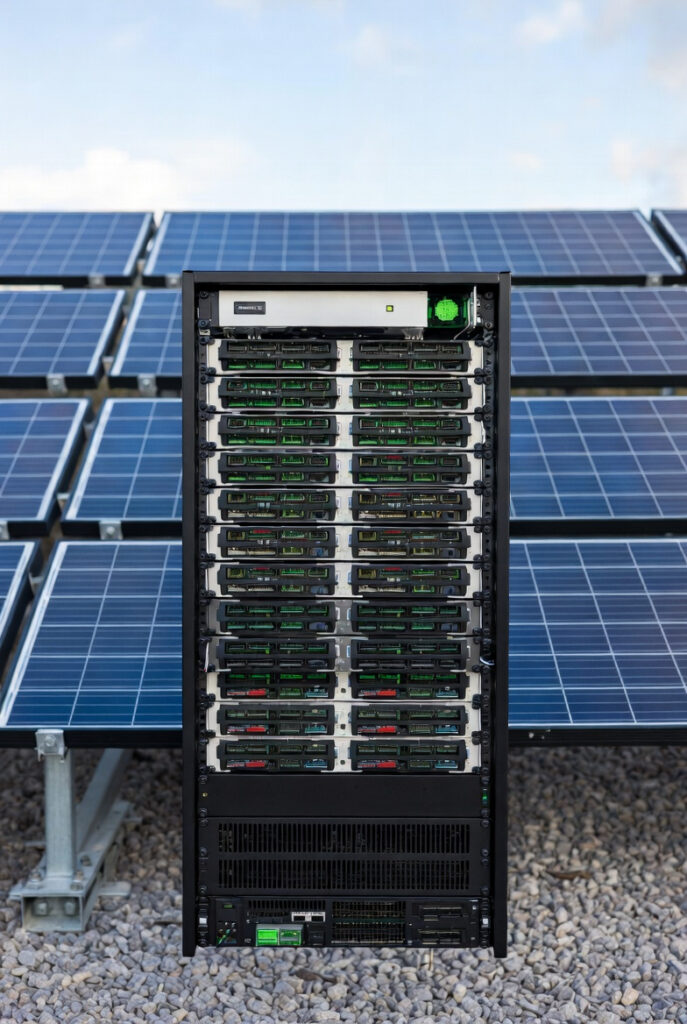
Data center uptime on an off-grid solar system starts with counting the conversion steps between the panel and the CPU. I audited a small edge AI research node in rural Ontario that was running four GPU servers drawing approximately 22kW total. The power path was: 48V battery bank to 3,000W Victron inverter to 240V AC panel to each server’s AC power supply to the server’s internal DC bus at 12V. I counted four conversion steps. At typical efficiency rates of 96% per step the cumulative efficiency was 84.9%. The system was losing 15.1% of every solar watt generated before it reached the GPU. On a 20kW server load that is 3.02kW of continuous waste heat being generated inside the server room from conversion losses alone. The fix was a direct 48V DC busbar connecting the MPPT charge controllers and battery bank directly to Open Rack V3 server power supplies with native 48V DC input. Four conversion steps became one. Efficiency climbed from 84.9% to 97.2%. The 3.02kW of waste heat dropped to 0.56kW. The cooling load dropped by 2.46kW, enough to eliminate one of the three cooling units running in the room.
Why Data Center Uptime Fails on Solar Without a Native DC Busbar
The standard AC-coupled conversion chain runs: solar MPPT to battery at 96%, inverter AC output at 96%, server AC power supply at 94%, and internal DC bus at 97%. The cumulative efficiency is 84.9%. The native 48V DC path runs: solar MPPT to battery at 96% and 48V DC busbar to server power shelf DC-to-DC at 97%. The cumulative efficiency is 93.1%. On a 20kW IT load the AC path draws 23.6kW from the array while the DC path draws 21.5kW. That 2.1kW difference is two additional solar panels required purely to cover conversion overhead in the AC architecture. For the system sizing hub that determines total array size based on IT load and PUE target, the hub covers the calculation foundation.
| Power Path | Conversion Steps | Cumulative Efficiency |
|---|---|---|
| AC-coupled (standard) | 4 steps | 84.9% |
| Native 48V DC busbar | 2 steps | 93.1% |
| Efficiency recovery on 20kW IT load | 2.1kW less array required |
The 48V DC Busbar: The Core of a Solar Off-Grid Data Center
The Open Rack V3 standard specifies 48V DC as the native server power input voltage, adopted by hyperscalers and now available to edge operators. MPPT charge controllers and LiFePO4 battery banks connect directly to the 48V DC busbar. Power shelves step 48V down to internal server voltages via high-efficiency DC-to-DC converters. The inverter is eliminated from the IT power path entirely. The battery bank serves as the UPS, maintaining 48V on the busbar for microsecond-level power continuity that prevents data corruption. There is no transfer switching. When solar production drops below IT load, the bank discharges to maintain voltage on the busbar seamlessly. For the community microgrid architecture that applies the same island mode logic at community scale, Article 177 covers the operating standard.
2N+1 Redundancy: The Data Center Uptime Insurance Standard
2N+1 redundancy means two active Victron MultiPlus-II inverter-charger strings each sized for the full IT load, plus one identical standby unit. For a 20kW IT load each active string is rated for 20kW minimum. The common mistake is sizing two 10kW inverters for a 20kW load, thinking that provides redundancy. Both units would be overloaded if one fails. The correct specification is two 24kW strings at 125% of the 20kW continuous load rating, plus one 24kW standby. When String A is taken offline for maintenance, String B carries the full load without transfer delay. The standby activates for any single component failure. This is the architecture that delivers 99.99% data center uptime. A single inverter with a backup on a shelf delivers approximately 99.5% uptime, adequate for non-critical edge computing but not for revenue-generating inference workloads.
PUE Monitoring: The Data Center Uptime Efficiency Metric
I walked a client through the PUE calculation on his small off-grid inference server rack last spring. He had four A100-class GPU servers drawing 18kW total at full inference load. The facility load including cooling fans, lighting, networking equipment, and inverter overhead was 9.2kW. Total facility power consumption was 27.2kW. PUE was 27.2 divided by 18, which equals 1.51. For every watt reaching a GPU, 51 cents of additional solar production was being spent on overhead. On a system with 30kW of solar panels, 8.1kW of that array was doing nothing but running fans and lights. The overhead was an invisible tax that had never been calculated. Switching to immersion cooling and DC-native power reduced the facility overhead from 9.2kW to 3.8kW. The new PUE was 21.8 divided by 18, which equals 1.21. The client decommissioned 6kW of solar panels that were no longer needed and used the freed racking space for additional GPU capacity. The Cerbo GX provides real-time total facility power and IT load data for continuous PUE calculation. A PUE above 1.2 is a service failure in a well-designed solar data center uptime architecture. For the battery room venting standard that governs the thermal management of the battery bank in the data center environment, the venting guide covers the active air requirement.
Immersion Cooling: Eliminating the Fan Load for Data Center Uptime
Fan cooling in a 20kW IT load air-cooled facility typically requires 4 to 6kW of continuous fan power, representing 20 to 30% of IT load. Immersion cooling submerges servers in dielectric fluid that transfers heat directly to a heat exchanger. Fan energy drops to near zero. The circulation pump draws approximately 0.3 to 0.5kW, ten to fifteen times less than air cooling fans. Servers in immersion cooling run 8 to 12°C cooler than air-cooled equivalents, maintaining GPU clock speeds at rated boost frequencies without thermal throttling. For a 20kW GPU inference cluster, eliminating thermal throttling recovers approximately 5 to 10% of compute throughput at no additional power cost. For the DC disconnect standard that governs the high-current busbar protection in a data center DC architecture, the disconnect guide covers the isolation requirement. For the remote mining skid standard that covers NEMA 4X vibration-damped enclosure requirements for remote facility electronics, Article 181 covers the enclosure specification.
The Data Center Uptime Architecture: Minimum Viable vs Full 2N+1 Standard
The decision between two systems follows the criticality of the workload and the financial consequence of an outage.
The minimum viable architecture is the correct choice for non-critical edge computing, research archiving, or development workloads where a 30-minute to 4-hour outage has no financial consequence. It includes a single 20kW inverter-charger string, a hot standby inverter on shelf with manual transfer, AC-coupled power to standard server power supplies, air cooling with variable speed fans, and basic PUE monitoring. Capital cost for a 20kW IT load runs $40,000 to $80,000 in power infrastructure. Expected data center uptime is 99.5 to 99.9%.
The full 2N+1 standard is the correct choice for revenue-generating inference, financial computation, or research that cannot be interrupted. It requires dual 24kW active strings plus one 24kW standby, native 48V DC busbar via Open Rack V3, immersion cooling with dielectric fluid, continuous PUE monitoring below 1.2, and a battery bank sized for 4 hours of full IT load at rated capacity plus 25% reserve. Capital cost for a 20kW IT load runs $150,000 to $300,000 in power infrastructure. Expected data center uptime is 99.99% or above.
NEC and CEC: What the Codes Say About Off-Grid Data Centers
NEC 708 covers critical operations power systems and applies to facilities where loss of power would interrupt critical processes. For a data center classified as a critical operations facility under NEC 708, the power system must include an alternate power source capable of sustaining critical loads indefinitely, an automatic transfer system, and a maintenance bypass for each critical component. NEC 645 covers information technology equipment and requires that IT equipment be installed with adequate power distribution, grounding, and branch circuit protection. The native 48V DC busbar in an off-grid data center is a DC power distribution system subject to NEC Article 480 for battery systems and NEC 690 for the PV source circuits feeding the busbar.
In Ontario, a data center is an electrical installation subject to the CEC and requires an ESA permit for the power distribution system regardless of whether it is grid-connected or off-grid. CEC Section 64 governs the PV source circuits. CEC Section 26 covers branch circuits and applies to the distribution from the 48V DC busbar to individual server racks. An off-grid data center with battery storage exceeding 50V nominal is subject to CEC Section 64 battery requirements. The installation must be designed and stamped by a licensed professional engineer in Ontario. For facilities operating as commercial data centers, the Ontario Fire Code requirements for server room fire suppression also apply regardless of grid connection status.
Pro Tip: Before you buy a single solar panel for a data center project, calculate your target PUE and multiply your IT load by that number. That is your total facility power requirement and your minimum array size. A 20kW IT load at PUE 1.5 needs a 30kW array. The same load at PUE 1.2 needs a 24kW array. Fix the PUE first. Then buy the panels.
The Verdict
Data center uptime on solar at 99.99% or above requires three engineering decisions made correctly before a single server is racked.
- Eliminate AC conversion from the IT power path. A native 48V DC busbar connected directly from the battery bank to Open Rack V3 power shelves recovers 8 to 12% of solar production that the AC conversion chain wastes as heat.
- Size each inverter string for the full IT load, not half the load. 2N+1 means two full-capacity strings active plus one standby. Two half-capacity strings is not redundancy. It is a guaranteed overload when one fails.
- Calculate PUE before sizing the solar array. A PUE of 1.5 requires 50% more solar panels than a PUE of 1.0. Fix the architecture first. Then size the array to what the architecture actually requires.
In the shop, we do not let a parasitic drain kill the battery. In the data center, a PUE above 1.2 is the parasitic drain.
Questions? Drop them below.
This post contains affiliate links. If you purchase through our links, we may earn a small commission at no extra cost to you.