
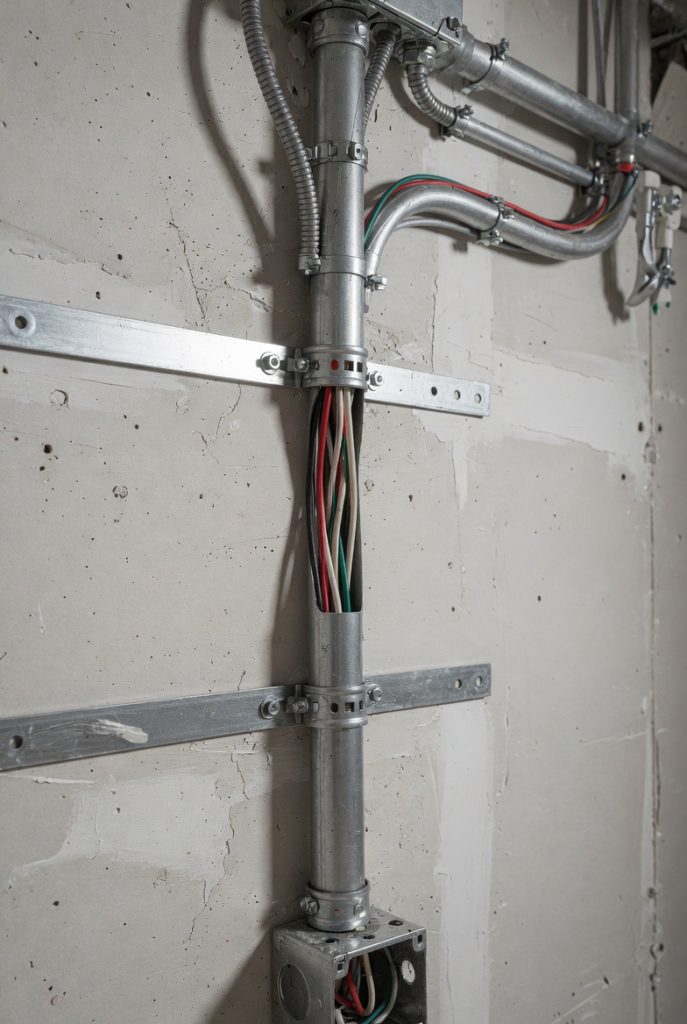
In the service bay we know that if you don’t leave room for airflow around a hot component it is going to fail. A transmission cooler with a plugged line. An alternator with the ventilation blocked. Same result: thermal failure from heat that has nowhere to go. In an off-grid system the conduit is the cooling system for the wires inside it. Stuff it too full and the heat from multiple cables cooking each other destroys the insulation and eventually creates the catastrophic short circuit your conduit fill solar calculations were supposed to prevent. Before sizing your conduit understand how much solar power you actually need the system current determines the cable sizes and therefore the conduit requirements.
Conduit Fill Solar: Why Wires Cook Each Other
How wire heat accumulates in conduit: Every conductor carrying current generates heat P = I²R per unit length. In open air this heat dissipates into the surrounding air freely the ambient temperature around the wire stays manageable and the insulation remains below its rated temperature. In a conduit the air is confined. Multiple conductors in the same conduit each generate heat and this heat accumulates in the shared air space. Each conductor raises the ambient temperature for the other conductors around it. The effective temperature each conductor operates at is the sum of its own heat generation plus the heat from every other conductor in the same conduit.
The insulation failure mode: Standard THWN-2 and USE-2 wire insulation the correct types for solar DC applications is rated for 90°C maximum conductor temperature. When conduit fill causes the accumulated heat to exceed this threshold the insulation begins to soften. Softened insulation loses its dielectric properties it allows current to leak between conductors. The first indication is typically an unexplained voltage drop. The second indication is a burning plastic smell. The third indication is a short circuit.
Why this matters for 4/0 AWG battery cables: As covered in our Wire Gauge guide 4/0 AWG is the main artery of a 3,000W 48V system. At 200-300A the heat generated per unit length of 4/0 AWG is significant. In open air the cable handles this without difficulty. In a conduit with other cables present the same 4/0 AWG cable runs at a higher effective temperature and if the conduit fill solar rules are violated the cable may be operating above its rated insulation temperature continuously during normal system operation.
The 40% Fill Rule – The Code Standard
What the 40% rule means: Both NEC and CEC limit the total cross-sectional area of conductors in a conduit to 40% of the conduit’s interior cross-sectional area when there are more than two conductors. The remaining 60% of the conduit interior is not wasted space it is the thermal buffer that allows heat from the conductors to dissipate into the air column rather than accumulating against other conductors.
The calculation procedure:
- Sum the cross-sectional areas of all conductors to be installed from NEC Annex C or CEC Appendix tables
- Calculate the interior cross-sectional area of the conduit from conduit dimension tables
- Divide conductor area sum by conduit interior area
- If the result exceeds 40% upsize the conduit
4/0 AWG cable area reference: A single 4/0 AWG THWN conductor has a cross-sectional area of approximately 0.3970 square inches including insulation. For a positive and negative 4/0 AWG battery cable pair in the same conduit: 2 × 0.3970 = 0.794 square inches of conductor area. Maximum 40% fill conduit: 0.794 / 0.40 = minimum 1.985 square inches of interior conduit area a 2-inch Schedule 80 PVC conduit with 2.048 square inches of interior area is the minimum correct specification for this cable pair.
Adding additional conductors: If a ground conductor, an EGC, or additional control cables are added to the same conduit the total conductor area increases and the required conduit size increases proportionally. Each additional conductor must be included in the fill calculation including EGC and bonding conductors even though they do not normally carry current. As covered in our Equipment Bonding guide every EGC in the system must be accounted for in the conduit fill calculation even though it carries current only during fault events.
NEC 310.15 Derating – The Ampacity Math
What derating means: NEC 310.15(B)(3)(a) requires that when more than three current-carrying conductors are installed in a conduit the ampacity of each conductor must be reduced derated by a correction factor. This accounts for the mutual heating effect of multiple conductors sharing a confined space.
The NEC derating factors:
- 4-6 current-carrying conductors: multiply ampacity by 0.80 (80%)
- 7-9 current-carrying conductors: multiply ampacity by 0.70 (70%)
- 10-20 current-carrying conductors: multiply ampacity by 0.50 (50%)
The practical calculation: WindyNation 4/0 AWG battery cable THWN-2 90°C rated has a base ampacity of 230A for a single conductor in free air at 30°C ambient per NEC Table 310.15(B)(16). If this cable is installed in a conduit with 5 other current-carrying conductors (6 total): derated ampacity = 230A × 0.80 = 184A. A system drawing 200A continuous from the battery bank through this cable in this conduit configuration is exceeding the derated ampacity by 16A continuously every time the inverter runs at full load.
The CEC Table 5C equivalent: The Canadian Electrical Code Table 5C provides equivalent ampacity correction factors for multiple conductors in conduit. For 4-6 conductors the CEC factor is 0.80 identical to NEC. For 7-9 conductors the CEC factor is 0.70. The calculation procedure is the same base ampacity from the conductor table multiplied by the correction factor equals the derated allowable ampacity for that installation.
I ran this calculation for a client who had installed his positive battery cable, negative battery cable, MPPT output positive, MPPT output negative, AC output L1, and AC output neutral all in the same 2-inch conduit 6 current-carrying conductors. His Victron MultiPlus-II was rated for 300A battery input. His 4/0 AWG cable derated to 184A in that conduit configuration. He was drawing 250A from the battery under full inverter load 66A above the derated ampacity of his main battery cable. The conduit was warm to the touch during operation. The insulation was degrading. We separated the circuits into appropriate conduits and the conduit temperature returned to ambient.
Schedule 80 vs Schedule 40 – The Right Conduit for the Application
What the schedule numbers mean: PVC conduit is manufactured in different wall thicknesses Schedule 40 (thin wall) and Schedule 80 (thick wall). Schedule 80 has the same outside diameter as Schedule 40 but thicker walls meaning the interior diameter and fill capacity is smaller for the same nominal size. The trade-off is significantly greater physical protection from impact and abrasion.
When Schedule 80 is required: NEC 352.10 and CEC Section 12 require rigid PVC conduit rated for physical protection in locations subject to physical damage. Schedule 80 is the correct specification for:
- Exposed runs from equipment room floor to wall-mounted equipment
- Conduit passing through floors and walls where it may be subject to physical contact
- Any run within 1.8 metres (6 feet) of floor level in a working area
When Schedule 40 is acceptable: Schedule 40 PVC is acceptable for buried conduit where it is protected from physical damage by soil cover minimum 18 inches of cover for general burial per NEC 300.5. Interior runs inside finished walls where physical damage is not a concern. The interior cross-sectional area is larger than Schedule 80 for the same nominal size beneficial for conduit fill solar calculations.
AC/DC Separation – NEC 300.3 and Why It Matters
The code requirement: NEC 300.3(C)(1) prohibits installing DC and AC conductors in the same conduit unless they are all insulated for the maximum voltage of any conductor present. For off-grid solar installations this means separate conduits for DC and AC circuits — no exceptions without specific engineering justification.
The AC/DC crosstalk mechanism: An AC conductor in the same conduit as a DC conductor creates electromagnetic induction between the circuits. The AC conductor’s alternating magnetic field induces a small AC voltage into adjacent DC conductors. This induced AC voltage appears as noise on the DC bus at millivolt levels it is usually imperceptible but in a Victron system with VE.Direct and VE.Bus communication cables running nearby the induced noise can cause intermittent communication errors and random resets that are difficult to diagnose without a spectrum analyzer.
The practical separation rule: Maintain separate conduits for:
- DC battery cables (positive, negative, EGC)
- DC solar input cables (array positive, array negative)
- AC output cables (L1, neutral, ground)
- Communication and control cables (VE.Direct, VE.Bus, sensor cables)
I found AC output cables and DC battery cables bundled together in a single 2-inch flex conduit on a DIY build. The owner had run it that way to keep it neat. Within an hour of running his microwave at full power the conduit was warm enough to notice. By the time he was cooking a full meal the PVC had a faint burning smell the insulation on the AC conductors was at its thermal limit. The Blue Sea Systems 100A DC Breaker on the MPPT output was cycling on thermal overload. We pulled the conduit, separated AC from DC into their own Schedule 80 runs, and the thermal issues disappeared immediately. Separate conduits. Always.
The Conduit Fill Solar Calculation Checklist
Before pulling any wire through conduit:
- List every conductor going into the conduit include EGC and bonding conductors
- Record the cross-sectional area of each conductor including insulation from NEC Annex C or manufacturer data
- Sum total conductor area
- Select conduit size: total conductor area ÷ 0.40 = minimum required conduit interior area
- Count current-carrying conductors if more than 3 apply NEC 310.15 derating factor
- Verify derated ampacity exceeds maximum continuous current for each conductor
- Verify AC and DC conductors are in separate conduits
- Verify Schedule 80 PVC for all exposed runs subject to physical damage
Quick Reference – Conduit Fill and Derating
| Conductors in Conduit | NEC Derating Factor | CEC Derating Factor | Max Fill |
|---|---|---|---|
| 1-3 current-carrying | 1.00 no derating | 1.00 no derating | 40% of interior area |
| 4-6 current-carrying | 0.80 | 0.80 | 40% of interior area |
| 7-9 current-carrying | 0.70 | 0.70 | 40% of interior area |
| 10-20 current-carrying | 0.50 | 0.50 | 40% of interior area |
| 4/0 AWG base ampacity | 230A (THWN-2 90°C) | 230A equivalent | Derate for fill |
| 4/0 AWG derated (6 cond.) | 184A | 184A | Check vs system current |
Pro Tip: Use wire pulling lubricant not dish soap when pulling 4/0 AWG cables through conduit. Dish soap dries and leaves a residue that can affect cable jacket integrity over time. Wire pulling lubricant is specifically formulated for cable jacket materials and does not degrade PVC insulation. If the cable requires significant force to pull more than two people pulling firmly the conduit is either too small for the fill or has too many bends. NEC limits conduit bends to 360 degrees total between pull points if your run has more than 4 × 90-degree bends you need a pull box. A cable pulled through with excessive force has stretched insulation at the bend points a future failure site.
The Verdict
Conduit fill solar calculations are not optional they are the difference between a cable that operates at 85°C and one that operates at 110°C in the same conduit with the same ambient temperature.
Three calculations before calling the conduit installation done:
- Total conductor area – confirm 40% fill rule satisfied for selected conduit size
- Derated ampacity – confirm each conductor’s derated ampacity exceeds its maximum continuous current
- AC/DC separation confirmed – no AC and DC conductors sharing the same conduit
Disclosure: This article contains affiliate links. If you buy through them, GridFree Guide earns a small commission at no extra cost to you.
Questions? Drop them below.