
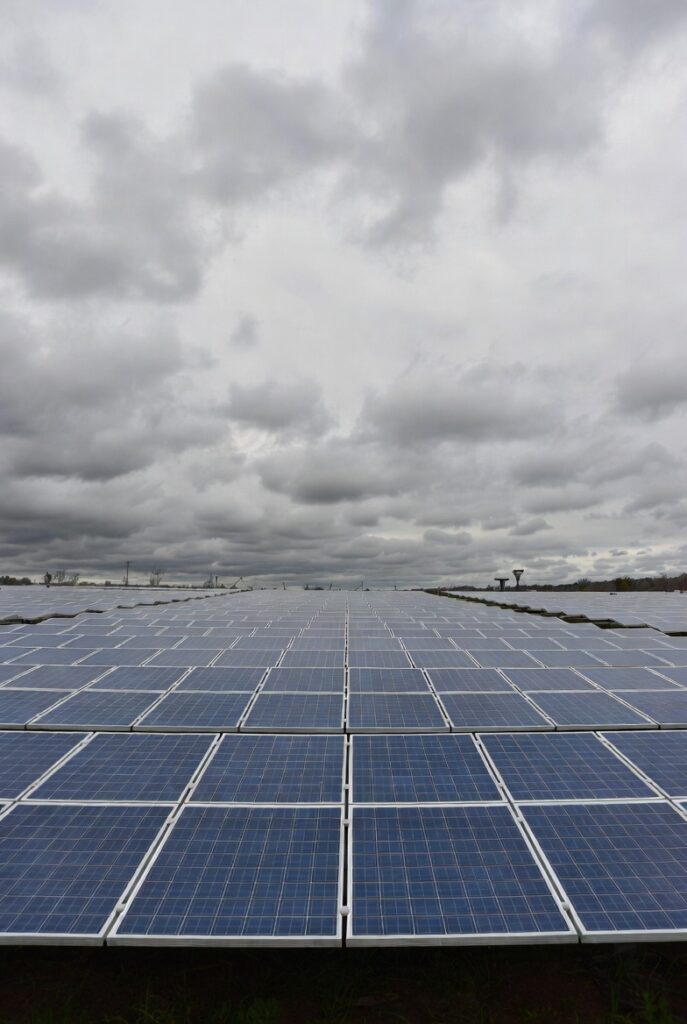
The most common cloudy weather solar question I get from Ontario homeowners is not whether the panels work. They do. The real question is how much output to actually expect on a November grey day, and whether the number on the monitoring app means the system is broken or behaving correctly. A Renogy 100W panel produces 15 to 32 watts on a moderate Ontario overcast. A 400W array produces 60 to 130 watts. Neither number is zero, and for low-power critical loads, neither number is a problem.
In November 2025 I drove to a property on Arkell Road in Guelph, Wellington County, Ontario to inspect a 400W array that the homeowner was convinced had failed. She had installed the array paired with a Victron SmartSolar MPPT 100/30 charge controller and a 100Ah LFP battery the previous spring. Her monitoring app was showing 38W of output on a grey Tuesday afternoon.
I measured the irradiance with a handheld meter: 112 W/m2. A clear July noon in Guelph produces approximately 950 W/m2. The overcast sky was delivering 11.8% of peak irradiance. At 11.8% irradiance a 400W array should theoretically produce 47W. The Victron MPPT was delivering 38W. That is 80.8% of the theoretical maximum at that irradiance level. The system was not failing. It was performing correctly for the conditions.
I showed her the November data on the Victron app. Over the previous 14 days of predominantly grey November weather, the 400W array had delivered an average of 182Wh per day. Her router at 18W plus LED lights at 30W plus phone charging at 20W totalled 272Wh of daily consumption across a 4-hour evening window. The 182Wh of solar harvest covered 66.9% of her daily load without any direct sun. On the three partially sunny days in that 14-day window the system delivered 680Wh, 490Wh, and 510Wh, enough to top the battery back to full each time. The grey days were not a problem. The cloudy weather solar system was working exactly as designed.
Direct vs diffuse irradiance: why clouds do not switch off your panels
Solar panels respond to the full solar spectrum including diffuse radiation scattered by clouds. UV and visible light still penetrate cloud cover even when no shadow is visible on the ground. The practical rule for any Ontario cloudy weather solar installation is direct: if you can read a page outside without turning on a light, your panels are producing electrons. The question is not whether they are working but how many watts they are generating at that moment.
| Sky Condition | Irradiance (W/m2) | % of Rated Watts | Output from 400W Array |
|---|---|---|---|
| Clear summer noon (Guelph, July) | ~950 | 100% | ~340W (at STC) |
| Thin overcast (shadow visible) | 400 to 600 | 40 to 63% | 160 to 250W |
| Moderate overcast (Arkell Road) | 112 to 300 | 12 to 32% | 48 to 128W |
| Heavy overcast (dark sky) | 50 to 149 | 5 to 16% | 20 to 64W |
| Rain / thunderstorm | 20 to 60 | 2 to 6% | 8 to 24W |
At every level in that table the panels are producing output. The moderate overcast that the Arkell Road homeowner called a “failure” was delivering 38W, enough to run her router, an LED strip, and a phone charger simultaneously without drawing a single watt from the battery. Understanding the irradiance table is the difference between a worried phone call to me in November and a calm read of the monitoring app.
What cloudy weather solar output actually looks like in Ontario
The Arkell Road result is the benchmark for Ontario cloudy weather solar output in practice. A 400W array under moderate November overcast delivered 38W. That 38W ran a router at 18W, an LED strip at 12W, and a phone charger at 8W continuously without battery draw. The grey day was not killing the system. It was running the low-priority loads for free. The battery sat at 97% for the entire afternoon because solar input matched load consumption exactly.
The 14-day November average of 182Wh per day across a predominantly grey period is the number that matters most for Ontario system design. In that 14-day window the array averaged 0.455 peak sun hour equivalents per day. The annual Ontario solar pattern breaks into three zones: approximately 5 months of reliable harvest from May through September averaging 4 to 5 peak sun hours per day, 4 months of partial grey harvest in April, October, November, and March averaging 2 to 3 peak sun hours per day, and 3 months of low but non-zero harvest in December, January, and February averaging 1 to 2 peak sun hours per day. The system never truly stops. It slows down.
The cold temperature advantage: why Ontario Novembers have a hidden solar bonus
Solar panels have a negative temperature coefficient. They produce more power at lower temperatures. A standard monocrystalline panel loses approximately 0.35% of rated output for every degree Celsius above 25C, which is the Standard Test Condition temperature. In November when panel surface temperature is around 5C, a 400W panel produces 400 x (1 + 0.35% x 20) = 428W at any given irradiance level. In July when panel surface temperature reaches 60C, the same panel produces 400 x (1 – 0.35% x 35) = 351W at the same irradiance. The cold Ontario November delivers a 22% output advantage over a hot July day at identical irradiance.
The practical implication for any cloudy weather solar installation in Ontario is meaningful. On a grey November day at 200 W/m2 irradiance, a 400W panel at 5C surface temperature produces 400 x (200/950) x 1.07 = 90W, compared to 400 x (200/950) x 0.877 = 74W in August heat. That 16W difference on a 10-hour grey day is 160Wh of additional harvest from temperature alone. The cold grey Ontario day is not as bad as it appears. The temperature is working in your favour even when the sun is not.
The cloudy weather solar MPPT advantage: how a Victron SmartSolar outperforms a cheap controller
A quality MPPT charge controller continuously scans the panel’s voltage-current curve to find the maximum power point. On a grey day when panel voltage fluctuates as clouds move, the MPPT resamples every few seconds and adjusts to the new maximum. A PWM controller uses a fixed voltage reference and loses 15 to 30% more power in low-light conditions because it cannot track the shifting curve. At the 112 W/m2 irradiance on Arkell Road, the Victron SmartSolar MPPT delivered 38W from the 400W array. A PWM controller under identical conditions would have delivered approximately 27W. That 11W gap over a 10-hour grey day is 110Wh of lost harvest every single grey day.
In November 2025 I also reviewed a property on Derry Road near Milton, Halton County, Ontario. The owner had a 200W array on a south-facing shed roof, a Victron SmartSolar MPPT 75/15, and a 200Ah LFP battery. She was running a desktop PC and dual monitors at 350W combined through a grey week. The battery was at 40% by Wednesday morning.
I reviewed the app data: grey day harvest was averaging 74Wh per day while she was drawing 350W for 4 hours each afternoon, 1,400Wh of daily consumption. The net depletion was 1,326Wh per day. The fix was a laptop at 60W instead of the desktop, plus shifting the dishwasher to the two daily solar windows when irradiance spiked to 380 W/m2. After the switch, daily consumption dropped from 1,400Wh to 240Wh. The 74Wh daily cloudy weather solar harvest covered 30.8% of the new load. The battery recovered to 85% by Friday. I would have made the same switch on my own off-grid system without hesitation.
Bifacial panels and snow albedo: a real but secondary grey-day gain
Bifacial panels generate power from both the front face receiving direct and diffuse light and the rear face capturing reflected light from the ground below. In Ontario winter the albedo contribution from snow-covered ground is significant. Fresh snow reflects 60 to 90% of incident light back upward onto the rear face of a mounted bifacial panel. On a grey February day in Wellington County with snow-covered ground, a 100W bifacial panel produces 5 to 10% more output than a standard 100W monofacial panel under the same sky conditions.
For a fixed-angle off-grid array mounted above snow-covered ground in Wellington County in January, the bifacial rear gain adds approximately 5 to 8Wh per day per 100W of bifacial panel capacity. Over a 90-day Ontario winter that adds 450 to 720Wh of additional harvest per 100W of bifacial panel compared to monofacial. That is real. However, it is secondary. The primary driver of output on any cloudy weather solar day is always the front-face irradiance. Bifacial is the right choice for a new build in Ontario. It is not worth replacing functional monofacial panels to gain a winter albedo benefit.
Load shifting on grey days: the Milton Escarpment strategy
The Derry Road result is the Ontario load shifting case study for any cloudy weather solar installation. Replacing a 350W desktop with a 60W laptop reduced daily consumption from 1,400Wh to 240Wh. The solar harvest of 74Wh per grey day went from covering 5.3% of load to covering 30.8%. No new panels. No new battery. Just a different device choice. For any Ontario homeowner running a grey-day deficit, the first question to ask is not how to add more solar but which loads can be reduced or shifted.
The solar window concept is the second tool. Most Ontario grey days include 1 to 3 breaks in cloud cover lasting 30 to 90 minutes each where irradiance spikes to 400 to 600 W/m2. Timing high-draw loads like dishwashers, washing machines, and battery charging to those windows is the correct strategy. One practical indicator: the weather app wind direction overlay. When the wind shifts to southwest in Ontario, grey days tend to break for 30 to 60 minutes in late morning. That is the dishwasher window. On the Derry Road property, two daily 45-minute solar windows at 380 W/m2 delivered approximately 57Wh each, adding 114Wh of harvest beyond the grey-day baseline.
NEC and CEC: code compliance for solar panel installations in Ontario
NEC 690 governs solar photovoltaic system design and installation in the United States, covering wiring methods, overcurrent protection, disconnecting means, and grounding for all PV arrays including off-grid and battery-backed systems. NEC 690.12 requires rapid shutdown for rooftop arrays. NEC 690.47 governs grounding electrode requirements. For any fixed array installation paired with a battery system and MPPT charge controller, NEC 690 compliance requires a licensed electrician to verify the installation before energizing. Contact the NFPA at nfpa.org for current NEC 690 requirements applicable to solar PV installations in your jurisdiction.
In Ontario solar PV installations are governed by CEC Section 50, which covers photovoltaic systems including off-grid, grid-tied, and hybrid battery-backed configurations. An ESA permit is required before any solar array is installed on a residential or commercial property in Ontario. The permit requirement applies to both rooftop arrays and ground-mounted systems. CEC Section 50 references CSA C22.2 No. 107.1 for inverter and charge controller certification requirements. Contact the Electrical Safety Authority Ontario at esasafe.com for current permit requirements applicable to solar PV and battery storage installations in Ontario residential and commercial properties before beginning any installation work.
Pro Tip: Before writing off your cloudy weather solar output as a system failure, check the irradiance reading in your monitoring app and run the simple calculation: irradiance divided by 950 W/m2, multiplied by your rated panel watts, multiplied by 0.85 for MPPT efficiency. That is your expected output at that exact moment. On Arkell Road in Guelph, 112 / 950 x 400 x 0.85 = 40W expected, and 38W was delivered. That is 95% of theoretical. If your measured output is within 15% of that formula result, the system is working correctly. If it is significantly below, that is a diagnostic signal worth investigating.
The cloudy weather solar verdict: what your panels can and cannot run on a grey Ontario day
- For the Ontario homeowner with low-power critical loads under 100W: cloudy weather solar covers you. The Arkell Road result is the template. A 400W array on a grey November day delivered 38W continuously, running a router at 18W, LED lighting at 12W, and phone charging at 8W without touching the battery. For a homeowner whose critical outage loads are a router, phone charging, and LED lights, even a 200W array in moderate Ontario overcast produces 35 to 65W continuously, which is enough to run those loads without battery draw for the full grey day.
- For the remote worker or contractor with loads above 200W: load management is the tool, not more panels. The Derry Road Milton result is the template. A 350W desktop drew 1,400Wh per day against a 74Wh grey day solar harvest, depleting the battery at 1,326Wh per day. Switching to a 60W laptop and timing the dishwasher to daily solar windows brought daily consumption to 240Wh and solar coverage to 30.8%. The cloudy weather solar system did not change. The load strategy did. Before sizing a larger array for grey-day coverage, identify which loads can be reduced or shifted. Our guide on what you can run on 1,000W during a blackout covers typical Ontario household load profiles. Our solar sizing guide covers load profiling from first principles.
- For the off-grid cottage owner in Wellington County through November to February: plan for the low harvest months explicitly. The annual Ontario pattern delivers 1 to 2 peak sun hour equivalents per day in December and January. A 400W array delivers 340 to 680Wh per day in those months, which covers essential low-power loads but not a full household. Battery storage sized for 3 to 5 days of autonomy, combined with a unit from our best solar generators under $1,000 guide as backup,, combined with a grid or generator top-up option, is the correct design for Ontario cloudy weather solar installations that must run year-round. The cold temperature bonus adds 15 to 22% to output at any irradiance level, which partially offsets the shortened winter days.
Frequently Asked Questions
Q: What output should I expect from my cloudy weather solar panels on a grey Ontario day?
A: On a moderate overcast day at 150 to 300 W/m2 irradiance, expect 16 to 32% of your rated panel watts. A 100W panel produces 15 to 32W. A 400W array produces 60 to 128W. On a heavy overcast day at 50 to 150 W/m2, expect 5 to 16% of rated watts. At no point is output zero as long as there is enough light to read outside without artificial light. Run the formula: irradiance / 950 x rated watts x 0.85 to get your expected output at any measured sky condition.
Q: Does a cloudy weather solar system work well enough to run a refrigerator through a November overcast?
A: Not continuously from solar alone on a heavy overcast day. A standard fridge draws 100 to 200W average running (see our solar generator refrigerator runtime guide for detailed fridge math), which exceeds the solar output of most residential arrays in heavy overcast. However, with a properly sized battery bank the cloudy weather solar harvest charges the battery during daylight hours and the battery runs the fridge through the evening and night. On Arkell Road in Guelph, 182Wh of average daily grey-day harvest combined with a 100Ah LFP battery provided adequate coverage for a 68W evening load across 14 consecutive grey days without reaching low-battery cutoff.
Q: Will a better charge controller improve my cloudy weather solar output?
A: Yes, significantly. An MPPT controller like the Victron SmartSolar continuously tracks the panel’s maximum power point as irradiance shifts with cloud movement. At 112 W/m2 measured on Arkell Road, the Victron SmartSolar MPPT delivered 38W from a 400W array while a PWM controller would have delivered approximately 27W under identical conditions. That 11W difference on a 10-hour grey day equals 110Wh of additional harvest per grey day. Over a 90-day grey-season period in Wellington County, that difference accumulates to approximately 9,900Wh of additional energy, which is nearly 10 full charges of a 1,000Wh battery.
This build is engineered within the 48V DC Safety Ceiling. Diagnostic logic is based on 20+ years of technical service experience. All structural and electrical installations must be verified by a Licensed Professional and comply with your Local AHJ.
This article contains affiliate links. If you purchase through these links, I earn a small commission at no extra cost to you.