
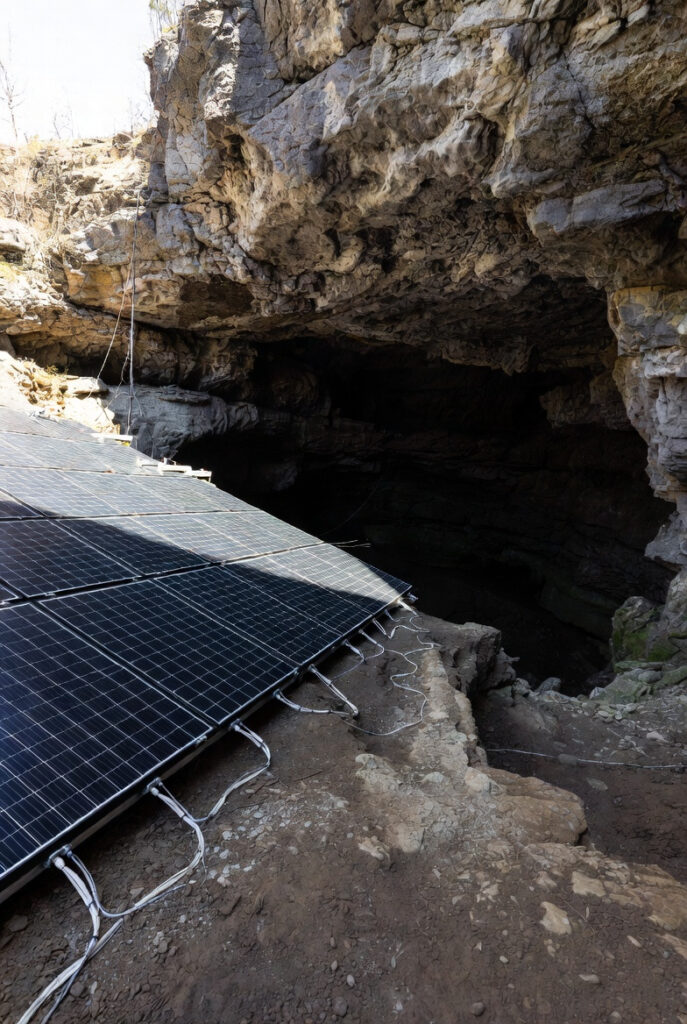
Cave exploration solar power failures happen in complete darkness 200 metres from the nearest sunlight. I was asked to review the power system for a speleological survey team from McMaster University mapping the Eramosa Karst Conservation Area near Guelph in Wellington County, Ontario. The team was running a FARO Focus laser scanner and four LED survey lights from a 200W panel array at the cave entrance, with a 24V DC cable run of 185 metres into the main gallery. The cable was 12AWG two-conductor rated for direct burial.
At 24V DC and 8A total load the round-trip resistance of the 12AWG cable over 370 metres was 2.28 ohms. The voltage drop was 18.2V. The instruments at the end of the cable were receiving 5.8V instead of 24V. The FARO scanner required a minimum 18V to initialise. The LED lights flickered at 6V and produced approximately 12% of rated output. The survey team had been working in near-darkness for 3 hours before they realised the scanner was not actually recording. It had failed to initialise every time they attempted to start it. They had completed 3 hours of what they believed was a survey but had captured zero data.
I redesigned the power transmission system using 48V DC from the surface battery bank to a waterproof IP68-rated DC-DC step-down converter mounted at the survey face, dropping to 24V for the FARO scanner and 12V for the LED lights at the point of use. At 48V the same 8A total load produced only 4.56V drop over the 185-metre run, leaving 43.44V at the converter input, well above its 36V minimum. The survey team completed the full gallery mapping in the next session. The cable upgrade and converter cost $340. The 3 hours of lost survey time represented approximately $2,400 in lost research time at McMaster field school rates. For the seismic monitoring solar galvanic isolation standard that covers the same long-run power transmission principle for underground scientific instruments, Article 212 covers the full specification. For the full system sizing hub that covers the load calculation foundation, the hub covers the numbers.
Why a Cave Exploration Solar System Goes Dark 200 Metres from the Surface
At 24V and 8A total load the round-trip resistance of 12AWG at 370 metres is 2.28 ohms, producing 18.2V drop and leaving 5.8V at the load. At 48V the same 8A wattage draws only 4A because current is halved at double voltage. The voltage drop at 4A through 2.28 ohms is 9.1V, leaving 38.9V at the load. Upgrading to 6AWG at 48V reduces round-trip resistance to 0.57 ohms and the drop to 2.3V, less than 5% loss over 185 metres.
Switching to 48V transmission is the single highest-value modification for any cave exploration solar system with a cable run over 50 metres. The Victron SmartShunt monitors the 48V surface bank SoC and alerts the team before the survey face converter drops below its 36V minimum input threshold. For the remote sensor solar long-run voltage drop standard that covers the same Ohm’s law cable sizing principle for river bank installations, Article 209 covers the full specification.
| Configuration | Voltage at Survey Face | Percentage Loss |
|---|---|---|
| 24V, 12AWG, 185 metres | 5.8V | 76% loss — instruments fail to initialise |
| 48V, 12AWG, 185 metres | 38.9V | 19% loss — converter operates above minimum |
| 48V, 6AWG, 185 metres | 45.7V | 5% loss — full instrument power |
The IP68 Gel Splice Connections: Defeating 100% Humidity
Cave exploration solar connection failures at 100% relative humidity are not dramatic. They are progressive, invisible, and they drain the battery in 4 days. I reviewed a recurring power interruption problem at a bat habitat monitoring station at Bonnechere Caves near Renfrew in the Ottawa Valley that a wildlife biology team from the University of Ottawa was operating to monitor little brown bat colony temperatures and CO2 levels during winter hibernation. The station had been installed with a 100W panel at the cave entrance, a 24V LFP battery, and a 45-metre cable run into the hibernaculum chamber using standard MC4 solar connectors at the panel junction.
The team had experienced 6 power interruptions over 14 months, each requiring a site visit. At each visit the fault was traced to the MC4 connectors at the panel junction box. The female MC4 housing had admitted moisture through the cable entry seal, which had relaxed over time at 98% relative humidity. The moisture bridged the positive and negative contacts and caused a partial short drawing 2.8A continuously through the contact corrosion, depleting the 24V LFP battery in 4 days. Each site visit to the Bonnechere Caves required a 3-hour drive from Ottawa and a cave entry permit. Total visit cost: $380 per visit, $2,280 over 14 months.
I replaced all MC4 connectors with IP68 resin-filled gel splicing kits that encase each connection in a cast polyurethane resin block with no entry point for moisture. The gel splice has no mechanical seal to relax at 98% humidity. The resin is a solid mass around the connection. In 18 months since the installation there have been zero power interruptions and zero site visits for electrical faults. The gel splice kits cost $24 for a pack of 6. For the seismic monitoring solar IP68 sealed connection standard that covers the same submersion-rated connection principle for underground scientific instrument installations, Article 212 covers the full specification.
The 48V Transmission Cable: Ferrite Chokes and 6AWG for the Long Run
At 48V the same wattage load draws half the current of a 24V system. As a result voltage drop is halved and power loss in the cable is reduced by 75% because power loss is proportional to the square of the current. For a 185-metre cave run this difference is the boundary between a functional survey system and one that never starts.
However, the 48V transmission cable also acts as a 185-metre antenna for conducted emissions from the MPPT charge controller at the surface. The FT-240-31 ferrite cores wound 3 turns at each end of the 48V transmission cable suppress conducted emissions above 1MHz before they travel 185 metres to the FARO scanner. As a result the scanner power supply receives clean 48V from the surface without the switching noise artefacts that would otherwise appear in the point cloud data. For the remote sensor solar FT-240-31 ferrite choke standard that covers the same conducted emission suppression principle for 24-bit ADC instruments, Article 209 covers the full specification.
The Nitrogen-Purged Battery Vault: Safe Power in Confined Atmospheric Conditions
Vented lead-acid batteries produce hydrogen at up to 6.6mL per ampere-hour during charging. In a confined cave alcove of 1 cubic metre with 0.5 air changes per hour a 100Ah lead-acid battery charging at 10A produces 66mL of hydrogen per hour. The lower explosive limit of hydrogen in air is 4% by volume. As a result the hydrogen concentration reaches the explosive threshold in approximately 24 hours in a poorly ventilated alcove without any ignition source being present.
However, sealed LFP cells produce no hydrogen at normal operating voltages. A nitrogen-purged battery housing displaces the residual oxygen entirely, ensuring that even an unexpected cell fault cannot produce a combustion event in the cave environment. The nitrogen purging requires a 0.5-litre industrial nitrogen cylinder connected to the housing inlet with a regulator maintaining 0.5 PSI positive pressure. For the fish hatchery solar hermetically sealed LFP cabinet standard that uses the same sealed enclosure principle for chemically sensitive environments, Article 207 covers the full enclosure specification.
The Guano Overlay and EL Glow-Path Safety System
Bat guano at a cave mouth has a pH of 3 to 4 due to uric acid from an insectivorous diet. At pH 3 to 4 uric acid dissolves the silicon dioxide anti-reflection coating from solar panel glass at 5 to 15 nanometres per week. A 4-week guano exposure removes 20 to 60 nanometres of the coating and reduces light transmission by 3 to 8%. However, a sacrificial 50-micron Mylar film overlay bonded to the panel glass with removable adhesive absorbs the guano acid contact and is peeled and replaced monthly. As a result the anti-reflection coating is permanently protected at a cost of approximately $8 per overlay per replacement cycle.
The electroluminescent glow-wire safety system uses the solar controller load output to power 3 to 5 metres of EL wire per 10 metres of cable run along the full transmission cable from surface to survey face. EL wire at 12V draws 0.12W per metre and produces a faint 2 to 3 lux green glow visible from 20 metres in complete darkness. As a result the cable becomes a continuous luminescent path marker from the survey face to the cave mouth, visible without a headlamp and non-destructive to dark-adapted vision.
The Cave Exploration Solar System: Minimum Viable vs Full Abyss Standard
The decision follows cable run length and whether the cave environment has unknown atmospheric hazards.
The minimum viable cave exploration solar system for a single-passage survey with a cable run under 100 metres includes a 200W panel at the cave mouth, a 48V LFP battery, a 4AWG cable run to the survey face, a waterproof IP68 DC-DC step-down converter at the work face, and IP68 gel splice connectors throughout. Capital cost runs $680 to $1,100. It provides clean power to instruments at the survey face with less than 3% voltage drop.
The full abyss standard for a multi-passage cave research station with 200-metre-plus cable runs includes a 400W panel array with monthly Mylar overlay replacement, a 200Ah 48V sealed LFP bank in nitrogen-purged housing, 6AWG transmission cable with IP68 gel splices throughout, waterproof step-down converters at each work face, and electroluminescent glow-wire path markers along the full cable run. Capital cost runs $2,800 to $4,200. It provides continuous instrument power and personnel safety lighting through a full survey season in any Ontario cave system.
NEC and CEC: What the Codes Say About Cave Exploration Solar
NEC 690 governs the PV source circuits of any cave exploration solar installation. The 48V DC transmission cable running from the surface array into the cave is subject to NEC 690 wiring methods requirements for DC circuits. NEC 501 governs electrical installations in hazardous locations, if the cave environment contains methane at concentrations above 1% the transmission cable, step-down converter, and all electrical equipment inside the cave must comply with NEC 501 Class I Division 2 hazardous location requirements. The nitrogen-purged battery housing must comply with NEC 501.10 for equipment installed in Class I hazardous locations. The NFPA publishes NEC 501 requirements for hazardous location electrical installations applicable to cave and mine environments.
In Ontario, cave access for research purposes on provincial Crown land requires a permit from the Ontario Ministry of Natural Resources and Forestry under the Public Lands Act. Cave systems on the Bruce Peninsula and in the Eramosa Karst area may be subject to additional permits under the Ontario Heritage Act if the cave contains archaeological resources. Contact Environment and Climate Change Canada for permits required under the Species at Risk Act if the cave is a designated bat hibernaculum. Little brown bat colonies in Ontario hibernacula are protected under SARA. The solar power installation for a cave research station on Crown land is a temporary installation and does not require an ESA electrical permit provided the system meets the definition of a temporary low-voltage DC installation under the Ontario Electrical Safety Code. Contact the Ontario Speleological Society before accessing any Ontario cave system to confirm current permit and access requirements.
Pro Tip: Before specifying the transmission cable gauge for a cave survey system, calculate the round-trip resistance of the cable and the voltage at the far end at the maximum expected load current. I have reviewed cave power system specifications where the designer measured the voltage at the surface battery terminals – 48.2V and assumed the instruments at the survey face were receiving 48V. The actual voltage at the face was 38.7V because nobody had calculated the 185-metre cable resistance. The waterproof DC-DC converter specified for that installation had a minimum input voltage of 40V. The system never worked. Calculate the far-end voltage before buying any cable. The formula is simple: far-end voltage equals supply voltage minus current times round-trip resistance. Do the arithmetic on the surface. Not 185 metres underground in the dark.
The Verdict
A cave exploration solar system built to the abyss standard means the Eramosa Karst survey team captures data instead of spending 3 hours in near-darkness following a scanner that never initialised, and the Bonnechere bat station runs for 18 months without a single 3-hour drive from Ottawa to trace a corroded MC4 connector.
- Switch to 48V DC transmission before running any cable over 50 metres into a cave. The McMaster team spent 3 hours capturing zero data and lost $2,400 in research time because 12AWG wire at 24V delivered 5.8V to a scanner that needed 18V. A $340 cable upgrade and IP68 converter delivered 43.44V to the same scanner face. The voltage drop formula takes 2 minutes to calculate on the surface. It takes considerably longer to discover underground.
- Replace every MC4 connector with IP68 gel splice kits before the first winter deployment. The Bonnechere bat station paid $2,280 in site visit costs over 14 months because 6 MC4 connectors relaxed their cable seals at 98% humidity and shorted the battery in 4 days each time. A $24 pack of gel splice kits ended every failure. The solid resin block has no seal to relax.
- Use sealed LFP in a nitrogen-purged housing before entering any cave with unknown atmospheric conditions. A 100Ah lead-acid battery charging at 10A in a 1-cubic-metre alcove reaches the explosive hydrogen threshold in 24 hours without any ignition source. Sealed LFP produces no hydrogen at all. Nitrogen purging eliminates the residual oxygen. The combination costs less than one emergency evacuation.
In the shop, we do not size the extension cord for the average load when the peak load is what trips the breaker. In the cave, we do not size the cable for the surface voltage when 18.2V of drop is what kills the scanner.
Frequently Asked Questions
Q: Why does 24V DC power fail over a long cave cable run when 48V works? A: Voltage drop is proportional to current. At 24V a given wattage load draws twice the current of the same load at 48V. On a 185-metre cave cable run in 12AWG wire the voltage drop at 24V and 8A is 18.2V, leaving only 5.8V at the survey face. The same run at 48V and 4A drops only 9.1V, leaving 38.9V, well above the minimum input of any DC-DC step-down converter.
Q: Why do standard MC4 solar connectors fail in cave environments? A: MC4 connectors rely on a mechanical cable entry seal that relaxes at 98 to 100% relative humidity over time, allowing moisture to wick into the connector housing. The moisture bridges the positive and negative contacts and creates a partial short that drains the battery continuously. IP68 resin-filled gel splice kits encapsulate each connection in a solid cast polyurethane block with no mechanical seal and no moisture entry path.
Q: Can lithium batteries be used safely in a cave with unknown atmospheric conditions? A: Sealed LFP batteries produce no hydrogen or flammable gas at normal operating voltages, unlike vented lead-acid batteries that produce hydrogen during charging. A nitrogen-purged battery housing displaces residual oxygen around the cells, providing a second layer of protection that ensures no combustion event is possible even in the event of an unexpected cell fault.
Questions? Drop them below.
This post contains affiliate links. If you purchase through our links, we may earn a small commission at no extra cost to you.