
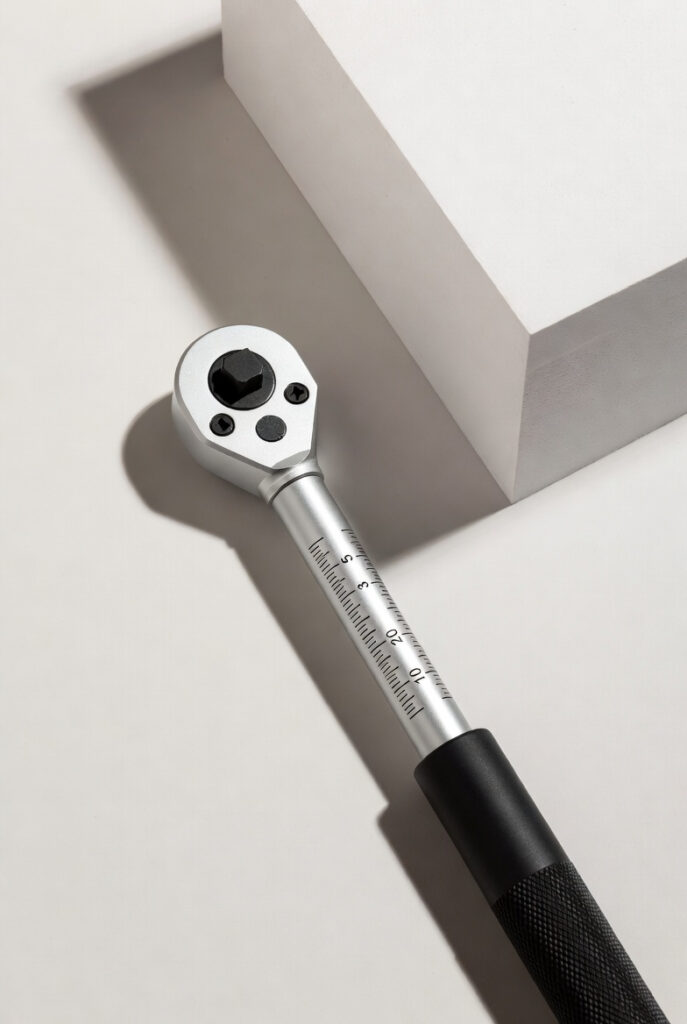
Tight is not a measurement. In the service bay tight means nothing 12 Nm means something. A hand-tightened busbar bolt on a 48V battery bank carrying 300A is not a connection it is a resistor waiting to become a blowtorch. Busbar torque specs are not a suggestion from the manufacturer. As of the 2020 NEC update they are a legal requirement. The click of a calibrated torque wrench is the sound of a connection that will still be correct at year 25. Before the wrench comes out understand how much solar power you actually need the system current determines which connections carry the most critical load.
Busbar Torque Specs: Why Clamping Force Determines Conductivity
The physics of a bolted electrical connection: A bolted busbar connection is not held together by friction. It is held together by clamping force the tensile load in the bolt that compresses the mating surfaces together. The electrical conductivity of the connection is directly proportional to the effective contact area between the mating surfaces and the effective contact area is directly proportional to the clamping force. More clamping force means more contact area means lower contact resistance means less heat. As covered in our Battery Cable Crimping guide the same P=I²R physics that make a poor crimp a fire hazard make a hand-tightened busbar bolt equally dangerous.
The elastic limit – the bolt as a spring: A bolt torqued to its specification is stretched it is operating in the elastic deformation zone where the steel behaves like a spring. The stretched bolt applies continuous clamping force to the connection it actively pushes the mating surfaces together. If the bolt loosens slightly due to thermal cycling or vibration the spring tension resists the loosening the bolt wants to return to its torqued length. A bolt torqued below specification is not in the elastic zone it is not acting as a spring it will continue to loosen under thermal cycling until the connection fails.
I was explaining this to a client last autumn during a commissioning session he was nervous about overtightening his M8 studs on the Victron Lynx Distributor. I showed him the torque specification in the Victron manual 14 Nm and put the click wrench on the first bolt. When it clicked he jumped slightly. I told him: that click is the sound of correct. The bolt is now in the elastic zone. It is acting as a spring. It will hold that connection for 25 years of thermal cycling. He torqued every remaining bolt himself. He understood.
Why under-torque creates resistance: A busbar bolt hand-tightened to approximately 3-4 Nm achieves perhaps 20-30% of the contact area of a correctly torqued M8 connection at 14 Nm. The remaining 70-80% of the mating surface area has microscopic air gaps invisible but electrically equivalent to open circuits at those points. The current must crowd through the small contact area that does exist current crowding increases local current density increases local heat and accelerates oxidation at the contact perimeter.
The P=I²R consequence: At 300A through a connection with 0.002Ω above nominal contact resistance: P = 300² × 0.002 = 180 watts at a single busbar bolt. A connection running at 110°C under load is not a stable connection. It is a connection in active thermal degradation the heat accelerates oxide formation, oxide formation increases resistance, resistance increases heat. The cascade ends with a melted busbar cover or a fire.
The NEC 110.14(D) Requirement – Torque Is Now Law
What changed in the 2020 NEC: Prior to the 2020 National Electrical Code revision torque specifications were a manufacturer recommendation good practice but not code-enforceable. The 2020 NEC added Section 110.14(D): electrical connections shall be torqued to the manufacturer’s published torque specifications using a calibrated torque tool.
What this means for off-grid installers: If Victron publishes a torque specification for the Lynx Distributor output terminals and they do the NEC requires that the installer use a calibrated torque tool to achieve that specification. Hand-tightening is not code-compliant. An adjustable wrench is not code-compliant. An impact driver is not code-compliant. A calibrated click-type torque wrench achieving the published specification is code-compliant.
CEC Section 12 – Canada: The Canadian Electrical Code Section 12 requires that electrical connections be made in accordance with manufacturer’s instructions and that connection integrity be maintained for the lifetime of the installation. For bolted connections the manufacturer’s torque specification is the CEC-compliant installation standard. As covered in our Equipment Bonding guide every EGC connection to a chassis stud must also be torqued to specification bonding conductors are not exempt from the torque requirement.
The Torque Reference – What the Manufacturers Specify
Victron Lynx Distributor – M8 output terminals: The Victron Lynx Distributor specifies M8 output terminal torque at 14 Nm (124 in-lbs). This applies to all output positions inverter, MPPT, DC-DC converter, all loads. Every M8 connection on the Lynx Distributor is 14 Nm.
–Victron Lynx Power-In – M10 main battery terminals: The Victron Lynx Power-In specifies M10 main battery terminal torque at 25 Nm (221 in-lbs). The main battery cables carrying full system current terminate here this is the highest-current connection in the system and the most critical busbar torque specs in the build.
Victron SmartShunt M10 battery negative terminals: The Victron SmartShunt 500A M10 terminals are specified at 25 Nm consistent with the Lynx Power-In specification for M10 connections. Every amp of system current flows through the SmartShunt this connection is as critical as the main battery terminal.
General M-size reference:
- M6 terminals (MPPT inputs, small component connections): 6-8 Nm
- M8 terminals (Lynx Distributor outputs, most busbars): 12-14 Nm
- M10 terminals (Lynx Power-In, SmartShunt, main battery): 25 Nm
Always verify against the specific manufacturer documentation these are the Victron specifications and may differ for other manufacturers.
Mating Surface Preparation – Why Clean Metal Matters
What copper oxidation does to contact resistance: A copper busbar surface exposed to air develops a thin copper oxide layer within days of manufacture. As covered in our Tinned Copper guide copper oxide resistivity is orders of magnitude higher than pure copper. Even at correct busbar torque specs the contact is metal-oxide-to-metal rather than metal-to-metal if the surfaces are not prepared the oxide layer maintains contact resistance regardless of clamping force.
The preparation procedure:
- Lightly scuff both mating surfaces with a Scotch-Brite pad removing the surface oxide layer and exposing bare copper
- Wipe both surfaces with isopropyl alcohol removing oxidation particles and any oils from handling
- Assemble and torque immediately do not allow surfaces to re-oxidize before connection
- Apply busbar torque specs with calibrated click-type torque wrench
The IR thermometer verification: After assembly and torquing connect the system and apply a representative load. Use an IR thermometer to measure the temperature at every busbar connection the connection temperature should be within 3-5°C of the busbar body temperature. Any connection running more than 10°C above the busbar body temperature has elevated contact resistance disassemble, re-prepare surfaces, and retorque.
I found an oxidized busbar connection on a DIY system inspection last year. The M8 bolt was correctly torqued I checked with my wrench and it clicked at 13 Nm. The installer had done the torque correctly. But the IR thermometer showed 87°C at that connection while adjacent correctly prepared connections were at 35°C. The mating surfaces had been assembled without preparation tightened metal-to-oxide rather than metal-to-metal. Even at correct busbar torque specs the oxide layer was maintaining contact resistance. We disassembled the connection, scuffed both surfaces with Scotch-Brite, wiped with IPA, and retorqued to 14 Nm. Temperature at the next load test: 34°C. The torque was always correct. The surface preparation was the missing step.
The Paint Pen Method – The Visual Inspection Standard
What the paint pen does: A paint pen mark drawn across the bolt head and onto the adjacent busbar surface creates a continuous line that spans the bolt-to-busbar interface. If the bolt rotates loosening under thermal cycling, vibration, or creep the paint line breaks and the break is visible at a glance without tools. This is the automotive wheel nut inspection standard applied to busbar torque specs.
The application procedure: Immediately after achieving the torque specification with the click wrench not before, not after re-checking draw a single paint pen line from the bolt head across the busbar surface at the 12 o’clock position. Use a bright colour yellow or white visible against the copper surface. The line width should be narrow enough that a 5-degree rotation breaks it cleanly.
The inspection schedule:
- At commissioning: apply paint pen marks to every connection after torquing
- At annual October inspection: visually inspect every mark – ALIGNED or SHIFTED – recorded in maintenance log as covered in our Off-Grid Solar Maintenance guide
- Any shifted mark: retorque to specification, apply fresh mark, document in log
I explained the paint pen method to a client during commissioning showed him the mark on each M10 bolt at the Victron Lynx Power-In and explained that if that mark shifts before the October inspection something has changed mechanically. He asked how a bolt tightened to 25 Nm could shift. I told him: thermal cycling. Every charge and discharge cycle the copper expands and contracts at a different rate than the steel bolt. Over 365 cycles one year of daily use this differential expansion can back a bolt off by 2-3 degrees. Two degrees is invisible without the paint pen. The mark makes it visible. As covered in our Battery Fortress guide the paint pen is the final step of every connection not optional, not cosmetic.
Quick Reference – Busbar Torque Specs by Terminal Size
| Terminal Size | Victron Specification | General Reference | Paint Pen |
|---|---|---|---|
| M6 | 6 Nm (53 in-lbs) | MPPT inputs | Yes – every connection |
| M8 | 14 Nm (124 in-lbs) | Lynx Distributor outputs | Yes – every connection |
| M10 | 25 Nm (221 in-lbs) | Lynx Power-In, SmartShunt | Yes – every connection |
| Battery terminals | Per manufacturer | SOK/EG4 check manual | Yes – every connection |
Pro Tip: Never use an impact driver, cordless drill, or adjustable wrench for busbar torque specs. An impact driver applies torque in millisecond pulses the peak torque far exceeds the specified value before you can react, stripping the terminal threads in the battery case. A cordless drill has no torque sensing at battery terminal resistance levels. An adjustable wrench has no torque measurement whatsoever. The calibrated click-type torque wrench is the only acceptable tool it costs $25-40 and is the cheapest insurance against a stripped battery terminal. Buy one. Use it on every connection. Every time.
The Verdict
Busbar torque specs are the foundation of every low-resistance connection in the Battery Fortress. The correct torque. The prepared surface. The paint pen mark.
Four steps for every connection:
- Prepare mating surfaces Scotch-Brite and isopropyl alcohol
- Torque to specification with calibrated click-type wrench
- Apply paint pen mark immediately after torquing
- Verify with IR thermometer under load below 10°C above busbar body temperature
Disclosure: This article contains affiliate links. If you buy through them, GridFree Guide earns a small commission at no extra cost to you.
Questions? Drop them below.