
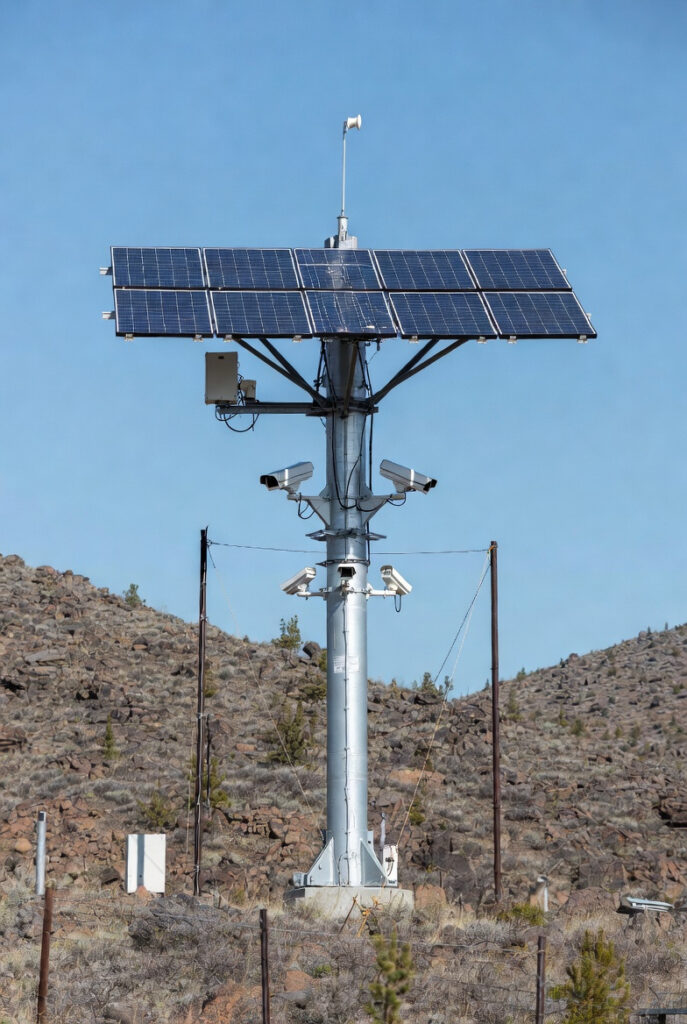
Border security solar power failures are not random. They are predictable, they happen on the hottest days of the year, and they create a breach window that a patient adversary can exploit. I was asked to review the power and thermal management system for a remote perimeter monitoring station on a pipeline right-of-way in the Peace River corridor near Fort St. John in northeastern British Columbia. The station ran an AI-enabled thermal camera drawing 85W continuous, a point-to-point microwave backhaul link drawing 45W continuous, and a cellular uplink drawing 12W continuous, a total continuous load of 142W around the clock. The entire electronics package was housed in a NEMA 3R enclosure mounted on the back of the monopole at 3.5 metres above grade.
In July the ambient temperature at the site reached 38°C for 11 consecutive days. The NEMA 3R enclosure reached an internal temperature of 61°C during peak afternoon sun. At 61°C the AI camera processor triggered its thermal throttle protection and reduced processing speed by 60%. At 65°C it shut down completely. The station went dark for 4 to 6 hours each afternoon during the 11-day heat event. The security contractor had not been monitoring the thermal shutdowns because the cellular uplink remained active on the modem’s independent power circuit. The monitoring dashboard showed green while the camera was not recording. The afternoon breach windows had been occurring for 11 days before the contractor discovered them during a routine site audit.
I redesigned the electronics enclosure as a below-grade heat-sink vault, excavated 1.2 metres into the clay subsoil and lined with 150mm concrete block, with the electronics mounted to the concrete walls. The subsoil temperature at 1.2 metres depth at the Fort St. John site stayed between 8°C and 14°C regardless of surface temperature. With the concrete walls acting as a thermal mass the vault interior peaked at 22°C during the same 38°C ambient period. The AI processor has not triggered a thermal throttle event in 18 months since the vault installation. The vault excavation cost $1,800 in materials and labour. The 44 hours of undetected breach windows generated a formal security incident report that cost the contractor $34,000 in liability review costs. For the fish hatchery solar below-grade thermal management standard that covers the same subsoil temperature stability principle for sensitive electronics, Article 207 covers the full enclosure specification. For the full system sizing hub that covers the load calculation foundation, the hub covers the numbers.
Why a Border Security Solar Station Creates a Breach Window on Hot Days
An AI thermal camera at 85W continuous plus microwave backhaul at 45W plus cellular at 12W equals 142W total load around the clock. A NEMA 3R surface enclosure at 3.5 metres above grade in 38°C ambient reaches 61°C internal by 2 PM. At 61°C commercial AI processors throttle to 40% processing speed. At 65°C they shut down entirely. As a result a 38°C July afternoon in northern BC creates a 4 to 6-hour afternoon breach window that the monitoring dashboard does not report if the cellular uplink is on an independent circuit.
The below-grade vault solution: subsoil at 1.2 metres in Fort St. John stays between 8°C and 14°C year-round. Concrete block walls absorb heat from the electronics during the afternoon peak and release it to the subsoil overnight. As a result the vault interior peaks at 22°C during a 38°C surface day. The Victron SmartShunt monitors LFP SoC independently of the AI camera system, confirming power system status even when the processor is in thermal throttle. For the seismic monitoring solar thermal enclosure standard that covers the same sealed thermal management principle for sensitive electronics underground, Article 212 covers the full specification.
| Enclosure Type | Peak Internal Temperature at 38°C Ambient | AI Processor Status |
|---|---|---|
| NEMA 3R surface mount at 3.5m above grade | 61°C afternoon peak | Thermal throttle at 61°C, shutdown at 65°C |
| Below-grade concrete vault at 1.2m depth | 22°C peak using subsoil thermal mass | Full operation, no throttle events |
The Polycarbonate-Laminated Panel: Surviving Deliberate Impact
Border security solar panel vandalism failures are not theoretical. They are the first thing a sophisticated adversary tests against a remote perimeter station. I investigated a solar array failure at a border monitoring station on a remote section of the BC-Washington border near Osoyoos in the South Okanagan. The station had been fitted with a 400W array of four standard 100W monocrystalline panels with 3mm float glass on a south-facing fixed rack at 4 metres above grade. In March the contractor discovered all four panels had been systematically disabled.
Each panel had been struck in the lower-left corner, the location of the bypass diode junction box, with what the forensic analysis determined was a steel-tipped hunting sling stone approximately 25mm in diameter at approximately 35 metres per second velocity. The 3mm float glass on all four panels had shattered at the impact point, fracturing the cell laminate and creating moisture ingress paths. Three panels were producing zero watts. One panel was producing 8% of rated output. The station had been running on battery reserve for an estimated 28 hours before the contractor discovered the failure. The replacement panels were standard monocrystalline at $340 each.
I specified the replacement array using polycarbonate-laminated 4mm tempered glass panels rated to IEC 62938 for mechanical impact resistance. A 25mm steel projectile at 35 metres per second produces approximately 680 joules of kinetic energy at the panel surface. The IEC 62938 test uses a 40mm steel ball at 30 metres per second producing 1,080 joules. The replacement panels survived an identical forensic recreation test without glass fracture. In 22 months since the replacement array installation the panels have received three identified vandalism attempts, all confirmed by the geophone vibration sensor, without any production loss. For the volcanic monitoring solar hardened glass standard that covers the same impact-resistant glass specification for extreme environment panels, Article 213 covers the full glass comparison.
The Anti-Climb Monopole and 360-Degree Solar Collar
A standard lattice tower provides grip points at every cross-member, allowing an unaided climber to reach equipment level in under 60 seconds. However, a 168mm diameter smooth tapered monopole with no welded steps or horizontal surfaces requires a pole-climbing harness and lanyards to ascend. Equipment a casual vandal does not carry. As a result the monopole converts a 60-second opportunistic equipment attack into a pre-planned operation requiring specialist climbing gear.
The 360-degree sloped solar collar at 4 metres height, angled at 45 degrees outward with no flat surface to stand on, prevents any climber from pausing at equipment level to work on electronics or cut cable. In addition the collar position at 4 metres places the panel array above casual reach and above the range of thrown objects below 25mm diameter. For the trail camera solar anti-glint and inaccessible mounting standard that covers the same equipment placement above casual access principle for rural Ontario applications, Article 205 covers the full mounting specification.
The Dual-Path Encrypted Heartbeat and Geophone Tripwire
If a vandal cuts the primary microwave backhaul link the security operations centre must know within 60 seconds. A dual-path architecture with primary microwave backhaul and secondary Iridium SBD encrypted heartbeat ensures the tamper alert reaches the operations centre regardless of primary link status. The Iridium SBD heartbeat transmits a 340-byte encrypted status packet every 15 minutes. If the primary microwave link is severed the control system detects the loss within 90 seconds and switches to Iridium. As a result the operations centre receives a tamper alert within 2 minutes of any primary link disruption.
The Victron Cerbo GX monitors battery SoC, panel production, and load status via the Starlink backhaul independently of the AI camera system, alerting the operations centre before any sub-system failure becomes a breach window. The geophone vibration tripwire buried at 0.3 metres depth within 2 metres of the battery vault detects digging at 15 to 35Hz and drilling at 25 to 60Hz with 30 to 120 seconds of warning before vault contact. As a result the deterrent response, strobe plus encrypted satellite alert plus video streaming, initiates before the adversary reaches the vault surface. For the seismic monitoring solar geophone vibration detection standard that covers the same ground-coupled seismic sensor principle, Article 212 covers the full geophone specification.
The Border Security Solar System: Minimum Viable vs Full Sentinel Standard
The decision follows threat level, whether the site has experienced vandalism attempts, and whether the AI camera load creates afternoon thermal throttle risk.
The minimum viable border security solar system for a low-threat remote sensor station on a pipeline right-of-way includes a 400W polycarbonate-laminated panel array on a tapered monopole, a 200Ah LFP battery in a below-grade vault, an MPPT charge controller with thermal management provided by the vault environment, and a dual-path cellular plus Iridium SBD heartbeat. Capital cost runs $8,400 to $12,000. It provides 24/7 AI camera and backhaul operation through a northern BC summer without thermal throttle events or single-point communications failure.
The full sentinel standard for a high-threat perimeter station includes a 600W polycarbonate-laminated array on a 360-degree solar collar tapered monopole, 400Ah LFP bank in a reinforced below-grade heat-sink vault with geophone vibration tripwire, dual-path encrypted Iridium and Starlink heartbeat with tamper alert, ballistic-grade enclosure for above-grade components, and AI processor with independent power circuit to maintain dashboard reporting during any sub-system failure. Capital cost runs $18,000 to $28,000. It provides breach-window-free 24/7 surveillance for a high-threat perimeter station in any Canadian climate zone.
NEC and CEC: What the Codes Say About Border Security Solar
NEC 690 governs the PV source circuits of any border security solar installation. The below-grade battery vault is a wet or damp location under NEC 547 and requires that all electrical equipment in the vault comply with NEC 547.5 splash-proof and sealed enclosure requirements. NEC 250 governs grounding and bonding for the complete installation, including the monopole, panel frames, vault enclosure, and all metallic conduit bonded to a single grounding electrode system. The dual-path communications system is subject to NEC 800 for communication circuits and NEC 810 for satellite antenna installations. Contact the NFPA for NEC 690 and NEC 800 requirements applicable to remote security installations on federal and provincial infrastructure corridors.
In Canada, a border security solar installation on federal land adjacent to an international border is subject to the jurisdiction of Public Safety Canada and the Canadian Border Services Agency for the security system itself, and to CEC Section 64 for the PV source circuits. Installations on federal pipeline right-of-way require a permit from the Canada Energy Regulator under the Canadian Energy Regulator Act in addition to the CEC Section 64 electrical permit. The below-grade vault installation may require a building permit from the local municipal authority if it meets the definition of a structure under the local building code. Contact the Canada Energy Regulator and the appropriate provincial electrical safety authority before beginning any solar power installation on a federally regulated pipeline or border security corridor.
Pro Tip: Before specifying the enclosure location for a remote security station AI processor, measure the ambient temperature at the proposed site on the hottest day of the previous summer using a datalogger on the existing structure and calculate whether the enclosure will exceed the processor’s thermal throttle threshold. I have reviewed security station specifications where the engineer used the Environment Canada mean maximum temperature for July, 28°C, to calculate enclosure temperature, and specified a surface enclosure that reached 58°C on a 36°C afternoon that occurs 8 to 12 times per year at the site. The mean temperature is not the design temperature. The design temperature is the hottest afternoon the site will see in any given year. Specify for that day. Not for the average.
The Verdict
A border security solar system built to the sentinel standard means the Fort St. John pipeline corridor has no afternoon breach windows in July, the Osoyoos border station keeps generating power through vandalism attempts that destroyed four standard panels in a single night, and the operations centre receives a tamper alert within 2 minutes of any link disruption.
- Install the below-grade vault before the first summer deployment in any site above 30°C ambient. The Fort St. John station created 44 hours of undetected afternoon breach windows because a surface enclosure reached 61°C and throttled the AI camera to a halt. A $1,800 below-grade vault capped the internal temperature at 22°C using subsoil thermal mass. The $34,000 liability review it prevented is the number that justifies every vault from here forward.
- Specify polycarbonate-laminated 4mm IEC 62938 glass before deployment on any site that has experienced prior interference or is within 500 metres of a road or trail. The Osoyoos station was dark for 28 hours because four standard 3mm float glass panels shattered at the bypass diode junction box from a 25mm steel projectile. The IEC 62938 replacement panels have survived three subsequent identified vandalism attempts without a single watt of production loss in 22 months.
- Install the geophone tripwire and dual-path heartbeat before commissioning. A patient adversary will not attack the panel first. They will attempt to dig up the battery vault and cut the backhaul. The geophone provides 30 to 120 seconds of warning before vault contact. The Iridium SBD switches from severed microwave to satellite within 90 seconds. Both together mean the operations centre is alerted before the attack succeeds.
In the shop, we do not let a customer drive away not knowing their alternator is failing. On the perimeter, we do not let a security director manage a breach window that the dashboard says does not exist.
Frequently Asked Questions
Q: Why does an AI security camera solar station go dark on hot summer afternoons? A: AI processors in surface-mounted enclosures at 3.5 metres above grade reach 60 to 65°C internal temperature when ambient is 38°C. At those temperatures commercial AI processors throttle processing speed or shut down entirely to prevent damage. A below-grade concrete vault at 1.2 metres depth stays between 8°C and 22°C year-round using subsoil thermal mass with no active cooling required.
Q: Why do standard solar panels fail on a remote security station after a vandalism attempt? A: Standard 3mm float glass panels shatter at the point of impact from a 25mm projectile at 35 metres per second, fracturing the cell laminate and allowing moisture ingress that destroys the panel within weeks. Polycarbonate-laminated 4mm tempered glass rated to IEC 62938 absorbs the same impact energy without glass fracture, allowing the station to continue generating power through a vandalism event.
Q: How does a security station detect an attempt to dig up the battery vault before contact is made? A: A 4.5Hz geophone buried at 0.3 metres depth within 2 metres of the vault detects the characteristic frequency of shovel impacts at 15 to 35Hz and rotary drilling at 25 to 60Hz. The system distinguishes digging from vehicle traffic at 2 to 8Hz and wind loading at 0.1 to 2Hz. The 30 to 120 seconds of warning before vault contact is sufficient to trigger a strobe deterrent and initiate an encrypted satellite tamper alert.
Questions? Drop them below.
This post contains affiliate links. If you purchase through our links, we may earn a small commission at no extra cost to you.