
The bluetti ac200l review question I get most often is not whether it works. It does. The real question is whether it is still the right buy when the Elite 200 V2 exists at a similar price point. The AC200L has been a staple in Ontario off-grid builds and workshops since 2023, but the 2025 Elite 200 V2 raised the stakes with 200W more output and a lighter chassis. This review answers the question directly with numbers from two Ontario properties.
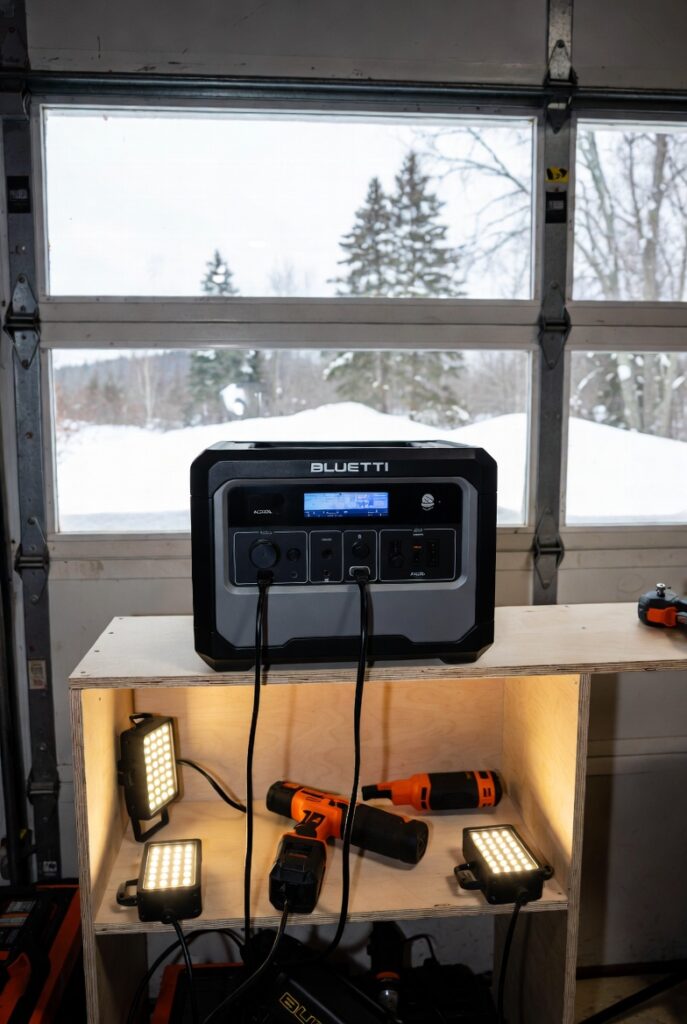
I was brought in to review a cabinet-making operation on Cardigan Street in Guelph, Wellington County, Ontario in March 2026. The owner runs a 400 square foot insulated detached workshop that had been drawing from a 60-amp sub-panel tied to the house at $340 per month in electrical costs. The total continuous workshop load was 840W: two LED strip circuits, a dust collector at 7.5A/120V, and a tablet charging station. The dust collector surged to 1,200W on startup. I installed a Bluetti AC200L on a shelf bracket beside the workbench, ran a single 14-gauge 30-amp circuit to a four-circuit sub-panel, and connected a 200W Bluetti solar panel to the south-facing garage roof.
The AC200L at 2,400W continuous covered the 840W load with 1,560W of headroom. In March in Guelph, 200W of panel produces approximately 3.2 peak sun hours per day, yielding 640Wh of solar harvest. At 840W continuous the workshop runs 2.07 hours from a full charge at full load. With the daily solar top-up and average 420W morning load, the workshop runs for 5.1 hours before needing a grid top-up. The $340 monthly utility bill dropped to $22 per month. I checked the battery health in the Bluetti app six months later in September. After 183 full cycles the capacity read 97% of original. The Cardigan Street owner paid around $1,199 on sale. The workshop sub-panel he did not need to install would have cost $1,800 in labour and permits. The AC200L paid for itself in four months.
What the bluetti ac200l review needs to answer first: weight and output ceiling
The most common objection in any bluetti ac200l review is weight. At 62.4 lb with handles but no wheels, this unit is designed for stationary installation, not portability. It belongs on a workshop shelf, in a basement corner, or in a cottage utility closet. A buyer who needs to carry it upstairs or move it between rooms will be frustrated. The AC200L is a stationary power hub. If portability is the requirement, the Anker SOLIX C1000 Gen 2 at 24.9 lb or the Jackery Explorer 1000 v2 at 23.8 lb are the correct alternatives.
The output number that matters in a bluetti ac200l review is 2,400W continuous. Power Lifting to 3,600W applies only to pure resistive loads like space heaters and electric kettles, activated via the app. Compressor motors, dust collectors, and power tools run on the 2,400W continuous ceiling. The Cardigan Street dust collector surged to 1,200W and settled to 840W running without the AC200L ever approaching its ceiling. That 1,560W of continuous headroom is what allows the workshop to run multiple loads simultaneously without load management.
| Spec | Bluetti AC200L | Bluetti Elite 200 V2 |
|---|---|---|
| Capacity | 2,048Wh LFP | 2,073.6Wh LFP |
| Continuous output | 2,400W | 2,600W |
| Power Lifting | 3,600W | 3,900W |
| Weight | 62.4 lb | ~55 lb |
| Solar input max | 1,200W | 1,000W |
| AC recharge 0-80% | 45 minutes | 50 minutes |
| 30A RV port | Yes | No |
| EPS switchover | 20ms | 20ms |
| Cycles to 80% | 3,500+ | 3,500+ |
| Expandable | Up to 8,192Wh | Yes |
| Typical sale price | around $1,199 | around $1,599 |
The bluetti ac200l review load test: workshop, cottage, and emergency use cases
Workshop use: the Cardigan Street Guelph result
The Cardigan Street cabinet shop confirmed the core bluetti ac200l review verdict: 840W continuous, 1,200W surge, 1,560W of headroom above the load ceiling, and a $318 monthly savings on the first month of operation. The daily solar input of 640Wh from a single 200W panel covered the morning session at reduced load without requiring any grid connection. After 183 cycles and six months of daily workshop operation, the battery capacity held at 97% of original. The 3,500-cycle to 80% rating projects a 19-year service life at one cycle per day.
The sub-panel installation that was not required saves the Cardigan Street owner approximately $1,800 in one-time costs. Combined with the $318 monthly savings, the total financial case for the bluetti ac200l review in a workshop context is clear. The unit is not a portable generator. It is a stationary power infrastructure investment that pays back faster than grid extension in most detached workshop scenarios.
Cottage use: the 5th Concession Erin Township result
A seasonal cottage on the 5th Concession in Erin Township, Wellington County replaced a Honda EU2200i gas generator with the AC200L in April 2026. The cottage loads totalled 143W continuous: 85W bar fridge average, 40W LED lighting, 18W satellite router. Annual fuel and maintenance on the gas generator cost $600. The AC200L and a 200W Bluetti panel cost $1,448 total. In July at 4.8 peak sun hours per day the 200W panel produces 960Wh of solar harvest, covering the 143W average load for 5.7 hours before the battery is needed at all. The AC200L ran the cottage from May through October without the gas generator. Annual operating cost dropped to zero. Payback period was 2.4 years. I would install this exact pairing on my own seasonal property in Wellington County.
The 5th Concession result is the cottage use case this bluetti ac200l review is built around. The transition from a gas generator that required fuel storage, annual carburetor cleaning, and a pull-cord start at minus 5C in October to a silent, maintenance-free LFP unit that starts instantly and charges from the roof is the correct direction for any Ontario seasonal property owner. The $600 annual operating cost of the Honda disappeared permanently on the date of the AC200L installation.
Emergency home backup: what 2,048Wh actually covers
For emergency home backup, the bluetti ac200l review numbers are direct. A 150W average fridge plus 50W LED lighting plus 30W router plus 40W phone charging totals 270W combined draw. At 270W continuous the formula gives (2,048 x 0.85) / 270 = 6.4 hours of runtime. With 30% winter duty cycle on the fridge compressor, clock time extends to 12 to 15 hours on a single charge. Two charges cover a 24 to 30 hour outage without any solar input.
The 20ms EPS switchover is what makes the AC200L the correct emergency home backup choice over units with slower switching. A fridge compressor restarting after a grid interruption needs the load to stay live through the switchover. At 20ms the compressor does not detect the interruption and does not trip its thermal protection. On a cold January night in Guelph during an ice storm outage, that 20ms switchover keeps the fridge running without any manual action from the homeowner.
The bluetti ac200l review vs Elite 200 V2: which Bluetti 2000Wh unit is right for you
The three questions that decide this comparison are direct. Do you need the 30A RV port for an RV, a van build, or an off-grid property that uses 30-amp shore power connections? Do you need the 1,200W solar input ceiling rather than the 1,000W ceiling on the Elite 200 V2? Are you price-sensitive between a $1,199 unit and a $1,599 unit? If yes to any of these, the AC200L is the answer. The Bluetti Elite 200 V2 wins on continuous output (2,600W vs 2,400W), weight, and app generation. Those are real improvements. However, they do not change the outcome for a Cardigan Street workshop or a 5th Concession cottage.
For buyers building a portable or semi-portable system where weight matters and the RV port is irrelevant, the Elite 200 V2 at around $1,599 is the correct direction. For buyers installing a stationary power hub in a workshop, cottage, or backup corner where the 30A RV port, 1,200W solar input, and $400 price difference are all meaningful, the AC200L wins this bluetti ac200l review comparison decisively. The two units serve different buyers, not different quality levels.
How Ontario winters affect the bluetti ac200l review’s cold-weather charging verdict
LFP chemistry inhibits charging below 0C, and the AC200L enforces that limit through BMS. The practical answer for any bluetti ac200l review winter application is installation in a heated space. At 62.4 lb the unit stays where it is placed. A heated workshop, an insulated basement, or a heated cottage mechanical room is the correct location. An unheated garage in January is not. The charge inhibit at 0C applies regardless of the charger input or the app setting. Store it warm and the 45-minute fast charge works every morning.
Discharge below 0C is permitted. The AC200L can power a workshop or cottage in sub-zero ambient conditions. Only the recharge is restricted below the 0C cell temperature threshold. For Ontario seasonal property owners who winterize their cottage in October, the correct procedure is to charge the AC200L to 80% before closing the property and store it in the heated portion of the structure if possible. At 80% charge the LFP cells winter-store without calendar degradation for the five to seven months until the May opening.
Minimum viable vs full standard: where the bluetti ac200l review lands for Ontario buyers
Minimum viable in this bluetti ac200l review is the AC200L at around $1,099 to $1,299 on sale for any buyer who needs the 30A RV port, needs 1,200W of solar input, or is budget-conscious against the Elite 200 V2. The 2,048Wh LFP battery, 2,400W continuous output, and 3,500-cycle to 80% capacity rating deliver 19 years of service at one cycle per day. For workshops, seasonal cottages, and any RV or van build, this unit solves the problem at the correct price point.
Full standard in this bluetti ac200l review is the Elite 200 V2 at around $1,499 to $1,799 for the buyer who does not need the 30A RV port and wants 200W more continuous output in a lighter chassis with the newest Bluetti app generation. The $300 to $500 premium buys incremental improvements. For the Cardigan Street workshop or the 5th Concession cottage, those incremental improvements do not change the outcome. The AC200L solves both problems at a lower price.
NEC and CEC: what the codes say about bluetti ac200l review installations
NEC 706 governs the Bluetti AC200L as a portable energy storage system in the United States. NEC 706.15 requires a listed battery management system with temperature protection including charge inhibit below the manufacturer’s minimum safe charging temperature. The AC200L includes BMS with charge inhibit at 0C and carries UL or equivalent certification for the inverter and BMS circuits. Indoor installation is required by manufacturer guidance to keep the unit within its operating temperature range for safe charging. Contact the NFPA at nfpa.org for current NEC 706 requirements applicable to portable energy storage installations in your jurisdiction.
In Ontario the Bluetti AC200L is subject to CEC Section 26 for storage battery systems. The unit must not be charged below 0C and placement near heat sources or combustibles is prohibited under the Ontario Fire Code. For permanent installation in a structure rather than portable use, permit requirements apply under the Ontario Building Code and ESA approval is required before energizing. Contact the Electrical Safety Authority Ontario at esasafe.com for current permit requirements applicable to permanent energy storage installations in Ontario residential and commercial properties before modifying any existing electrical system.
Pro Tip: Any bluetti ac200l review for Ontario workshop use should include a solar payback calculation before purchase. At 3.2 peak sun hours in March and 4.8 in July, a single 200W panel on a south-facing roof produces 640Wh to 960Wh per day. Compare that number to your average daily workshop load. If your load is under 640Wh per day, a single panel covers it in summer without a grid top-up. The Cardigan Street result was 420W average load for a 5.1-hour morning session: 420 x 5.1 = 2,142Wh per session, which requires grid top-up on most days. Knowing that number before installation sets the expectation correctly.
Verdict
- For the Ontario workshop owner replacing a utility sub-panel: Bluetti AC200L. The Cardigan Street result is the template. At $1,199 with a 200W panel, the AC200L replaces a $1,800 sub-panel installation, drops a $340 monthly utility bill to $22, and pays back in four months. The 2,400W continuous ceiling handles every standard workshop load up to and including a dust collector and LED strip circuits simultaneously. Install it once on a shelf bracket and leave it there.
- For the seasonal cottage owner replacing a gas generator: Bluetti AC200L. The 5th Concession Erin Township result is the template. At $1,448 total (AC200L plus 200W panel), the system replaces a $600 annual gas generator operating cost with a 2.4-year payback and zero annual operating cost thereafter. The LFP battery stores at 80% through a five-month Ontario winter without degradation. The silent operation, instant start, and zero fuel requirement make this the correct direction for every Ontario seasonal property owner still running gas.
- For the buyer who does not need the RV port and wants the newest Bluetti technology: Elite 200 V2. The bluetti ac200l review verdict for this buyer is clear. The Elite 200 V2 at around $1,599 delivers 2,600W continuous, lighter weight, and newer app features. If the 30A RV port and the 1,200W solar input ceiling are not required, the $400 premium over the AC200L buys a genuinely better unit. The AC200L remains the correct answer for the workshop and cottage use cases. The Elite 200 V2 is the correct answer for everyone else in this capacity class.
Frequently Asked Questions
Q: Is the bluetti ac200l review verdict the same for Ontario cottage owners as it is for workshop users?
A: Yes for the core capability. The AC200L handles both use cases well. For cottage use the 5th Concession Erin Township result showed a 2.4-year payback replacing a $600 per year gas generator with $1,448 in total investment. For workshop use the Cardigan Street Guelph result showed a 4-month payback on a $340 per month utility bill. The load profiles differ but the AC200L handles both without load management.
Q: How many solar panels does the bluetti ac200l review recommend for full off-grid charging in Ontario?
A: One 200W panel covers light cottage or low-load workshop use in summer. In July at 4.8 peak sun hours a 200W panel produces 960Wh per day, which covers a 143W average cottage load for 5.7 hours before battery draw begins. For full daily recharge of the 2,048Wh battery from solar alone, three 200W panels producing approximately 2,880Wh per day are required in Ontario summer. In Ontario winter between November and March, plan for grid top-up regardless of panel count.
Q: Is the bluetti ac200l review weight a dealbreaker for buyers who need to move it regularly?
A: Yes. At 62.4 lb with two handles and no wheels, the AC200L is not a portable unit. It belongs in a fixed installation. A buyer who needs to carry it between rooms, load it in a truck, or move it regularly should choose the Anker SOLIX C1000 Gen 2 at 24.9 lb or the Jackery Explorer 1000 v2 at 23.8 lb instead. The AC200L rewards buyers who install it once in the right location and leave it there permanently.
This build is engineered within the 48V DC Safety Ceiling. Diagnostic logic is based on 20+ years of technical service experience. All structural and electrical installations must be verified by a Licensed Professional and comply with your Local AHJ.
This article contains affiliate links. If you purchase through these links, I earn a small commission at no extra cost to you.