
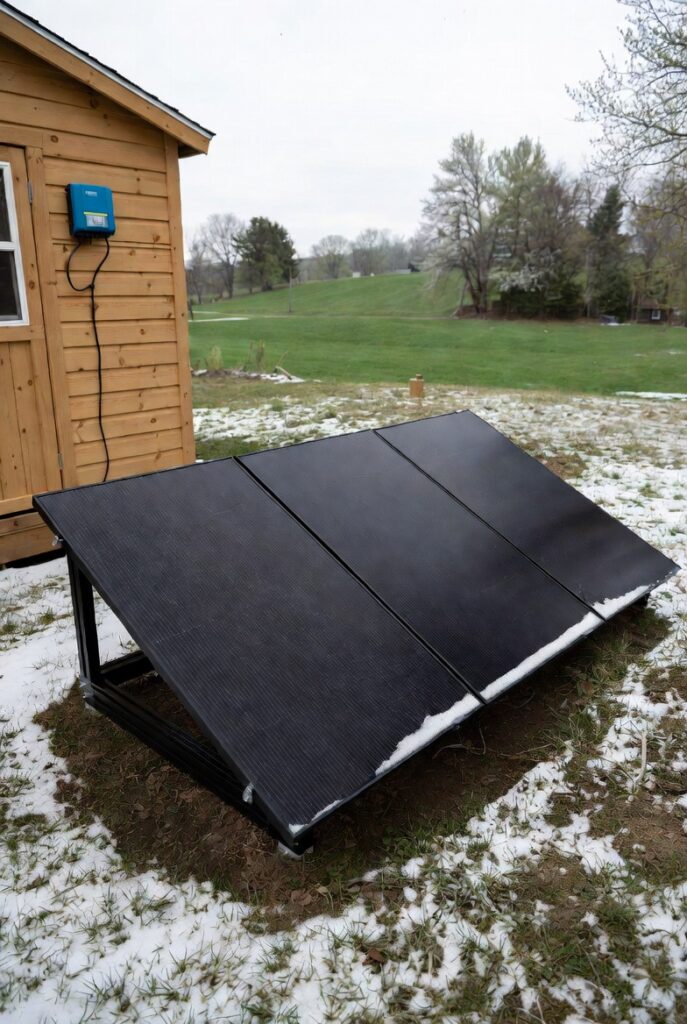
The best 400w solar decision is not about the panel on the box, it is about the panel on the roof in January. A homeowner on Stone Road West in Guelph, Wellington County was building a 1,200W ground-mount array in the spring of 2025. His original plan was twelve 100W panels. His installer quoted the wiring and mounting hardware for twelve panels at $1,840, because twelve panels require twelve sets of mounting feet, twelve cable runs to the combiner box, and six MC4 parallel branch connectors.
The installer then showed him the alternative: three 400W panels at the same 1,200W total. The hardware for three panels cost $640: six mounting feet, three cable runs, no branch connectors needed. He saved $1,200 on hardware alone before touching a single panel price.
The wiring simplification compounded the savings. Each 100W panel in a 12-panel array needs individual overcurrent protection, a dedicated cable run to the combiner box, and a branch connector at each parallel junction. Three 400W panels in a series string need one fused disconnect and one continuous cable run to the charge controller. The Guelph homeowner’s total installation time dropped from an estimated 14 hours to 6 hours.
His charge controller saw a clean 93V series string at standard test conditions from three 400W panels rather than a parallel bank of twelve lower-voltage panels. At Ontario’s minus 18 Celsius January minimum, the three-panel series string reaches approximately 125V. The Victron MPPT 150/70 he installed handles up to 150V input, keeping the installation safely within spec at the coldest Ontario operating temperature.
I inspected the system after three months of operation. The three-panel ground mount was producing within 4% of calculated output at Ontario’s 3.5 average peak sun hours, with 1,470Wh per day in May at 4.2 PSH. The twelve 100W panels at the same site would have produced identically in watt-hours because the array size was the same. However, the three-panel system had zero parallel connectors to develop oxidation resistance, zero branch points to create voltage mismatch, and a single unbroken cable run from the array to the controller.
Fewer connections mean fewer failure points over a 25-year panel service life. The best 400w solar purchase is not just about efficiency. It is about how the system holds up after 10 Ontario winters and 10 spring thaws. See our Ontario solar sizing guide to size the full array before choosing panel count.
Why the best 400w solar choice starts with voltage, not wattage
The series versus parallel argument is the most important concept for any Ontario buyer comparing 400W panels to smaller alternatives. A single 400W panel at 37.1V in a three-panel series string gives 111.3V at STC, a high-voltage DC input that a Victron MPPT handles efficiently. Four 100W panels in parallel give approximately 22.3V at high current, a low-voltage input that loses more energy to wire resistance on any run over 5 metres. The voltage advantage is the most underappreciated specification in the 100W versus 400W comparison, and it becomes decisive on any installation with a cable run longer than 10 metres from the array to the charge controller.
A rural property owner on Main Street East in Milton, Halton County had a 30-metre cable run from a detached equipment shed to his ground-mount array installed in August 2024. He had originally specified four 100W panels in parallel at 24V nominal and 21.2A combined. At 30 metres and 21.2A, his 10AWG cable was dropping approximately 4.2V on the run, a 17% voltage drop at 24V that was costing him approximately 170Wh per peak sun hour in wasted heat in the cable.
He switched to two BougeRV 400W bifacial panels in series at 74.2V and 12.9A. At 30 metres and 12.9A on 10AWG, the voltage drop fell to approximately 1.5V, a 2% loss at 74V. His MPPT controller started reporting 15 to 18% higher daily harvest on identical irradiance days. The switch from low-voltage parallel to high-voltage series recovered approximately 280Wh per peak sun hour from the same array and the same cable.
The 10BB busbar advantage: less heat, more power on Ontario July afternoons
Ten busbars mean current is collected across 10 parallel conductive paths instead of the traditional 4 to 6. Lower internal resistance means less heat generated at high current. At a Rockwood July afternoon cell temperature of 60C, a 10BB panel recovers approximately 3 to 5% more power than a 4BB panel of identical rated wattage. This is not marketing. It is Ohm’s law applied at the cell level, and it is measurable with any clamp meter on a hot clear day.
Half-cut cell design compounds the busbar benefit. A half-cut cell produces half the current of a full cell, reducing resistive loss by approximately 75% at the cell level. Combined with 10BB current collection, the BougeRV 400W 10BB bifacial panel at 23% efficiency holds up better under Ontario summer thermal conditions than older 4BB PERC panels rated at the same wattage. For any installation where the panels will see consistent 50 to 60C cell temperatures on Ontario July afternoons, the 10BB design is the correct choice for long-term production. See our best 200W solar panel guide if your roof area limits you to smaller panels.
NOCT vs STC: what your panel actually produces in a Rockwood summer
STC, Standard Test Conditions, is a lab benchmark: 25C cell temperature, 1,000 W/m2 irradiance, and no wind. Real Ontario panels run hotter than that. NOCT, or Nominal Operating Cell Temperature, is a more realistic benchmark at approximately 45C with modest irradiance and light wind. At NOCT a 400W panel produces approximately 373W. On an Ontario July afternoon with the panel at 60C surface temperature, output drops to approximately 352W.
A Master Tech sizes for NOCT, not STC. Three panels at NOCT produce approximately 1,120W, not 1,200W. Over a 150-day Ontario summer season at 4.5 PSH average, that 80W NOCT difference adds up to approximately 54 kWh of lost production versus the STC assumption. Sizing for NOCT builds in the right buffer from the start.
The bifacial bonus partially offsets the NOCT penalty, and it matters most in the Ontario winter months when the array needs every watt available. Ontario’s fresh snow albedo runs 80 to 90%, meaning snow reflects significant irradiance onto the rear surface of a ground-mounted bifacial panel. A BougeRV 400W bifacial panel producing 280W from the front surface in January at 2.5 PSH and 0C may produce an additional 40 to 70W from the rear, reaching 320 to 350W effective output. That is the honest Ontario winter bifacial advantage, 15 to 25% above front-surface-only calculation in ideal snow conditions, not the inflated 450W figure sometimes cited in marketing materials.
Best 400w solar panels for Ontario: BougeRV 10BB bifacial vs Renogy N-Type
Two products have verified Amazon.ca listings with confirmed specs from manufacturer datasheets. The BougeRV 400W Bifacial 10BB is a single large panel with a transparent bifacial back. The Renogy option delivers 400W as two 200W N-Type 16BB panels, which allows more flexible placement on smaller roof areas and provides a slight efficiency advantage from N-Type cell chemistry. Both panels meet Ontario’s 5,400 Pa snow load requirement, confirming they are rated to survive the structural loads of a Wellington County blizzard on a roof or ground mount without frame buckling.
| Specification | BougeRV 400W Bifacial 10BB | Renogy 2x200W N-Type 16BB |
|---|---|---|
| Maximum Power | 400W | 400W (2x200W) |
| Open Circuit Voltage (VOC) at STC | 37.1V | 37.44V per panel |
| Max Power Voltage (Vmp) | 31V | ~31V per panel |
| Short Circuit Current (ISC) | 13.8A | ~6.5A per panel |
| Efficiency | 23% | 25% |
| Weight | 45.21 lbs (20.5 kg) | ~20 to 22 lbs each |
| Snow load | 5,400 Pa ✓ | 5,400 Pa ✓ |
| Bifacial | Yes (15 to 25% albedo bonus) | No |
| Busbar | 10BB half-cut | 16BB N-Type |
| Cold temp VOC at -18C (single) | ~41.9V | ~42.1V |
| 3-panel series at -18C | ~125.7V, needs 150V MPPT | ~126.3V, needs 150V MPPT |
| 2-panel series at -18C | ~83.8V, safe on 100V MPPT | ~84.3V, safe on 100V MPPT |
| Buy on Amazon.ca | BougeRV 400W Bifacial | Renogy 200W N-Type (x2) |
| Warranty | 10-year product + 25-year power | 10-year product + 25-year power |
The cold-temperature voltage calculation is the most safety-critical specification on this comparison. Three BougeRV panels in series at Ontario -18C reach approximately 125.7V. Three Renogy 200W panels in series at -18C reach approximately 126.3V. Both exceed the 100V maximum input of a standard Victron MPPT 100/50 controller. For any Ontario installation running three or more 400W-class panels in a series string, a 150V-minimum MPPT controller is required, not optional.
The Victron SmartSolar MPPT 150/35 handles up to 150V input and 35A charge current, which is the correct specification for a three-panel 1,200W string. Two panels of either brand in series at -18C reach approximately 83.8 to 84.3V, safely within the 100V limit. See our best 100W solar panel guide to understand the full comparison between small and large-format panel classes.
NEC and CEC: code compliance for large-format solar panel installations in Ontario
NEC 690.7 requires that maximum system voltage be calculated at the coldest expected operating temperature, not at the 25C STC reference. For Ontario installations with three 400W panels in series, the cold-temperature VOC calculation confirms approximately 125.7V at -18C for the BougeRV string. This calculation must appear in the system design documentation before installation begins. NEC 690.9 requires that all conductors be rated for the maximum system voltage, meaning 150V-rated wire, disconnects, and fusing for a three-panel series string in Ontario.
A contractor who installs three 400W panels in series connected to a 100V-rated controller has created an installation that will destroy the controller on the first clear January morning. Contact the NFPA at nfpa.org for current NEC 690 requirements applicable to large-format PV installations.
CEC Section 50 governs all solar PV installations in Ontario. An ESA permit is required before connecting any solar array to a battery bank or grid-tied inverter, regardless of panel size or system voltage. Large-format 400W panels require the same permit process as any other PV installation. The permit application must include the maximum string voltage at minimum operating temperature per NEC 690.7. For a three-panel BougeRV 400W string, that figure is 125.7V.
This number must match the rated input voltage of the charge controller specified in the permit application. A permit submitted with a 100V controller and a three-panel 400W string will correctly fail review. Contact the Electrical Safety Authority Ontario at esasafe.com for current permit requirements before beginning any large-format solar installation in Ontario.
Pro Tip: The two-panel rule covers most Ontario residential best 400w solar installations and avoids the 150V controller requirement entirely. Two BougeRV 400W panels in series produce 800W at 74.2V STC, within the 100V Victron MPPT 100/50 limit at any Ontario temperature. For a cottage or shed needing 800 to 1,200W, running two separate two-panel strings with two standard MPPT 100/50 controllers is often less expensive and simpler than one three-panel string requiring a 150V controller. The Guelph Stone Road West homeowner chose a three-panel string because his 1,200W load required it and he specified the correct 150V controller from the start. For most Ontario buyers adding best 400w solar to an existing system, two panels per string keeps the entire installation within standard 100V equipment specifications.
The best 400w solar verdict: three Ontario installation profiles
- Ontario homeowner building a 1,200 to 2,400W ground-mount array with cable runs under 15 metres: BougeRV 400W Bifacial 10BB B0CSFCT4ZM. The Stone Road West result confirms the case. Three panels replacing twelve produces identical watt-hours, saves $1,200 in hardware, and cuts installation time by more than half. The bifacial design adds 15 to 25% production in January over fresh snow without any additional hardware. Specify a Victron MPPT 150/35 or 150/70 for a three-panel series string, the cold-temperature VOC of 125.7V at -18C makes a 150V-rated controller mandatory. For a two-panel 800W system, a standard Victron MPPT 100/50 is sufficient. The snow load rating of 5,400 Pa means the BougeRV frame survives the structural load of a fully loaded Ontario flat-roof snow event without flex or fastener pull-through. See our Ontario ground mount vs roof mount guide for structural installation details.
- Ontario cottage or shed owner with cable runs over 20 metres, or where roof geometry limits panel size: two Renogy 200W N-Type panels B08CRJYJ22 per 400W unit. The Milton Main Street voltage-drop recovery confirms the long-run case. At 30 metres, a high-voltage two-panel series string at 74.4V and 6.5A recovers 280Wh per PSH versus a parallel 24V bank drawing 13A on the same cable. The Renogy N-Type’s 25% efficiency outperforms the BougeRV’s 23% in cold conditions, and N-Type cell chemistry provides better low-light performance on overcast Ontario mornings. Two Renogy 200W panels in series reach 84.3V at -18C, comfortably within the 100V standard MPPT limit. The smaller 200W panel footprint also allows placement on roofs where a single 67.9-inch 400W panel would not fit or would require awkward racking angles.
- Ontario RV owner, seasonal trailer, or small cottage with a roof under 12 square metres: do not use 400W panels. The BougeRV 400W panel measures 67.9 x 44.6 inches and weighs 45.21 lbs. Three panels require approximately 13 square metres of structural mounting surface and two people plus lifting equipment for safe installation. A small RV roof with 8 square metres of usable area cannot safely accommodate 400W-class panels without exceeding the roof’s structural load rating. An Ontario boater or RV owner in this situation achieves better results with four or six 100W rigid panels, which are lighter, smaller, and can be arranged around obstructions like vents and AC units. See our 200W panel guide for the right comparison at that scale.
Frequently Asked Questions
Q: What makes the best 400w solar panel choice different for Ontario vs warmer climates?
A: Three factors are unique to Ontario. First, the cold-temperature VOC spike: at -18C Ontario January, a 400W panel’s open-circuit voltage rises to approximately 41.9V, and three panels in series reach 125.7V, exceeding a standard 100V MPPT controller. Second, the 5,400 Pa snow load rating confirms the panel frame can survive a weighted Ontario blizzard, a specification irrelevant in California but critical here. Third, the bifacial albedo bonus from Ontario’s 80 to 90% fresh snow reflectivity adds 15 to 25% rear-surface production in January that a non-bifacial panel in a snowless climate never captures.
Sizing correctly for the best 400w solar in Ontario means calculating cold VOC before specifying the controller, confirming snow load before finalising racking, and choosing bifacial for ground mounts where snow albedo is available.
Q: How many best 400w solar panels can I wire in series before exceeding my MPPT controller’s limit?
A: Two panels in series is the maximum for a standard 100V MPPT controller in Ontario. Two BougeRV 400W panels in series reach approximately 83.8V at -18C, safely within the 100V limit. Three panels in series reach approximately 125.7V at -18C, which exceeds a 100V controller’s input rating and will damage or destroy it on a cold January morning. Three panels in series require a Victron MPPT 150/35 or equivalent 150V-rated controller.
The same rule applies to the Renogy 200W N-Type option: two panels in series at 84.3V is safe on a 100V MPPT; three panels at 126.3V requires a 150V controller. When in doubt, use two panels per string and add a second controller rather than exceeding the voltage limit.
Q: Is bifacial worth the premium for the best 400w solar setup in Ontario winter?
A: For ground-mount installations in Ontario, yes. A bifacial panel mounted at 35 to 40 degrees above a snow-covered ground surface captures reflected irradiance from Ontario’s 80 to 90% albedo fresh snow. The production bonus is 15 to 25% above the front-surface-only calculation in January and February, which are the months when every available watt matters most for a system trying to maintain battery state of charge.
For roof-mounted installations on a dark asphalt shingle roof with no snow accumulation below the panels, the bifacial bonus is negligible. The premium is worth it for ground mounts in Wellington and Halton Counties. It is not worth it for sloped roof mounts where the rear surface sees only the roof surface beneath it.
This build is engineered within the 48V DC Safety Ceiling. Diagnostic logic is based on 20+ years of technical service experience. All structural and electrical installations must be verified by a Licensed Professional and comply with your Local AHJ.
This article contains affiliate links. If you purchase through these links, I earn a small commission at no extra cost to you.