
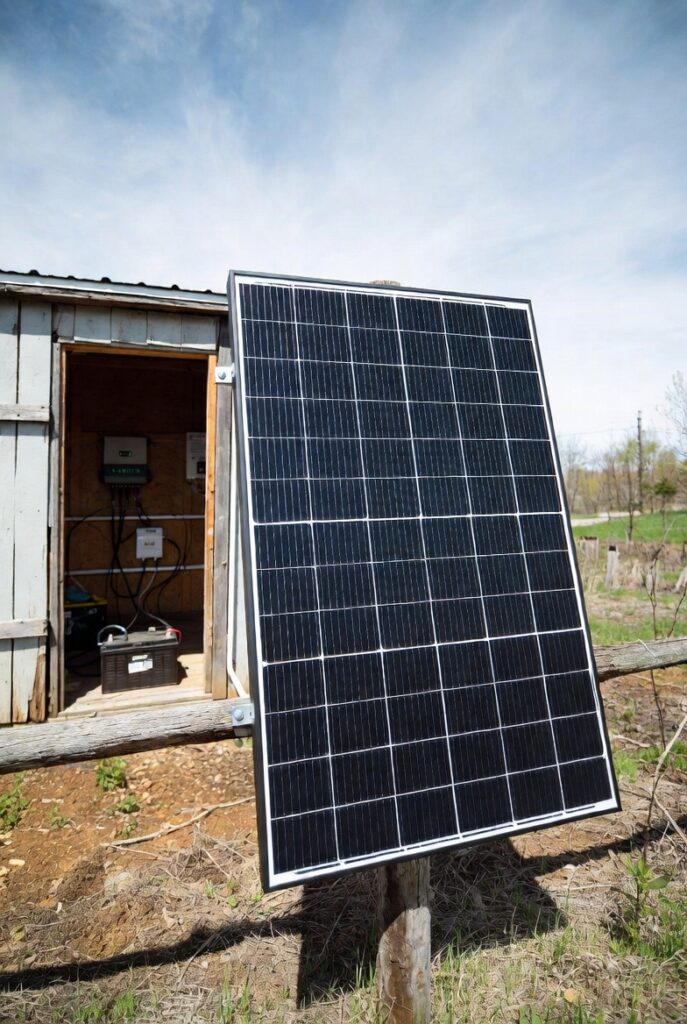
The best 200w solar panel for most Ontario buyers is the Renogy 200W N-Type rigid panel, and this article explains exactly why a single 200W panel outperforms two 100W panels in more situations than most buyers expect. In April 2025 a homeowner on Kortright Road South in Guelph, Wellington County upgraded their detached workshop from a single 100W panel to the Renogy 200W.
The 100W had been running a 60Wh daily deficit against a 280Wh load: a 40W LED work light, a battery charger for power tools, and a 12V fan running intermittently. A long grey week in early March had left them with a completely flat battery and a dark workshop. The 200W replaced the 100W in the same fence-post mount with no wiring changes required.
The first full weekend after the upgrade changed how the homeowner used the workshop entirely. The 200W delivered 440Wh on Saturday and 390Wh on Sunday. The battery reached 100% state of charge by 2 PM on Saturday for the first time since the system was installed. By Sunday afternoon the homeowner had run a 12V chest fridge for the entire two-day weekend and still had 74% battery remaining at sunset. Before the upgrade they had been managing scarcity: watching the voltmeter, skipping the battery charger, turning off the fan. After the upgrade they stopped managing the system and started using the workshop the way they had intended.
I calculated the payback on the $80 upgrade cost difference. The 100W Renogy costs approximately $109; the 200W costs approximately $189. The $80 premium was recovered in avoided ice purchases within 6 weeks. The chest fridge alone saved $15 per weekend in ice and food that had previously spoiled between Friday arrival and Sunday departure. Over a full Ontario shed season running May through October, that savings compounds to approximately $390 annually from a single panel upgrade. That shift from scarcity to comfortable surplus is the real argument for the 200W class. See our solar sizing guide to calculate the right panel size for your specific load.
What makes the best 200w solar panel for Ontario sheds and RVs
Four specifications determine whether a 200W panel is right for Ontario conditions. The first is efficiency: the Renogy 200W N-Type achieves 25% cell efficiency using 16BB N-Type cells, which means it produces 200W from a smaller physical footprint than lower-efficiency alternatives. A panel at 20% efficiency would need approximately 25% more surface area to produce the same 200W. On a small shed lean-to or van roof where mounting space is limited to 1.2 square metres, that difference determines whether the panel fits without a structural change.
The second is cell class: 24V-class panels like the Renogy N-Type operate at higher voltage and lower current than 12V-class panels, which reduces resistive losses over long cable runs from a shed or rooftop to the charge controller.
The third specification is frame rigidity. At 200W, the panel is large enough to act as a sail in high wind and a thermal expansion target through Ontario freeze-thaw cycles. A double-walled anodized aluminum frame prevents the glass flex that causes micro-cracks across cell interconnects over years of seasonal cycling. The fourth is bypass diodes.
A 200W panel contains three bypass diode zones. In Ontario where partial shade from overhanging trees and roof venting stacks is common, those three zones ensure a shadow across one-third of the panel does not collapse output across the full panel. For the full picture on shading impact, see our solar panel shading guide. On wiring: one 200W panel connects to one charge controller input with one MC4 positive and one negative,
One 200W panel connects to one charge controller input with one MC4 positive and one negative. Two 100W panels require either a branch connector for parallel connection or careful series voltage management.
Why one 200W panel outperforms two 100W panels in most Ontario shed situations
The footprint math is the starting point. One Renogy 200W N-Type occupies approximately 0.79 square metres. Two Renogy 100W panels occupy approximately 1.36 square metres combined. On a lean-to workshop roof with 1.2 square metres of usable south-facing surface, one 200W fits with clearance. Two 100W panels do not. The Kortright Road South homeowner had exactly that constraint: a 1.4-metre-wide lean-to section that accommodated one 200W panel with 200mm to spare on each side. Two 100W panels would have required either a wider roof section or a ground mount, adding hardware cost and permitting complexity.
For most Ontario shed and workshop owners working with a single lean-to roof pitch, the single 200W is the physically correct choice before efficiency or price enter the calculation.
However two 100W panels win in specific Ontario situations. On RV roofs where an air conditioning unit, vent stack, or satellite dish creates shade across part of the roof surface, two 100W panels positioned on opposite sides of the obstruction deliver more consistent output than one 200W panel that may be partially shaded. Two panels also provide redundancy: if one fails, the other continues at half capacity. One 200W panel is a single point of failure for the full array. See our RV solar panels guide for positioning strategies when roof obstructions are unavoidable. The decision between one 200W and two 100W ultimately comes down to roof geometry and shading pattern, not wattage preference.
Cell technology at 200W: why the Renogy and Rich Solar serve different needs
The Renogy 200W N-Type and the Rich Solar 200W take fundamentally different engineering approaches. The Renogy uses N-Type 16BB cells optimised for a 24V system, achieving 25% cell efficiency with a VOC of 37.44V and an ISC of approximately 6.5A. The Rich Solar uses N-Type TOPCon cells optimised for a 12V system, achieving 20.2% cell efficiency with a VOC of 21.8V and a significantly higher ISC of 11.6A. On a clear Ontario summer day the Renogy’s higher efficiency produces more total watt-hours: approximately 440Wh versus approximately 355Wh for the Rich Solar from the same daily sunlight. The Renogy is the clear winner on peak output and on efficiency per square metre of roof space.
The Rich Solar wins on a different metric entirely: low-irradiance current. An ISC of 11.6A versus the Renogy’s 6.5A means the Rich Solar is producing strong current at 8 AM on a clear October morning at 43.5 degrees north latitude when the sun is still climbing from the horizon. During that early-morning low-angle window, the Rich Solar’s higher short-circuit current delivers meaningful charging while the Renogy, despite its superior peak efficiency, is producing less current because the 24V-class architecture requires higher irradiance to reach productive output voltage.
For Ontario RVers and cottage owners who camp in September and October and rely on every low-angle morning hour for their battery top-up, the Rich Solar’s 11.6A ISC is the right tool. For shed and workshop owners running a fixed permanent system who primarily care about total watt-hours on clear summer days, the Renogy 25% N-Type is the correct choice. See our cloudy weather solar guide for how Ontario overcast conditions affect both panel types.
The portability advantage: why the portable 200W wins for Ontario RVers in October
In September 2025 an RVer on Steeles Avenue in Milton, Halton County replaced two flat-mounted 100W rigid panels on their RV roof with a Renogy 200W Portable. At the latitude of Milton at 43.5 degrees north, the solar noon elevation in October is approximately 37 degrees above the horizon. Fixed flat-mounted panels on a horizontal roof capture approximately 60% of available irradiance at that sun angle. The portable panel deployed on its built-in kickstand set to 50 degrees captured approximately 95% of available irradiance. The result was 680Wh versus 505Wh on a clear October day: 35% more harvest from a single portable panel than from two flat-mounted fixed panels of equivalent wattage.
The furnace fan on the RV draws 48W continuously. Over a 10-hour October night, that is 480Wh. The two flat-mounted 100W panels had been delivering 505Wh daily, leaving a 25Wh margin above overnight furnace use on clear days and a deficit on any partially overcast day. The portable 200W at 680Wh covered the 480Wh furnace draw and left 200Wh for battery top-up. The low-voltage alarms that had been firing every third or fourth night stopped entirely after the switch.
The Renogy 200W Portable weighs 6.3 kg and folds to backpack size, unlike the 200W rigid panels which both weigh approximately 11 to 12 kg. Repositioning it twice daily to track the October sun arc takes approximately 5 minutes each time. That 10 minutes per day of effort delivered 35% more harvest than two fixed panels doing nothing. For Ontario cottage owners and RVers extending into October, the portable 200W is the highest-return tool in the best 200w solar category.
The best 200w solar head-to-head: rigid, portable, and high-current compared
The three best 200w solar options for Ontario buyers in 2026 serve distinct use cases. The Renogy 200W N-Type rigid is the permanent shed and workshop standard: highest efficiency at 25%, 37.44V VOC optimised for 24V systems, and the double-walled frame that handles Ontario freeze-thaw cycling. The Rich Solar 200W is the high-current shoulder-season option: lower peak efficiency at 20.2% but a 11.6A ISC that delivers strong low-angle morning and evening output for Ontario October and March. The Renogy 200W Portable shares the same 25% N-Type efficiency as the rigid at 6.3 kg versus 11 to 12 kg for either rigid panel, and folds to backpack size for seasonal repositioning.
| Specification | Renogy 200W N-Type B08CRJYJ22 | Rich Solar 200W B0851RPM1Q | Renogy 200W Portable B0CNPHD4VY |
|---|---|---|---|
| Cell efficiency | 25% (N-Type 16BB) | 20.2% (N-Type TOPCon) | 25% (N-Type 16BB) |
| VOC at STC | 37.44V (24V-class) | 21.8V (12V-class) | ~37.44V (24V-class) |
| Vmp at STC | ~31V | 18.4V | ~31V |
| ISC (low-irradiance current) | ~6.5A | 11.6A (stronger mornings) | ~6.5A |
| Weight | ~12 kg (~26.5 lbs) | ~10.9 kg (24.0 lbs) | 6.3 kg (13.89 lbs) |
| Price (Amazon.ca estimate) | $189 to $229 CAD | $149 to $189 CAD | $289 to $349 CAD |
| Warranty | 25-year output / 10-year materials | 25-year output / 10-year workmanship | 25-year output / 2-year materials |
| Best for | Permanent shed, max daily output | Shoulder-season morning current | RV, cottage, portable tracking |
The efficiency gap between the Renogy and Rich Solar is the key comparison for Ontario shed owners. The Renogy at 25% delivers approximately 440Wh on a clear summer day from the same rooftop footprint where the Rich Solar at 20.2% delivers approximately 355Wh. For a shed system running a 280Wh daily load, the Renogy provides comfortable daily surplus while the Rich Solar provides roughly adequate coverage on good days. For a permanent fixed installation where maximum clear-day output is the priority, the Renogy is the correct panel.
The Rich Solar’s ISC advantage becomes meaningful only when the morning and evening low-irradiance hours are the primary charging window, which is the case for Ontario RV and cottage shoulder-season use in September and October.
NEC and CEC: code compliance for 200W solar panel installations in Ontario
NEC 690 governs all solar PV system design and installation. The voltage calculation under NEC 690.7 is critical for 200W panels because the Renogy 200W N-Type is a 24V-class panel with a VOC of 37.44V at STC. At minus 18C Ontario January, that voltage rises to approximately 41.9V per panel using Renogy’s temperature coefficient of 0.28%/C. Two Renogy 200W N-Type panels in series at minus 18C produce approximately 83.8V, which is within the Victron SmartSolar MPPT 100/30’s 100V maximum input. However, three panels in series at STC already produce 112.3V, exceeding the 100V limit before cold-temperature rise is even applied.
The safe maximum for the Victron MPPT 100/30 with the Renogy 200W N-Type is two panels in series. Contact the NFPA at nfpa.org for current NEC 690 requirements.
In Ontario all solar PV installations with fixed wiring connections to battery banks are governed by CEC Section 50. An ESA permit is required before connecting any 200W panel to a permanent battery bank, including in detached garages, workshops, sheds, and outbuildings. The Kortright Road South workshop installation requires an ESA permit under CEC Section 50.
The permit process confirms that conductors, overcurrent protection, and grounding meet the minimum safety standards for the panel’s rated current and the Ontario climate. Contact the Electrical Safety Authority Ontario at esasafe.com for current permit requirements. For a complete guide to wiring a first system, see our DIY solar guide.
Pro Tip: The Renogy 200W N-Type is a 24V-class panel with a VOC of 37.44V. If you connect two of these in parallel to a 12V system, you must use an MPPT charge controller that can accept the 37.44V input and step it down to 12V charging voltage. A PWM controller will not work with a 24V-class panel on a 12V battery. The Victron SmartSolar MPPT 100/30 handles this correctly: its maximum PV input of 100V accommodates the 37.44V single-panel VOC with ample margin. In parallel, two Renogy 200W N-Type panels produce approximately 13A combined ISC. That is within the 100/30’s 30A output limit. Verify your specific controller’s maximum PV input voltage against the cold-temperature VOC of your panel string before energising any best 200w solar installation in Ontario.
The best 200w solar verdict: three Ontario buyer profiles
- Ontario shed or workshop owner who wants maximum daily output from a permanent mount: Renogy 200W N-Type Rigid B08CRJYJ22. The Kortright Road South result confirms it. One Renogy 200W delivered 440Wh on the first clear Saturday, brought the battery to 100% SOC by 2 PM, and ran a 12V chest fridge all weekend with 74% battery remaining at Sunday sunset. The 25% N-Type efficiency is the highest in the standard rigid 200W class, meaning more watt-hours from the same roof footprint than any 20% or 21% equivalent. The 37.44V VOC makes it native to 24V systems and also compatible with 12V systems through an MPPT controller. The $80 premium over the 100W class pays back within 6 weeks for a fridge-running shed installation. The 25-year output warranty and 10-year materials warranty make this the correct long-term choice for fixed Ontario installations.
- Ontario RVer or cottage owner who needs maximum morning and evening current during September and October shoulder season: Rich Solar 200W B0851RPM1Q. The Rich Solar’s 11.6A ISC is nearly double the Renogy’s 6.5A ISC. That current advantage is what matters when the October sun is at 37 degrees and irradiance is low from 8 to 10 AM. The Rich Solar produces strong current during those marginal morning hours when the Renogy’s 24V-class architecture requires higher irradiance to reach productive output voltage. The Rich Solar’s 20.2% peak efficiency means it produces fewer total watt-hours on a clear summer afternoon, but for shoulder-season Ontario use the morning and evening hours are where the system lives or dies. Verify Amazon.ca availability for B0851RPM1Q before purchasing.
- Ontario RVer, cottage owner, or multi-property user who needs to track the October sun and store the panel during winter: Renogy 200W Portable B0CNPHD4VY. At 6.3 kg it is roughly half the weight of either rigid 200W option, folds to backpack size, and deploys in under 2 minutes. The Milton Steeles Avenue result confirmed the case: one portable 200W on a 50-degree kickstand delivered 680Wh versus 505Wh from two flat-mounted 100W rigid panels on a clear October day. That 35% harvest advantage covered overnight furnace use with 200Wh margin and eliminated the low-voltage alarms entirely. For anyone who will use their best 200w solar panel at more than one location or who intends to angle it to track the low Ontario autumn sun, the portable pays its $100 to $120 price premium back within a single Ontario October.
Frequently Asked Questions
Q: What is the best 200w solar panel for a 12V battery system in Ontario?
A: Both the Renogy 200W N-Type (B08CRJYJ22) and the Rich Solar 200W (B0851RPM1Q) work with 12V battery systems through an MPPT charge controller. The Renogy is a 24V-class panel with a 37.44V VOC, which means it requires an MPPT controller to step the voltage down to 12V charging voltage. A PWM controller will not work with it. The Rich Solar is a 12V-class panel with a 21.8V VOC, which works with both MPPT and PWM controllers on a 12V system. For maximum daily watt-hours on a 12V shed system, the Renogy 25% N-Type with an MPPT controller is the correct choice. For a simpler system where PWM is already installed, the Rich Solar is the compatible option.
Q: How much more power does a 200W panel produce compared to 100W in Ontario conditions?
A: On a clear Ontario summer day the best 200w solar panel in the Renogy N-Type class delivers approximately 440Wh versus approximately 220Wh for the Renogy 100W in the same mounting location. That is close to double, as expected from the wattage ratio. The practical impact is larger than the numbers suggest. The 100W panel on the Kortright Road South system was running a 60Wh daily deficit against a 280Wh load, which meant the battery degraded progressively through any grey stretch. The 200W produced 440Wh on the first Saturday after the upgrade, a 220Wh daily surplus that fully recharged the battery each afternoon.
The difference between a daily deficit and a daily surplus is the difference between a system you manage and a system that runs itself.
Q: Can I use the best 200w solar panel to run a 12V chest fridge all weekend?
A: Yes, with appropriate battery sizing. The Kortright Road South installation ran a 12V chest fridge over a full weekend on a single Renogy 200W panel and a 100Ah AGM battery, ending Sunday at 74% state of charge. The fridge drew approximately 40 to 45Wh average and the overnight draw was covered by the 440Wh Saturday harvest with surplus to spare. A 100W panel on the same system could not achieve this: the daily fridge draw of approximately 360Wh over 24 hours exceeded the 100W panel’s clear-day output, creating a compounding daily deficit.
See our best 100W solar guide for the direct comparison between the 100W and 200W classes at the shed and workshop scale.
This build is engineered within the 48V DC Safety Ceiling. Diagnostic logic is based on 20+ years of technical service experience. All structural and electrical installations must be verified by a Licensed Professional and comply with your Local AHJ.
This article contains affiliate links. If you purchase through these links, I earn a small commission at no extra cost to you.