
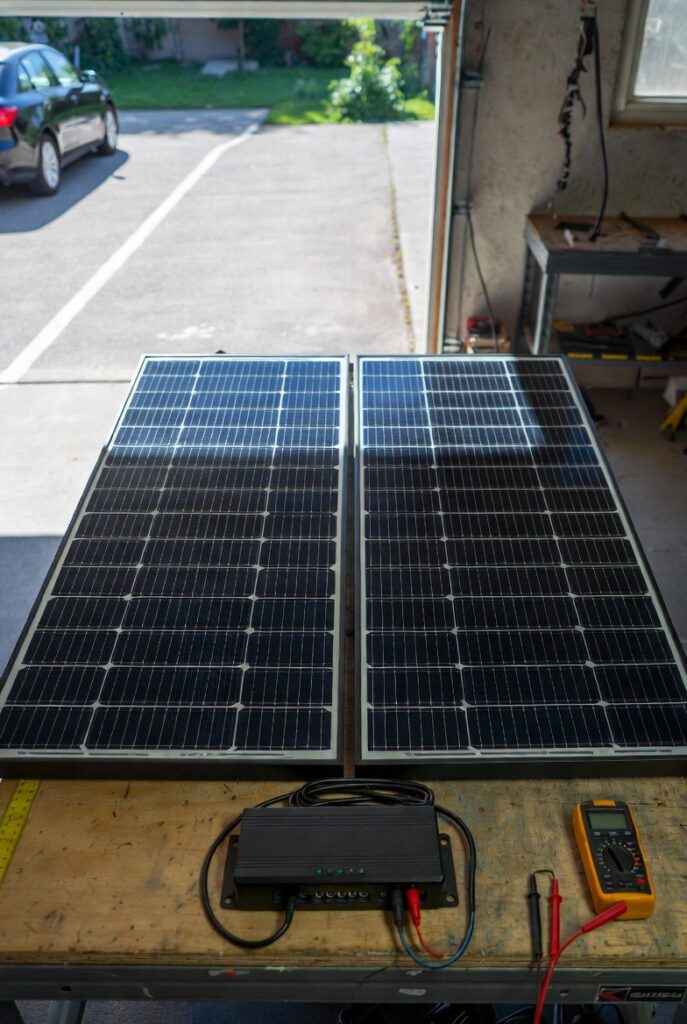
Every rv solar panels question I get from Ontario RVers comes down to one fear: that the panels are going to fly off at 110 km/h on the 401. This concern is valid but the solution is straightforward. In June 2025 a couple on Kortright Road West in Guelph, Wellington County prepared their Class C motorhome for a 10-day East Coast trip. They installed two Renogy 100W panels on their fiberglass roof using the VHB hybrid method: 3M VHB 4950 tape across the full contact area of each Z-bracket foot, supplemented by four stainless steel self-tapping screws per bracket as mechanical backup. The installation took one Saturday afternoon. They saved $1,200 in professional labor.
During the 10-day trip they boondocked at four locations in New Brunswick and Nova Scotia without firing the generator once. The two 100W panels connected to a Victron SmartSolar MPPT 100/30 and a 200Ah LFP battery delivered an average of 640Wh on clear days and 180Wh on overcast days. Their daily load was approximately 300Wh: DC fridge at 45Wh average, LED lighting at 20W for 4 hours, phone charging at 15W, and Starlink at 50W. Solar covered daily consumption entirely on clear days with 340Wh to spare for battery top-up each afternoon. The couple drove 3,800 km total, including rough sections of the Cabot Trail in Cape Breton at speeds between 60 and 90 km/h.
I inspected the mounting hardware after the trip. Both panels were immovable. All eight bracket feet held at spec torque with zero rotation when I checked them. The 3M VHB 4950 under each bracket foot had not crept or lifted at any corner after 3,800 km. The cable entry gland, sealed with Dicor lap sealant around the base, showed zero moisture ingress after two rainstorms on the Cape Breton leg. The rv solar panels installation had survived the most demanding Canadian road trip possible without a single fastener loosened or a single drop of water inside. I would specify the identical VHB hybrid method on any fiberglass-roof RV without hesitation.
What makes rv solar panels different from a house installation
A residential roof does not travel at 110 km/h. It does not flex over potholes on Highway 17 north of Sudbury or vibrate through the washboard gravel of a Muskoka cottage road. The rv solar panels environment is fundamentally more demanding than any fixed installation. The mounting system must hold against highway wind uplift forces of approximately 15 to 25 kg per panel at 100 km/h, resist flex fatigue on rough roads over thousands of kilometres, and survive the full Ontario temperature cycle from minus 30C in January storage to plus 70C panel surface temperature in July. A house roof mounting lives its entire service life without experiencing any of those forces.
The roof material question determines which mounting method is appropriate. Fiberglass roofs on Class A and most Class C motorhomes accept VHB adhesive reliably when the surface is clean and properly prepped. TPO and rubber membrane roofs, common on older Class A motorhomes and many travel trailers, do not. VHB adhesive bonds to the membrane surface, not the substrate below. The membrane flexes independently of the substrate, and the adhesive peels away progressively under road vibration. The 30-second field test: press a fingernail firmly into the roof surface. If it leaves a clear indent, the roof is TPO or rubber. On a TPO roof, mechanical fasteners with Dicor or butyl tape sealant are the only correct method. No exceptions.
| Roof Type | Common RVs | Correct Mount Method | VHB 4950? |
|---|---|---|---|
| Fiberglass | Most Class A and C motorhomes | VHB hybrid (tape + screws) | Yes, with prep |
| TPO / rubber membrane | Older motorhomes, many trailers | Mechanical fasteners + Dicor only | No |
| Metal (steel or aluminum) | Cargo trailers, van conversions | VHB hybrid on clean unpainted metal | Yes, if clean |
| ABS plastic | Pop-up trailers, small caravans | VHB only, no screws through ABS | Yes, full coverage |
Rigid vs flexible panels: why the air gap choice matters on an Ontario roof
Rigid panels mounted on XOOL aluminum Z-brackets sit approximately 25mm above the roof surface. That air gap allows convective cooling across the entire rear face of the panel. As a result, rigid panels on a fiberglass RV roof in Ontario July sun reach approximately 55 to 65C surface temperature rather than the 85 to 95C that a flat-bonded flexible panel reaches on the same day. The temperature coefficient of a standard monocrystalline panel is -0.35% per degree above 25C. At 65C the loss is 14%. At 90C the loss is 22.75%.
The Kortright Road couple’s rigid 100W panels delivered 640Wh on their best clear day at the two-panel array level. Equivalent flexible panels bonded flat to the same roof would have delivered approximately 585Wh from that same day’s sunlight due to the heat penalty. The more serious concern with flat-bonded flexible panels is longevity. Repeated thermal cycling at 90C degrades the cell adhesive in flexible panel laminates within 18 to 36 months. The cells begin to delaminate from the substrate, creating air pockets that scatter light and reduce efficiency further. This is the primary reason flexible RV solar installations fail early despite working perfectly in the first season.
The fix is straightforward: cut a sheet of corrugated plastic, called coroplast, to the panel dimensions and bond the flexible panel to the coroplast rather than directly to the roof. The corrugated channels create a 6mm air gap that reduces surface temperature by 15 to 25C. For any Ontario RV that will see summer camping use, that air gap extends flexible panel service life from 2 years to 7 to 10 years.
How to mount rv solar panels on a fiberglass roof: the VHB hybrid method
The VHB hybrid method starts with surface preparation, because the tape bonds to whatever the surface presents. The morning of the install, sand the bracket landing zones with 300-grit paper to remove any wax, oxidation, or gelcoat chalking. Wipe each landing zone with isopropyl alcohol and allow to dry fully, approximately 10 minutes at 20C. Apply 3M VHB 4950 to the full contact area of each Z-bracket foot. Press each bracket onto its landing zone for 30 seconds with firm downward pressure to ensure full tape contact. Allow the adhesive to cure for 24 hours before driving.
After the cure period, add four stainless steel self-tapping screws per bracket foot as mechanical backup. The screws are the secondary retention system. Because VHB and screws work independently of each other, either one alone would hold the panel at highway speed. Both together make panel loss essentially impossible on a properly prepped fiberglass roof.
Panel layout affects both aerodynamics and heat management. Orient each panel so its shorter dimension faces the direction of travel. This reduces the frontal wind profile and therefore the uplift force at highway speed. Leave a minimum 75mm gap between panels to allow for thermal expansion of the aluminum frames in summer and to provide cleaning access. Do not position panels directly over roof vents.
A panel over a vent blocks the air exhaust from the vent stack, which causes heat to back up inside the RV. For the Kortright Road couple, the two panels were positioned behind the rooftop air conditioner unit, leaving the vent stacks forward of the array completely unobstructed. That layout choice is why the interior never overheated during the 10-day July trip despite the panels being on a dark roof in full Nova Scotia sun.
The cable entry gland: why silicone caulk is a one-winter solution
In August 2025 a van on Tremaine Road in Milton, Halton County had installed 400W of rv solar panels using a single drilled hole with silicone caulk and no gland. By the following March, water stains appeared on the headliner directly above the cable penetration point. I inspected and found the silicone had cracked clean around the cable at 270 degrees of its circumference. Every Ontario freeze-thaw cycle from October through March had worked the caulk loose progressively. Over 9 months the seal had failed completely. The water damage to the headliner required $380 in materials and 8 hours of labor to repair. A $15 gland and $8 of Dicor, installed at the beginning, would have prevented the entire problem.
After the repair I installed a BougeRV dual cable entry gland with a Dicor wet seal around the full base perimeter. That gland has now been through one full Ontario winter and shows zero moisture signs. The correct installation sequence is: drill the hole from outside with a 28mm hole saw, pass the positive and negative leads through the two gland openings, apply fresh Dicor to the full underside of the gland base, screw the gland down with three stainless self-tapping screws, and apply a second bead of Dicor around the full gland perimeter before it skins over.
The butyl tape seals below and the Dicor seals around the outside, creating two independent water seals that protect the interior from 10 to 15 years of Ontario road conditions.
I install a gland on every single rv solar panels roof penetration I touch. Silicone caulk is not a substitute.
Wiring from roof to charge controller: the MPPT connection inside the rig
From the cable entry gland, the positive and negative leads run directly to the PV input terminals on the Victron SmartSolar MPPT 100/30 mounted inside the RV in a ventilated location away from the battery bank. For runs under 5 metres from gland to controller, 10AWG wire is adequate. For 5 to 8 metre runs, upgrade to 8AWG to limit voltage drop. Connect the MPPT battery output terminals to the battery bank using appropriately sized cable for the battery bank current. The Victron Bluetooth app shows real-time array output, battery state of charge, and historical harvest data.
For the Kortright Road couple the app confirmed 640Wh on the best clear day in Nova Scotia and allowed them to manage their Starlink runtime based on the daily harvest forecast.
Before energising, verify the cold-temperature open-circuit voltage of your panel string against the MPPT maximum input. The Renogy 100W has a VOC of 22.3V at STC (25C). Using a temperature coefficient of -0.30%/C, at minus 18C Ontario January that voltage rises to approximately 25.2V per panel. Two panels in series at minus 18C produce approximately 50.4V, well within the Victron SmartSolar MPPT 100/30’s 100V maximum input. Three panels in series produce approximately 75.6V, also within the limit. However, four Renogy 100W panels in series at minus 18C produce approximately 100.7V, which marginally exceeds the 100V maximum input.
That marginal overage risks controller damage on a cold January morning.
Four panels at STC test at 89.2V and appear safe, which is exactly why this check matters. Always calculate at the coldest expected Ontario operating temperature, not at the lab reference of 25C. The formula takes 5 minutes and prevents a destroyed $150 controller.
NEC and CEC: code compliance for solar panel installations on Ontario RVs
NEC 690 governs solar photovoltaic system design and installation across all configurations including mobile vehicle-mounted systems. NEC 690.7 requires that maximum system voltage be calculated at the minimum expected operating temperature. For Ontario RV installations that are stored outdoors in winter, the minimum temperature calculation must use minus 30C or lower as the design temperature, not the STC reference of 25C. NEC 690.12 requires rapid shutdown capability for systems where first responders may interact with a powered PV array. NEC 690.9 governs overcurrent protection for PV source circuits. Contact the NFPA at nfpa.org for current NEC 690 requirements applicable to vehicle-mounted solar PV installations.
In Ontario all solar PV installations including vehicle-mounted systems with fixed wiring connections to battery banks are governed by CEC Section 50. An ESA permit is required before connecting a fixed solar array to any battery bank on an Ontario-registered vehicle. The permit requirement applies even to recreational vehicles used primarily for camping. CEC Section 50 requires that all conductors be sized for the full short-circuit current of the array, that overcurrent protection be installed at each source circuit, and that all wiring meet the voltage rating for the maximum expected open-circuit voltage at minimum operating temperature. Contact the Electrical Safety Authority Ontario at esasafe.com for current permit requirements before beginning any fixed solar installation on an Ontario-registered vehicle.
Pro Tip: The single most common cause of rv solar panels installation failure in Ontario is VHB tape applied in cold weather. The 3M VHB 4950 data sheet specifies a minimum application temperature of 15C (60F). Below that temperature the adhesive does not flow into the surface texture and the initial bond strength is 50 to 70% of the rated value. If you install rv solar panels in September when the roof surface is 12C at 8 AM, the tape will appear to hold but may peel progressively over the first winter season. The fix is simple: apply VHB only when the roof surface and bracket have been in direct sun long enough to reach at least 20C. A quick touch tells you. Warm to the touch is correct temperature. Cold to the touch is not. The Kortright Road installation was done at 1 PM in June with the roof at 32C surface temperature. The bond is now two years old and has never shown a loose corner.
The rv solar panels verdict: three Ontario rig types and the right approach
- Class C fiberglass motorhome heading east for summer boondocking: VHB hybrid mount, rigid panels on Z-brackets, BougeRV dual cable entry gland. The Kortright Road result confirms this approach for Ontario conditions. Two Renogy 100W rigid panels on 25mm Z-brackets with 3M VHB 4950 plus stainless screws survived 3,800 km including the Cabot Trail with zero panel movement and zero moisture ingress. The system delivered 10 days of silent boondocking without generator use. Total hardware cost including Z-brackets, VHB tape, cable gland, Dicor, and stainless screws was approximately $85 plus the panel and charge controller costs. The $1,200 saved in professional labor more than covered the cost of the components multiple times over. For any Ontario RVer with a fiberglass roof and a summer trip planned, this is the correct approach. See our solar panel mounting guide for the residential equivalents.
- Travel trailer with a TPO or rubber membrane roof: mechanical fasteners only, no VHB, Dicor butyl tape at every penetration. VHB does not work on TPO. The membrane surface is too compliant and the adhesive bonds to the membrane face rather than the substrate, allowing progressive peel under road vibration. For a TPO roof the correct method is to locate the structural members below the membrane using a stud finder from inside the trailer, drill through the membrane with a sharp bit, insert a crush sleeve to prevent membrane compression, and fasten the bracket through the membrane into the structural member below. Apply butyl tape under each bracket foot and Dicor over each screw head and around the bracket perimeter. This method is slower and requires interior access, but it is the only approach that provides a 10-year seal on a TPO roof.
- Van conversion or cargo trailer on a metal roof: VHB hybrid on clean bare metal or clean painted metal, same BougeRV gland protocol. Metal roofs provide the best substrate for the VHB hybrid method when the surface is clean. Remove any surface rust, wax, or coating from the bracket landing zones. Apply 3M VHB 4950 to the full contact area and supplement with stainless self-tapping screws. Metal roofs are more prone to road salt corrosion at the screw penetration points than fiberglass. Apply a dab of Dicor over each screw head after installation. Check the screw heads and bracket feet annually and reapply Dicor where needed. For the wiring, the BougeRV dual cable entry gland with Dicor wet seal protocol is identical to the fiberglass method. See our guide on sizing your RV solar system before specifying panel count and controller size.
Frequently Asked Questions
Q: Can I use rv solar panels with VHB tape on a rubber TPO roof?
A: No. VHB adhesive bonds to the TPO membrane surface, not the structural substrate beneath it. The membrane flexes independently of the structure under road vibration, and the adhesive peels progressively from the edge inward. The Kortright Road VHB hybrid method that survived 3,800 km on a fiberglass roof would delaminate from a TPO roof within one or two seasons. On a TPO roof, use mechanical fasteners with crush sleeves to prevent membrane compression, butyl tape under each bracket foot, and Dicor over every screw head and bracket perimeter. No exceptions.
Q: How long does the VHB hybrid mount for rv solar panels last in Ontario winters?
A: When applied correctly at above 15C to a clean prepped fiberglass surface and supplemented with stainless mechanical screws, the VHB 4950 hybrid mount typically lasts the full service life of the panels, 20 to 25 years. The key is the application temperature requirement: do not apply below 15C. The Kortright Road installation applied at 32C roof surface temperature in June 2025 is now two years old with no sign of adhesive creep or corner lift after 3,800 km of road use. Annual inspection of all bracket corners during the spring RV prep takes 10 minutes and identifies any early signs of tape movement before they become a road hazard.
Q: What size charge controller do I need for 400W of rv solar panels in a van conversion?
A: The Victron SmartSolar MPPT 100/30 handles up to four Renogy 100W panels wired in parallel on a 12V or 24V battery system. In parallel the combined VOC stays at 22.3V per panel, well within the 100V controller limit at any Ontario temperature.
In series, the maximum safe configuration for this controller is three Renogy 100W panels: at minus 18C three panels in series produce approximately 75.6V, safely within the 100V limit. Four panels in series at minus 18C reach approximately 100.7V and risk controller damage on a cold January morning. See our best 100W solar panel guide for panel specs, and our guide on solar panel shading and string configuration for wiring considerations specific to RV rooftop layouts with AC units and vents creating partial shade.
This build is engineered within the 48V DC Safety Ceiling. Diagnostic logic is based on 20+ years of technical service experience. All structural and electrical installations must be verified by a Licensed Professional and comply with your Local AHJ.
This article contains affiliate links. If you purchase through these links, I earn a small commission at no extra cost to you.