
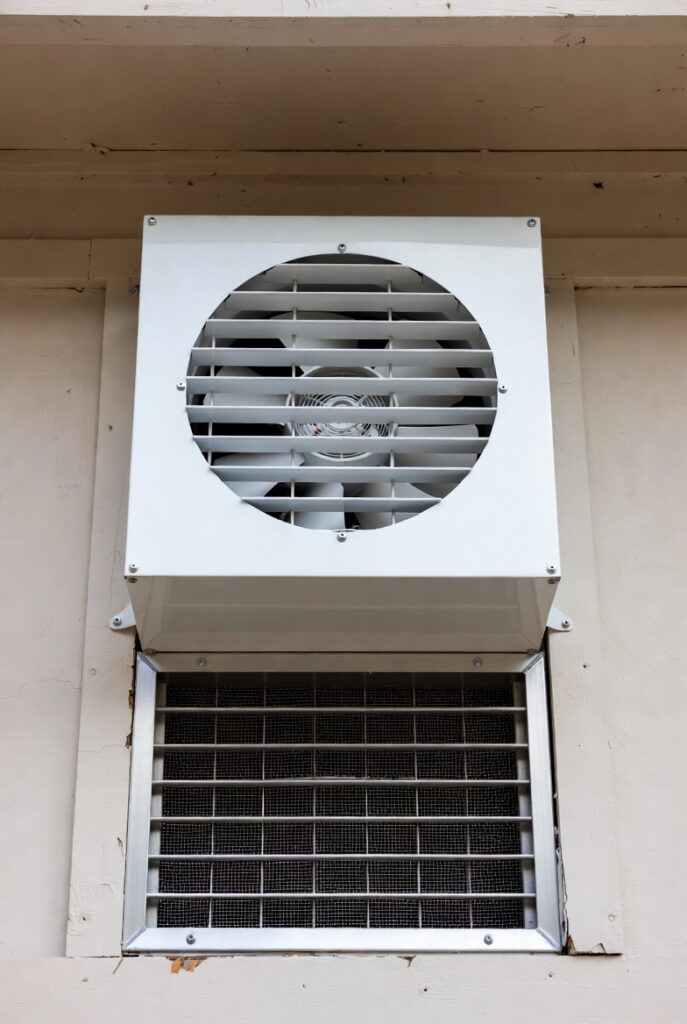
Battery room ventilation is not about preventing hydrogen buildup from lead-acid chemistry. It is about managing the heat that LiFePO4 cells generate during charging and discharging. I helped a property owner near Gravenhurst in Muskoka District diagnose his premature battery capacity loss in summer 2025. He had installed a 15kWh LiFePO4 battery bank and 5000W inverter in a 4×4 foot closet two years earlier. The system performed well through two winters. By summer of year two, his usable capacity dropped noticeably. His battery monitor showed 15kWh installed but only 11kWh available before the BMS triggered low-voltage cutoff.
I measured the closet temperature during a sunny afternoon charge cycle. The ambient air in the closet was 47°C. His batteries were absorbing 80A of charge current from his solar array. His inverter was simultaneously powering a 1500W load, dumping heat from its cooling fins into the same enclosed space. The combination created a thermal trap. His LiFePO4 cells were operating continuously at the upper limit of their temperature range. Elevated temperature increased internal resistance, reduced charging efficiency, and accelerated cell degradation. Two years of summer heat aged his batteries by the equivalent of five years.
I installed battery room ventilation using a 6-inch intake vent at floor level and a thermostat-controlled exhaust fan at ceiling level. The fan activated at 28°C and pulled cool outside air through the enclosure. The closet temperature during the same charge conditions dropped from 47°C to 31°C. His BMS stopped throwing high-temperature warnings. Charging efficiency improved by approximately 8%. The ventilation installation cost $145 in parts and took three hours. Remaining battery capacity stabilized at the degraded 11kWh level, but further loss stopped. The thermal trap was broken. For the battery chemistry that requires proper thermal management, The Budget Off-Grid System Standard covers LiFePO4 selection.
Why Battery Room Ventilation Matters for LiFePO4 Longevity
Battery room ventilation protects your investment in LiFePO4 cells. These batteries do not off-gas hydrogen like lead-acid. They do not require ventilation for explosive gas management. However, they generate heat during charging and discharging that must be removed. A cell operating at 45°C degrades faster than a cell at 25°C. The degradation is chemical and cumulative.
Each summer of high-temperature operation permanently reduces capacity. The Gravenhurst owner lost 4kWh of his 15kWh bank in two summers of thermal stress. A Victron Battery Sense provides accurate temperature data to the charge controller for temperature-compensated charging. The sensor prevents overcharging at high temperatures but cannot prevent the heat accumulation itself.
Only proper battery room ventilation removes the heat before damage occurs. Temperature-compensated charging adjusts voltage limits based on cell temperature. However, if ambient temperature in the enclosure exceeds 40°C, even compensated charging cannot prevent accelerated degradation. The ventilation system is the primary defense against thermal aging.
The Thermal Trap: When Batteries and Inverters Share a Closet
The thermal trap forms when batteries and inverters share an enclosed space without airflow. A 5000W inverter at 50% load dissipates approximately 250W of waste heat through its cooling fins. A battery bank absorbing 80A of charge current generates another 100W to 150W of internal heat. Combined, 350W to 400W of heat enters a small closet continuously during peak solar hours.
A Victron SmartShunt reveals battery temperature trends and alerts to high-temperature conditions before damage occurs. The temperature logging shows exactly when thermal stress peaks and how long cells spend above optimal range. Without ventilation, the heat accumulates until wall losses equal heat input.
That equilibrium point can exceed 45°C in summer depending on closet size and wall insulation. The Gravenhurst owner’s 47°C closet was the predictable result of 400W of continuous heat input into a 4x4x8 foot space with no airflow. The physics is straightforward. The solution is equally straightforward: move the heat outside.
The Battery Room Ventilation Design: Intake Low, Exhaust High
The battery room ventilation design uses physics to remove heat efficiently. Hot air rises. Cool air sinks. An intake vent at floor level admits cool outside air. An exhaust vent at ceiling level releases the hot air that accumulates at the top of the enclosure. The temperature differential drives natural convection even without a fan.
Adding a fan to the exhaust vent accelerates the airflow and increases cooling capacity. A 6-inch fan moving 200 CFM can exchange the air in a 4x4x8 foot closet every 30 seconds. The continuous airflow prevents heat accumulation and maintains temperatures close to outdoor ambient.
The intake vent should be sized to match or exceed the exhaust vent. A 6-inch exhaust fan needs a 6-inch or larger intake opening. Restricting the intake creates negative pressure that reduces fan effectiveness and can draw air through unintended paths like cable penetrations. Match your openings for optimal airflow.
Thermostat-Controlled Fans: Running Only When Needed
A continuously running exhaust fan wastes 3W to 8W of battery capacity around the clock. Over 24 hours, that totals 72Wh to 192Wh of unnecessary consumption. A thermostat-controlled fan runs only when temperatures exceed the setpoint. The 28°C setpoint activates cooling before batteries reach the 35°C degradation threshold.
A simple bimetallic thermostat switch inline with the fan power costs $8 to $15. The fan runs during high-charge periods in summer, typically 2 to 6 hours daily. The rest of the time it stays off, preserving battery capacity for actual loads. The thermostat pays for itself in reduced fan runtime within the first month.
A Victron Cerbo GX can trigger relay outputs for fan control based on battery temperature data, providing programmable control with logging. The logged temperature history shows exactly how often the fan runs and confirms the ventilation system is maintaining target temperatures. The data proves the investment is working.
Battery Room Ventilation for Fire Safety: The Smoke Exit Path
I was called to inspect a system after a thermal event at a property near Bracebridge in Muskoka District, Ontario in fall 2025. The owner had experienced a cell failure in one of his LiFePO4 modules. The BMS had disconnected the pack properly. No fire occurred. However, the failing cell had vented smoke and electrolyte vapor before the BMS cutoff. The battery enclosure was sealed with no ventilation path. The smoke filled the enclosure, seeped through cable penetrations, and entered the living space of the cabin. The owner and his family evacuated. The cabin interior required professional smoke remediation costing $3,200.
I examined the enclosure design. The battery room ventilation was completely absent. The owner had built a tight enclosure to protect the batteries from dust and moisture. His intention was good. His execution created a sealed container with no path for thermal event gases to exit. When the cell vented, the smoke had nowhere to go except into the cabin. A proper battery room ventilation design would have directed the smoke outside through the exhaust vent and backdraft shutter. The family would have smelled smoke outside the cabin, not inside their living room.
I redesigned the enclosure with proper battery room ventilation including a 6-inch exhaust vent with backdraft shutter exiting directly through the exterior wall. The intake vent at floor level draws air from outside. Any smoke or vapor from a future thermal event will rise to the exhaust vent and exit the building rather than entering the living space. The ventilation retrofit cost $280 including the wall penetration and exterior vent hood. The smoke remediation cost $3,200. The lesson is that battery room ventilation is not just about temperature management. It is about providing a safe exit path for the gases that a catastrophic event produces. Reference NFPA for fire safety and ventilation codes that apply to battery installations.
The Intake Filter Rule: Keeping Spiders Off Your Busbars
The intake vent needs filtration to prevent debris from entering the battery enclosure. Spider webs across busbars create tracking paths for arc faults. Dust accumulation on battery terminals increases contact resistance and generates localized heat. Insects nesting in warm enclosures can damage wire insulation over time.
A simple fiberglass mesh screen stops large debris and insects. A furnace filter element in a frame stops fine dust that mesh alone cannot catch. The filter requires inspection and cleaning every 3 to 6 months depending on environment. Rural locations with more dust and insects need more frequent maintenance.
A clogged intake filter restricts airflow and defeats the purpose of the ventilation system. The fan runs but cannot move adequate air volume. Temperatures rise despite the fan operation. Check your filter when you check your connections. Add filter inspection to your quarterly maintenance routine.
External Venting: Backdraft Shutters and Exterior Hoods
The exhaust vent should exit directly through an exterior wall rather than into another interior space. Venting into an attic or adjacent room simply moves the heat problem rather than solving it. Direct exterior venting removes the heat from the building entirely.
A backdraft shutter prevents outside air from entering when the fan is off. The shutter flaps open when the fan runs and close by gravity when it stops. This prevents winter cold air from backdrafting into the battery space during overnight hours when the fan is inactive.
An exterior hood with downward-facing opening prevents rain entry. The hood should include a screen to prevent birds and insects from nesting. The complete assembly of fan, backdraft shutter, exterior hood, and screen costs $60 to $100 for a 6-inch installation. The exterior venting ensures heat and any smoke exit the building rather than redistributing to other rooms.
Minimum Viable vs Full Standard: Choosing Your Ventilation Level
The battery room ventilation approach offers two levels depending on your climate, system size, and load profile. The minimum viable setup uses natural convection. The full standard adds active cooling with thermostat control.
| Ventilation Level | Components | Cost | Temp Reduction | Best For |
|---|---|---|---|---|
| Minimum Viable | Passive intake + passive exhaust | $40-$80 | 5-10°C | Moderate climate, light loads |
| Full Standard | Active fan + thermostat + filter + exterior vent | $120-$200 | 15-20°C | Hot climate, heavy loads |
The minimum viable battery room ventilation includes passive intake at floor level and passive exhaust at ceiling level using natural convection only. Cost runs $40 to $80. It provides 5°C to 10°C reduction compared to a sealed enclosure. This level works for moderate climates with light charge and discharge loads.
The full battery room ventilation standard includes active exhaust fan with 28°C thermostat, filtered intake, backdraft shutter, direct exterior venting, and exterior hood with screen. Cost runs $120 to $200. It provides 15°C to 20°C reduction compared to a sealed enclosure and maintains optimal battery temperature during peak charge and discharge cycles. Both approaches improve dramatically on a sealed enclosure. The difference is cooling capacity and control precision. For the battery sizing that determines heat generation during charging, The Solar Sizing Guide covers capacity calculations. For the expandable system design that may require larger ventilation as you grow, The Expandable Solar System Standard covers future-proofing.
Frequently Asked Questions
Q: Do LiFePO4 batteries require battery room ventilation like lead-acid?
A: LiFePO4 batteries do not off-gas hydrogen during normal operation, so they do not require ventilation for explosive gas management. However, battery room ventilation is still essential for thermal management. LiFePO4 cells generate heat during charging and discharging. A sealed enclosure traps this heat and accelerates cell degradation. Proper ventilation maintains optimal operating temperature and extends battery life by years.
Q: What size exhaust fan do I need for battery room ventilation?
A: A 6-inch exhaust fan moving 200 to 300 CFM provides adequate battery room ventilation for most residential systems up to 20kWh. Larger systems or high-power inverters may require 8-inch fans or multiple 6-inch fans. The intake vent should match or exceed the exhaust fan size. A thermostat set at 28°C activates the fan before batteries reach damaging temperatures.
Q: Can battery room ventilation prevent thermal runaway in LiFePO4?
A: Battery room ventilation cannot prevent internal cell failures that cause thermal runaway. However, proper ventilation provides a smoke exit path that directs gases outside rather than into living spaces. The Bracebridge owner’s sealed enclosure trapped smoke from a cell failure, requiring $3,200 in remediation. The same event with proper battery room ventilation would have vented smoke outside with minimal interior impact.
Pro Tip: Before you finalize your battery room ventilation design, measure your enclosure temperature during peak charging on a hot summer day. The Gravenhurst owner assumed his closet was fine until I measured 47°C. Your battery room ventilation should keep ambient temperature below 35°C during the hottest charging conditions. If your current setup exceeds that threshold, upgrade before another summer cooks your cells. An infrared thermometer costs $25. A replacement battery bank costs $3,000.
Verdict
- The Gravenhurst Battery Room Ventilation Standard. The cabin owner’s 15kWh LiFePO4 bank lost 4kWh of usable capacity in two summers because his sealed 4×4 closet with inverter reached 47°C during charge cycles. Installing $145 in ventilation with thermostat-controlled exhaust dropped temperatures to 31°C. His BMS stopped throwing high-temperature warnings. His charging efficiency improved by 8%. The remaining capacity stabilized immediately.
- The Bracebridge Smoke Exit Path Standard. The sealed battery enclosure trapped smoke from a cell failure, filling the cabin with vapor and requiring $3,200 in professional smoke remediation. The $280 ventilation retrofit with exterior exhaust would have directed the smoke outside with minimal interior impact. The family would have smelled smoke in the yard, not evacuated their living room.
- The Thermostat Control Standard. A continuously running exhaust fan wastes 72Wh to 192Wh daily. A thermostat-controlled fan at 28°C runs only during high-charge periods, typically 2 to 6 hours in summer. The $15 thermostat switch pays for itself in reduced fan runtime within the first month while maintaining the same thermal protection.
This build is engineered within the 48V DC Safety Ceiling. Diagnostic logic is based on 20+ years of technical service experience. All structural and electrical installations must be verified by a Licensed Professional and comply with your Local AHJ.
This article contains affiliate links. If you purchase through these links, I earn a small commission at no extra cost to you.
Questions? Drop them below.