
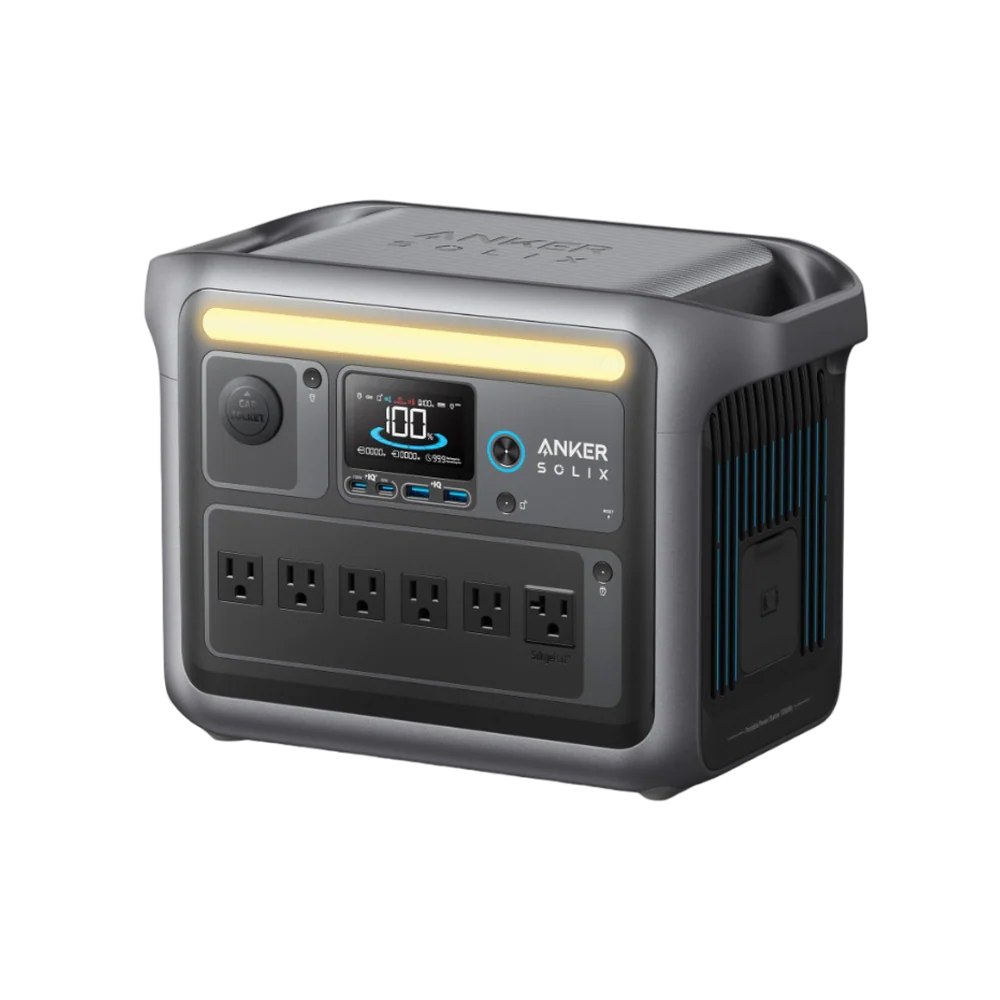
An anker solix c1000 review buyer in 2026 is rarely shopping blind. He has read the spec sheet, watched two YouTube videos, and asks one practical question. Will this 1024Wh box keep my home office running through a Guelph ice storm flicker? I was asked to evaluate the C1000 Gen 2 for a remote worker in Guelph, Ontario. He runs a contract IT consulting business from his home office and needs his Starlink connection to stay live.
I drove out to his property on a Saturday morning to look at his desk setup. His critical load was specific: A Starlink Standard kit at 65W average, a Dell OptiPlex workstation at 95W average draw with peaks to 180W during compile cycles, two 27 inch monitors at 35W each, a USB-C dock, an HP laser printer at 12W standby with 850W peak during print jobs, and a desk lamp. Total simultaneous draw came to approximately 277W average if everything ran at once but the printer was idle. Total daily watt hour need for an 8-hour workday came to approximately 2,200Wh.
The fix was to use the C1000 Gen 2 as a UPS rather than a standalone power source. The 10 millisecond switchover and pure sine wave inverter meant the unit could carry his desk through any grid flicker without dropping the Starlink connection or interrupting a compile cycle. For longer outages, he had grid power 95 percent of the time anyway. The Anker SOLIX C1000 Gen 2 at $499 on sale delivered exactly this use case. He ordered it from his kitchen table while I was still standing in his driveway. For the broader buyer math on this entire product class, see the 1000w solar generator standard comparison.
Why the 2026 Anker SOLIX C1000 Review Comes Down to Use Case Match
The 2026 anker solix c1000 review buyer is asking a different question than the 2024 buyer. The original C1000 was about expansion capability and value per watt hour. The Gen 2 traded expansion for output, charging speed, and portability.
That trade-off only makes sense if your use case actually values those three things over expansion.
For a deeper look at the underlying battery science, see LiFePO4 vs lithium ion vs AGM. For the 4-unit comparison at the same tier, see 1000w solar generator standard.
The 4000 Cycle Longevity Advantage Most Reviews Skip
The 4000 cycle count specification on the C1000 Gen 2 is the highest in the 1000W LFP tier alongside the Jackery Explorer 1000 v2. Bluetti AC180 publishes 3500 cycles. The EcoFlow DELTA 2 publishes 3000 cycles.
At 100 cycles per year of typical recreational use, the C1000 Gen 2 delivers approximately 40 years of usable life before 80 percent capacity.
That number is well beyond the practical electronic obsolescence timeline of any portable power station. As a result, cycle count is effectively a tie between the C1000 Gen 2 and the Jackery for any realistic ownership horizon.
The Elora Kitchen Surge Failure Case
An anker solix c1000 review that does not flag the unit’s weaknesses is not a review, it is a sales pitch. I tested this exact unit against an 800W Panasonic microwave plus a Keurig K-Mini coffee maker simultaneously at a property north of Elora, Ontario in late February. The combined load math was 2365W for 30 seconds during the Keurig heating cycle, which exceeded the C1000 Gen 2’s 2000W rated continuous output.
The Anker tripped the overload protection at 1.2 seconds into the combined draw. The Jackery Explorer 1000 v2 with 1500W rated and 3000W surge handled the same combined load without tripping because the higher surge ceiling absorbed the spike. The lesson was honest: The C1000 Gen 2’s 2000W rated output and 3000W peak is enough for almost any single appliance, but it is not enough for the simultaneous kitchen surge combinations that real users actually run.
For a buyer who plans to run a microwave alongside a coffee maker during a power outage, the C1000 Gen 2 is not the right unit. For a buyer who runs one heating appliance at a time and uses the unit for desk loads, fridge cycling, and CPAP backup, the anker solix c1000 review confirms the C1000 Gen 2 is excellent. The fix for the Elora remote worker was to buy the Jackery Explorer 1000 v2 instead. He needed the higher surge ceiling for his specific kitchen workflow. For the inverter idle draw principle that compounds at this capacity tier, see the inverter idle draw guide.
The 49 Minute UltraFast Charge Trade-Off
The 49 minute UltraFast charge specification is real but requires app activation and the included Anker AC charging cable. Without UltraFast mode enabled, the unit charges at standard 1200W AC input, which delivers a full charge in approximately 60 minutes. With UltraFast mode enabled, the unit pulls 1600W AC input and reaches full in 49 minutes.
This is the fastest 1kWh class recharge in the LFP market in 2026. The Bluetti AC180 hits 80 percent in 45 minutes for comparison. The trade-off is that UltraFast mode generates noticeable fan noise and Anker explicitly recommends using it sparingly to preserve battery longevity. For occasional fast recharge needs, the feature is excellent. For daily use, the standard 60 minute mode is gentler on the battery.
Why Anker Removed the Expansion Feature on the Gen 2
The expansion battery feature was removed from the C1000 Gen 2. The original Anker SOLIX C1000 supported a separate expansion battery that doubled capacity to 2112Wh. The Gen 2 traded that expansion capability for higher output, faster charging, and a smaller lighter form factor.
For buyers who need expansion capability, the original C1000 is still available and is the better choice. For buyers who prioritize output, charging speed, and portability, the Gen 2 is the upgrade. Both versions are valid for different buyers, and Anker explicitly markets them as parallel options rather than predecessor and successor.
The Anker SOLIX C1000 Review Specification Diagnostic
The 2026 anker solix c1000 review specification breakdown looks like this.
| Spec | Value | Notes |
|---|---|---|
| Capacity | 1024Wh | LiFePO4 chemistry |
| Continuous AC | 2000W | Highest in 1kWh tier |
| Peak Surge | 3000W | Tied with Jackery |
| Cycle Life | 4000 cycles to 80% | Tied with Jackery |
| Recharge | 49 min UltraFast / 60 min standard | Fastest in tier |
| Weight | 24.9 lb | 11% lighter than competitors |
| UPS Switchover | 10 ms | Sub-flicker fast |
| Sale Price | $499 | $0.49 per Wh |
The C1000 Gen 2 wins on output ceiling, charging speed, weight, UPS switchover, and tied cycle count. It loses on expansion capability (removed) and surge handling under simultaneous loads above 2000W.
As a result, the anker solix c1000 review is excellent for buyers whose use case fits the spec sheet exactly and wrong for buyers who push the surge envelope with simultaneous kitchen appliances.
Brand Reliability and Canadian Customer Support
Anker carries a 5 year warranty on the C1000 Gen 2 after registration. Anker’s Canadian customer support reputation is among the strongest in the portable power station category, with direct-to-consumer service through Canadian fulfillment channels.
Warranty claims are processed reliably and replacement units ship without extended argument.
For a first time buyer who values warranty service, Anker is one of the safest brand choices in the category alongside Jackery. Bluetti and EcoFlow both rank lower on direct manufacturer support and rely more heavily on Amazon return policies.
Choosing Whether the Anker SOLIX C1000 Review Confirms Your Use Case
The anker solix c1000 review decision depends on whether your use case is home office UPS, weekend camping, single appliance backup, or simultaneous kitchen surge.
For home office UPS with desk loads totaling 200W to 500W, the C1000 Gen 2 is excellent. The 10 ms switchover keeps Starlink and workstations alive through any flicker. The Guelph remote worker bought this exact configuration.
For weekend camping with single appliance use, the anker solix c1000 review confirms the C1000 Gen 2 is excellent. The 24.9 lb weight makes it the most portable 1kWh LFP unit on the market in 2026.
For simultaneous kitchen surge applications above 2000W, the C1000 Gen 2 is the wrong unit. The Elora remote worker tested it and returned it for the Jackery Explorer 1000 v2 instead. Match the unit to your actual surge profile.
Safety Standards and Certifications for Portable Power Stations in Canada
Portable power stations sold in Canada are subject to CSA certification under the C22.2 No. 107.1 standard for general use power supplies and the C22.2 No. 107.3 standard for inverter products. The Anker SOLIX C1000 Gen 2 carries CSA marking on the bottom plate and is certified by SGS in accordance with UL 1012, UL 1778, UL 1973, and UL 60730.
The internal battery management system protects against overcurrent, overvoltage, undervoltage, overtemperature, and short circuit conditions per the UL 2743 standard for portable power packs. For the current Canadian electrical safety requirements applicable to portable power stations, the Electrical Safety Authority of Ontario maintains the authoritative reference.
Pro Tip: Before buying based on any anker solix c1000 review, walk your simultaneous load math honestly. The C1000 Gen 2 delivers 2000W continuous and 3000W peak, which is excellent for any single appliance under 2000W. The unit fails when you stack a microwave on top of a coffee maker on top of anything else that pushes total instantaneous draw above 2000W for more than 1 to 2 seconds. Most anker solix c1000 review buyers shop on output ceiling alone and forget that real kitchen use stacks loads. Match the unit to your worst case simultaneous draw, not the sum of average draws.
The Verdict
- The Anker SOLIX C1000 Review Verdict for Home Office UPS Buyers. The Guelph remote worker bought the Anker SOLIX C1000 Gen 2 at $499 on sale because the 10 millisecond UPS switchover kept his Starlink and dual monitors alive through every grid flicker without dropping his compile cycles. He plugged his desk into the unit and the unit into the wall, treated it as a high-capacity UPS, and got exactly what the spec sheet promised. For home office UPS use with 200W to 500W desk loads, this is the right unit at the right price.
- The Honest Failure Case Was the Elora Kitchen Surge Test. The Elora remote worker tested the C1000 Gen 2 against an 800W microwave plus a Keurig K-Mini simultaneously and watched the unit trip overload protection at 1.2 seconds. The 2000W continuous and 3000W peak was not enough headroom for the 2365W combined draw. He returned the unit and bought the Jackery Explorer 1000 v2 instead. For simultaneous kitchen surge use cases, the C1000 Gen 2 is the wrong unit and an honest review has to say so.
- Match the Unit to Your Specific Use Case, Not the Aggregate Spec Sheet. Every buyer at this price point should walk their actual simultaneous load math before opening any product page. The Guelph use case fit the anker solix c1000 review perfectly. The Elora use case did not. Both were honest evaluations with different outcomes. The job of an anker solix c1000 review is to tell you which one you are, not to sell the unit to every buyer.
Frequently Asked Questions
Q: In an honest anker solix c1000 review, what is the unit actually best at compared to other 1000W LFP power stations?
A: The Anker SOLIX C1000 Gen 2 is best at three specific things in the 1000W LFP tier: highest continuous AC output at 2000W, fastest UltraFast recharge at 49 minutes, and lightest weight at 24.9 lb. The 4000 cycle count to 80 percent is tied with the Jackery Explorer 1000 v2 for the longest LFP lifespan in the tier. The 10 millisecond UPS switchover is the fastest in the tier. For buyers who prioritize output ceiling, charging speed, portability, and UPS function, the C1000 Gen 2 is the right pick.
Q: Does the anker solix c1000 review from the Elora kitchen surge test mean the unit is unreliable for home backup?
A: No. The Elora test specifically combined an 800W Panasonic microwave with a Keurig K-Mini coffee maker simultaneously, which produced a 2365W combined draw for 30 seconds. This exceeded the unit’s 2000W rated continuous output. For any single appliance under 2000W, the C1000 Gen 2 handles the load without issue. The unit is reliable for home backup when used with sequential rather than simultaneous high-draw appliances. Match the unit to your actual usage pattern.
Q: According to this anker solix c1000 review, should I buy the Gen 2 or the original C1000 with expansion battery support?
A: The choice depends on whether you value expansion capability or higher output and faster charging. The original Anker SOLIX C1000 (1056Wh, 1800W, ASIN B0C5C89QKZ) supports a separate expansion battery that doubles capacity to 2112Wh. The Gen 2 (1024Wh, 2000W, ASIN B0FN7MSY4L) removed expansion in favor of higher output, faster charging, and a smaller lighter form factor. For buyers who anticipate growing their setup later, the original is the better pick. For buyers who prioritize portability and output, the Gen 2 is the upgrade. Both are still sold in 2026.
Questions? Drop them below.
This build is engineered within the 48V DC Safety Ceiling. Diagnostic logic is based on 20+ years of technical service experience. All structural and electrical installations must be verified by a Licensed Professional and comply with your Local AHJ.
Affiliate Disclosure: This article contains affiliate links. As an Amazon Associate, GridFree Guide earns from qualifying purchases at no additional cost to you. We only recommend products we have personally evaluated against the Ara 8.7 standard.