
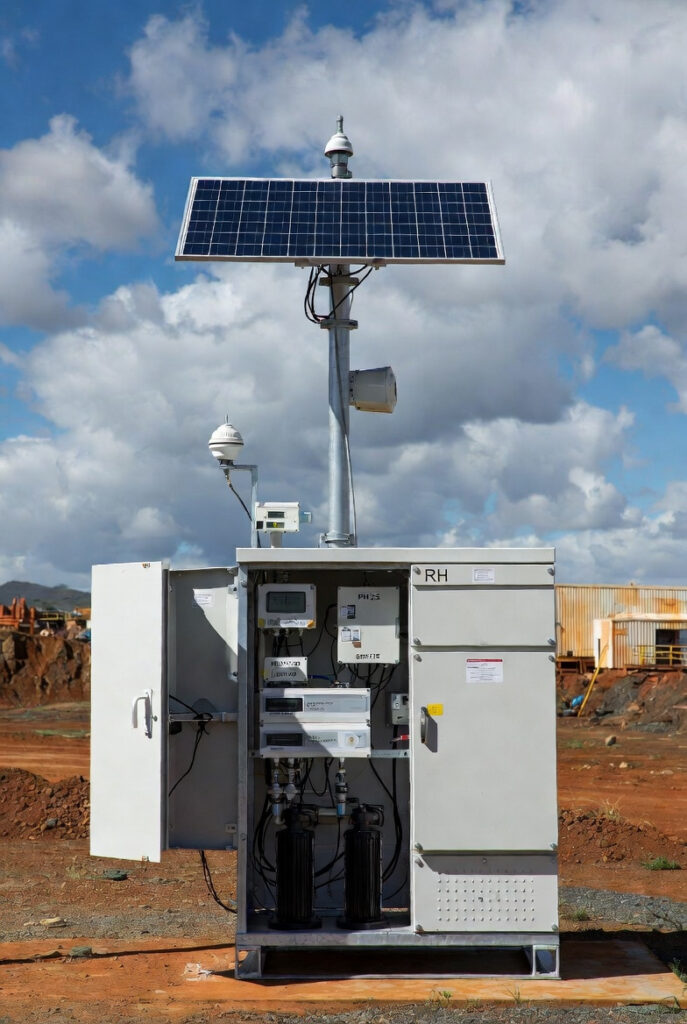
Air quality solar power failures at remote monitoring stations create compliance gaps that cannot be retroactively filled. If the regulator requires continuous hourly PM2.5 data and the system goes down at 6 AM those hours are gone. I was called to troubleshoot a recurring data gap problem at a PM2.5 monitoring station on a mine site near Timmins in the Cochrane District that an environmental consulting firm was operating under a provincial environmental compliance approval. The station ran an AQMesh pod with an internal vacuum pump drawing 4.2W continuous at room temperature, a solar system consisting of a 120W panel and a 100Ah LFP battery, and a standard MPPT charge controller.
Between November and March the station experienced 14 data gaps ranging from 2 to 18 hours, all occurring between 5 AM and 8 AM on mornings when the overnight low had been below minus 20°C. At minus 20°C the pump motor’s internal lubricant viscosity increases by approximately 3 times. The pump drew 11.8A inrush current for the first 2.3 seconds of each start cycle in cold conditions versus 1.4A warm. The MPPT charge controller had a peak current output rating of 10A. Every cold-start attempt exceeded the controller’s peak output, caused the controller to current-limit, dropped the battery terminal voltage to 10.4V, and triggered the pump controller’s low-voltage protection. The pump never completed a cold start without tripping. The station went dark at every cold-start attempt below minus 20°C.
I replaced the standard MPPT controller with a 20A controller and added a dedicated PWM soft-start driver on the pump circuit. The soft-start driver ramped the pump motor from 0 to full speed over 4.5 seconds, limiting the peak inrush to 6.2A regardless of ambient temperature. The 20A controller handled the 6.2A peak without current limiting. The battery terminal voltage never dropped below 12.1V during any subsequent cold start. In 16 months of operation since the modification the station has not experienced a single cold-start data gap, including 4 mornings below minus 28°C. For the remote sensor solar PWM soft-start principle that covers the same inductive load isolation technique for motor-driven field instruments, Article 209 covers the full circuit standard. For the full system sizing hub that covers the load calculation foundation, the hub covers the numbers.
Why an Air Quality Solar System Trips on the Coldest Morning of the Year
A vacuum pump motor draws 6 to 12 times its running current during cold-start at minus 20°C because the internal lubricant thickens and increases mechanical starting torque. If the MPPT charge controller’s peak output current rating is lower than the pump inrush current the controller current-limits, the battery terminal voltage sags, and the pump controller triggers a low-voltage shutdown before the motor reaches running speed.
The cold-start inrush mechanism: vacuum pump at stall draws current limited only by winding resistance, typically 24A at 12V supply with a 0.5-ohm winding. At minus 20°C lubricant viscosity triples, mechanical starting torque increases, and the inrush duration extends from 0.8 seconds warm to 2.3 seconds cold. As a result a 10A MPPT controller current-limits instantly, battery terminal voltage sags to 10.4V, and the pump protection trips before the motor reaches running speed.
The PWM soft-start solution ramps the motor from 0 to full speed over 4.5 seconds. Back-EMF develops gradually during the ramp, limiting peak current to 6.2A. The Victron MPPT 100/30 handles 6.2A peak without current limiting and provides 30A burst capacity for simultaneous pump start and battery charging during winter morning operation. For the fish hatchery solar dedicated high-current pump circuit standard that uses the same dedicated DC pump circuit principle, Article 207 covers the full circuit architecture.
| Condition | Pump Inrush Current | Controller Response |
|---|---|---|
| Warm start, 10A MPPT | 1.4A for 0.8 seconds | No trip — normal operation |
| Cold start at minus 20°C, 10A MPPT | 11.8A for 2.3 seconds | Current-limits — battery sags to 10.4V — pump trips |
| Cold start at minus 20°C, 20A MPPT plus PWM soft-start | 6.2A for 4.5 seconds | No trip — battery stays above 12.1V |
The RH-Threshold Inlet Heater: Eliminating Humidity Artefacts from PM2.5 Data
Air quality solar inlet heater failures are invisible in the data. The station keeps running and transmitting but the PM2.5 readings are 40 to 80% higher than reality. I reviewed a data quality complaint from an environmental officer at a gravel quarry near Barrie in Simcoe County who was seeing PM2.5 spikes of 18 to 45 micrograms per cubic metre every morning between 5 AM and 10 AM regardless of wind speed or quarry activity. The spikes were appearing as exceedances of the provincial 24-hour PM2.5 standard of 27 micrograms per cubic metre and triggering automatic dust suppression protocols that were slowing quarry operations.
When I reviewed the meteorological data for the spike periods the relative humidity during those morning hours was consistently between 82% and 96%. At high relative humidity water vapour adsorbs onto fine particulate matter, swelling PM2.5 particles to apparent sizes 1.4 to 2.2 times their dry diameter. A laser-scatter PM2.5 sensor reports particle mass based on particle size. At 90% RH a particle that is truly 1.5 micrograms per cubic metre appears to the sensor as 3.1 to 5.4 micrograms per cubic metre. The 18 to 45 microgram spikes were humidity artefacts, not actual quarry dust.
The inlet heater on the station was set to activate below 4°C ambient temperature, a temperature threshold not a humidity threshold. During the morning fog events the ambient temperature was 8°C to 12°C so the heater never activated. I reconfigured the inlet heater to activate on relative humidity above 70% regardless of temperature and replaced the thermostat controller with an RH-threshold controller drawing 18W for an average of 2.1 hours per morning during fog conditions. As a result the daily heater energy dropped from the previous always-on 432Wh per day to 37.8Wh per day. The morning PM2.5 spikes disappeared. The quarry restored normal operations. The RH-threshold controller cost $145. For the solar weather station aspirated shield humidity correction standard that uses the same humidity-correction principle for temperature measurement accuracy, Article 210 covers the full shield architecture.
The Panel Siting Standard: 1 Metre Minimum from the Air Inlet
A solar panel mounted within 0.5 metres of the air quality station’s sample inlet creates a stagnant air zone on the lee side. This zone can accumulate 3 to 8 times the ambient PM2.5 concentration during any wind conditions where the panel is upwind of the inlet. However, mounting the panel at minimum 1 to 1.5 metres horizontal separation eliminates the wake zone overlap entirely.
Wind tunnel studies show the wake zone extends 5 to 10 panel heights downstream with wind speed reduced to 20 to 40% of free-stream velocity. In this low-velocity zone particles settle and accumulate near the surface rather than remaining suspended. As a result a station with the panel upwind of the inlet samples a disturbed air mass 3 to 8 times more concentrated than the ambient. The panel should not be mounted directly upwind of the prevailing wind direction. However, when the prevailing wind is unknown a minimum 1.5-metre separation in all directions is the conservative specification. For the remote sensor solar panel siting standard that covers the same obstacle-free air sampling zone principle for water quality sensors, Article 209 covers the enclosure placement architecture.
The Dual-Channel Reference Comparison: Detecting Sensor Drift Before It Corrupts Data
A gas sensor or optical PM sensor drifts gradually as the sensing element ages, the optical lens accumulates film, or the electrochemical cell depletes. On a single-channel station drift is invisible. The readings change slowly and appear as real environmental trends. However, a dual-channel configuration runs two sensors on the same sample stream and compares their outputs every 15 minutes. When the channels diverge by more than 15% the system flags the data and sends a maintenance alert.
The alert fires before the drift reaches the level where regulatory data is invalid. As a result the environmental consultant has 24 to 72 hours to service the station before a reportable data gap occurs. The Victron SmartShunt on the battery bank tracks daily energy consumption from both sensor channels, providing an independent check on whether unusual energy draw indicates a malfunctioning sensor consuming more power than normal. For the solar remote monitoring VRM alert standard that covers the full threshold alert configuration for remote station management, Article 187 covers the complete setup.
The Air Quality Solar System: Minimum Viable vs Full Atmosphere Standard
The decision follows whether the station is operating under a regulatory Environmental Compliance Approval or a voluntary monitoring program.
The minimum viable air quality solar system for a permit-required PM2.5 monitoring station includes a 120W panel, a 100Ah LFP battery, a 20A MPPT controller, a PWM soft-start driver on the pump circuit, and an RH-threshold inlet heater controller. Capital cost runs $1,200 to $2,000. It eliminates cold-start data gaps and RH artefact spikes while meeting Environment and Climate Change Canada continuous monitoring data completeness requirements.
The full atmosphere standard for a continuous monitoring station under provincial Environmental Compliance Approval includes a 200W panel with minimum 1-metre inlet clearance, 200Ah LFP bank with Victron SmartShunt low-battery alert, 20A MPPT with PWM soft-start, RH-threshold inlet heater, dual-channel PM reference comparison with 15% divergence alert, and Starlink maintenance notification to the environmental officer’s phone. Capital cost runs $3,500 to $5,500. It provides regulatory-grade uptime for a station where every data gap is a compliance event.
NEC and CEC: What the Codes Say About Air Quality Solar
NEC 690 governs the PV source circuits of any air quality solar installation. The 120W or 200W array, MPPT charge controller, and LFP battery bank are subject to NEC 690 overcurrent protection and disconnecting means requirements. The vacuum pump motor circuit is subject to NEC 430 for motor branch circuit protection. NEC 430.52 requires a motor branch circuit protective device rated for the motor’s locked-rotor current, not the running current, to allow the motor to start without nuisance tripping. The PWM soft-start driver must be listed for the pump’s voltage and current rating and installed between the branch circuit protection and the motor terminals.
In Ontario, an air quality monitoring station operating under a provincial Environmental Compliance Approval issued by the Ontario Ministry of the Environment, Conservation and Parks must meet the continuous monitoring data completeness requirements specified in the ECA, typically 90% data capture per calendar quarter. The solar power system supporting the station must be designed to meet this data completeness requirement as a functional power system specification, not merely an electrical installation specification. Contact Environment and Climate Change Canada for instrument performance requirements under the National Air Pollution Surveillance network standards if the station is contributing data to the national ambient air quality monitoring program.
Pro Tip: Before specifying the MPPT controller rating for an air quality solar system with a vacuum pump, measure the actual cold-start inrush current of the pump at your site’s design minimum temperature using a clamp meter on the pump power cable. Do this in November before the first cold spell. I have measured pumps labelled 4W running that drew 14.2A for the first 1.8 seconds of a minus 18°C cold start. A 15A MPPT controller would have tripped on that pump every cold morning. Measure at cold. Specify to cold. Deploy after.
The Verdict
An air quality solar system built to the atmosphere standard means the Timmins mine site compliance log has no cold-start gaps, the Barrie quarry operates at full pace instead of triggering false dust suppression, and every data point submitted to the regulator was collected with clean dry-state air through a sensor that was not drifting.
- Replace the 10A MPPT with a 20A controller and add a PWM soft-start driver before the first cold spell. The Timmins mine site lost 14 compliance data gaps between November and March because an 11.8A pump inrush was tripping a 10A controller at minus 20°C every morning. A 20A controller and $185 soft-start driver limited the inrush to 6.2A. Zero cold-start gaps in 16 months since including 4 mornings below minus 28°C.
- Replace the temperature-threshold heater controller with an RH-threshold controller before the first autumn fog season. The Barrie quarry was triggering false PM2.5 exceedances and slowing operations because a heater set to 4°C never activated during 10°C fog events at 90% RH. A $145 RH-threshold controller dropped the daily heating energy from 432Wh to 37.8Wh and eliminated the false spikes entirely.
- Measure the 1-metre panel-to-inlet separation before the station goes live. A panel within 0.5 metres of the inlet creates a wake zone with 3 to 8 times ambient PM2.5 concentration. Move the panel first. Calibrate after. The siting error is the one compliance gap you cannot fix with a firmware update.
In the shop, we do not run the emissions test with the exhaust pipe pointed at the intake. On the mine site, we do not mount the solar panel in front of the air inlet and call it monitoring.
Frequently Asked Questions
Q: Why does a solar-powered air quality monitor fail on cold mornings? A: A vacuum pump motor draws 6 to 12 times its running current during cold-start at minus 20°C because the internal lubricant thickens and increases mechanical starting torque. If the MPPT charge controller’s peak output current rating is lower than the pump inrush current the controller current-limits, the battery terminal voltage sags, and the pump controller triggers a low-voltage shutdown before the motor reaches running speed.
Q: Why do PM2.5 readings spike during foggy Ontario mornings? A: At relative humidity above 70% hygroscopic particles absorb water and swell to 1.4 to 2.2 times their dry diameter. A laser-scatter PM2.5 sensor interprets the larger apparent diameter as higher mass concentration, producing systematic overestimates of 1.5 to 3 times the actual dry-state PM2.5 level. An RH-threshold inlet heater that activates above 70% RH eliminates this artefact entirely.
Q: How far should a solar panel be from an air quality monitor’s inlet? A: A minimum of 1 to 1.5 metres horizontal separation is required to prevent the panel’s wind shadow from creating a stagnant air zone at the inlet. In the wake zone behind a panel wind speed drops to 20 to 40% of free-stream velocity, causing particles to settle and accumulate near the inlet rather than remaining suspended in the representative ambient air.
Questions? Drop them below.
This post contains affiliate links. If you purchase through our links, we may earn a small commission at no extra cost to you.