
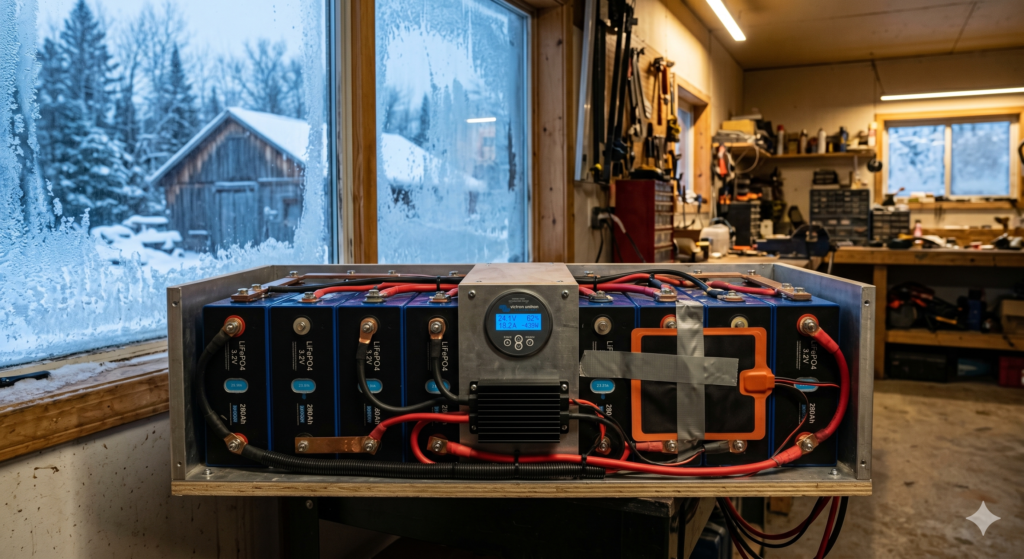
This solar battery guide covers every decision from chemistry selection to long-term maintenance. The wrong battery choice costs more to fix than the right one costs to buy. LFP wins on cycle life at 3,000 to 3,500 cycles versus 500 to 800 for AGM. LFP wins on depth of discharge at 80 to 100 percent versus 50 percent for AGM. LFP wins on weight at half the mass of an equivalent AGM bank.
The cost per cycle tells the real story. LFP costs approximately $0.13 per cycle. AGM costs approximately $0.54 per cycle. The upfront price of AGM is lower, but replacement cost over 5 years makes AGM the more expensive option for any system used regularly. For the detailed chemistry comparison, see the LiFePO4 vs AGM guide.
This solar battery guide is the master map for the entire Battery and Storage category. Each section summarizes a critical decision and links to the full detailed guide. Follow the 10 steps in order because each decision depends on the previous one being resolved first.
| Decision Point | Generic Approach | Ontario Master Tech Standard |
|---|---|---|
| Chemistry selection | Cheapest upfront price | Cost per cycle over 5 years |
| Bank sizing | Match daily load 1:1 | 1.5 to 3 day autonomy for gray streaks |
| Cold weather | Not addressed | Heated LFP mandatory below 0C |
| SoC monitoring | Voltage meter | Coulomb counting with SmartShunt |
| Charging profile | Default settings | Chemistry-specific voltage targets |
| Winter storage | Leave connected | 50-60% SoC, check every 90 days |
The Solar Battery Guide Decision Sequence: Chemistry First
Step 1 is choosing your battery chemistry. LFP is the correct choice for any system used daily or weekly. AGM only makes sense for a rarely used backup where the $2,000+ upfront difference cannot be justified. Once chemistry is selected, every other decision in this solar battery guide follows from it.
Step 2 is sizing the bank. The formula is daily load in watt-hours divided by depth of discharge divided by system voltage. A 5,000Wh daily load at 80 percent DoD on a 48V bank needs 130Ah. Multiply by 3 to 5 autonomy days for the Ontario gray streak and you need 390Ah to 650Ah. For the complete sizing formula, see the solar sizing guide.
Ontario Cold Weather Protection: Why Heated LFP Is Mandatory
Step 4 is the most critical decision in this solar battery guide for Ontario. LFP batteries cannot charge below 0C. The BMS locks charging to prevent lithium plating on the anode. In Ontario, an unheated LFP bank in a garage loses charging capability from late November through mid-March.
Heated LFP batteries like the Battle Born 100Ah heated have internal heating pads that activate automatically near 0C. The pads draw approximately 45W and warm cells above the charging threshold within 30 minutes. The $150 premium per battery over the standard Battle Born 100Ah LFP pays for itself in the first winter of recovered production.
State of Charge Monitoring and Charging Stages
Step 5 is installing accurate SoC monitoring. Voltage lies on LFP batteries. A fully charged cell at 13.4V and a half-depleted cell at 13.2V look nearly identical on a voltmeter. A Victron SmartShunt measures every amp-hour using coulomb counting and provides true SoC on your phone via Bluetooth.
Step 6 is configuring correct charging stages. Bulk pushes maximum current until absorption voltage. Absorption holds voltage while current tapers. Float maintains a lower voltage for storage. LFP requires different targets than AGM. Setting AGM voltage on an LFP bank causes persistent overcharging that degrades cells.
The Rockwood Heated LFP Save
Field diagnostic from Rockwood, Wellington County, Ontario, January 2026. A homeowner installed a 400Ah 48V LFP bank with Battle Born heated batteries in his unheated workshop. His neighbor built the same bank with standard unheated LFP cells to save $600. Both systems went through their first Ontario January at minus 22C.
The Rockwood system heating pads activated automatically below 0C. The BMS allowed charging through the entire winter. The neighbor’s unheated bank locked out charging on November 28 when the workshop hit minus 1C. His panels produced power all winter but the battery refused to accept it.
Heated LFP is like a block heater on a diesel truck in Ontario. The diesel works fine in summer without it. In January, the block heater is the difference between starting and sitting. The $600 savings on unheated cells cost the neighbor $1,200 in lost production over one winter.
The Milton Oversized AGM Failure
Field diagnostic from Milton, Halton County, Ontario, 2025. A client chose a 400Ah 12V AGM bank at $1,200 for his off-grid cabin. Daily load was 3,000Wh. At 50 percent DoD on AGM, usable capacity was 200Ah or 2,400Wh. He was 600Wh short every day.
Because he discharged below 50 percent regularly, cycle life dropped from 800 to approximately 300 cycles. The bank lasted 10 months before capacity fell below 60 percent. His 2-year battery cost was $2,400 for AGM versus $3,800 one-time for LFP that would have lasted 8 to 10 years.
Pro Tip: Choosing AGM to save money on a high-demand system is like buying retreaded tires for a vehicle that drives 50,000 km per year. The retreads cost half as much but last one-third as long. The cost per kilometre is higher on the cheap option. LFP at $0.13 per cycle costs one-quarter of AGM at $0.54 per cycle.
Protection, Balancing, and Long-Term Maintenance
Step 7 is verifying BMS protection against overcharge, over-discharge, over-temperature, and cell imbalance. Step 8 is cell balancing. Cells drift over time and Ontario winter storage accelerates drift because uneven self-discharge compounds over 4 months of cold weather.
Step 9 is storage and ventilation. Store batteries at 50 to 60 percent SoC during seasonal layup. Check every 90 days. Ventilate the battery room even with sealed LFP. Step 10 is lifespan maintenance. LFP at 3,000 cycles to 80 percent capacity. Annual maintenance includes torquing connections, checking SoC, and verifying BMS function.
Solar Battery Guide Code Compliance for Ontario
NEC Article 706 covers energy storage system installation including ventilation, grounding, overcurrent protection, and disconnecting means. All residential battery installations must comply with current NEC standards for fire safety and conductor protection. Contact the NFPA (National Fire Protection Association) for current requirements.
CEC Section 64 governs residential energy storage installation and safety in Ontario. All battery installations must comply with ESA guidelines for ventilation, grounding, and overcurrent protection. Contact the ESA (Electrical Safety Authority) for current compliance guidelines before any installation.
- Choose LFP chemistry for any system used daily or weekly. The $0.13 per cycle cost is one-quarter of AGM at $0.54. The upfront premium pays back within the first year of regular use.
- Size the bank for 1.5 to 3 days of autonomy using the formula: daily Wh divided by DoD divided by system voltage. Ontario gray streaks demand more autonomy than southern climates.
- Buy heated LFP batteries for any Ontario installation in an unheated space. The $150 per battery premium prevents $1,200+ in lost winter production from BMS charging lockout.
Frequently Asked Questions
Should I buy LFP or AGM for my first solar battery system?
LFP for any system used regularly. The cost per cycle is $0.13 versus $0.54 for AGM. AGM only makes sense for a rarely used backup where the $2,000+ upfront difference cannot be justified.
Do I need heated LFP batteries in Ontario?
Yes, if the bank is in any space that drops below 0C during winter. The BMS locks charging at 0C. Heated LFP with internal pads solves this for approximately $150 extra per battery.
How often should I check my battery bank?
Monthly during active use and every 90 days during seasonal storage. Verify terminal connections are torque-tight annually. Ontario temperature swings cause metal to expand and contract.
Why does voltage lie on LFP batteries?
A fully charged LFP cell at 13.4V and a half-depleted cell at 13.2V look nearly identical on a voltmeter. Only coulomb counting with a shunt like the Victron SmartShunt provides accurate SoC. Voltage monitoring alone leaves you guessing within a 40 percent range.
This build is engineered within the 48V DC Safety Ceiling. Diagnostic logic is based on 20+ years of technical service experience. All structural and electrical installations must be verified by a Licensed Professional and comply with your Local AHJ.
About the Author
Robert Bertrand spent 20 years as a service advisor in the automotive industry (Lexus and Nissan), where precision diagnostics, wiring integrity, and documentation standards were non-negotiable. He brings that same technical discipline to GridFree Guide, where he researches, tests, and documents off-grid solar systems for Ontario conditions. Based in Rockwood, Ontario, every article is built on verified specifications, manufacturer data, and the real-world climate constraints of Canadian off-grid living.
As an Amazon Associate I earn from qualifying purchases. This site also contains affiliate links to other products and services. GridFree Guide earns a small commission at no extra cost to you.