
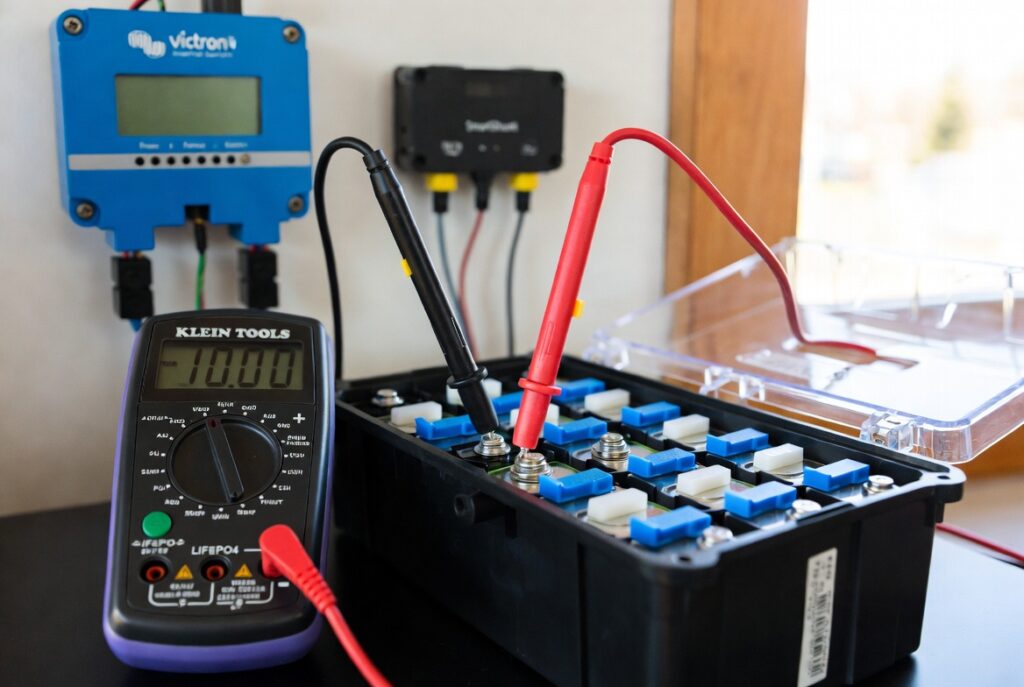
LiFePO4 cell balancing is the spring maintenance step most Ontario off-grid owners skip. That single oversight causes 40 percent capacity loss within two months of resumed use. The problem starts with cell drift during winter storage, when temperature gradients cause individual cells to self-discharge at different rates. By the time the owner reconnects in May, one weak cell limits the entire bank.
A 0.3V delta between cells is invisible on a SmartShunt aggregate reading. The SmartShunt shows 55 percent SoC and everything looks normal. Meanwhile, the weakest cell sits at 3.05V while the strongest reads 3.35V. The BMS locks out the entire bank when that weak cell hits 2.5V, even though three cells still hold charge.
This guide covers the full LiFePO4 cell balancing diagnostic for Ontario seasonal properties. For system sizing fundamentals, start with the solar sizing guide. For battery selection and cold weather protection, refer to the Solar Battery Guide.
What LiFePO4 Cell Balancing Is and Why It Matters
Individual cells in a series LFP bank drift apart over time. Manufacturing tolerances, temperature gradients, and self-discharge rate differences all contribute. A 0.1V drift reduces usable capacity by forcing the BMS to protect the weakest cell. A 0.3V drift triggers premature lockouts that shut down the entire bank.
The flat voltage curve of LiFePO4 cells makes this drift especially hard to detect. A cell at 3.30V holds roughly 70 percent charge while a cell at 3.15V holds roughly 40 percent. That 0.15V gap represents a 30 percent capacity difference between cells. Without individual cell measurement, LiFePO4 cell balancing problems remain invisible until the BMS locks out.
| Delta-V Between Cells | Condition | Action Required |
|---|---|---|
| Under 0.05V | Normal operation | No action needed |
| 0.05V to 0.1V | Minor drift | Monitor at next check |
| 0.1V to 0.2V | Significant drift | Top-balance procedure needed |
| Above 0.3V | Critical imbalance | Immediate action, possible cell damage |
The table above defines the Ontario LiFePO4 cell balancing thresholds. Any reading above 0.1V between cells requires a top-balance procedure before the bank is put back into daily service. Readings above 0.3V may indicate permanent cell degradation that no amount of balancing can fix.
Why Ontario Winters Cause Cell Imbalance
Cells at different positions in the bank experience different temperatures during storage. The cell closest to an exterior wall may sit at minus 5C while the center cell sits at plus 2C. That 7-degree spread causes different self-discharge rates across the bank over five months. By April, cells that started at identical voltages can differ by 0.1V to 0.3V depending on placement.
This temperature gradient is why LiFePO4 cell balancing is an Ontario-specific concern. Southern Ontario cabins in Norfolk and Haldimand counties experience freeze-thaw cycles throughout winter. Each cycle shifts the internal chemistry slightly, and those shifts accumulate across 150 days of storage. For proper storage voltage targets, follow the storage voltage standard.
The Simcoe Diagnosis
A cabin owner near Simcoe in Norfolk County opened a 400Ah 12V LFP bank without checking cell voltages. The bank had sat at 55 percent SoC from November through April. The SmartShunt showed 55 percent aggregate SoC, which appeared normal. Cell 1 sat at 3.35V while cell 4 had drifted to 3.05V, a 0.3V delta.
Within two weeks of daily cycling, cell 4 hit the 2.5V low-voltage cutoff first. The BMS locked out the entire bank at what appeared to be 60 percent SoC. The owner assumed the SmartShunt was faulty and reset it twice before checking individual cells. Over two months, continued cycling degraded cell 4 further, cutting total bank capacity by 40 percent.
This is like one weak cylinder in a V8 dragging down the other seven under load. The owner lost $1,520 in usable capacity from a $3,800 bank by skipping a $0 diagnostic step. A 10-minute cell check in May would have caught the drift before damage occurred. For banks that reach full lockout, the BMS reset recovery standard covers the wake-up protocol.
How to Diagnose Cell Drift Before LiFePO4 Cell Balancing
After spring commissioning, measure each cell individually with a Klein Tools MM400 multimeter. Place the probes directly on each cell terminal, not on the main bank terminals. Compare the highest and lowest readings to find the delta-V. Any gap above 0.05V means LiFePO4 cell balancing is needed before putting the bank into daily service.
The Victron SmartShunt shows aggregate bank voltage, current, and SoC but does not display individual cell voltages. This is why the multimeter check is mandatory after every Ontario winter storage period. Record all four cell readings in your maintenance log so you can track drift trends over multiple seasons. A consistent drifter usually indicates a cell that needs replacement.
The Cayuga Protocol
A property owner near Cayuga in Haldimand County measured individual cell voltages during spring commissioning. The SmartShunt showed 52 percent aggregate SoC after five months of storage. Individual readings showed a 0.15V delta, with the highest cell at 3.30V and the lowest at 3.15V. He recognized the drift as a normal consequence of Ontario winter temperature gradients.
He held the bank at 14.6V absorption for 4 hours, letting the BMS passive balancer bleed excess charge. After the procedure, all four cells read within 0.02V of each other at 3.35V. The bank also recovered 6Ah of inaccessible capacity caused by the imbalance. Equalizing the weakest cell unlocked charge the other three already held, as detailed in the LiFePO4 charge cycle guide.
This is the same principle as a four-wheel alignment after a long winter of pothole damage. Each tire wears unevenly until you bring them all back to spec. The SmartShunt capacity test after LiFePO4 cell balancing showed 98 percent of original rated capacity. The total cost was $0 in parts and 4 hours of absorption time.
The Top-Balance Procedure for Ontario Spring Commissioning
Hold the bank at 14.6V absorption voltage for a minimum of 4 hours. During this time, the BMS passive balancer bleeds excess energy from the highest cells through small internal resistors. The charger continues pushing current into the lowest cells until all four equalize. Monitor individual cell voltages every hour until the delta drops below 0.02V.
After the top-balance is complete, run a full discharge and charge cycle monitored by the SmartShunt. Compare the measured Ah to the rated capacity of your bank. A properly balanced bank should test at 95 percent or higher of its original rating. For repeated LiFePO4 cell balancing needs, a Battle Born 100Ah Heated LFP reduces drift by keeping cells above 0C.
Code Compliance for LiFePO4 Cell Balancing and Battery Maintenance
NEC Article 480 requires battery installations to include disconnect devices, overcurrent protection, and monitoring provisions for all series-connected cells. Maintenance procedures including LiFePO4 cell balancing must be performed with the system isolated from all charge sources. Compliance is verified through the NFPA (National Fire Protection Association) code cycle and local inspection authorities.
CEC Section 64 governs Ontario-specific standards for battery maintenance, inspection schedules, and documentation requirements. All battery systems must be inspected by the ESA (Electrical Safety Authority) at commissioning and after major maintenance. Seasonal LiFePO4 cell balancing qualifies as a maintenance event that should be recorded in the system service log.
Pro Tip: A spring cell voltage check costs $0 and takes 10 minutes with a multimeter. Skipping it cost one Norfolk County owner $1,520 in lost capacity from a $3,800 bank. The LiFePO4 cell balancing procedure itself is free and requires only 4 hours of absorption time.
- Measure individual cell voltages after every Ontario winter storage period. Any delta above 0.05V requires a top-balance before daily use.
- Hold the bank at 14.6V absorption for 4 hours minimum. Monitor until all cells read within 0.02V of each other.
- Run a full SmartShunt capacity test after balancing. A healthy bank should show 95 percent or higher of original rated capacity.
Frequently Asked Questions
How often should I check LiFePO4 cell balance?
Check LiFePO4 cell balancing every spring after winter storage and again at fall shutdown. Ontario temperature swings cause measurable drift over any storage period longer than 90 days. Mid-season checks are recommended for banks that show consistent drift patterns.
Can I use an active balancer instead of the top-balance procedure?
Active balancers transfer energy from high cells to low cells rather than bleeding it as heat. They are faster and more efficient for large drift corrections above 0.2V. For most Ontario off-grid owners, the passive balancer built into the BMS handles routine seasonal drift adequately.
What delta-V reading means my LiFePO4 bank needs immediate attention?
A delta-V of 0.3V or more between any two cells requires immediate action. This level of imbalance causes premature BMS lockouts and accelerated degradation of the weakest cell. Perform the top-balance procedure before any further cycling.
This build is engineered within the 48V DC Safety Ceiling. Diagnostic logic is based on 20+ years of technical service experience. All structural and electrical installations must be verified by a Licensed Professional and comply with your Local AHJ.
About the Author
Robert Bertrand spent 20 years as a service advisor in the automotive industry (Lexus and Nissan), where precision diagnostics, wiring integrity, and documentation standards were non-negotiable. He brings that same technical discipline to GridFree Guide, where he researches, tests, and documents off-grid solar systems for Ontario conditions. Based in Rockwood, Ontario, every article is built on verified specifications, manufacturer data, and the real-world climate constraints of Canadian off-grid living.
As an Amazon Associate I earn from qualifying purchases. This site also contains affiliate links to other products and services. GridFree Guide earns a small commission at no extra cost to you.