
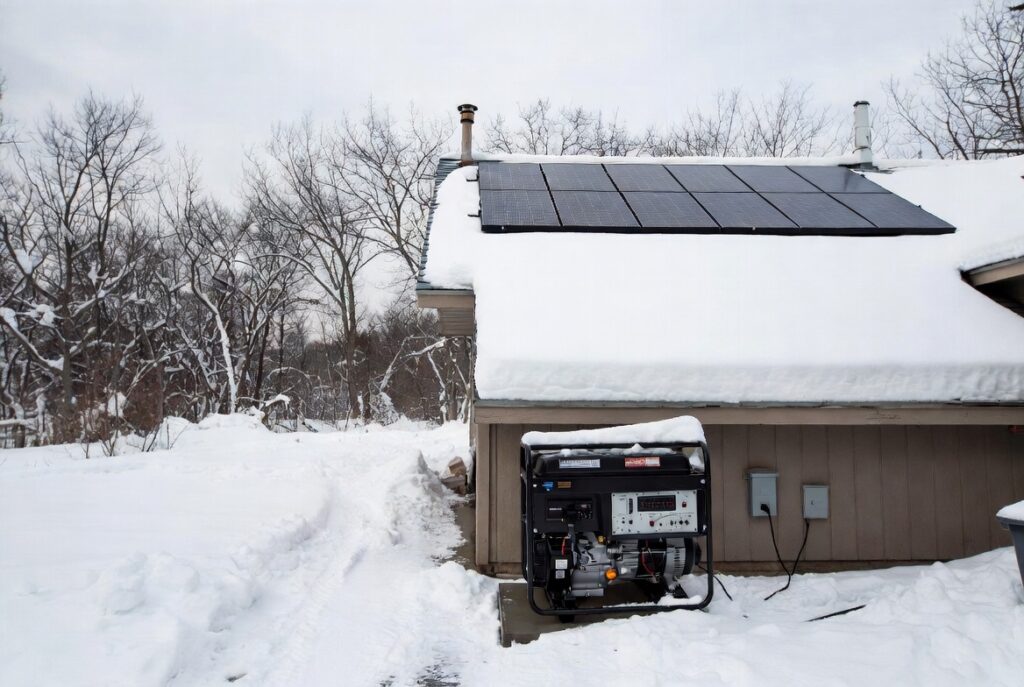
The battery generator ontario decision that most Ontario property owners get wrong is treating it as a permanent either/or choice, because a property owner in Centre Wellington ran a gasoline generator as his only backup power source for three years and spent approximately $1,800 in fuel and maintenance costs before calculating that a two-cell Battle Born heated LFP bank at that same $1,800 investment would have delivered the same energy output at approximately $0.23 per kWh versus the $0.76 per kWh he had been paying in gasoline. By the time he made the switch, his new battery bank had paid for itself in fuel savings within eighteen months.
The generator had not failed him. It had kept the lights on through every Ontario gray streak for three years.
The problem was the running cost: $0.76 per kWh in gasoline versus $0.23 per kWh from an LFP bank amortised over 3,000 cycles.
He kept the generator after the switch. The battery bank became the primary source for daily consumption , the quiet, zero-fuel overnight power that covers lights, fridge, pump, and furnace fan without noise or fuel cost. The generator became the gray streak backup, running through the MultiPlus-II AC input at 50A bulk charge when the SmartShunt showed the bank reaching 30 percent SoC during extended cloud cover. His fuel cost dropped from approximately $600 per year to under $80 per year because the generator ran far less often.
The battery generator ontario hybrid approach is not a compromise between two imperfect systems. It is the correct Ontario off-grid architecture , battery primary for daily efficiency, generator backup for gray streak endurance beyond the bank’s 4-day autonomy window. Neither component performs the function the other is better at. See our Ontario solar sizing guide before any battery generator ontario specification decision.
The battery generator ontario cost comparison: $0.23 per kWh versus $0.76 per kWh over 10 years
| Power source | Upfront cost | Cost per kWh | Annual maintenance | Ontario gray streak verdict |
|---|---|---|---|---|
| Battle Born LFP bank (all-in) | $1,800 for 2 cells | $0.15-0.18/kWh | $0 | Wins daily cost, 4-day autonomy |
| Gasoline generator | ~$1,200 | $0.76/kWh fuel only | $80-120/year | Unlimited runtime, loud, $0.85-0.90 all-in |
| Propane generator | ~$1,500 | ~$0.37/kWh | $60-100/year | Quieter than gas, still 2x LFP cost |
| Hybrid (LFP primary + generator backup) | $3,000-6,000 | $0.15-0.18/kWh daily | ~$30/year | Correct Ontario Tier 2 architecture |
A single Battle Born 100Ah heated LFP cell costs $900, providing 1,280Wh usable at 80 percent DoD over 3,000 cycles. That is 3,840kWh of lifetime output per cell at $0.234 per kWh battery-only. When the array and MultiPlus-II are amortised over 25 years, the all-in cost drops to approximately $0.15 to $0.18 per kWh. A gasoline generator costs approximately $1,200 upfront, burns $1.52 per hour at Ontario gasoline prices of $1.60 per litre, and delivers approximately 2kWh per hour at operating load , approximately $0.76 per kWh in fuel alone, before the $80 to $120 annual maintenance cost.
Over 10 years, the gasoline generator costs approximately $0.85 to $0.90 per kWh all-in versus $0.15 to $0.18 per kWh all-in for the battery generator ontario system. The propane generator at approximately $0.37 per kWh sits between gasoline and battery on cost , quieter than gasoline and better for long-term fuel storage, but still twice the cost of the battery bank per kWh after year 3. For an Ontario property that already has a propane heating system, a propane generator is the correct gray streak backup choice. See our solar system planning Ontario guide for the full Tier 2 bank sizing calculation that determines the battery component of the hybrid cost.
The Centre Wellington conversion: three years of gasoline versus eighteen months of LFP payback
The Centre Wellington property owner ran a Honda EU2200i equivalent as his sole backup power source for three years. Annual costs included fuel purchases at approximately $1.60 per litre, oil changes every 50 hours of operation, spark plugs annually, and carburetor service every two years , totalling approximately $600 per year. At $0.76 per kWh, the generator delivered approximately 790kWh of backup power annually. The same 790kWh from a 2-cell Battle Born LFP bank (approximately 2,560Wh usable daily) would have cost approximately $180 per year in all-in amortised battery cost, a saving of approximately $420 per year.
After the switch, the generator ran approximately 10 to 12 times per year during gray streaks, for 90-minute bulk charges through the MultiPlus-II AC input at 50A. At $1.52 per hour, each 90-minute run cost approximately $2.28. For 12 annual runs: approximately $27.36 in annual fuel versus the previous $600. The SmartShunt confirmed that the battery bank covered 95 percent of the property’s backup energy demand without the generator running at all. The 2-cell LFP bank at $1,800 investment had paid for itself in fuel savings within 18 months of the switch.
The generator is not obsolete in this setup. It runs 12 times per year instead of every day, it runs for 90 minutes instead of 4 hours, and it runs only when the SmartShunt confirms the bank has reached 30 percent SoC. The battery bank handles everything the generator used to handle at one-fifth the operating cost. The generator handles only what the battery bank cannot , the Ontario gray streaks that run longer than 4 days. See our winter solar Ontario guide for the full Ontario gray streak frequency data by month.
The battery generator ontario gray streak test: when the generator wins and when the bank wins
A 6-day January gray streak in Orangeville demonstrated the hybrid advantage in a single week. The generator-only property owner ran 4 hours per day at $1.52 per hour, totalling $36.48 in fuel across 6 days. The hybrid battery-primary neighbour’s SmartShunt showed the bank depleting from 100 percent to approximately 30 percent SoC over the first 4 days , the bank covered 4 full days of household load without any generator fuel. On days 5 and 6, the generator ran through the MultiPlus-II AC input for 90-minute bulk charges, costing $4.56 total. Total saving: $31.92 in one gray streak event. His comment: “Six days of January and I spent $4.56. My neighbour spent $36.”
The correct battery generator ontario gray streak protocol: when the SmartShunt shows 30 percent SoC, start the generator and connect to the MultiPlus-II AC input. The MultiPlus-II bulk charger at 50A on a 48V system charges at 2,400W, restoring from 30 percent to 80 percent SoC on a 200Ah bank in approximately 2 hours. When the generator stops, the MPPT 100/30 takes over solar charging when irradiance recovers. The SmartShunt time-to-full display confirms when to shut the generator down. Never connect the generator directly to the MPPT 100/30 , the MPPT is a solar charge controller, not a generator AC input device. See our solar battery monitor Ontario guide for the SmartShunt 30 percent SoC alert setup.
The generator-only property owner’s $36.48 over 6 days is not the worst-case scenario. During an 8-day Ontario January cloud event , which occurs several times per decade , the same generator runs $48.64 in fuel. The hybrid battery-primary system covers days 1 through 4 on the bank and runs the generator only on days 5 through 8 for bulk charges, at approximately $9.12 total. The 8-day saving versus generator-only: approximately $39.52. Over a full Ontario winter with 3 to 4 extended gray streak events, the hybrid saving easily covers the incremental cost of the battery bank within 2 to 3 years.
When the generator is the correct Ontario specification
Two Ontario scenarios where the generator is the correct primary specification. First: extended gray streaks beyond 4-day battery autonomy. No battery bank provides unlimited runtime. A correctly sized Tier 2 system provides 4-day gray streak autonomy, but an 8-day Ontario January cloud event requires fuel-based backup for days 5 through 8 regardless of bank size. The generator is not optional in the Ontario battery generator ontario hybrid architecture , it is the essential insurance for the rare but real extended gray streak.
Second: limited upfront capital. A $1,200 gasoline generator provides backup power today. A correctly sized Tier 2 battery bank costs $3,000 to $6,000. For the first 1 to 2 years of an Ontario property build, a generator is the practical starting point.
The generator is also the correct specification for backup power on a property with a heavily shaded array or a north-facing roof where solar production cannot reliably recharge a battery bank. On a property producing only 500Wh per day from a compromised array, a battery bank depletes faster than the array restores it , the generator must run more frequently and the all-in cost advantage shrinks significantly. On a correctly sited Ontario Tier 2 property with a clear south-facing array, the battery bank wins the 10-year battery generator ontario cost comparison decisively. See our solar heater Ontario guide for the related generator protocol covering propane wall heaters as the correct heating backup in the same off-grid context.
NEC and CEC: Ontario permit requirements for generator and battery bank integration
NEC 690, NEC 702, and NEC 706 govern battery bank and generator integration in Ontario off-grid and hybrid systems. A permanent generator connection to the battery system through the MultiPlus-II transfer switch input requires that the generator output is properly rated for the MultiPlus-II AC input specifications, that all AC wiring between generator and inverter is sized for 125 percent of maximum continuous current, and that the generator connection includes a properly rated disconnect accessible from outside the generator enclosure. The MultiPlus-II manages the generator transfer automatically , the inverter switches between solar, battery, and generator power without manual intervention. Contact the NFPA at nfpa.org for current NEC 702 and NEC 706 requirements.
CEC Section 64 governs Ontario electrical installations. Any permanent generator connection to an off-grid battery bank system requires an ESA permit covering the generator AC output wiring, the MultiPlus-II AC input connection, and all associated disconnects and overcurrent protection. A licensed electrician must complete the permanent generator integration and schedule the ESA inspection. Portable generator connections through a manual transfer switch are subject to different requirements. Contact the Electrical Safety Authority Ontario at esasafe.com for the current Ontario requirements for both permanent and portable generator integration with battery bank systems.
Pro Tip: Track your generator runtime and fuel cost in a simple log for the first full Ontario winter after switching to the battery generator ontario hybrid. Write down each generator start date, runtime in minutes, and estimated fuel used. After one winter, the log will confirm exactly how many gray streak events hit your property and how much the generator actually cost versus your pre-battery generator-only year. The Centre Wellington property owner did this and confirmed 12 generator runs totalling approximately 18 hours over one winter , versus the estimated 395 hours his generator ran in the year before the switch. The log is also useful for right-sizing the battery bank if the gray streak frequency suggests the 4-day autonomy window needs extending.
The battery generator ontario verdict: bank primary, generator backup, SmartShunt decides when
- Ontario property owner with an existing generator and no battery bank: calculate your annual fuel and maintenance cost, then compare it to the all-in amortised cost of a Battle Born LFP bank sized for 4-day autonomy. The Centre Wellington result: $1,800 in 3 years of generator costs versus $1,800 invested in a 2-cell LFP bank that paid for itself in fuel savings within 18 months. Retain the generator for gray streaks beyond 4 days. Run it through the MultiPlus-II AC input when the SmartShunt shows 30 percent SoC.
- Ontario property owner building a new Tier 2 system from scratch: specify battery primary and generator backup from day one, sizing the LFP bank for 4-day gray streak autonomy. Include the MultiPlus-II as both the inverter and the generator charger input. Set the SmartShunt 30 percent SoC alert as the generator trigger. The Orangeville hybrid result: $4.56 for a 6-day January gray streak versus $36.48 for a generator-only approach on the same event. The MPPT 100/30 resumes solar charging as soon as the sun returns , the generator and solar charge sources never conflict because the MultiPlus-II manages the handoff automatically.
- Ontario property owner with limited upfront capital: start with the generator and build toward hybrid over 2 to 3 years. The generator provides backup power today at a higher per-kWh cost. As the battery bank budget accumulates, add the Battle Born LFP bank and MultiPlus-II to transition to battery primary. The generator cost during the transition period is not wasted , it confirms the actual daily load figures that the battery bank will be sized for when the budget is available. The log of generator runtime during the transition years is the best input data for correctly sizing the final battery bank.
Frequently Asked Questions
Q: Is a solar battery bank cheaper than a generator for Ontario backup power?
A: Over 10 years, yes. A Battle Born LFP bank costs approximately $0.15 to $0.18 per kWh all-in when amortised with the array and MultiPlus-II over 25 years. A gasoline generator costs approximately $0.85 to $0.90 per kWh all-in at Ontario fuel and maintenance prices. The crossover point is approximately 18 months to 3 years depending on the property’s daily backup energy consumption. The Centre Wellington result: $1,800 in 3 years of generator costs versus a 2-cell Battle Born bank at $1,800 that paid for itself in fuel savings within 18 months. The battery generator ontario hybrid (LFP primary, generator gray streak backup) provides the best of both: low daily operating cost and unlimited emergency runtime.
Q: How do I use a generator to charge my LFP battery bank in Ontario?
A: Run the generator through the MultiPlus-II AC input. The MultiPlus-II’s built-in 50A AC charger converts the generator output to DC charging current for the battery bank at 2,400W on a 48V system. Do not connect the generator directly to the MPPT 100/30 , the MPPT 100/30 is a solar charge controller, not a generator input device. The correct generator charging sequence: start the generator, confirm the MultiPlus-II switches to charger mode on the SmartShunt display (it will show positive amps flowing into the bank), run until the SmartShunt shows 80 percent SoC, then shut the generator down.
The MPPT 100/30 resumes solar charging automatically when the sun returns. A bulk charge from 30 percent to 80 percent SoC on a 200Ah 48V bank takes approximately 2 hours at 50A.
Q: When should I run my generator during an Ontario winter gray streak?
A: Run the generator when the SmartShunt shows the battery bank reaching 30 percent SoC. This is the correct Ontario gray streak generator trigger , not 20 percent, not 10 percent. Running at 30 percent keeps the bank above the BMS low-voltage protection window and gives the generator a substantial bank capacity to refill, making the 90-minute to 2-hour bulk charge run efficient.
The SmartShunt time-to-empty display during a gray streak will show you when 30 percent SoC is approaching with enough lead time to start the generator before the bank gets too low. The Orangeville result confirms the protocol: 4 days on the bank, generator on day 5 at 30 percent SoC, total fuel cost for a 6-day January gray streak: $4.56.
This build is engineered within the 48V DC Safety Ceiling. Diagnostic logic is based on 20+ years of technical service experience. All structural and electrical installations must be verified by a Licensed Professional and comply with your Local AHJ. See our legal and safety disclosure for full scope.
About the Author
Robert Bertrand spent 20 years as a service advisor in the automotive industry (Lexus and Nissan), where precision diagnostics, wiring integrity, and documentation standards were non-negotiable. He brings that same technical discipline to GridFree Guide, where he researches, tests, and documents off-grid solar systems for Ontario conditions. Based in Rockwood, Ontario, every article is built on verified specifications, manufacturer data, and the real-world climate constraints of Canadian off-grid living.
As an Amazon Associate I earn from qualifying purchases. This site also contains affiliate links to other products and services. GridFree Guide earns a small commission at no extra cost to you.