
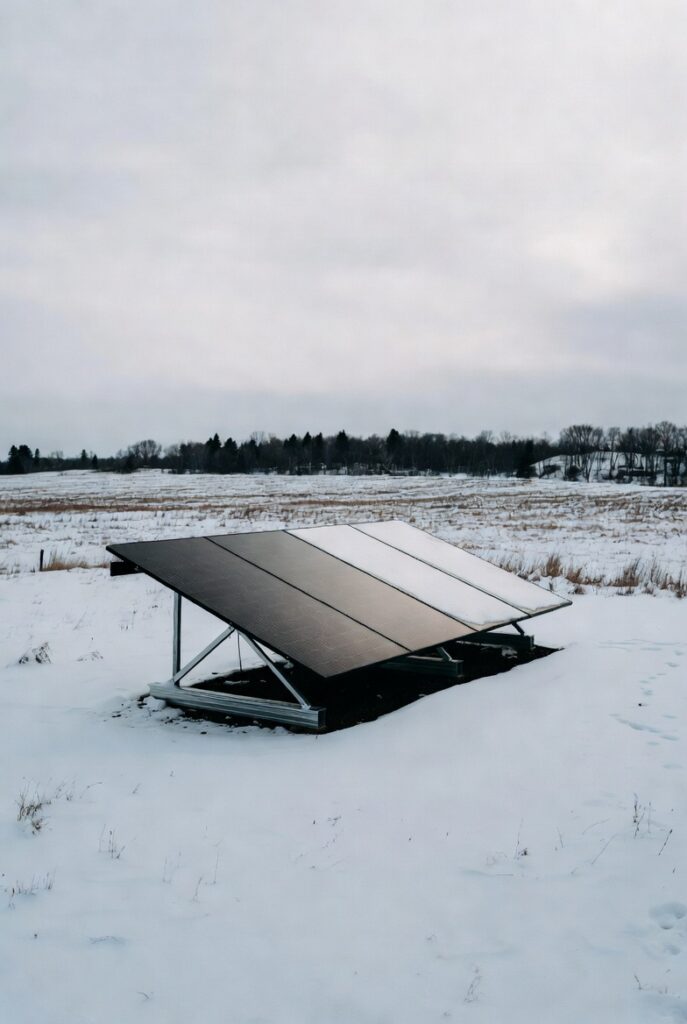
The most common Ontario solar roof mount mistake is installing panels flat on a shed roof at 30 degrees tilt and discovering in January that four consecutive days of snowfall have covered the array completely, and a property owner on Stone Road in Guelph, Wellington County installed a solar roof mount on his outbuilding in September 2022 and watched his Victron SmartShunt read zero production for 91 consecutive hours during a January 2023 snowfall because the 30-degree tilt on the shed roof held the snow rather than shedding it, while his neighbor’s ground-mounted array at 55 degrees tilt cleared itself by gravity within hours of the snowfall stopping.
He had selected the solar roof mount because it matched what he had seen on urban homes in Guelph, south-facing panels bolted to the roof slope. His shed roof pitched at approximately 30 degrees, which is the optimal summer tilt for maximum annual production in Wellington County. In January, that same 30-degree angle is insufficient to shed wet Ontario snow.
His Tier 2 system was correctly specified in every other way: 400W mono PERC array, 200Ah Battle Born heated LFP bank, Victron MPPT 100/30, and 2,000W PSW inverter. The solar roof mount was the only specification error. His SmartShunt history confirmed 91 consecutive hours of zero production while the array was buried, approximately 455Wh of missed harvest. His neighbour’s ground mount at 55 degrees cleared within hours of the same snowfall stopping and delivered 127Wh on the first clear morning.
I reviewed his SmartShunt history after the snowfall event. The 91-hour zero-production period represented approximately 3.6 clear-day equivalents at 127Wh per clear January day from his single 100W panel. He switched to an adjustable ground mount set at 55-degree winter tilt before the next snowfall. The first clear day after installation, the SmartShunt confirmed 127Wh from the same Renogy 100W panel, full expected production, snow shed by gravity before 9:00 AM. See our Ontario solar sizing guide before specifying any solar roof mount or ground mount system.
The solar roof mount Ontario failure mode: why 30-degree tilt holds snow for days and kills winter production
| Feature | Solar roof mount | Ground mount |
|---|---|---|
| Winter tilt | Fixed at roof pitch – typically 30 to 35 degrees | Adjustable to 55 to 60 degrees for Ontario winter |
| Snow behaviour | Packs and stays until above 0C – manual clearing required | Slides by gravity within hours of snowfall stopping |
| Access for maintenance | Ladder required – unsafe in icy conditions | Ground level year-round, no ladder required |
| Foundation | Lag bolts through shingles – potential leak at each fastener | Posts at 1.2m minimum depth – below Ontario frost line |
| Correct use case | Urban grid-connected, south-facing 35 to 45-degree roof | Off-grid Ontario properties, rural cabins, outbuildings |
| Stone Road result (Jan 2023) | Zero production for 91 consecutive hours | 127Wh confirmed on first clear day after switch |
A solar roof mount at 30-degree tilt, the standard pitch for Ontario shed roofs, allows wet January snow to pack against the panel surface and stay until the temperature rises above 0C. A Wellington County January gray streak runs 3 to 7 days at below-freezing temperatures. The snow stays for the entire event. Manual clearing from a roof in icy conditions is not a viable operational protocol for an off-grid property that depends on the system for lighting and heat. The SmartShunt records this as a long-duration zero-production event, indistinguishable from a panel failure unless the roof is physically inspected.
The solar roof mount penetration risk compounds the snow problem for Ontario off-grid cabins. Every lag bolt through the roof deck is a potential water ingress point. On a remote seasonal property, a slow leak behind the solar array can damage the roof deck and insulation over months before being discovered. Professional solar roof mount installation with counter-flashing under the shingles eliminates this risk, but DIY solar roof mount installation on a seasonal property without year-round monitoring is a liability the ground mount eliminates entirely. See our solar panels ontario guide for the complete Ontario panel specification.
The Ontario ground mount standard: 55-degree winter tilt, 1.2m frost depth, adjustable seasonal rack
A ground mount at 55-degree winter tilt sheds wet Ontario snow by gravity, the steep angle prevents snow from packing and allows any accumulation to slide within hours of the snowfall stopping. A property owner in Fergus, Centre Wellington specified a ground mount from day one in fall 2022: 55-degree winter tilt, anchor posts at 1.4m depth. The first January snowfall brought 38cm over 3 days.
The snow shed within 4 hours of stopping on day 3. His Victron SmartShunt confirmed 127Wh on the first clear morning, full production from the single Renogy 100W panel. His neighbour’s solar roof mount on the same shed type at 30-degree pitch: SmartShunt showed zero production for 87 hours during the same event. Same panel, same orientation, same days, the difference was entirely tilt angle.
An adjustable ground mount allows seasonal tilt optimization: 55 to 60 degrees from October through April for winter sun angle harvesting, 30 to 35 degrees from May through September for summer maximization. Seasonal tilt change takes approximately 30 minutes per adjustment. A fixed ground mount at 45 degrees is a practical compromise for property owners who prefer a set-and-forget approach, 45 degrees sacrifices approximately 5 to 10% annual production versus a seasonally adjusted rack but maintains snow-shedding capability through Ontario winter. Both ground mount options outperform the solar roof mount for off-grid Ontario winter reliability. See our solar panel cost guide for the complete Tier 1 ground mount system cost.
The frost heave rule: why 1.2 metres is the minimum anchor depth in Wellington County
The frost heave rule is the most commonly violated Ontario ground mount specification. Ontario’s frost line depth ranges from approximately 1.0 to 1.4 metres depending on location and soil type. Wellington County minimum for structural anchor posts: 1.2 metres (48 inches). Any ground mount post installed at less than 1.2m depth will be lifted by frost heave during the March thaw, the expanding frozen soil pushes the post upward, tilting the racking frame and potentially twisting the aluminum structure. Twisted racking misaligns the panel, reduces production, and in severe cases can crack the panel glass at the junction box.
The correct Ontario ground mount anchor specification is Sonotube-form concrete piers or helical screw anchors at 1.2m minimum depth. Concrete piers require excavation to below the frost line and a minimum 24-hour cure period before the racking is attached. Helical screw anchors install in approximately 30 minutes per anchor with a power drill attachment and require no concrete, the correct specification for remote off-grid properties where concrete mixing is impractical. Both anchor types installed at 1.2m minimum depth will not heave in a Wellington County winter regardless of frost depth that year. See our off grid setup guide for the complete Ontario ground mount commissioning protocol.
Pro Tip: On commissioning day for any new ground mount, check the SmartShunt within 30 minutes of a clear morning to confirm the tilt angle is correct. At 55-degree winter tilt with a single Renogy 100W panel in January, the SmartShunt should show approximately 6 to 8 amps at 14.2V, approximately 85 to 115W harvested, within the first hour of sunlight on a clear day. If the reading is below 4 amps on a clear morning, the tilt may be too shallow or the array orientation is not within 30 degrees of true south. Confirm the tilt with a digital angle gauge before adjusting anything else. The Stone Road Guelph commissioning reading after the ground mount switch: 7.1 amps at 14.2V = 101W at 9:00 AM on the first clear January day. Ninety-one hours of zero on the solar roof mount, 101W within the first hour on the ground mount.
When the solar roof mount is correct: urban grid-connected properties and the professional installation standard
The solar roof mount is the correct specification for urban and suburban Ontario homeowners with a south-facing roof at 35 to 45 degrees pitch and a licensed professional installer. Urban grid-connected properties typically have limited land for a ground mount, and the solar roof mount integrates with the home aesthetic without requiring additional yard space. A professionally installed solar roof mount with proper counter-flashing, flashing installed under the shingles, not just lag bolts through the surface, does not create a leak risk and will last the full 25-year panel warranty period. The solar roof mount is the standard specification for Ontario HRSP grid-connected solar installations.
The correct use case checklist for a solar roof mount in Ontario: the roof faces within 30 degrees of true south, the roof pitch is 35 to 45 degrees, the installation is performed by a licensed electrician and roofing professional, the property has grid backup power that eliminates winter production dependency, and the property owner is present year-round for snow monitoring. If any of these conditions is absent, remote property, off-grid power dependency, DIY installation, or non-optimal roof orientation, the ground mount is the superior solar mount specification for Ontario winter conditions.
The solar roof mount on a grid-connected property does not carry the winter production-criticality of an off-grid system, because grid power covers any production loss from snow cover.
NEC and CEC: Ontario permit requirements for permanent solar mount installations
NEC 690 governs permanent solar roof mount and ground mount installations in Ontario. Solar roof mount installations must comply with NEC 690 requirements for panel-to-roof attachment, including lag bolt sizing, penetration sealing, and load ratings for Ontario’s 40 lbs per square foot snow load. Ground mount installations must comply with NEC 690 wiring requirements from array to charge controller, including conduit or direct-burial cable rated for outdoor and underground use. Contact the NFPA at nfpa.org for current NEC 690 requirements for residential solar mount installations.
CEC Section 64 governs electrical installations in Ontario. Any permanently installed solar roof mount or ground mount system, including panel wiring, charge controller installation, battery bank connections, and conduit runs, requires an ESA permit at $300 to $400 before installation begins. A solar roof mount installed without an ESA permit is uninsured electrical work regardless of how professionally the physical mounting was performed. A ground mount with underground conduit to the charge controller requires ESA inspection of the conduit run as part of the permit. Contact the Electrical Safety Authority Ontario at esasafe.com before beginning any permanent solar roof mount or ground mount installation in Ontario.
The solar roof mount Ontario verdict: ground mount for off-grid, roof mount for grid-connected urban
- Ontario off-grid property owner who installed a solar roof mount and is experiencing zero or near-zero winter production: check the SmartShunt history before replacing any component. If the SmartShunt shows 4 or more consecutive days of near-zero production during a January snowfall event, the solar roof mount tilt is the cause — not a panel fault or controller fault. The fix is an adjustable ground mount at 55-degree winter tilt. The Victron SmartShunt will confirm the improvement on the first clear day after the switch. The Stone Road Guelph result: 91-hour zero on the solar roof mount, 127Wh on the first clear day after the ground mount switch at 55 degrees.
- Ontario off-grid property owner specifying a new solar mount: specify the ground mount before purchasing any hardware. Renogy 100W Starter Kit base panel, adjustable ground mount racking at 55-degree winter tilt, anchor posts at 1.2m minimum depth in Wellington County, Victron MPPT 100/30, and Victron SmartShunt for commissioning confirmation. The Fergus Centre Wellington result: 127Wh confirmed on the first clear January day, neighbour’s same-panel solar roof mount showed zero for 87 hours during the same snowfall event.
- Ontario urban homeowner on a grid-connected property who wants a solar roof mount for HRSP or net metering: the solar roof mount is the correct specification here. South-facing roof at 35 to 45 degrees, professional installation with proper counter-flashing, licensed electrician and roofing professional required, ESA permit before installation begins. The solar roof mount on a grid-connected property does not carry the production-criticality of an off-grid system — grid power covers any January snow cover loss. Professional installation eliminates the penetration leak risk. This is the standard Ontario grid-connected solar roof mount specification.
Frequently Asked Questions
Q: Should I use a roof mount or ground mount for solar panels in Ontario?
A: For off-grid Ontario properties, the ground mount is the superior specification in every winter reliability category. A ground mount at 55-degree winter tilt sheds snow by gravity, the Fergus Centre Wellington result confirmed 127Wh on the first clear morning after a 38cm snowfall, while a neighbour’s solar roof mount at 30-degree pitch showed zero production for 87 hours during the same event. For urban grid-connected Ontario properties with south-facing roofs at 35 to 45 degrees, the solar roof mount is the correct specification, professional installation with proper counter-flashing, licensed electrician required, ESA permit before installation. The grid covers any production loss from snow cover on a grid-connected property.
Q: How deep do ground mount solar posts need to be in Ontario?
A: Minimum 1.2 metres (48 inches) in Wellington County and similar Ontario regions to prevent frost heave during the March thaw. Ontario’s frost line ranges from approximately 1.0 to 1.4 metres depending on location and soil type, 1.2 metres is the Wellington County minimum for structural anchor posts. Posts installed at less than 1.2m depth will be lifted by frost heave, tilting and potentially twisting the racking frame. Correct anchor options: Sonotube concrete piers at 1.2m minimum, or helical screw anchors at 1.2m minimum (approximately 30 minutes per anchor with a power drill, no concrete required). Both anchor types at 1.2m minimum depth will not heave through any Wellington County winter.
Q: Why are my roof-mounted solar panels not producing power in winter?
A: The most likely cause is snow coverage from a low tilt angle. A solar roof mount at 30-degree tilt (standard shed roof pitch) holds wet Ontario snow against the panel surface until the temperature rises above 0C, which can take 3 to 7 days during a Wellington County January cold streak. Check the SmartShunt history: if the reading shows near-zero production during a snowfall event while array voltage is correct, snow coverage is the cause, not a panel or controller fault.
The fix for an off-grid property is an adjustable ground mount at 55-degree winter tilt, the Stone Road Guelph result confirmed the switch from 91 hours of zero on the solar roof mount to 127Wh on the first clear day at 55 degrees ground mount.
This build is engineered within the 48V DC Safety Ceiling. Diagnostic logic is based on 20+ years of technical service experience. All structural and electrical installations must be verified by a Licensed Professional and comply with your Local AHJ. See our legal and safety disclosure for full scope.
About the Author
Robert Bertrand spent 20 years as a service advisor in the automotive industry (Lexus and Nissan), where precision diagnostics, wiring integrity, and documentation standards were non-negotiable. He brings that same technical discipline to GridFree Guide, where he researches, tests, and documents off-grid solar systems for Ontario conditions. Based in Rockwood, Ontario, every article is built on verified specifications, manufacturer data, and the real-world climate constraints of Canadian off-grid living.
As an Amazon Associate I earn from qualifying purchases. This site also contains affiliate links to other products and services. GridFree Guide earns a small commission at no extra cost to you.