
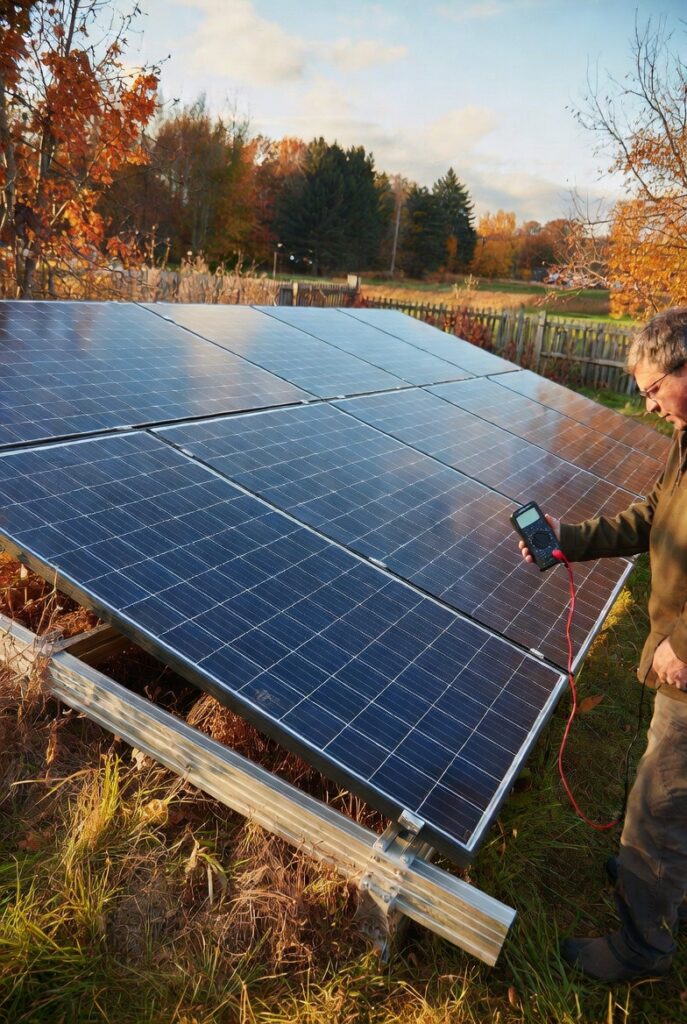
Solar panel degradation is not a cliff edge, it is a gentle slope that the best panels in Ontario barely even notice. A homeowner on Clair Road East in Guelph, Wellington County installed a 1,200W array in the spring of 2015. In the fall of 2025, ten years later, he noticed his battery bank was reaching full charge later in the afternoon than it had in the first year.
He used the Voc multimeter test from our diagnostics guide to check each panel individually. All four 300W panels read within 4% of their rated open-circuit voltage, consistent with approximately 0.5% annual solar panel degradation over 10 years, which equates to a total performance loss of approximately 5.9% from the original rating.
He had expected the panels to be failing at year 10. They were not failing. They were delivering exactly what a quality array should deliver at the 10-year service interval. The 5.9% total drop is well within the 10% threshold that most Tier 1 manufacturers use to define normal degradation. His charge controller data confirmed the trend: year 1 daily average in October was 3.2 kWh, year 10 daily average was 3.0 kWh.
The 0.2 kWh difference represents approximately $0.026 per day in Ontario electricity value, roughly $9.50 per year. Over the full 10 years the cumulative loss was approximately $52 in electricity value compared to original rated output, on a system that cost approximately $2,400 to install. Solar panel degradation at 0.5% per year is an entirely manageable service cost.
The critical question at year 10 was whether to replace the panels. The answer was no. The panels retained 94% of their original output, carried a 15-year remaining warranty, and showed no physical damage on visual inspection. I walked him through the same three-photo documentation workflow from the diagnostics guide and confirmed all four panels were within spec. He redirected the money he had budgeted for early replacement into expanding the array by two additional panels, adding 600W of new capacity for approximately $600.
The combination of four degraded but healthy 10-year panels and two new panels gave him a 1,800W effective array at year 10 for less than the cost of a full replacement. Understanding solar panel degradation rates is what made that decision possible. See our Ontario solar sizing guide for planning your array expansion.
Solar panel degradation in the first year: LID, LeTID, and the break-in loss
LID, or Light-Induced Degradation, is the rapid initial efficiency loss that occurs in the first 100 to 200 operating hours. It happens because boron-oxygen defects form in the silicon crystal lattice as the cells are exposed to sunlight for the first time. For standard P-Type PERC monocrystalline panels the LID loss is approximately 1 to 2%. N-Type panels, including TOPCon and HJT cell technologies, experience LID of approximately 0.5% or less because they do not share the boron-oxygen defect pathway. After LID stabilises the panel enters the slow annual phase. A 400W P-Type PERC panel after LID settles at approximately 394W effective output. A 400W N-Type panel settles at approximately 398W.
LeTID, or Light and Elevated Temperature Induced Degradation, is an additional mechanism that primarily affects P-Type PERC panels during their first one to two Ontario summers. It triggers at cell temperatures of 70 to 85C under simultaneous light exposure, and can add 0.5 to 2% of additional degradation beyond the LID loss in the first operating season. N-Type panels are largely immune to LeTID, which is one of the key practical advantages of the premium cell chemistry at Ontario July operating temperatures.
For an Ontario homeowner buying P-Type PERC panels, the combined LID and LeTID effect means the first year may show a total drop of approximately 2 to 3% before the panel settles into its long-term 0.5% annual rate. This is not a defect, it is the expected break-in, and any Tier 1 power warranty accounts for it.
Solar panel degradation over 25 years: Tier 1 vs budget performance curve
The annual degradation rate difference between Tier 1 and budget panels appears small per year but compounds significantly over a 25-year service life. Tier 1 N-Type panels like the BougeRV 400W bifacial 10BB degrade at approximately 0.45% per year after LID, confirmed by NREL field data. Standard P-Type PERC monocrystalline panels from mid-quality manufacturers degrade at approximately 0.5% per year. Budget and no-name panels typically degrade at 0.7 to 1.0% per year. The industry standard 80% power warranty at year 25 implies a degradation rate of approximately 0.8% per year, which is the budget tier.
| Year | Tier 1 400W (0.45%/yr) | Budget 400W (0.8%/yr) | Difference |
|---|---|---|---|
| Year 1 (after LID) | 394W | 394W | 0W |
| Year 5 | 387W | 381W | 6W |
| Year 10 | 370W | 365W | 5W |
| Year 15 | 362W | 349W | 13W |
| Year 20 | 340W | 334W | 6W |
| Year 25 | 354W (88.4%) | 325W (81.2%) | 29W |
A rural property owner on Derry Road in Milton, Halton County ran this comparison before buying a full array in 2025. The Tier 1 N-Type panel carried a 0.45% annual rate and an 88% year-25 power warranty. The budget alternative was priced $85 cheaper per panel with a 0.8% annual rate and an 80% year-25 warranty. For a 10-panel 4,000W array at Ontario’s 3.5 PSH with electricity prices escalating at approximately 3% per year, the Tier 1 array produces approximately 119,000 kWh over 25 years while the budget array produces approximately 114,000 kWh.
That 4,800 kWh difference is worth approximately $1,020 in Ontario electricity value over 25 years, exceeding the $850 total price premium on a 10-panel array. The Tier 1 panels recover their premium through superior energy retention before year 17 and continue widening the margin through year 25. See our best 400W solar panel guide for verified Tier 1 options available on Amazon.ca.
Hot spots and micro-cracks: the accelerated wear mechanisms that break the curve
A hot spot forms when one cell in a string produces less current than its neighbours due to shading, a crack, or contamination. Because series-wired cells must carry equal current, the underperforming cell becomes a reverse-biased load, it absorbs power from the string rather than contributing to it. The absorbed power heats the cell, and temperatures at a hot spot can reach 80 to 180C in severe cases.
That heat accelerates local silicon degradation, discolours the EVA encapsulant around the affected zone, and can permanently damage the junction box in chronic cases. Bypass diodes mitigate the problem by activating when a cell string goes reverse-biased, rerouting current around the shaded zone. However, a chronic hot spot from a permanent partial shade source stresses the bypass diode through repeated thermal cycling, and bypass diodes themselves can fail after 5 to 10 years of chronic activation.
Micro-cracks are the second mechanism that breaks the standard solar panel degradation curve. Walking on a panel, placing mounting clamps too close to the panel edge, and shipping damage that was not caught at unboxing all create micro-cracks in the 180 to 200-micron silicon cells. A micro-cracked cell zone can degrade at 2 to 5% per year locally while the rest of the panel holds its 0.45% to 0.5% annual rate.
The cumulative effect is a panel that tests normal on a casual visual inspection but has one zone producing 25 to 33% less than specified. The Voc and Isc multimeter test from our diagnostics guide detects the zone failure once it has progressed to full bypass diode activation. For a new installation, the pre-mount bench test catches micro-cracking from shipping before it ever goes on the roof.
Ontario conditions: UV cycling, freeze-thaw, and what actually affects your panels
Ontario’s climate affects solar panels in specific and measurable ways. UV cycling is the primary encapsulant stressor, Ontario UV index peaks 7 to 8 in summer, comparable to mid-latitude US climates. Premium tempered glass and ETFE lamination handle Ontario UV without yellowing for the full 25-year service life. Budget panels using PET backing or lower-grade EVA show encapsulant yellowing within 3 to 5 years, which reduces light transmission to the cells and accelerates effective degradation beyond the rated annual rate.
Freeze-thaw cycling runs approximately 50 to 60 events per year in Wellington and Halton Counties, which stresses junction box adhesive seals and frame corner joints over time. IP68-rated junction boxes are not optional for any Ontario roof-mount installation, the seal failure that begins at year 7 on an IP65 box starts at year 15 or later on an IP68 box.
What Ontario does not do is accelerate silicon crystal degradation in the cells themselves. Silicon has an extremely low thermal expansion coefficient, and the annual -30C to +70C temperature swing creates minimal stress in the crystalline structure that causes electrical degradation. The 100C annual thermal range that frightens Ontario homeowners is far less damaging to silicon than prolonged UV exposure is to the encapsulant. Premium glass, quality EVA, and IP68 junction boxes are the correct Ontario-specific specifications, not because Ontario is uniquely harsh to silicon, but because the peripherals determine whether water ever reaches the silicon.
A dry cell in a quality encapsulant degrades predictably at 0.45 to 0.5% per year. A cell with moisture ingress from a failed junction box seal degrades at a rate the warranty will not cover. See our solar panel lifespan guide for the full service life expectations by panel tier.
NEC and CEC: warranty, permits, and replacement panels in Ontario
NEC 690 governs solar PV installations. The solar panel degradation that occurs over time does not change the code compliance status of the original installation. A permitted system remains compliant as panels age and output decreases gradually within the warranted degradation range. NEC 690.5 governs ground-fault protection for PV systems. Systems installed and permitted under NEC 690 are not required to be re-permitted because panel output has decreased within the normal degradation specification. The disconnect requirements, conductor sizing, and overcurrent protection that were correct at installation remain correct as long as the panels are replaced with identical or equivalent specifications. Contact the NFPA at nfpa.org for current NEC 690 requirements applicable to aging and maintained residential PV systems.
CEC Section 50 governs solar PV installations in Ontario. Panel replacement due to age, degradation, or warranty claim does not require a new ESA permit provided the replacement panel matches the original system specification, same wattage class, same Voc range, same Isc class. If a replacement panel changes the string voltage, for example replacing a 22V Voc panel with a 37V Voc panel, the system design changes and a permit amendment is required before energising the modified system.
The most important documentation to preserve from installation day is the original ESA permit number, the individual panel serial numbers photographed against the spec sheet, and the installer’s record of the system configuration. A warranty replacement that matches spec requires no permit work. A panel upgrade that changes the electrical characteristics requires a permit amendment. Contact the Electrical Safety Authority Ontario at esasafe.com before replacing degraded panels with a different model specification in any Ontario permitted installation.
Pro Tip: The 25-year performance warranty on a Tier 1 panel is only enforceable if you have three pieces of documentation: the purchase invoice with the panel model and serial numbers, the installation date, and the original ESA permit number. Without the purchase invoice, most manufacturers will not process a warranty claim because they cannot confirm the panel was new at installation. The Guelph Clair Road homeowner had all three documents in a single PDF saved to cloud storage on installation day. When he contacted the panel manufacturer at year 10 to confirm his warranty coverage, the claim was processed in 72 hours. His neighbour, who had installed the same panels the same year but could not locate the original purchase invoice, spent six weeks trying to prove his panels were not second-hand before the manufacturer processed the warranty inquiry. File the paperwork once, find it instantly 15 years later.
The solar panel degradation verdict: what your Ontario array will produce in 2051
- Ontario homeowner with a 1 to 5 year old Tier 1 array: your panels have passed through the LID break-in and are now in the slow annual degradation phase. The LID and LeTID losses in year one are behind you. From this point forward, Tier 1 N-Type panels degrade at approximately 0.45% per year and standard P-Type PERC at approximately 0.5% per year. A 400W panel installed in 2026 will produce approximately 354W in 2051, still a functional, productive panel capable of contributing to your system for the full 25-year warranty period. The year-over-year change is too small to notice without data logging. Your charge controller’s historical data will show the gentle downward slope if you look across years rather than weeks. The correct response to a 0.5% annual rate is to plan your array expansion at year 10 to 15, not to worry about it at year three.
- Ontario homeowner at year 10 whose array feels like it is underperforming: test before replacing anything. The Guelph Clair Road result confirms the pattern. A 5.9% total drop over 10 years is normal, documented, and warranty-compliant for any Tier 1 panel. Use the Voc multimeter test on each panel individually before making any replacement decision. If all panels read within 10% of rated Voc, the solar panel degradation is within spec and no replacement is warranted. If one panel reads significantly below the others, 25% or more below rated Voc, that panel may have a physical fault unrelated to normal degradation, and that fault may be covered under the product warranty. The test costs four minutes per panel and either confirms that the system is healthy or identifies the specific panel requiring a warranty conversation.
- Ontario buyer comparing Tier 1 vs budget panels for a new installation: the 25-year math favours Tier 1 in every scenario. The Milton Derry Road calculation shows that a $850 total price premium on a 10-panel array returns approximately $1,020 in additional production value over 25 years at Ontario electricity prices. The payback on the quality premium is complete before year 17. After year 17, every additional year of service returns net value above the original price difference. Budget panels that degrade at 0.8% per year versus the Tier 1 0.45% rate may also require early replacement at year 15 to 18 when output falls below the system’s useful threshold, adding a second installation cost that eliminates any initial savings. Buy Tier 1 components, install them once, and let the degradation curve work in your favour for 25 years.
Frequently Asked Questions
Q: What is the normal rate of solar panel degradation for Ontario homeowners to expect?
A: For Tier 1 monocrystalline panels, the normal annual solar panel degradation rate is approximately 0.45% per year after the initial LID break-in loss of 1 to 2% in the first 100 to 200 operating hours. Standard quality P-Type PERC panels degrade at approximately 0.5% per year. Budget panels with 80% power warranties at year 25 imply approximately 0.8% per year. At 0.5% annual degradation, a 400W panel installed in 2026 produces approximately 378W at year 10 and 354W at year 25. The 10-year total loss from a Tier 1 panel is approximately 5 to 6% of original output, less than the output difference between a clear Ontario summer day and a day with light cloud cover.
Q: Do Ontario winters and freeze-thaw cycles accelerate solar panel degradation faster than warmer climates?
A: Ontario freeze-thaw cycling, approximately 50 to 60 events per year, stresses peripheral components, specifically junction box adhesive seals and frame corner joints, but does not significantly accelerate silicon cell degradation. The silicon crystal itself handles Ontario’s -30C to +70C annual temperature range without measurable acceleration of the electrical degradation rate. The components that fail prematurely in Ontario are the non-silicon peripherals: IP65-rated junction boxes that admit moisture after 6 to 8 years, budget EVA encapsulant that yellows under Ontario UV within 3 to 5 years, and thin aluminium frames that admit moisture at corner joints. Specify IP68 junction boxes, premium glass, and robust aluminium frames, and Ontario conditions will not accelerate solar panel degradation beyond the rated annual rate.
Q: When should I replace degraded solar panels versus expanding my existing array?
A: Replace panels only when they show evidence of physical damage, hot-spot discolouration, moisture ingress, or Voc readings more than 25% below rated specification, indicating a fault beyond normal degradation. Normal solar panel degradation at 0.5% per year does not justify replacement. At year 10 with approximately 6% total loss, the correct decision is almost always to expand the array with additional new panels rather than replace the aging ones.
The Guelph Clair Road homeowner added two 300W panels at year 10 for $600, bringing his effective array to 1,800W, which outperformed the original 1,200W rated output by 50%. That expansion cost was a fraction of full replacement and left the original 10-year panels contributing healthy production for another 15 years.
This build is engineered within the 48V DC Safety Ceiling. Diagnostic logic is based on 20+ years of technical service experience. All structural and electrical installations must be verified by a Licensed Professional and comply with your Local AHJ.
About the Author
Robert Bertrand spent 20 years as a service advisor in the automotive industry (Lexus and Nissan), where precision diagnostics, wiring integrity, and documentation standards were non-negotiable. He brings that same technical discipline to GridFree Guide, where he researches, tests, and documents off-grid solar systems for Ontario conditions. Based in Rockwood, Ontario, every article is built on verified specifications, manufacturer data, and the real-world climate constraints of Canadian off-grid living.
As an Amazon Associate I earn from qualifying purchases. This site also contains affiliate links to other products and services. GridFree Guide earns a small commission at no extra cost to you.