
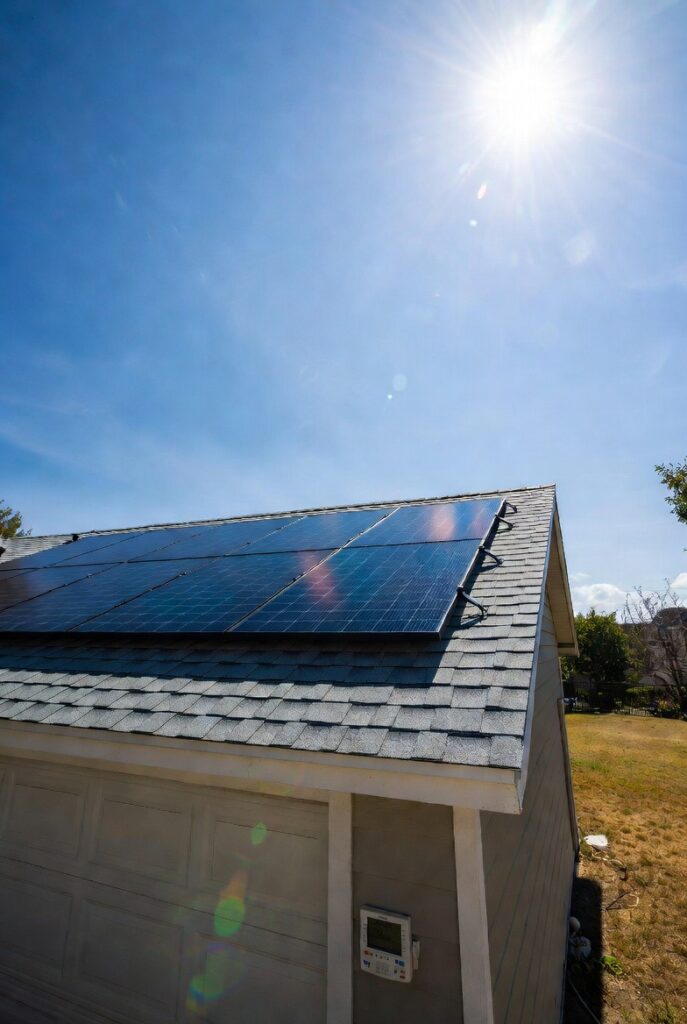
Every hot weather solar question I get from Ontario homeowners during July has the same trigger: the monitoring app shows 320W from a Renogy 400W panel array at noon and they assume the system is broken. On July 19, 2025 on Kortright Road West in Guelph, Wellington County, the air temperature was 34C at noon and the homeowner texted me at 12:23 PM convinced a panel had failed. I checked the data remotely. Array output was 318W. Panel surface temperature based on the Victron SmartSolar app was approximately 65C. At 65C a 400W monocrystalline array produces 400 x (1 – 0.35% x 40) = 344W theoretical maximum at full irradiance. The actual 318W was 92.4% of that theoretical maximum.
Nothing was broken.
I explained the physics to her: the panels were operating exactly within the temperature coefficient. At 34C ambient air temperature on a dark asphalt-shingled roof with the panels mounted flush with no air gap, the panel surface temperature was running 31C above ambient. That gap between air temperature and panel surface temperature is where the performance loss lives. The STC rating of 400W is measured at 25C in a laboratory. On a Guelph July noon that surface temperature is 40C hotter than the lab reference point. Every 10C above 25C costs 3.5% of output. At 65C the loss is 14%, which brings the 400W theoretical down to 344W before any irradiance or efficiency considerations.
I pulled her full July 19th daily data that evening. The array produced 1,847Wh for the full day despite the midday heat. Her January 15th clear-day harvest on the same array had been 847Wh. The July 19th heatwave day produced 2.18 times the January clear-day harvest. The hot weather solar performance loss was real at 344W theoretical minus 318W actual equalling 26W of midday loss. However, the 14-hour July production window more than compensated for the hourly penalty. The morning hours from 7 AM to 10 AM and the evening hours from 4 PM to 7 PM ran at near-STC temperatures because the panels had not yet heated up or had cooled down.
The lesson from Kortright Road is direct: hot weather solar costs you watts per hour but gives you hours
What hot weather solar output actually looks like at noon in July Ontario
The 318W at noon result on Kortright Road is the standard Ontario hot weather solar benchmark. At 34C ambient and 65C panel surface, 318W is 92.4% of the 344W theoretical maximum for those exact conditions. That is an efficient and healthy system. The comparison that matters for a beginner is 318W actual versus the 400W rated nameplate, which is 79.5% of rated. That 20.5% shortfall is entirely explained by the temperature coefficient at 65C. There is no panel failure, no charge controller fault, no wiring problem. The panel is delivering what physics allows at 65C.
The full Ontario July output picture completes the context. A south-facing 400W array with a 14-hour summer production window typically delivers 1,600 to 2,000Wh total on a hot July day despite the midday throttle. The midday window from 11 AM to 2 PM produces less per hour than a cooler May day would. However, the morning and evening shoulder hours deliver near-STC output because panel temperatures have not yet climbed or have already dropped. For the Kortright Road homeowner, 1,847Wh on a 34C heatwave day is a strong result. The winter solar power benchmark for that same array was 847Wh on the best January clear day. Hot weather solar delivers more than twice the daily harvest in absolute terms.
| Panel Temperature | Temp above STC | Output Loss | 400W Array Output | Typical Condition |
|---|---|---|---|---|
| 25C (STC) | 0C | 0% | 400W | Lab reference |
| 40C | +15C | 5.25% | 379W | Cool May morning |
| 55C | +30C | 10.5% | 358W | Warm July, good airflow |
| 65C | +40C | 14% | 344W | Hot July, flush roof mount |
| 75C | +50C | 17.5% | 330W | Extreme heat, no airflow |
The temperature coefficient: why 65C panel temperature costs exactly 14% output
The temperature coefficient of a standard monocrystalline silicon panel is -0.35% per degree Celsius above 25C. That number is on every solar panel spec sheet and is not a manufacturer estimate. It is a measured electrical property of silicon. For every degree of panel surface temperature above 25C, output drops by 0.35% of the rated wattage. At 65C the math is straightforward: 40 degrees above STC reference, multiplied by 0.35%, equals 14% output reduction. For a 400W array the reduction is 56W at midday on a flush-mounted Ontario July roof.
The reason the panel surface is always hotter than the ambient air is conduction and radiation combined. The panel absorbs sunlight across the full spectrum, converts roughly 20 to 22% of it into electricity, and converts the remaining 78 to 80% into heat. With no airflow beneath a flush-mounted panel that heat has nowhere to go except back through the panel substrate. On a 34C Ontario July afternoon with full sun and no air gap, the panel surface temperature stabilises at 25 to 35C above ambient. At 34C ambient that puts the panel surface at 59 to 69C.
The Kortright Road 65C measurement at 12:23 PM was therefore expected. The 65C figure for Kortright Road was measured at 12:23 PM when the roof had been in full sun since 7 AM. The roof substrate below the panels had also been absorbing heat for five hours, adding radiant heat from below to the solar radiation from above.
Voltage sag in summer: why hot panels charge your battery differently
As panel temperature rises, open-circuit voltage decreases. A 100W panel with a 21V open-circuit voltage at 25C STC produces approximately 21 x (1 – 0.4% x 40) = 17.6V at 65C. Four panels in series produce 4 x 17.6V = 70.4V on a hot July afternoon versus 4 x 24.6V = 98.4V on a minus 18C January morning. The Victron SmartSolar MPPT 100/30 continuously scans the voltage-current curve as it shifts with temperature and finds the new maximum power point. The MPPT does not stop charging because of lower panel voltage. It adapts.
The practical implication is direct. When the charge controller shows lower output on a hot afternoon, it is correctly tracking the lower-voltage maximum power point of the hot array. The watt-hour loss is from the temperature coefficient reducing peak power, not from the MPPT losing efficiency. The Victron MPPT delivered 318W from a 344W theoretical maximum on Kortright Road at 65C panel temperature. That is 92.4% extraction efficiency under difficult conditions. For the Tremaine Road ground mount at 41C panel temperature, the MPPT delivered 371W from a 378W theoretical maximum: 98.1% extraction efficiency. The charge controller performs better at lower panel temperatures because the voltage curve is broader and easier to track.
The hot weather solar airflow fix: why ground mounts outperform roof mounts in summer
On the same July 19th heatwave day that the Kortright Road flush roof mount produced 318W at noon, I checked the monitoring data for a property on Tremaine Road in Milton, Halton County. The owner had built a 400W open-rack ground mount with the panels elevated 25cm above the ground surface on aluminum standoffs in an open field with unrestricted airflow on all sides. The Tremaine Road ambient temperature at noon was 33C, nearly identical to Kortright Road at 34C. The panel surface temperature on the open rack measured approximately 41C. The array output at noon was 371W.
The difference between 318W and 371W at essentially the same ambient temperature is entirely attributable to the 24C reduction in panel surface temperature from better airflow. The full July 19th harvest at Tremaine Road was 2,064Wh compared to 1,847Wh at Kortright Road. That 217Wh difference on a single day equals 11.7% more harvest from airflow alone. Over 120 hot Ontario summer days, that difference accumulates to approximately 26,000Wh of additional annual harvest. The airflow gap costs nothing once the installation is complete. It is free energy from better design. For more context on how installation angle affects seasonal performance, see our guide on solar panel tilt angles for Ontario.
The airflow gap: how 10cm of clearance recovers 9% of lost output
The relationship between air gap and panel surface temperature is well-established from thermal engineering. A flush-mounted panel with no clearance runs 25 to 35C above ambient because trapped air beneath the panel cannot circulate. A panel with a 10cm air gap runs 15 to 20C above ambient. A panel with 20cm clearance runs 10 to 15C above ambient. A ground-mounted open rack with full airflow on all sides runs 5 to 10C above ambient. Each reduction in panel surface temperature directly reduces the temperature coefficient loss.
At 34C ambient the comparison is concrete. Flush mount at 65C loses 14% output. Open rack at 41C loses only 5.6% output. The difference is 8.4 percentage points of recovered output from airflow management. For a 400W array that is 34W recovered at every midday hour during summer. Over a 14-hour July day with 6 hours of full midday heat, the airflow improvement delivers approximately 150 to 200Wh more harvest per day.
The practical minimum is a 10cm air gap for any rooftop installation. The ideal for a new Ontario ground-mount build is 20 to 25cm clearance with the rack oriented so the prevailing southwest summer wind passes freely beneath the panels. The Tremaine Road result was achieved with 25cm clearance and confirmed with monitoring data.
NEC and CEC: code compliance for solar panel installations in Ontario
NEC 690 governs solar photovoltaic system design in the United States. NEC 690.7 requires that maximum system voltage be calculated at the lowest expected operating temperature, which for Ontario means accounting for minus 18C panel temperatures in January. The same section also requires that overcurrent protection be sized for the maximum short-circuit current at elevated temperatures. NEC 690.9 covers overcurrent protection requirements for PV source circuits. A system designed without proper thermal calculations can fail either the NEC 690.7 winter over-voltage test or the NEC 690.9 summer over-current test. Contact the NFPA at nfpa.org for current NEC 690 requirements applicable to solar PV installations in your jurisdiction.
In Ontario solar PV installations are governed by CEC Section 50. CEC Section 50 requires that voltage and current calculations account for the full operating temperature range of the installation, from winter minimum to summer maximum. For an Ontario rooftop system the design temperature range runs from approximately minus 20C in January to plus 70C panel surface temperature in July. Our solar sizing guide covers system design from first principles. An ESA permit is required before installation begins on any Ontario residential or commercial property, and the permit application must include the temperature-corrected voltage and current calculations. Contact the Electrical Safety Authority Ontario at esasafe.com for current permit requirements before beginning any solar installation in Ontario.
Pro Tip: If your hot weather solar output at noon on a 34C day is within 15% of the temperature-corrected theoretical maximum, your system is performing correctly. Calculate the theoretical maximum by taking your rated watts, subtracting 0.35% for each degree of panel surface temperature above 25C. Measure panel surface temperature either from your charge controller’s app or by holding an infrared thermometer against the rear of the panel. The Kortright Road array at 65C had a theoretical maximum of 344W and delivered 318W, which is 92.4% of theoretical. Any result above 85% of temperature-corrected theoretical on a hot clear day means the system is healthy. Below 80% is worth investigating.
The hot weather solar verdict: what your array can and cannot do on a 34C Ontario day
- For the Ontario homeowner with a flush-mounted roof array: expect 320 to 360W at noon from a 400W panel set on a hot July day, and plan your load schedule accordingly. The Kortright Road result of 318W at noon on July 19th is the correct benchmark for a flush-mounted south-facing array in Wellington County on a 34C day. Morning hours before 10 AM and evening hours after 4 PM will produce closer to STC output because panel temperatures have not yet peaked. Run high-draw loads like dishwashers and washing machines in the morning or evening shoulder hours when the panels are cooler and producing at 90% or more of rated capacity. The full-day harvest of 1,847Wh on that heatwave day was strong despite the midday throttle.
- For anyone planning a new ground-mount or roof installation in Ontario: design for airflow and recover up to 12% of annual hot weather solar output for free. The Tremaine Road Milton result confirmed 371W versus 318W at noon on the same day under nearly identical ambient conditions. The only difference was 25cm of clearance below the panels on an open rack. Over 120 Ontario summer days that airflow advantage adds approximately 26,000Wh of annual harvest compared to a flush-mounted equivalent. The incremental cost of elevated racking over flush mounting is modest. The return in recovered hot weather solar output is permanent for the life of the system.
- For the Ontario homeowner worried that their charge controller is causing the output reduction: it is not. The Victron SmartSolar MPPT delivered 92.4% of theoretical maximum at 65C panel temperature and 98.1% of theoretical maximum at 41C on the same day. The charge controller adapts to lower panel voltage in summer and finds the maximum available power on the shifted voltage curve. Lower output on a hot day is the temperature coefficient at work, not a controller fault. Compare your actual noon output to the temperature-corrected theoretical using 0.35% per degree above 25C. If the result is above 85%, the hot weather solar system is performing as designed.
Frequently Asked Questions
Q: What output should I expect from my hot weather solar panels on a 34C Ontario day?
A: For a flush-mounted 400W array in southern Ontario, expect 310 to 360W at noon on a 34C day depending on roof surface colour and airflow. The calculation is 400W x (1 – 0.35% x temperature above 25C). At 65C panel surface temperature the result is 344W theoretical maximum. Actual output should be 88 to 95% of that theoretical figure if the system is healthy. The Kortright Road Guelph result of 318W at 65C panel surface was 92.4% of theoretical, which is excellent performance.
Q: Does hot weather solar performance loss mean my charge controller is failing?
A: No. The Victron SmartSolar MPPT delivered 92.4% of temperature-corrected theoretical maximum on the Kortright Road array at 65C. When the charge controller shows lower output on a hot afternoon it is correctly tracking the maximum power point on the lower-voltage summer curve. The output reduction is from the temperature coefficient reducing peak panel power, not from controller inefficiency. If your actual output is significantly below 85% of temperature-corrected theoretical on a hot clear day, that is worth investigating. But 320W from a 400W array at noon on a 34C day is normal and expected.
Q: How much does the airflow gap improve hot weather solar output on a ground mount?
A: The Tremaine Road Milton open rack with 25cm clearance produced 371W versus 318W from the Kortright Road flush roof mount on the same 34C day, an 11.7% improvement. Over 120 Ontario summer days that advantage accumulates to approximately 26,000Wh of additional annual harvest for a 400W array. For a new installation, building in a minimum 10cm air gap on a roof mount recovers approximately 4 to 6% of hot weather solar output. A 20 to 25cm gap on a ground mount recovers 8 to 12%. The cloudy weather solar guide and the winter solar power guide complete the full Ontario seasonal output picture alongside this article.
This build is engineered within the 48V DC Safety Ceiling. Diagnostic logic is based on 20+ years of technical service experience. All structural and electrical installations must be verified by a Licensed Professional and comply with your Local AHJ.
About the Author
Robert Bertrand spent 20 years as a service advisor in the automotive industry (Lexus and Nissan), where precision diagnostics, wiring integrity, and documentation standards were non-negotiable. He brings that same technical discipline to GridFree Guide, where he researches, tests, and documents off-grid solar systems for Ontario conditions. Based in Rockwood, Ontario, every article is built on verified specifications, manufacturer data, and the real-world climate constraints of Canadian off-grid living.
As an Amazon Associate I earn from qualifying purchases. This site also contains affiliate links to other products and services. GridFree Guide earns a small commission at no extra cost to you.