
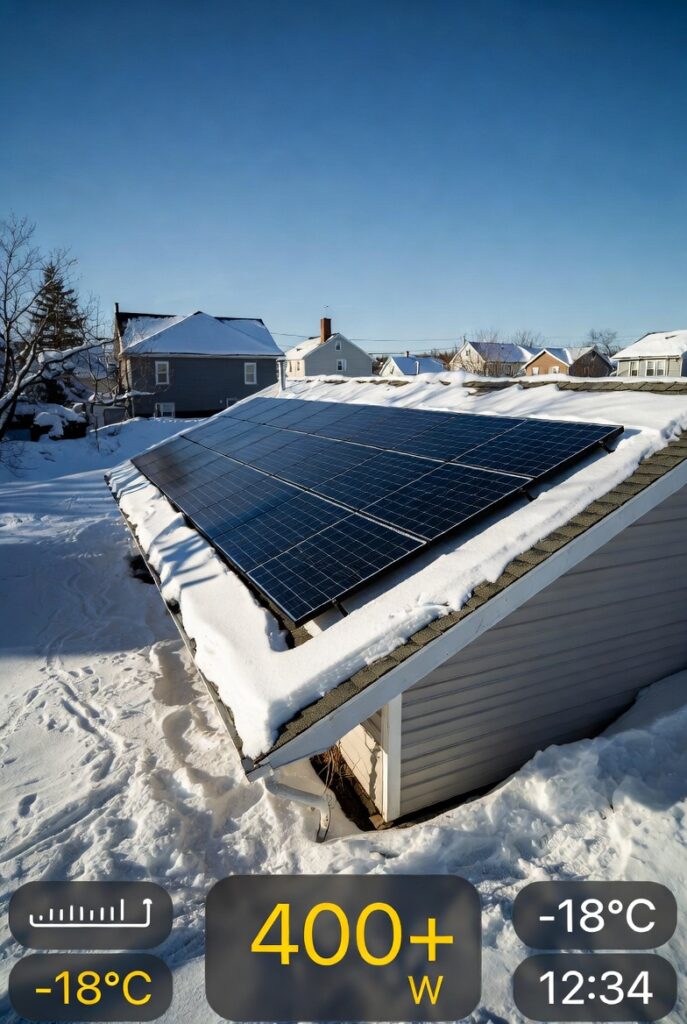
Every winter solar power question I get from Ontario homeowners comes down to one fear: that January means dead panels and a dead battery. The fear is understandable. Short days, snow, and minus temperatures sound like everything a solar system hates. The reality is more useful than the fear: cold temperatures make panels more efficient per watt of sunlight, and the short Ontario winter day is the actual constraint, not the cold. A Renogy 100W panel produces more watts per unit of irradiance on a minus 18C January morning than on a plus 35C July afternoon.
On January 15, 2026, the homeowner at a property on Stone Road West in Guelph, Wellington County, Ontario texted me at 9:47 AM. Her monitoring app showed the 400W array on her south-facing garage roof peaking at 412W. That is 103% of the rated capacity for four 100W panels. The overnight temperature had dropped to minus 18C and the sky was clear blue after three days of cloud cover.
I explained what she was seeing: the temperature coefficient working in her favour and snow albedo from the fresh driveway contributing reflected light to the panels. At minus 18C panel surface temperature, a 400W monocrystalline array produces a theoretical maximum of 460W at any given irradiance. The fresh driveway snow was reflecting 60 to 90% of incident light back upward, adding 15 to 20% to the harvest.
I checked her full January 15th data that evening. The array produced 847Wh from 8:23 AM when output first cleared 10W to 4:51 PM when it dropped back below 10W. That is an 8.47-hour production window compared to a July day’s 14-hour window. However, the hourly output was higher per unit of sunlight because of the temperature advantage. Her average July clear-day harvest was 1,240Wh. Her January 15th clear-day harvest was 847Wh, which is 68.3% of the summer peak. Winter solar power on a clear Ontario day is not dead. It is two-thirds of a summer day in total harvest.
What winter solar power actually produces on a January day in Ontario
The monthly averages for a south-facing 45-degree tilt 400W array in the Guelph area tell a clear story. December averages approximately 350 to 450Wh per day across the full month including both clear and overcast days. January averages 400 to 500Wh per day. February climbs to 500 to 700Wh per day as daylight hours lengthen. On clear days within those months the output is higher: the Stone Road West January 15th result of 847Wh sits at the upper end of the January clear-day range. On overcast days the output drops to 80 to 250Wh, consistent with the cloudy weather solar output data for the region.
Those monthly averages are enough to run low-power critical loads continuously. A router at 18W, LED lighting at 30W, and phone charging at 20W total 272Wh of daily consumption. The January average of 400 to 500Wh covers that load with margin every day of the month. For any load above that level, including a refrigerator, a desktop PC, or a space heater, the winter solar harvest alone is not sufficient. Battery storage bridges the overnight gap, and the correct winter solar power strategy is to charge the battery fully during the 8 to 9 hour production window and draw from it through the 15 to 16 hour overnight period.
| Month | Daily Average (400W array, 45° tilt) | Clear Day Peak | Overcast Day | Production Window |
|---|---|---|---|---|
| December | 350 to 450Wh | 700 to 900Wh | 80 to 180Wh | ~7.5 hrs |
| January | 400 to 500Wh | 800 to 900Wh | 80 to 200Wh | ~8.5 hrs |
| February | 500 to 700Wh | 900 to 1,100Wh | 100 to 250Wh | ~9.5 hrs |
| July (reference) | 1,100 to 1,400Wh | 1,200 to 1,400Wh | 200 to 500Wh | ~14 hrs |
Snow on panels vs snow around panels: the albedo difference that surprises beginners
Snow interacts with a winter solar power system in two completely opposite ways depending on where it lands. Snow on the panel surface blocks light completely and drops output to zero until it slides off or is cleared. Snow around the panels on the ground, driveway, or roof below the array reflects 60 to 90% of incident light back upward toward the panel face. The Stone Road West 412W result on January 15th happened because the driveway snow was contributing albedo gain while the panels themselves were clear. Both effects were present simultaneously, working in opposite directions on different parts of the system.
The practical rule for managing snow on panels is tilt angle. A panel at 60 degrees of tilt sheds snow by gravity within hours of the sun hitting the surface. A panel at 25 degrees holds snow for days. In January 2026 on the 10th Line in Erin Township, Wellington County, a ground-mount array at 60-degree winter tilt shed its full 22 cm snow load within 4 hours of the January 13th morning sun.
The roof-mounted neighbour with the same 400W array at 25-degree tilt lost 36 hours of production. The 10th Line owner produced 612Wh on January 13th while the neighbour produced 0Wh. For detailed snow management and structural considerations, see our guide on solar panel tilt angles for Ontario winters.
The tilt angle factor: why 60 degrees in January beats 25 degrees year-round
Guelph sits at 43.5 degrees north latitude. In January, the sun reaches only about 22 degrees above the southern horizon at solar noon. For a panel to be perpendicular to that sunlight it needs to be tilted at approximately 68 degrees. A 60-degree winter tilt is the practical compromise: it catches the low January sun effectively and allows snow to slide off by gravity rather than accumulating. A 25-degree summer tilt optimised for the high July sun angle is the worst possible angle for Ontario January winter solar power management because it is nearly parallel to the low winter sunlight and flat enough to hold snow for days.
The Erin Township 10th Line result confirmed this directly. At 60-degree winter tilt, the array self-cleared within 4 hours after a 22 cm storm and produced 612Wh the following day. The 25-degree roof mount neighbour produced 0Wh on the same day. For the full seasonal tilt calculation and how to adjust a ground mount for maximum winter output, see our complete guide on solar panel tilt angles for Ontario winters. The calculation is straightforward and the result is worth the effort of making the seasonal adjustment.
The winter solar power temperature advantage: why minus 18C beats plus 35C
The temperature coefficient of a standard monocrystalline silicon solar panel is approximately minus 0.35% per degree Celsius above 25C. Below 25C the relationship reverses: for every degree below 25C the panel produces 0.35% more output at any given irradiance. At minus 18C, a 400W panel produces 400 x (1 + 0.35% x 43) = 460W theoretical maximum at full irradiance. At plus 60C on a July afternoon, the same panel produces 400 x (1 – 0.35% x 35) = 351W at the same irradiance. The cold Ontario January delivers 31% more output per unit of sunlight than a hot July afternoon. The Victron SmartSolar MPPT 100/30 extracts the maximum available power from this cold-boosted voltage.
One important caution: as temperature drops, panel open-circuit voltage also rises above the STC rating. A 100W panel with 21V Voc at 25C produces approximately 24.6V Voc at minus 18C. Four panels in series produce 4 x 24.6V = 98.4V, which sits just under the Victron MPPT 100/30’s 100V maximum input voltage. A system designed at the edge of MPPT input limits in summer can exceed those limits on a cold January morning. This is the over-voltage risk that every Ontario winter solar power installation must account for at the design stage. For full over-voltage guidance specific to Ontario cold-climate systems, see our cold climate solar voltage guide.
The January daylight constraint: managing your energy budget in the short days
The January production window in Guelph runs from approximately 8 AM to 4:30 PM, which is 8.5 hours. In July the same location produces from about 5:30 AM to 8:30 PM, a 15-hour window. The temperature advantage on cold clear days does not compensate for the 6.5-hour reduction in production time. The correct winter solar power management strategy is to treat the production window as the only charging opportunity and plan all significant loads accordingly. Run the dishwasher, washing machine, or power tools between 10 AM and 2 PM when irradiance is highest. Leave those loads for overnight and the system will deplete faster than the next day’s harvest can recover.
Battery cold-weather performance is a separate constraint that compounds the short-day issue. LFP batteries perform well down to minus 20C on discharge, but charge inhibit activates at 0C, meaning the battery cannot accept charge from the panels if it is below freezing. A battery in a cold unheated garage on a minus 18C January morning may refuse to accept the morning’s solar harvest entirely. For complete guidance on managing batteries through Ontario winters, see our guide on cold weather solar battery performance. The panels and the battery are two separate systems in winter, and both need management.
NEC and CEC: code compliance for solar panel installations in Ontario
NEC 690 governs solar photovoltaic system design and installation across all configurations including off-grid, grid-tied, and battery-backed systems. NEC 690.7 specifically addresses maximum voltage calculations for series-connected PV source circuits, which is the over-voltage concern described above. A system installed without proper winter voltage calculations may exceed NEC 690.7 limits on the first cold clear morning of the year. NEC 690.12 requires rapid shutdown for rooftop arrays. All electrical work on PV systems must be performed or supervised by a licensed electrician. Contact the NFPA at nfpa.org for current NEC 690 requirements applicable to solar PV installations in your jurisdiction.
In Ontario solar PV installations are governed by CEC Section 50, which applies to all photovoltaic systems including the off-grid and hybrid battery-backed configurations most common on rural Ontario properties. An ESA permit is required before installation begins on any Ontario residential or commercial property. The permit requirement applies to both rooftop and ground-mounted arrays. For Ontario-specific winter solar power installations, the over-voltage consideration under CEC Section 50 is particularly relevant: the code requires that maximum system voltage be calculated at the lowest expected operating temperature, not STC. Contact the Electrical Safety Authority Ontario at esasafe.com for current permit requirements before beginning any solar installation in Ontario.
Pro Tip: Before your first Ontario winter, verify your MPPT input voltage headroom with a cold-temperature calculation. Take your panel’s Voc from the spec sheet, apply the temperature coefficient at minus 20C (the coldest realistic Ontario panel temperature), and multiply by the number of panels in series. If that number is within 5% of your MPPT maximum input voltage, you need to redesign the string configuration. The Stone Road West system with four panels in series at minus 18C produced 98.4V against a 100V MPPT maximum. That 1.6V margin is acceptable but not comfortable. A five-panel series string on the same MPPT would have exceeded 100V on that January morning and triggered over-voltage protection.
The winter solar power verdict: what your array can and cannot cover in January
- For the Ontario homeowner with low-power critical loads under 300W: winter solar power covers your daily needs year-round. The Stone Road West 400W array averaged 400 to 500Wh per day in January, which comfortably covers a router at 18W, LED lighting at 30W, and device charging at 50W totalling 272Wh of daily consumption. On clear days like January 15th, the 847Wh harvest covered that load and had 575Wh remaining to top the battery. For anyone whose outage essentials are communication, lighting, and device charging, a properly installed south-facing array produces enough winter solar power to meet those needs every day of the year in Ontario.
- For the rural property or cottage owner who needs the system to run through January storms: tilt angle and battery storage are the tools, not more panels. The Erin Township 10th Line result is the template. A 60-degree winter tilt ground mount shed 22 cm of snow within 4 hours without any manual clearing and produced 612Wh the following day while the 25-degree roof mount neighbour produced 0Wh. Combined with a properly housed battery bank kept above 0C, that self-clearing array delivers reliable winter solar power through the entire Ontario winter without roof climbing or manual snow management.
- For the off-grid homeowner running a full household load through January: winter solar power is part of the solution, not the whole answer. A 400W array averaging 400 to 500Wh per day cannot sustain a full household drawing 2,000 to 4,000Wh per day through the short winter days. The correct design adds battery storage sized for 3 to 5 days of autonomy, a grid connection or generator for January top-up, and aggressive load shifting of all high-draw appliances to the 8 to 9 hour daily production window. Winter solar power covers a meaningful fraction of the load and reduces generator runtime. It does not eliminate the generator requirement for a full Ontario household in January.
Frequently Asked Questions
Q: What does winter solar power actually produce in Ontario in January?
A: On a clear January day in the Guelph area, a south-facing 400W array at 45-degree tilt produces 800 to 900Wh. The monthly average across all clear and overcast January days is 400 to 500Wh per day. Overcast January days produce 80 to 200Wh. The January 15th Stone Road West clear-day result of 847Wh is a confirmed benchmark for what is achievable on the best winter days in Wellington County.
Q: Does winter solar power work well enough to keep a battery topped up between storms?
A: Yes, if the array is properly tilted for snow shedding and the battery is kept above 0C for charging. The 10th Line Erin Township ground mount at 60-degree tilt self-cleared within 4 hours after the January 12th storm and produced 612Wh the following day. A south-facing array at 60-degree tilt that clears itself after each storm delivers consistent winter solar power between events. A flat or low-tilt array that holds snow can lose 36 or more hours of production after a single storm.
Q: What is the biggest mistake Ontario homeowners make with winter solar power management?
A: Running high-draw loads during the evening and overnight instead of shifting them to the 8 to 9 hour production window. In January, the production window in Guelph runs from approximately 8 AM to 4:30 PM. Every watt-hour consumed outside that window draws from battery storage that may not fully recover the next day on an overcast winter morning. The second most common mistake is leaving a battery in an unheated space where the 0C charge inhibit prevents the panels from topping it up even on clear winter days.
This build is engineered within the 48V DC Safety Ceiling. Diagnostic logic is based on 20+ years of technical service experience. All structural and electrical installations must be verified by a Licensed Professional and comply with your Local AHJ.
About the Author
Robert Bertrand spent 20 years as a service advisor in the automotive industry (Lexus and Nissan), where precision diagnostics, wiring integrity, and documentation standards were non-negotiable. He brings that same technical discipline to GridFree Guide, where he researches, tests, and documents off-grid solar systems for Ontario conditions. Based in Rockwood, Ontario, every article is built on verified specifications, manufacturer data, and the real-world climate constraints of Canadian off-grid living.
As an Amazon Associate I earn from qualifying purchases. This site also contains affiliate links to other products and services. GridFree Guide earns a small commission at no extra cost to you.