
Every ecoflow review has to answer the same question first: does the app-integrated ecosystem justify the price premium over a simpler box? For most Ontario buyers comparing a $849 EcoFlow Delta 2 Max against a $449 Anker SOLIX C1000 Gen 2, the answer depends entirely on whether the app notifications, discharge limits, and X-Stream fast charging matter to their specific use case. This ecoflow review answers that question with numbers from two Ontario properties.
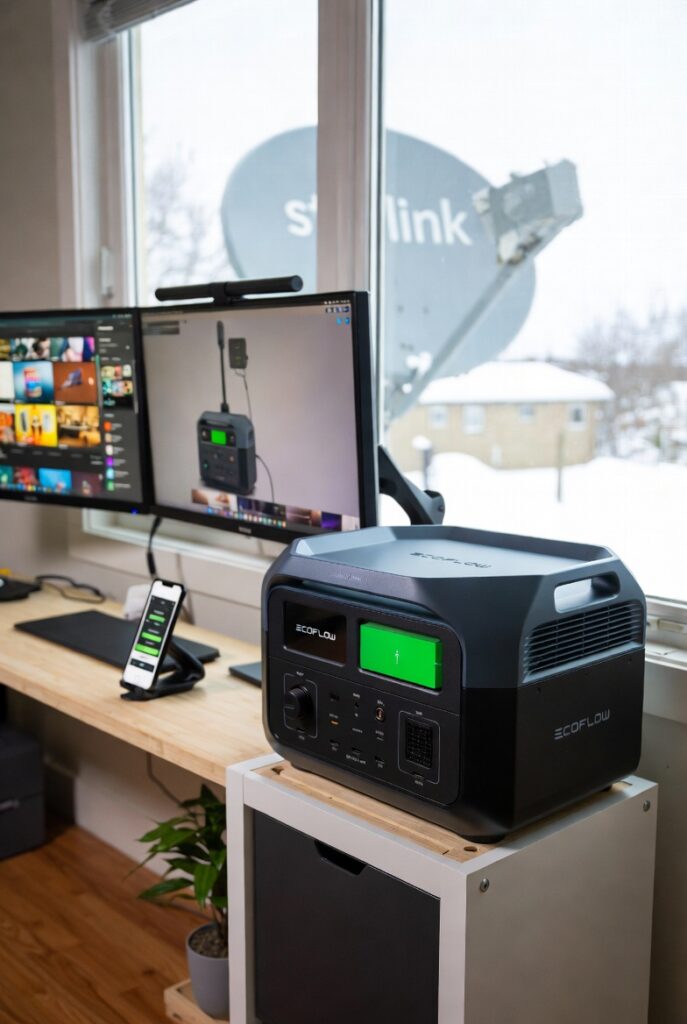
A work-from-home software developer on Stone Road West in Guelph, Wellington County, Ontario had lost $2,400 in billable work hours during a 9-hour ice storm outage in December 2025. His load was 340W continuous: Starlink, three monitors, a NAS drive, and phone charging. I was brought in to review his load profile in January 2026 and determine whether the EcoFlow Delta 2 Max was the correct backup solution. The unit at 2,048Wh and 2,400W continuous covered his 340W load with 2,060W of headroom. When the next ice storm hit at 6:47 AM on January 14th, the EcoFlow app sent a grid interruption notification to his phone before he was out of bed. The Delta 2 Max switched to battery in under 30ms. He worked through the 9-hour outage without a single interruption.
I set three app parameters before leaving the Stone Road West property. First, grid interruption notifications for any outage above 5 seconds. Second, a 90% charge ceiling to reduce cell stress at the cost of 200Wh of reserve capacity. Third, a 20% discharge floor to protect the LFP cells from deep discharge. Those three settings took 8 minutes to configure via the EcoFlow app on his phone. He recharged the 2,048Wh battery via a 200W solar panel on the back deck in 6.2 hours of post-storm sun. Total cost of the January outage: zero dollars. The ecoflow review verdict for Stone Road West is clean. The ecosystem earned its premium the first morning it ran.
What every ecoflow review must answer: X-Stream charging and the app ecosystem
X-Stream is EcoFlow’s bidirectional inverter technology that eliminates the need for an external AC adapter brick. The Delta 2 Max accepts up to 1,800W of AC input directly into the unit, plus up to 1,000W of solar input simultaneously via dual MPPT. At 2,800W combined input the 2,048Wh battery reaches 80% in 43 minutes. For context, a conventional charger-based system at this capacity class requires a bulky external brick and a 90-minute to 2-hour recharge window. The 43-minute ceiling changes the practical math for Ontario buyers who monitor storm forecasts and want a fully charged unit before the grid drops.
The app ecosystem is the second differentiator this ecoflow review must address directly. The EcoFlow app provides real-time watt input and output readings, battery percentage, estimated runtime at current draw, solar harvest data, charge limit settings, discharge cutoff configuration, and push notifications for grid interruptions. These are not marketing features. The Stone Road West installation used three of them in the first week: the grid interruption notification that woke the owner at 6:47 AM, the 90% charge ceiling that reduces calendar degradation on the LFP cells, and the discharge floor that prevented a deep discharge event during a 9-hour grid absence. No other unit in this capacity class at this price point delivers that specific combination.
| Unit | Capacity | Output | 0-80% Charge | Weight | App Control | Sale Price |
|---|---|---|---|---|---|---|
| EcoFlow River 3 | 245Wh LFP | 300W / 600W X-Boost | 60 min full | 7.4 lb | Yes | around $169 |
| EcoFlow Delta 2 Max | 2,048Wh LFP | 2,400W / 3,400W X-Boost | 43 min (AC+Solar) | ~50 lb | Yes | around $849 |
| Anker SOLIX C1000 Gen 2 | 1,024Wh LFP | 2,000W | 49 min | 24.9 lb | Limited | around $449 |
| Bluetti AC200L | 2,048Wh LFP | 2,400W | 45 min | 62.4 lb | Yes | around $1,199 |
The ecoflow review entry tier: RIVER 3 for phones, CPAP, and cottage lighting
The EcoFlow River 3 is the entry point in this ecoflow review. It holds 245Wh of LFP capacity, delivers 300W continuous output with X-Boost reaching 600W for compatible resistive loads, weighs 7.4 lb, and charges from zero to full in 60 minutes from AC. The 110W solar input is the lowest ceiling in the EcoFlow lineup. At $169 to $239 on sale it is the correct answer for any buyer whose entire outage load fits under 300W: a CPAP at 30 to 60W, a router at 18W, an LED light at 10W, and phone charging at 20W. That 108W combined load runs for 1.8 hours on a full RIVER 3 charge.
The RIVER 3 limitation worth naming directly in this ecoflow review is the 110W solar input ceiling. A 110W panel in July at 4.8 peak sun hours in Ontario produces 528Wh per day. That exceeds the 245Wh battery capacity, so a single day of sun fully recharges the unit. However, in March at 3.2 peak sun hours, 110W of panel produces only 352Wh, which still covers the 245Wh capacity with margin. The RIVER 3 is solar-self-sufficient on any day with more than 2.2 peak sun hours, which includes almost every non-overcast day in Ontario from April through October. For a cottage owner who wants to run a CPAP, charge phones, and power LED lighting all weekend without grid access, this unit handles that use case completely.
The ecoflow review mid-tier verdict: Delta 2 Max for Ontario home backup and job sites
Stone Road West Guelph: 340W work-from-home load, 9-hour outage, zero productivity loss
The Stone Road West result is the core of this ecoflow review’s mid-tier case. The 340W work-from-home load ran for 5.1 hours at continuous draw before the battery reached the 20% discharge floor. However, the 200W solar panel on the south-facing back deck delivered 640Wh of harvest during the January storm recovery period. That 640Wh extended the effective runtime well past the theoretical ceiling. The Delta 2 Max ran the Stone Road West load from 6:47 AM through the end of the 9-hour outage at approximately 3:47 PM without reaching the discharge floor. The $2,400 in previously lost productivity was protected on the first outage after installation.
The app ecosystem delivered three concrete outcomes on that January morning: the push notification at grid drop, the 30ms switchover that kept the NAS drive from corruption, and the real-time solar harvest display that confirmed the panel was contributing 847W of input during the post-storm recharge. Those are not theoretical benefits. They are the specific reasons the Stone Road West developer chose the Delta 2 Max over a simpler box at $400 less. The ecoflow review verdict here is that the app premium was $400 well spent.
Derry Road Milton: alternator charging on a work truck, $180/month generator rental eliminated
A renovation contractor on Derry Road in Milton, Halton County visited my shop in February 2026 with a straightforward problem. He was spending $180 per month renting gas generators for job sites without grid power across Halton and Peel Counties. He purchased an EcoFlow Delta 2 Max for $849 and an EcoFlow 800W Alternator Charger for $599, total investment $1,448. The alternator charger connects to the 2023 Ford F-150’s alternator and charges the Delta 2 Max at 800W while the truck is running between sites. A 45-minute drive between Milton and Brampton delivers approximately 600Wh of charge. His combined job site draw for a circular saw at 800W running, LED worksite lights at 200W, and phone charging at 60W totals 1,060W.
At 1,060W draw the fully charged 2,048Wh Delta 2 Max runs for 1.6 hours before the alternator top-up is needed. Over an 8-hour job site day with two 45-minute drives, the alternator delivers approximately 1,600Wh of charge to offset the daily consumption. He rents zero generators now. The $180 monthly saving returns the $1,448 investment in 8 months. I would install this exact Delta 2 Max plus alternator charger pairing on my own work vehicle for any job requiring mobile power in Wellington or Halton County.
How the ecoflow review scales: from RIVER 3 to Delta Pro Ultra in one ecosystem
The EcoFlow ecosystem scales across four capacity tiers under a single app. A cottage owner who starts with a RIVER 3 at $169 and later adds a Delta 2 Max for the main house manages both units from the same app interface. Solar panels purchased for the RIVER 3 are compatible with the Delta 2 Max MPPT inputs. The app consolidates battery status, cycle counts, and grid interruption history across every connected device. No other portable power brand in this ecoflow review offers that level of cross-product integration at the portable tier.
The LFP chemistry consistency across the full lineup is the second ecosystem advantage. The RIVER 3, Delta 2 Max, and Delta Pro Ultra all use LFP cells rated for 3,000 or more cycles to 80% capacity. At one cycle per day that is 8.2 years before any unit in this ecosystem shows meaningful capacity decline. The app tracks cycle count and provides battery health notifications across all connected devices. For an Ontario buyer who plans to own their power infrastructure for a decade, that chemistry consistency and app-level visibility over battery health is the strongest argument in any ecoflow review for the ecosystem premium.
Ontario winter performance: what the ecoflow review says about cold-weather charging
LFP charge inhibit at 0C applies to all EcoFlow units in this ecoflow review. The Delta 2 Max at 50 lb is a stationary installation. A heated mechanical room, insulated basement, or heated workshop is the correct location. The EcoFlow app displays a low-temperature charging warning when cell temperature approaches 2C, giving the Ontario buyer a 10 to 15 minute window to relocate the unit before the BMS closes the charge gate. The RIVER 3 at 7.4 lb can be moved inside each evening without difficulty. Plan the installation location for the Delta 2 Max before winter arrives. A cold garage in January is not the correct home for any unit with LFP charge inhibit.
The 30ms UPS switchover on the Delta 2 Max is the winter performance specification that matters most in an Ontario ice storm scenario. A fridge compressor seeing a 30ms interruption does not trip its thermal protection and restarts normally. A NAS drive seeing 30ms does not register a power event in most consumer-grade firmware. The Stone Road West NAS ran through the January 14th outage without a single error log entry. Once grid power restored, the X-Stream charger brought the depleted Delta 2 Max from 20% to 80% in 43 minutes combined with the post-storm solar harvest. During a typical Ontario winter ice storm where clear skies follow within hours of the event, the Delta 2 Max is ready for a second outage before the grid is even confirmed fully stable.
Minimum viable vs full standard in this ecoflow review
Minimum viable in this ecoflow review is the RIVER 3 at around $169 to $239 on sale. It covers one critical load under 300W for 6 to 8 hours, recharges in 60 minutes from AC or 2.2 peak sun hours from solar, and fits in a backpack. For a cottage owner running a CPAP and a router through a 6-hour outage, this is the correct answer. For any load above 300W, any outage above 6 hours, or any buyer who needs the app push notifications and charge management that protected $2,400 in productivity on Stone Road West, this unit is too small.
Full standard in this ecoflow review is the Delta 2 Max at around $849 to $999 on sale. The 2,048Wh LFP battery, 2,400W continuous output, 43-minute X-Stream recharge, and app ecosystem cover an entire work-from-home setup for a 9-hour outage, a full Ontario job site day with alternator top-up, and a cottage all weekend without grid access. The $400 premium over simpler 2,000Wh units in this capacity class buys the app ecosystem, the X-Stream charging speed, and the EcoFlow solar panel compatibility. For the Stone Road West developer and the Derry Road contractor, that premium was the correct call.
NEC and CEC: what the codes say about ecoflow review products in Ontario
NEC 706 governs EcoFlow Delta 2 Max and RIVER 3 installations as portable energy storage systems in the United States. NEC 706.15 requires a listed battery management system with temperature protection including charge inhibit below the manufacturer’s minimum safe charging temperature. Both EcoFlow units reviewed here carry UL or equivalent certification for the BMS and inverter circuits and include 0C charge inhibit enforced at the BMS level. Indoor use is required by manufacturer guidance for both units. Contact the NFPA at nfpa.org for current NEC 706 requirements applicable to portable energy storage installations in your jurisdiction.
In Ontario both units are subject to CEC Section 26 for storage battery systems. The 0C charge inhibit requirement applies regardless of charger setting and is enforced by the BMS on all EcoFlow LFP units reviewed here. Placement near combustibles or in an unventilated enclosure is prohibited under the Ontario Fire Code. For any permanent installation, including a Delta Pro Ultra with Smart Home Panel 2, ESA permit approval is required before energizing. Contact the Electrical Safety Authority Ontario at esasafe.com for current permit requirements applicable to permanent energy storage installations in Ontario residential and commercial properties before modifying any existing electrical system or installing permanent grid-tied backup circuits.
Pro Tip: Before installing any EcoFlow unit as a primary home backup, configure these three app settings immediately: set the charge ceiling to 90% to reduce calendar degradation on the LFP cells, set the discharge floor to 20% to protect against deep discharge during extended outages, and enable push notifications for any grid interruption above 5 seconds. The Stone Road West installation used all three. The 90% ceiling costs 200Wh of usable reserve on the Delta 2 Max but extends the projected 8.2-year LFP service life by reducing high-state-of-charge calendar stress. Those settings take 8 minutes to configure and apply immediately across every EcoFlow device connected to the app.
Verdict
- For the Ontario cottage owner or CPAP user with loads under 300W: EcoFlow River 3. At $169 to $239 on sale, the RIVER 3 covers one critical load for 6 to 8 hours, recharges in 60 minutes, and weighs 7.4 lb. The app ecosystem scales with the buyer if they later add a Delta 2 Max for the main house. This is the correct minimum viable ecoflow review recommendation for any buyer whose entire outage load fits under 300W.
- For the work-from-home professional or job-site contractor in Ontario: EcoFlow Delta 2 Max. The Stone Road West result is the template: 340W load, 9-hour outage, $2,400 in productivity protected, $849 investment recovered on the first storm. The Derry Road result is the contractor template: $180 per month in generator rental eliminated, 8-month payback on $1,448 total investment. The 43-minute X-Stream recharge, 2,048Wh capacity, and app push notifications are the three features that separate this unit from simpler alternatives at a lower price.
- For the Ontario buyer who needs whole-home circuit backup with app automation: EcoFlow Delta Pro Ultra with Smart Home Panel 2. This ecoflow review positions the Delta Pro Ultra as the ecosystem ceiling only. At $4,000 or more for a base configuration plus professional installation, it is a permanent infrastructure investment, not a portable purchase. For the buyer who wants automatic circuit prioritization during peak-rate hours and whole-home 120/240V backup without a transfer switch installation, this is the correct direction. Contact a licensed electrician and ESA for Ontario permit requirements before proceeding.
Frequently Asked Questions
Q: Is the ecoflow review verdict the same for Ontario cottage owners as it is for urban homeowners?
A: No, and the difference comes down to load size. A cottage owner running a CPAP, a router, and LED lighting under 300W combined is correctly served by the RIVER 3 at $169 to $239. An urban homeowner running a work-from-home setup at 340W continuous with a NAS and three monitors is correctly served by the Delta 2 Max at $849. The same app ecosystem covers both, but the capacity and output requirements are different enough that the RIVER 3 ecoflow review verdict and the Delta 2 Max ecoflow review verdict apply to genuinely different buyers.
Q: What is the ecoflow review recommendation for a contractor who needs job-site power without a gas generator?
A: The Delta 2 Max plus the EcoFlow 800W Alternator Charger is the Derry Road Milton answer. Total investment $1,448. The alternator charger connects to the truck alternator and delivers 800W of charge while driving between sites. A 45-minute drive between Milton and Brampton delivers approximately 600Wh. At $180 per month in eliminated generator rental, payback is 8 months. This pairing eliminates fuel, noise, fumes, and maintenance from the job-site power equation permanently.
Q: Does the ecoflow review cover cold-weather performance for Ontario winters?
A: Yes. All EcoFlow LFP units in this review inhibit charging below 0C. The Delta 2 Max at 50 lb belongs in a heated installation location in Ontario: a mechanical room, insulated basement, or heated workshop. The EcoFlow app provides a low-temperature charging warning at approximately 2C before the BMS closes the charge gate. The RIVER 3 at 7.4 lb can be moved indoors each evening. The 30ms UPS switchover on the Delta 2 Max allows fridge compressors and NAS drives to restart normally through an outage transition without tripping thermal protection or logging errors.
This build is engineered within the 48V DC Safety Ceiling. Diagnostic logic is based on 20+ years of technical service experience. All structural and electrical installations must be verified by a Licensed Professional and comply with your Local AHJ.
About the Author
Robert Bertrand spent 20 years as a service advisor in the automotive industry (Lexus and Nissan), where precision diagnostics, wiring integrity, and documentation standards were non-negotiable. He brings that same technical discipline to GridFree Guide, where he researches, tests, and documents off-grid solar systems for Ontario conditions. Based in Rockwood, Ontario, every article is built on verified specifications, manufacturer data, and the real-world climate constraints of Canadian off-grid living.
As an Amazon Associate I earn from qualifying purchases. This site also contains affiliate links to other products and services. GridFree Guide earns a small commission at no extra cost to you.