
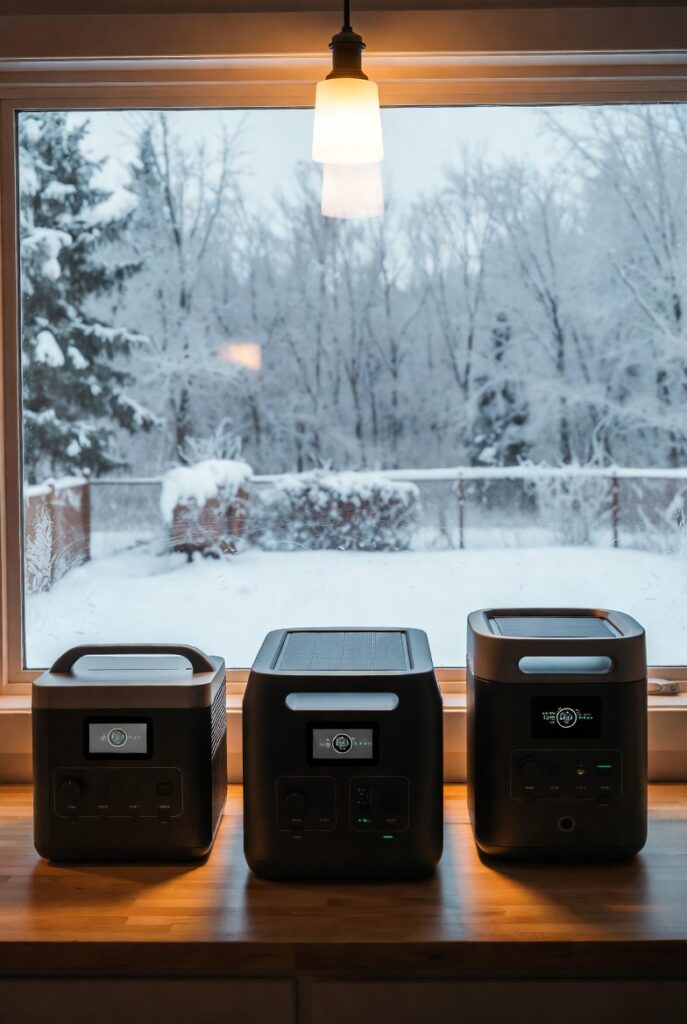
Solar generators 500 watt class units are the entry point where LFP battery chemistry finally became affordable, and that change matters more than any spec on the box. Before 2023, every unit under $300 used NMC lithium-ion cells rated for 500 to 800 cycles before hitting 80% capacity. That meant a unit cycled three times a week would degrade noticeably inside two years. The solar generators 500 tier today uses LFP cells rated for 3,000 cycles at the same price point, which changes the service life math entirely for Ontario buyers who need reliable seasonal backup.
I visited a property on Elora Road in Fergus, Wellington County, Ontario in January 2026. The owner had a Bluetti AC2A she bought for $149 during a Boxing Day sale, intended for CPAP backup. Her partner’s ResMed AirSense 10 draws 33W in standard mode without heat. At 33W draw, the 204.8Wh battery delivers 5.8 hours before the BMS low-voltage cutoff. When she called me, the unit was shutting off at 4.1 hours. I drove to the property on a Tuesday morning to review the setup. The problem was not the unit.
The actual problem was the humidifier. The heated humidifier on the ResMed AirSense adds 45 to 55W to the draw, pushing total consumption to 78 to 88W. At 80W average the 204.8Wh unit delivers 2.2 hours of runtime, not 5.8 hours. I showed her how to disable the humidifier in the ResMed settings for outage mode. The unit immediately delivered 5.3 hours of CPAP runtime on its next test cycle. After 22 full cycles the battery app read 98% of original capacity. The lesson from Elora Road is that solar generators 500 tier units are not underpowered. They are undersized for loads above 40W running more than 4 hours, and the humidifier is the most common reason a CPAP buyer gets that wrong.
Why solar generators 500 watt class units became the right answer in 2024
The inflection point was February 2024 when the Bluetti AC2A launched in Canada at $179 with LFP cells rated for 3,000 cycles. Before that date every unit under $300 used NMC chemistry. The AC2A was the first sub-$200 LFP unit from a tier-one brand sold through Amazon.ca, and it made the cycle life argument accessible at a price most Ontario buyers could justify for a CPAP backup or cottage emergency kit. EcoFlow and Jackery followed with their own sub-$300 LFP units inside six months.
The practical result for an Ontario buyer is that solar generators 500 class units now offer the same battery chemistry that was previously only available in $800 units. A unit bought today for $149 to $279 will cycle daily for 8 to 10 years before dropping to 80% capacity. That service life outlasts most gas generators at this price point and does it in complete silence with no fuel storage requirement. For cottage owners and emergency preparedness buyers in Wellington, Simcoe, and Grey counties, that trade is straightforward.
| Model | Capacity | Output | Weight | Cycles | Solar Input | AC Recharge | AC Outlets | Typical Sale Price |
|---|---|---|---|---|---|---|---|---|
| Bluetti AC2A | 204.8Wh | 300W / 600W lift | 7.9 lb | 3,000 to 80% | 200W max | 45 min to 80% | 2 | around $149 |
| EcoFlow RIVER 3 | 245Wh | 300W / 600W X-Boost | 7.4 lb | 3,000+ to 80% | 110W max | 60 min full | 2 | around $169 |
| Jackery Explorer 300 Plus | 288Wh | 300W / 600W surge | 8.27 lb | 3,000 to 80% | 100W max | 2 hours full | 1 | around $199 |
What solar generators 500 tier units actually cost you in a real Ontario outage
A retired couple in Collingwood, Simcoe County called me in February 2026 after a 7-hour grid outage. They had been relying on a 12-year-old gas generator that failed to start at minus 18C. Their actual load was simple: a router for the security system at 18W and two phones charging at 30W combined, totalling 48W. At 48W draw the EcoFlow RIVER 3 at 245Wh delivers 4.3 hours of router plus phone charging before the BMS cutoff. Any of the three solar generators 500 units covers their load with runtime to spare.
The deciding factor was not capacity. It was weight and port layout. The EcoFlow RIVER 3 weighs 7.4 lb, the lightest unit in the tier. The Jackery Explorer 300 Plus at 8.27 lb would have added 50 minutes of runtime at their 48W draw, but that 0.87 lb difference matters when a 72-year-old is carrying the unit upstairs from a basement. The Collingwood couple recharged their RIVER 3 fully in 58 minutes from the kitchen outlet before the next forecast event. I would install this unit on my own property for communication and lighting loads during winter outages. The deciding number was 48W combined draw, and the deciding factor was getting it up one flight of stairs without a second thought.
The three solar generators 500 units compared: capacity, weight, and recharge speed
Bluetti AC2A: the fastest recharge in the solar generators 500 tier
The Bluetti AC2A holds 204.8Wh, delivers 300W continuous with Power Lifting to 600W for resistive loads, weighs 7.9 lb, and recharges from 0 to 80% in 45 minutes in Turbo mode via the app. At around $149 on sale it is the lowest-cost LFP entry point from a tier-one brand in Canada. The 200W solar input is also the strongest in this comparison, meaning a single 200W panel recovers the battery in 1.2 hours on a clear day, faster than either competitor.
The weakness is the 204.8Wh capacity ceiling. At 40W CPAP draw in no-humidifier mode that is 4.4 hours before the BMS cutoff. The Elora Road scenario showed exactly how an 80W humidifier draw cuts that to 2.2 hours. Power Lifting to 600W works for pure resistive loads like space heaters and electric kettles, not for CPAP motors or compressor fridges. This unit is the right answer for sub-40W single-device use with the fastest pre-storm prep window in the tier.
EcoFlow RIVER 3: lightest unit in the solar generators 500 tier
The EcoFlow RIVER 3 holds 245Wh, delivers 300W continuous with X-Boost to 600W for compatible loads, weighs 7.4 lb, and recharges fully in 60 minutes from a standard outlet. At around $169 on sale it is the lightest sub-$250 LFP unit in this tier and the Collingwood answer for any buyer who needs to move the unit between rooms or floors without planning around its weight. The 1-hour full recharge is the second fastest in the tier.
The 110W solar input cap is the constraint to plan around. On a clear January day a 110W panel takes the full 60 minutes just to recover a depleted 245Wh battery. Compare that to the Bluetti AC2A recovering a 204.8Wh battery in 1.2 hours with a 200W panel input. For buyers who rely on solar recharge between outages rather than wall power, the Bluetti wins on solar recovery speed. The RIVER 3 base model is also not expandable. The River 3 Plus is a different product with expansion capability. This unit is not that.
Jackery Explorer 300 Plus: most capacity in the solar generators 500 tier
The Jackery Explorer 300 Plus holds 288Wh, delivers 300W continuous with 600W surge, weighs 8.27 lb, and recharges fully in 2 hours. At around $199 to $279 on sale it offers the most capacity in this comparison. At 40W CPAP draw in no-humidifier mode the 288Wh battery delivers 6.2 hours before the BMS cutoff, 50 minutes longer than the EcoFlow and 80 minutes longer than the Bluetti. That extra margin covers the full overnight window for most CPAP users.
The 2-hour AC recharge is the tradeoff for that capacity advantage. Pre-storm prep takes twice as long as the Bluetti or EcoFlow. Additionally, the v2 uses a DC8020 solar connector that is physically incompatible with older Jackery DC7909 solar panels without an adapter. If you own older Jackery panels, confirm the connector before ordering. The unit also has only one AC outlet, which limits simultaneous AC device use. For buyers who do not rely on solar recharge and can plan a 2-hour prep window, the 288Wh capacity is the right pick.
Ontario winter reality: what solar generators 500 class units do at minus 18C
All three units use LFP chemistry with a 0C charge inhibit floor enforced by the BMS. In an Ontario January, a unit stored in an unheated garage or vehicle overnight can reach minus 14C or colder. The BMS will refuse every watt of charge current until the cells warm above 0C, regardless of whether you plug into a wall outlet or a solar panel. The fix is the same for all three solar generators 500 units: store them indoors at night in winter and bring them to room temperature before you expect them to accept a charge.
Discharge below 0C is permitted on all three units. The Bluetti AC2A discharge rating extends to minus 20C. The EcoFlow RIVER 3 and Jackery 300 Plus have similar cold-discharge capability. Running any of these solar generators 500 units during a winter outage is safe. Recharging from solar panels or a wall outlet in a cold garage is not. Bring the unit indoors and let it warm for 30 to 60 minutes before plugging in. That 30-minute warm-up is the only cold-weather procedure these units require.
Minimum viable vs full standard in the solar generators 500 tier
Minimum viable in the solar generators 500 tier is the Bluetti AC2A at around $149 on sale. It covers a CPAP in no-humidifier mode for 5.3 hours, a router and two phones for 3.5 hours, and LED lighting through an entire overnight outage. The 45-minute 80% recharge from wall power is the fastest pre-storm prep window available at this price point. For a buyer who wants LFP chemistry and the lowest possible entry price, this is the correct answer.
Full standard for the solar generators 500 tier is the Jackery Explorer 300 Plus at around $199 to $279 on sale. At 288Wh it is the longest-endurance unit in this comparison. The 6.2-hour CPAP runtime in no-humidifier mode covers a full night with margin remaining. The buyer stepping up from the Bluetti pays $50 to $130 more for 83Wh of additional capacity and eliminates the margin anxiety on an overnight CPAP run. The tradeoff is a 2-hour recharge and a single AC outlet. For the buyer who values maximum runtime over fastest prep, this is where to land in the solar generators 500 category.
NEC and CEC: what the codes say about solar generators 500 class units
NEC 706 governs energy storage systems in the United States, including portable units used in residential settings. NEC 706.15 requires a listed battery management system with temperature protection functions including charge inhibit below the manufacturer’s minimum safe charging temperature. All three units in this comparison include BMS with charge inhibit at 0C and carry UL or equivalent certification for the inverter and BMS circuits. Manufacturer guidance recommends indoor use to keep the units away from combustibles and within the operating temperature range for safe charging. Contact the NFPA at nfpa.org for current NEC 706 portable energy storage requirements applicable to your jurisdiction.
In Ontario portable power stations are subject to CEC Section 26 for storage battery systems. The unit must not be charged below the manufacturer’s minimum temperature specification, and placement near heat sources or combustibles is prohibited under the Ontario Fire Code. For permanent installation in a structure rather than portable use, permit requirements apply under the Ontario Building Code and ESA approval is required before energizing. Contact the Electrical Safety Authority Ontario at esasafe.com for current permit requirements applicable to permanent energy storage installations in Ontario residential properties before modifying any existing electrical system.
Pro Tip: Solar generators 500 class units all share the same 0C charge inhibit floor. The single most important cold-weather habit for any of these units is storing them indoors overnight. A unit at room temperature accepts a full charge immediately. A unit at minus 14C from a cold garage sits idle until it warms. In the 30 minutes it takes to warm from cold, the Bluetti AC2A in Turbo mode would already be at 80% charge. Store it warm. Charge it fast. The solar generators 500 tier rewards preparation, not improvisation.
Verdict
- For the CPAP user on a budget: Bluetti AC2A. The Elora Road scenario settled this. At $149 on sale with a 45-minute recharge and 5.3 hours of CPAP runtime in no-humidifier mode, the AC2A is the correct first LFP solar generators 500 purchase for a buyer who needs one device covered overnight. Turn off the humidifier in your CPAP settings before the outage. That one step converts a 2.2-hour unit into a 5.3-hour unit without spending an additional dollar.
- For the portability-first buyer or communication load: EcoFlow RIVER 3. The Collingwood couple settled this at 7.4 lb. Router at 18W plus two phones at 30W equals 48W total, and the RIVER 3 covers that load for 4.3 hours. At 7.4 lb it is the easiest unit to move between floors during a winter outage. The 1-hour full recharge means the battery is topped before a forecast storm with time to spare. For anyone with a sub-50W load and a reason to carry the unit upstairs, this is the solar generators 500 answer.
- For the full-night coverage buyer: Jackery Explorer 300 Plus. At 288Wh and 6.2 hours of CPAP runtime in no-humidifier mode, this is the unit that covers an overnight outage with margin. The buyer who woke up at 4.1 hours in Fergus and reached for the outlet in the dark will not have that problem with the Jackery. The 2-hour recharge requires planning. The single AC outlet requires load discipline. Both are acceptable tradeoffs for a buyer who needs the longest runtime in the solar generators 500 tier.
Frequently Asked Questions
Q: Can solar generators 500 class units run a CPAP machine all night during an Ontario power outage?
A: Yes, with one critical condition. Disable the heated humidifier in your CPAP settings before the outage. At 33W draw without humidifier, the Bluetti AC2A delivers 5.3 hours and the Jackery Explorer 300 Plus delivers 6.2 hours. With humidifier enabled at 80W combined draw, those runtimes drop to 2.2 hours and 3.1 hours respectively. The humidifier is the single most important variable in CPAP runtime from any solar generators 500 class unit.
Q: Which solar generators 500 unit recharges fastest before a winter storm?
A: The Bluetti AC2A recharges from 0 to 80% in 45 minutes using Turbo mode via the Bluetti app, the fastest prep window in this tier. The EcoFlow RIVER 3 recharges fully in 60 minutes. The Jackery Explorer 300 Plus takes 2 hours for a full recharge. If you have one hour before a forecast storm hits, the Bluetti and EcoFlow are both viable. If you have 30 minutes, only the Bluetti reaches 80% in time.
Q: Are solar generators 500 watt class units worth buying without solar panels?
A: Yes. For most Ontario buyers the primary use case is wall-charge backup before a forecast storm. The Bluetti AC2A charges to 80% in 45 minutes from a standard outlet. The EcoFlow RIVER 3 charges fully in 60 minutes. Neither requires a solar panel to be useful as emergency backup. Add a solar panel later if extended off-grid use becomes a priority. The solar generators 500 tier earns its value as a wall-charge unit long before any panel is ever connected.
This build is engineered within the 48V DC Safety Ceiling. Diagnostic logic is based on 20+ years of technical service experience. All structural and electrical installations must be verified by a Licensed Professional and comply with your Local AHJ.
About the Author
Robert Bertrand spent 20 years as a service advisor in the automotive industry (Lexus and Nissan), where precision diagnostics, wiring integrity, and documentation standards were non-negotiable. He brings that same technical discipline to GridFree Guide, where he researches, tests, and documents off-grid solar systems for Ontario conditions. Based in Rockwood, Ontario, every article is built on verified specifications, manufacturer data, and the real-world climate constraints of Canadian off-grid living.
As an Amazon Associate I earn from qualifying purchases. This site also contains affiliate links to other products and services. GridFree Guide earns a small commission at no extra cost to you.