
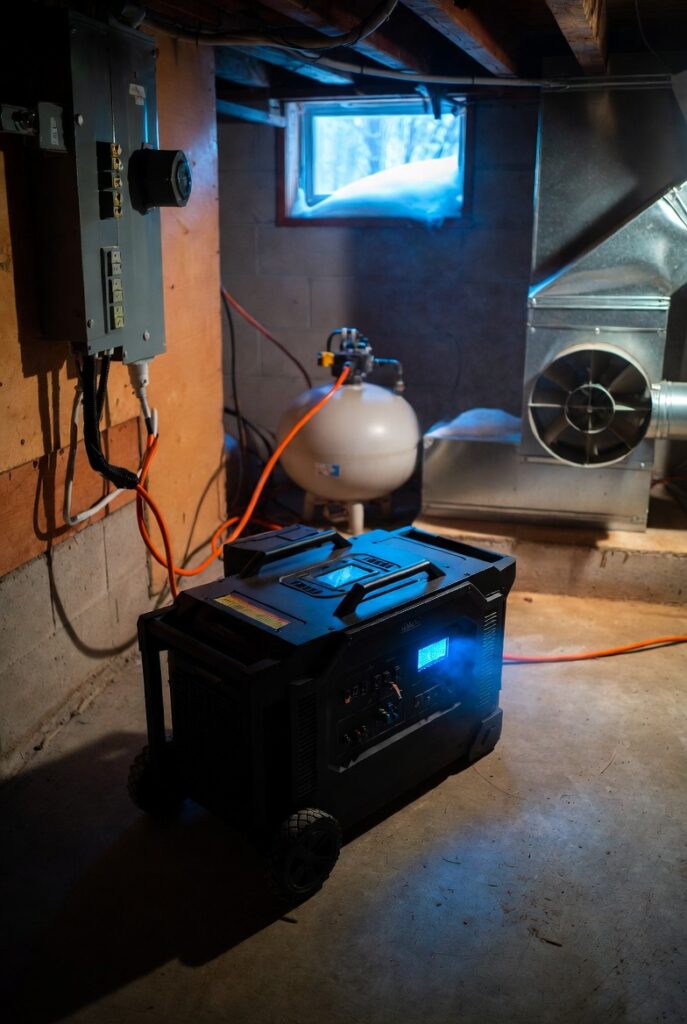
The 3000W solar generator class is the first tier that can realistically handle 240V split phase home loads, and that single spec separates it from everything in the 2000W class below. When I started spec’ing larger home backup systems out of Rockwood 20 years ago, I watched customers make the same mistake over and over: they would buy the unit with the highest continuous output rating and then discover their well pump or central AC wouldn’t even start because the unit was 120V only. Capacity is not the deciding spec in this tier. Voltage architecture is.
I walked through this with a family in Erin, Ontario, whose rural property runs on a deep well pump pulling 1500W continuous with a 4000W cold start surge on the pressure tank cycle. The pump is 240V split phase, wired to the main panel on a double pole breaker. Their January 2025 ice storm outage lasted 14 hours, and their furnace blower added another 450W continuous on top of the pump. The decision eliminated the Jackery HomePower 3000 immediately because it cannot output 240V split phase, so it physically cannot run the well pump regardless of its 3600W continuous rating. That is the trap buyers fall into when they read the spec sheet without checking voltage architecture first.
The right 3000W solar generator is the one whose voltage architecture and recharge ceiling match your actual load profile, not the one with the highest headline number. For buyers who may not need the split phase tier, the 2000W solar generator standard covers the class below this one. For buyers who know they need the 3000W tier, the three units worth comparing are the Anker SOLIX F3800, the EcoFlow DELTA Pro 3, and the Jackery HomePower 3000, and each one has a clear winning use case and a clear weakness.
Why the 3000W Solar Generator Class Is the Real 240V Home Backup Floor
The 3000W solar generator class is the first portable tier that can realistically handle split phase home loads. The typical 240V loads in an Ontario home include well pumps, central AC units, electric dryers, electric ranges, electric water heaters, and Level 2 EV charging. The 2000W tier below cannot handle any of these loads regardless of capacity, because those units are 120V only and the physical wiring on a 240V circuit needs two hot legs 180 degrees out of phase. That is not a capacity problem, it is an architecture problem.
| Unit | Capacity | Continuous | Surge | 240V Split Phase | Weight | Typical Price |
|---|---|---|---|---|---|---|
| Anker SOLIX F3800 | 3840Wh | 6000W | 6000W | Yes (native) | 132 lb | Around $2,799 |
| EcoFlow DELTA Pro 3 | 4096Wh | 4000W (6000W X-Boost) | 8000W | Yes (native) | 113.5 lb | Around $3,299 |
| Jackery HomePower 3000 | 3072Wh | 3600W | 7200W | No (120V only) | ~60 lb | Around $1,899 |
All three units use LiFePO4 chemistry and all three deliver pure sine wave output. The spec sheets diverge on three axes that actually matter in this 3000W solar generator tier: split phase capability, surge ceiling, and weight. When I ran the runtime math for the Erin family, 3840Wh divided by an average 1200W combined load (pump cycling plus continuous furnace) gave them 2.7 hours on the Anker F3800. The EcoFlow DELTA Pro 3 at 4096Wh gave them 2.9 hours. Neither number covered a 14 hour ice storm outage on battery alone, which means the recharge ceiling during daylight hours became the actual deciding spec.
The 3000W Solar Generator Weight and Mobility Tradeoff
The weight ranking in this 3000W solar generator tier is counterintuitive for most buyers. The Jackery HomePower 3000 is the lightest at just under 60 lb, which Jackery markets as the world’s lightest 3kWh portable power station thanks to its cell to body CTB design. The EcoFlow DELTA Pro 3 sits in the middle at 113.5 lb. The Anker SOLIX F3800 is the heaviest at 132 lb.
At this capacity tier, the weight problem is not about whether one person can lift the unit. It is about whether the unit is practical to deploy at all during an emergency. A 132 lb unit with industrial grade caster wheels is manageable on hard floors but essentially immobile on stairs or loose gravel. The Anker SOLIX F3800 has the best mobility aids in the tier with front casters, rear wheels, top and bottom handles, and a retractable pull handle. The EcoFlow DELTA Pro 3 has wide wheels and an ergonomic handle. The Jackery HomePower 3000 has dual side handles and no wheels at all, which is a design choice that only makes sense because the unit is light enough to actually carry.
Choosing Your 3000W Solar Generator by Use Case
The 3000W solar generator decision breaks into four use case buckets. Each bucket has a clear winner once you commit to what the unit is actually for, and the split phase requirement is the first filter you should apply.
Well pump and split phase home backup with existing solar array. The Anker SOLIX F3800 wins this lane on three specs that nothing else in the tier matches simultaneously: 6000W native continuous output, true 120V / 240V split phase with built in NEMA 14-50 and L14-30 ports, and a 2400W dual input solar ceiling. This was the Erin family’s deciding combination. Their existing 1600W ground mount array could push the F3800 back to full charge during daylight hours with margin to spare, which turned a 2.7 hour battery runtime into effectively unlimited runtime as long as the sun was up. The weakness is the 132 lb weight, which is the heaviest in the 3000W solar generator class.
Central AC and highest surge headroom. The EcoFlow DELTA Pro 3 wins the surge lane on the 8000W true surge ceiling, which is the only published spec in the tier with real transient margin above 6000W. I spec’d this out for a couple in Orangeville, Ontario, whose 13,500 BTU central AC pulled 3200W continuous while running and spiked to 5800W on compressor cold start. The Anker SOLIX F3800 at 6000W native continuous is only 200W above that cold start spike, which leaves essentially zero margin for any other load on the circuit. The DELTA Pro 3 at 8000W surge gave them 2200W of margin above the compressor cold start, and they bought it that afternoon. The DELTA Pro 3 also carries the best cycle life in the tier at 4000 cycles to 80 percent, which works out to roughly 11 years of daily full depth of discharge cycling.
Portable 120V cabin and off grid use. The Jackery HomePower 3000 wins the portability lane on three specs: just under 60 lb weight (the lightest in the 3000W solar generator tier by a wide margin), 8W idle consumption (the lowest in the tier, which gives it the best standby performance over weeks or months), and ChargeShield 2.0 technology for long term battery health. This is the right pick for a buyer who does not need 240V, who wants a unit they can actually carry into a cabin without a dolly, and who expects the unit to sit on standby for long stretches between uses. The weakness is 120V only architecture, which eliminates it from any scenario involving a well pump, central AC, electric dryer, electric range, or any other 240V home circuit.
Fastest recharge and UPS protection for sensitive equipment. The EcoFlow DELTA Pro 3 takes this lane again on the 10ms UPS switchover, which is the fastest in the tier, and the 2600W solar input ceiling, which is also the highest in the tier. For a home office with a server, a NAS, or sensitive medical equipment that cannot tolerate even a 20ms dropout, this is the unit.
Ontario Cold Climate Considerations for the 3000W Solar Generator Tier
All three units use LiFePO4 chemistry, which means all three share the same sub freezing charging lockout enforced by the BMS. LFP cells cannot accept a charge below 0°C without internal damage, so every unit in the 3000W solar generator tier blocks charging below freezing automatically. Discharging still works down to minus 20°C. The practical implication in this tier is that weight determines whether the unit can be warmed up in time to matter. A 132 lb Anker SOLIX F3800 stored in an unheated garage is not getting moved inside quickly. The 113.5 lb DELTA Pro 3 is still a two person lift on stairs. The 60 lb Jackery HomePower 3000 is the only unit in this tier that one person can actually carry inside to warm up. The HomePower 3000’s 8W idle consumption also matters in winter, because extended standby at low state of charge in cold conditions is exactly when LFP cells are most vulnerable to capacity loss.
NEC and CEC Compliance for the 3000W Solar Generator Class
All three units meet FCC, CSA, and UL certifications required for legal sale in the USA and Canada. Pure sine wave 60Hz / 120V (HomePower 3000) or 120/240V split phase (F3800 and DELTA Pro 3) AC output matches both NEC (National Electrical Code, USA) and CEC (Canadian Electrical Code) appliance compatibility requirements. Because the F3800 and the DELTA Pro 3 can feed split phase loads, any integration with a home’s fixed wiring via a manual transfer switch, a generator inlet box, or a smart home panel must be verified against your local Authority Having Jurisdiction before energizing. This is especially important at the 3000W solar generator capacity tier where the unit becomes a real backup power source rather than a plug and play appliance. For the current Canadian safety standard on portable power equipment and home backup installations, reference ESA Safe Ontario for the official guidance before integrating any of these units into a fixed installation.
Pro Tip: Always spec your 3000W solar generator by the split phase requirement first, not the capacity or continuous rating. A 1500W well pump is well inside the 3600W continuous rating of the Jackery HomePower 3000, but the unit physically cannot output 240V split phase, so the spec sheet headline is a trap. The right 3000W solar generator for any well pump, central AC, electric dryer, or electric range is one of the two split phase units in the tier, not the unit with the highest 120V continuous number.
Verdict: The 3000W Solar Generator by Profile
- For Well Pump and Split Phase Home Backup, Anker SOLIX F3800. At around $2,799, the F3800 wins the split phase lane on 6000W native continuous, true 120V/240V architecture, and a 2400W dual input solar ceiling. The Erin family chose it because their 1600W ground mount array could top the unit back up during a 14 hour ice storm outage, turning a 2.7 hour battery runtime into effectively unlimited daytime runtime. The weakness is the 132 lb weight, which is the heaviest in the tier.
- For Central AC and Highest Surge Headroom, EcoFlow DELTA Pro 3. At around $3,299, the DELTA Pro 3 wins the surge lane on the 8000W true surge ceiling, the only spec in the tier with real margin above 6000W. The Orangeville couple bought it because their 13,500 BTU central AC spiked to 5800W on compressor cold start, and the DELTA Pro 3 gave them 2200W of margin above that transient. The 4000 cycles to 80 percent rating also makes this the longest-lived unit in the tier by a measurable margin.
- For Portable 120V Cabin and Off Grid Use, Jackery HomePower 3000. At around $1,899, the HomePower 3000 wins the portability lane at just under 60 lb with an 8W idle consumption that gives it the best standby performance in the tier. This is the right pick for a buyer who does not need 240V, wants a unit they can actually carry, and expects it to sit between uses for weeks at a time. The weakness is 120V only architecture, which eliminates every split phase use case.
- For Fastest Recharge and UPS Protection, EcoFlow DELTA Pro 3. The DELTA Pro 3 takes this lane twice because the 10ms UPS switchover is the fastest in the tier and the 2600W solar input ceiling is the highest in the tier. For a home office with a server, a NAS, or sensitive medical equipment, this is the unit.
Frequently Asked Questions
Q: What is the best 3000W solar generator for well pump backup in Ontario?
A: The Anker SOLIX F3800 is the best 3000W solar generator for well pump backup because it provides 6000W native continuous output with true 120V/240V split phase architecture. A typical Ontario deep well pump pulls 1500W continuous with a 4000W cold start surge and must be fed by a 240V split phase source. The Jackery HomePower 3000 cannot output 240V split phase, so it is immediately eliminated from this use case regardless of its 3600W continuous rating.
Q: Can a 3000W solar generator run a 13,500 BTU central air conditioner?
A: Yes, but only the right 3000W solar generator can handle the compressor cold start surge. A 13,500 BTU central AC draws approximately 3200W continuous while running and spikes to 5800W on compressor cold start. The EcoFlow DELTA Pro 3 at 8000W true surge is the only unit in the tier with real margin above that spike. The Anker SOLIX F3800 at 6000W native continuous is only 200W above the cold start transient, which leaves essentially no headroom for any other load on the circuit.
Q: How long will a 3000W solar generator run a furnace and well pump during an outage?
A: The runtime depends on the specific 3000W solar generator and the load profile. For an average 1200W combined load (a cycling well pump plus a continuous furnace blower), the Anker SOLIX F3800 at 3840Wh delivers approximately 2.7 hours of runtime, and the EcoFlow DELTA Pro 3 at 4096Wh delivers approximately 2.9 hours. Neither number covers a full ice storm outage on battery alone, which is why the solar recharge ceiling during daylight hours is the deciding spec for Ontario home backup scenarios. For the broader sizing math across every tier, see the budget solar generator standard.
This build is engineered within the 48V DC Safety Ceiling. Diagnostic logic is based on 20+ years of technical service experience. All structural and electrical installations must be verified by a Licensed Professional and comply with your Local AHJ.
About the Author
Robert Bertrand spent 20 years as a service advisor in the automotive industry (Lexus and Nissan), where precision diagnostics, wiring integrity, and documentation standards were non-negotiable. He brings that same technical discipline to GridFree Guide, where he researches, tests, and documents off-grid solar systems for Ontario conditions. Based in Rockwood, Ontario, every article is built on verified specifications, manufacturer data, and the real-world climate constraints of Canadian off-grid living.
As an Amazon Associate I earn from qualifying purchases. This site also contains affiliate links to other products and services. GridFree Guide earns a small commission at no extra cost to you.