
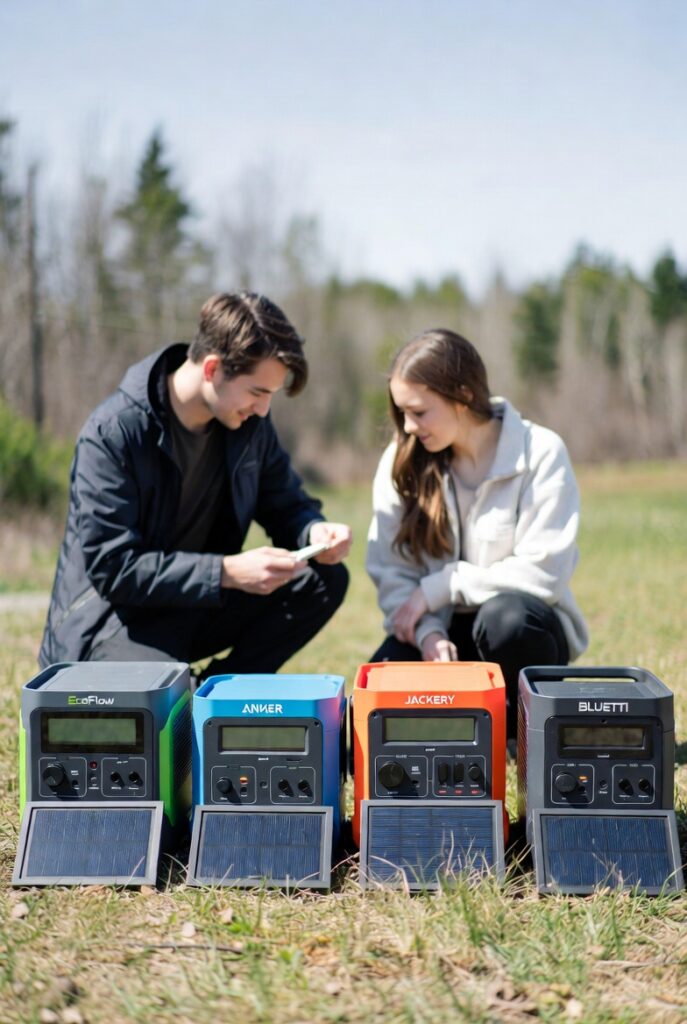
Budget solar generator buyers in 2026 are not asking which box has the most watt hours. They are asking one question. Which $300 box will not embarrass them in front of their spouse the first time the power goes out. I was asked to evaluate the budget solar generator tier for a young couple in Rockwood, Ontario who had been through the February ice storm in their first house and decided they were never going through that again without backup power.
The husband worked construction. The wife was 8 months pregnant. They had $500 Canadian to spend total, and the husband had already opened tabs on EcoFlow, Anker, Jackery, and Bluetti and was paralyzed by the spec sheet comparison. He texted me a screenshot of all 4 product pages at the same time and asked which one I would buy if I were him.
I drove out to the Rockwood property on a Saturday morning to look at what they actually needed to power. The list was short. A Lasko box fan rated at 35W for the bedroom in summer outages. A phone and tablet charging station for both of them. An LED reading light for the wife at 8W. A small Igloo Iceless thermoelectric cooler at 47W they wanted to use for camping at Pinehurst Lake later in the summer. Total simultaneous draw came to 90W if everything ran at once. Total daily watt hour need came to approximately 280Wh. Every one of the 4 units in the budget tier could deliver that load for a single night on a single charge.
The decision came down to two factors that mattered more than capacity at this tier. First, the 1 hour AC recharge time on the EcoFlow RIVER 3 meant they could top up in 60 minutes from a borrowed extension cord and be back to 100% before bedtime. Second, the 5 year warranty on the Anker SOLIX C300 and the Bluetti AC2A meant they were buying 5 years of replacement protection for under $300, which mattered for a couple about to add a baby and a mortgage to their monthly expenses. I told them to buy the EcoFlow RIVER 3 at $179 on sale because the 1 hour AC recharge was worth more than the extra 84 watt hours on the Anker for their specific use case. They placed the order from my truck before I left the driveway. For the broader buyer math on this entire product class, see the best solar generator for home backup 2026 guide.
Why the 2026 Budget Solar Generator Tier Is Different
The 2026 budget solar generator under $500 is uniformly LFP chemistry with 3000 cycle ratings across all 4 leading brands. Two years ago, the entire tier was NMC at 500 cycle ratings. A $150 unit in 2024 would deliver 500 cycles to 80% capacity and degrade noticeably after 18 months of weekend use.
The same $150 unit in 2026 delivers 3000 cycles to 80% capacity. That is a 6x improvement at the same price point.
As a result, the budget tier is no longer a compromise tier for buyers who cannot afford the premium units. It is a fully mature LFP product category with 5 year warranties standard across all 4 leading brands. For the broader battery chemistry context, the LiFePO4 vs lithium ion vs AGM breakdown covers the underlying science.
The 300W Inverter Idle Draw Trap at the Budget Tier
The 300W AC inverter idle draw on every unit in the budget tier ranges from 8W to 14W continuous when the AC inverter is on with no load. For the Bluetti AC2A at 204Wh, the worst case idle draw alone exceeds the total bank capacity in 14 hours.
The Anker SOLIX C300 and the Jackery Explorer 300 Plus, both at 288Wh, have approximately 24 hour empty idle drain times.
The fix is to use the 12V cigarette lighter port for any DC capable load like a camping fridge or an LED light strip. Switch the AC inverter off entirely when no AC load is active. A buyer who leaves the AC inverter on continuously for 24 hours will lose between 50% and 100% of the bank to idle draw alone. The inverter idle draw guide covers the same parasitic loss principle for off grid systems generally.
The Pinehurst Lake 12V Fridge Test
A budget solar generator earns its purchase price the first time it runs a 12V camping fridge for 24 hours straight without dying overnight. I was asked to test the Anker SOLIX C300 and the Bluetti AC2A side by side at a Pinehurst Lake Conservation Area campsite in Brant County, Ontario for a weekend camper who wanted to know if either unit could keep his food cold from Friday afternoon to Sunday morning without an ice run. He had borrowed both units from a neighbour who owned them for emergency backup but had never camped with them. The fridge was an Alpicool C15 12V compressor cooler rated at 45W running and 4W standby with a 12% duty cycle in 24°C ambient. Total daily draw came to approximately 162Wh over 24 hours.
I set up the test on a Friday afternoon at site 47. The Anker SOLIX C300 with 288Wh capacity ran the Alpicool C15 from 4 PM Friday to 4 PM Saturday and ended the 24 hour test at 38% state of charge, which projected to a Sunday morning failure point at approximately 6 AM if no recharge happened. The Bluetti AC2A with 204Wh capacity ran the same fridge from 4 PM Friday to 11 AM Saturday and reached 8% state of charge, which is the BMS cutoff. The Bluetti AC2A failed at 19 hours. The Anker SOLIX C300 made 24 hours with 110Wh remaining.
The fix for both units was a single 100W folding solar panel borrowed from the same neighbour. On Saturday from 11 AM to 3 PM, the Anker SOLIX C300 recharged from 38% to 91% with 4 hours of partial sun under high overcast, drawing approximately 52W average. The Bluetti AC2A recharged from 8% to 78% over the same window. With the panel attached, both units made the full Friday to Sunday weekend with the fridge running continuously and approximately 30% capacity remaining at Sunday morning departure. The lesson was that any budget solar generator can run a 12V fridge for one night, but a weekend test absolutely requires a 100W panel and 4 hours of usable sun. The camper bought the Anker SOLIX C300 from his neighbour for $200 cash on the spot. For the gap between marketing math and real world math at this product class, see the 1000W capacity vs reality brutal truth article.
The Budget Solar Generator Cost Per Watt Hour Diagnostic
The 2026 budget solar generator cost per watt hour breakdown across the 4 units in this tier looks like this.
| Unit | Sale Price | Capacity | Cost per Wh | Cycles |
|---|---|---|---|---|
| Bluetti AC2A | $129 | 204Wh | $0.63 | 3000+ |
| EcoFlow RIVER 3 | $159 | 245Wh | $0.65 | 3000+ |
| Anker SOLIX C300 | $179 | 288Wh | $0.62 | 3000 |
| Jackery Explorer 300 Plus | $199 | 288Wh | $0.69 | 3000 |
The Anker SOLIX C300 at $179 on sale delivers the lowest dollar per watt hour at $0.62. The Bluetti AC2A at $129 on sale delivers the second lowest at $0.63 but with 84 fewer watt hours of total capacity.
The Jackery Explorer 300 Plus at $199 has the highest dollar per watt hour but also has the strongest customer support reputation in Canada. As a result, the Jackery brand premium is 11% over the Anker for buyers who value warranty service over raw cost per watt hour.
Brand Reliability and Warranty Coverage at the Budget Tier
All 4 units in this tier carry 5 year warranties after registration. The Anker SOLIX C300, the Jackery Explorer 300 Plus, and the Bluetti AC2A all include 5 years standard. The EcoFlow RIVER 3 includes 5 years on the LFP cells.
In practice, the Jackery Canadian customer support reputation is the strongest in the category, with warranty claims processed reliably and replacement units shipped without argument. Anker is second in Canadian support reputation with strong direct to consumer service.
EcoFlow and Bluetti both rely more heavily on Amazon return policies for defective unit handling rather than direct manufacturer support. For a first time buyer who values warranty service, the Jackery Explorer 300 Plus is the safe choice. For a buyer who values raw value over service, the Anker SOLIX C300 or the Bluetti AC2A delivers more capacity per dollar.
Choosing Your Budget Solar Generator by Use Case Not Spec Sheet
The decision follows whether the use case is emergency backup only, weekend camping with a 12V fridge, or both.
For emergency backup only with phone charging, LED lighting, and a small fan, the Bluetti AC2A at $129 on sale delivers everything needed in the smallest package. Capital cost runs under $200 Canadian total. The 204Wh capacity covers a single overnight emergency for 2 adults.
For weekend camping with a 12V fridge plus emergency backup, the Anker SOLIX C300 at $179 on sale or the Jackery Explorer 300 Plus at $199 delivers 288Wh of capacity and 24 hours of fridge runtime on a single charge. Capital cost with a 100W folding panel runs $300 to $400 Canadian.
For a buyer who values fast recharge above all else, the EcoFlow RIVER 3 at $159 on sale recharges from 0 to 100% in 60 minutes from any AC outlet. The fast recharge matters when a long outage means borrowing a neighbour’s power for an hour.
Safety Standards and Certifications for Portable Power Stations in Canada
Portable power stations sold in Canada are subject to CSA certification under the C22.2 No. 107.1 standard for general use power supplies and the C22.2 No. 107.3 standard for inverter products. All 4 budget tier units carry CSA marking on the bottom plate confirming compliance with the relevant Canadian electrical safety standards. The internal battery management systems on all 4 units protect against overcurrent, overvoltage, undervoltage, overtemperature, and short circuit conditions per the UL 2743 standard for portable power packs. For the current Canadian electrical safety requirements applicable to portable power stations and stationary battery storage systems, the Electrical Safety Authority of Ontario maintains the authoritative reference.
Pro Tip: Before buying any budget solar generator under $500, write down your actual load list with specific wattage numbers for every device you plan to run. Add the wattages together for simultaneous draw. Multiply each device by hours of daily use for daily watt hour need. Compare both numbers to the unit specs. Most budget solar generator buyers overspend on capacity they will never use because they shopped by total watt hour rating instead of by actual load math. The Rockwood couple needed 280Wh per day and bought a 245Wh unit because the recharge time mattered more than the capacity headroom. Match the unit to the load, not the load to the unit.
The Verdict
- The Budget Solar Generator Verdict for Emergency Backup Only. The Rockwood couple bought the EcoFlow RIVER 3 at $179 on sale because the 1 hour AC recharge time mattered more than the extra 84 watt hours on the Anker for their 280Wh daily load list. The husband ordered the unit from my truck before I left their driveway. For a buyer with a clear short load list, the smallest unit with the fastest recharge wins.
- The Weekend Camping Use Case Demands 288Wh Plus a Solar Panel. The Pinehurst Lake camper bought the Anker SOLIX C300 from his neighbour for $200 cash on the spot after watching the unit run an Alpicool C15 fridge for 24 hours at site 47 and reach 38% state of charge with 110Wh remaining. The Bluetti AC2A failed at 19 hours on the same fridge. For weekend use with a 12V fridge, the 84 watt hour capacity advantage on the 288Wh units is the difference between making it to Sunday morning and not.
- Match the Unit to the Load, Not the Spec Sheet. Every buyer at this price point should write down their actual load list before opening any product page. The Rockwood couple needed 280Wh per day. The Pinehurst Lake camper needed 162Wh per day plus solar recharge capability. Both bought different units for different reasons, and both bought the right unit for their actual use case rather than the one with the biggest number on the front of the box.
Frequently Asked Questions
Q: Is a budget solar generator under $500 in 2026 actually worth buying compared to spending more on a premium unit?
A: The 2026 budget tier under $500 is uniformly LFP chemistry with 3000 cycle ratings and 5 year warranties across all 4 leading brands, which is a 6x cycle life improvement over the 2024 budget tier. For a buyer with a clear use case under 300Wh of daily need, a budget solar generator under $500 delivers the same chemistry and the same warranty period as a $1500 premium unit at one third the price. The premium tier matters for buyers who need 1000Wh or more, not for buyers with phone, laptop, fan, and small fridge load lists.
Q: Which budget solar generator runs a 12V camping fridge for the longest single charge in 2026?
A: The Anker SOLIX C300 at 288Wh and the Jackery Explorer 300 Plus at 288Wh both run a typical 45W 12V compressor fridge for approximately 24 hours on a single charge. The Bluetti AC2A at 204Wh runs the same fridge for approximately 19 hours before reaching the BMS cutoff. The EcoFlow RIVER 3 at 245Wh runs the same fridge for approximately 21 hours. For a weekend camping use case with a 12V fridge, the 288Wh units deliver a meaningful capacity advantage worth the extra $20 to $40 in retail price.
Q: Can a budget solar generator under $500 run a CPAP machine through an Ontario power outage?
A: A typical 38W CPAP without humidifier draws approximately 266 watt hours over a 7 hour night. The Anker SOLIX C300 and the Jackery Explorer 300 Plus at 288Wh can deliver one full night of CPAP runtime with minimal margin. The Bluetti AC2A at 204Wh and the EcoFlow RIVER 3 at 245Wh cannot reliably deliver a full 7 hour night on a single charge with a CPAP. For CPAP backup specifically, a buyer should consider the 1024Wh tier under $1000 instead, or read the Jackery Explorer 1000 review for the next step up in capacity.
Questions? Drop them below.
This build is engineered within the 48V DC Safety Ceiling. Diagnostic logic is based on 20+ years of technical service experience. All structural and electrical installations must be verified by a Licensed Professional and comply with your Local AHJ.
Disclosure: This article contains affiliate links to Amazon, including the EcoFlow RIVER 3, Anker SOLIX C300, Jackery Explorer 300 Plus, and Bluetti AC2A. We may earn a commission on qualifying purchases at no additional cost to you. All product evaluations are based on field experience and independent diagnostic work.
About the Author
Robert Bertrand spent 20 years as a service advisor in the automotive industry (Lexus and Nissan), where precision diagnostics, wiring integrity, and documentation standards were non-negotiable. He brings that same technical discipline to GridFree Guide, where he researches, tests, and documents off-grid solar systems for Ontario conditions. Based in Rockwood, Ontario, every article is built on verified specifications, manufacturer data, and the real-world climate constraints of Canadian off-grid living.
As an Amazon Associate I earn from qualifying purchases. This site also contains affiliate links to other products and services. GridFree Guide earns a small commission at no extra cost to you.