
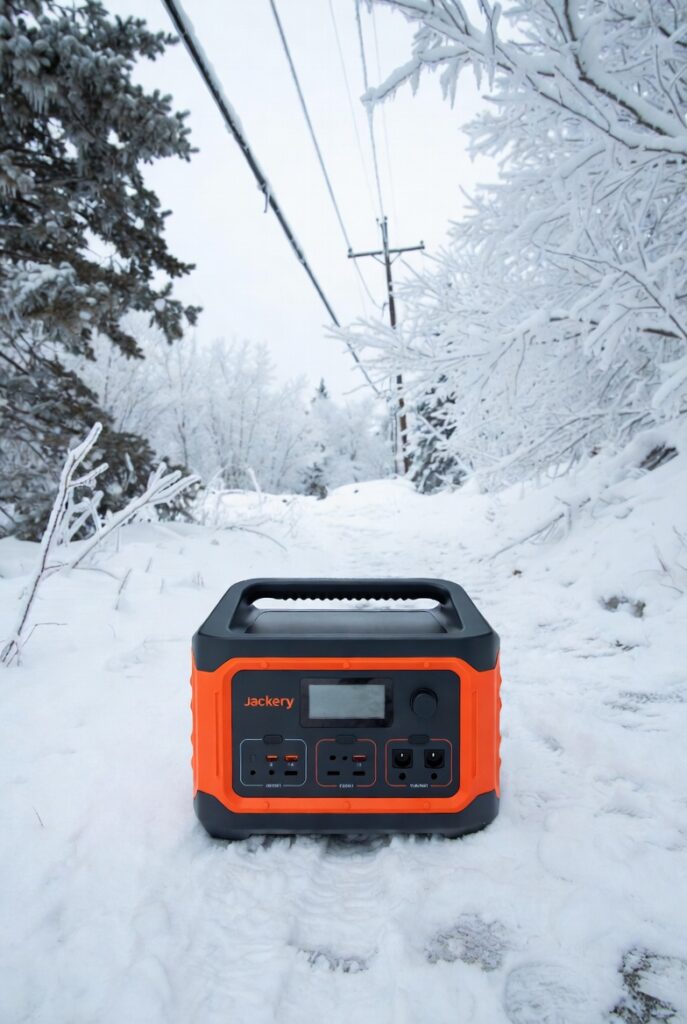
A jackery explorer 1000 review for an Ontario property owner is not a spec sheet recitation. It is the answer to one question. Will this $1,200 box keep my CPAP running and my fridge cold from Friday night to Sunday morning when the ice has taken the line down on County Road 7? I was asked to evaluate a Jackery Explorer 1000 for a retired couple on a side road off the 6th Line of Centre Wellington north of Fergus, Ontario after the February 14 ice storm took their hydro line down for 41 hours.
The husband was on a ResMed AirSense 11 CPAP at 38W draw for 7 hours per night. The wife had a small chest freezer rated at 80W running and 12W standby. They had already bought the Explorer 1000 from a Costco display in November on the recommendation of a neighbour and had never tested it under real load. They paid $1,199 Canadian. The unit had been sitting in the basement at 100% state of charge for 11 weeks before the ice storm. When the power failed at 11:47 PM on February 14, the wife plugged the freezer into the AC outlet and the husband plugged his CPAP into the second AC outlet, and they went to bed.
By 6:30 AM on February 15, the Explorer 1000 was reading 38% state of charge on the front panel display. The CPAP had drawn approximately 266 watt hours over 7 hours. The freezer had drawn approximately 180 watt hours cycling on and off through the night. Inverter idle losses through the 1000W pure sine inverter accounted for another 168 watt hours over 7 hours at the published 24W idle figure. Total draw came to 614 watt hours from a rated 1002 watt hour bank, which lined up almost exactly with the 38% remaining reading. The wife called me at 8:15 AM in a mild panic because she had assumed the 1002 watt hour rating meant the unit would run both loads for 2 nights, and the math said they would not make it through the second night. For the broader buyer math on this unit class, see the best solar generator for home backup 2026 guide.
Why the Jackery Explorer 1000 Still Sells in 2026
The jackery explorer 1000 has held its retail shelf position at Costco, Canadian Tire, and Best Buy for 6 years for three reasons that have nothing to do with the spec sheet. First, the orange chassis and the front panel display read as familiar and trustworthy to a non-technical buyer who is shopping for emergency backup. Second, the Jackery customer support reputation in Canada is genuinely strong, with warranty claims processed reliably and replacement units shipped without argument.
Third, the 1002 watt hour capacity number sits at exactly the threshold a buyer thinks they need for a weekend or a 1 night ice storm. As a result, the Explorer 1000 keeps selling at $1,199 Canadian even though newer LFP units at the same price deliver 6 times the cycle life and similar capacity. For a deeper look at the chemistry trade-off, the LiFePO4 vs lithium ion vs AGM breakdown covers the underlying battery science.
The 24W Inverter Idle Draw Nobody Mentions
The single biggest gap between the Explorer 1000 marketing claims and the real world performance is the 1000W pure sine inverter idle draw at 24W. An empty inverter with no AC load drains a full 1002 watt hour bank in approximately 41.7 hours. For the Fergus couple running a CPAP and a freezer overnight, the idle draw consumed 168 watt hours, which was 27% of their total 614 watt hour overnight consumption.
As a result, a buyer who leaves the AC inverter on continuously for a 2 night outage will lose between 384 and 576 watt hours to inverter idle alone, leaving very little headroom for actual loads. The fix is to use the 12V cigarette lighter port for any DC capable load like a 12V camping fridge and switch the AC inverter off when no AC load is active. The inverter idle draw guide covers the same parasitic loss principle for off grid systems generally.
The Jackery Explorer 1000 Real World Capacity Test
The 1002 watt hour rated capacity on the jackery explorer 1000 is a cell level measurement, not an AC outlet measurement. After inverter conversion losses at approximately 88% efficiency on resistive loads and 82% efficiency on inductive loads like a freezer compressor or a CPAP humidifier, the actual deliverable AC watt hours come to approximately 822 to 882 watt hours from a full charge. The honest planning number is 850 watt hours at the AC outlet, not 1002.
The jackery explorer 1000 capacity numbers translate to the following real world run times after inverter losses and idle draw.
| Load Type | Rated Capacity Calculation | Real World Run Time |
|---|---|---|
| CPAP only at 38W | 266 watt hours over 7 hours | 1 full night plus partial second night |
| Chest freezer only at 80W cycling | 180 watt hours overnight | 1 full night before recharge required |
| CPAP plus freezer combined | 614 watt hours total draw | 1 full night with reduced second night loads |
| AC inverter idle only at 24W | 168 watt hours over 7 hours | Drains full bank in 41.7 hours empty |
A 38W CPAP running 7 hours per night draws 266 watt hours, leaving approximately 584 watt hours for everything else, which covers a small chest freezer and a phone charger but not much more. For an Ontario buyer planning a 2 night outage scenario without solar recharge, the math says one full charge covers one full night plus a partial second night with reduced loads. The 1000W capacity vs reality brutal truth article covers the same gap between marketing math and real world math for this entire product class.
The Cost Per Watt Hour Cross Brand Diagnostic
A jackery explorer 1000 review in 2026 has to answer the chemistry question because the buyer who walks into a Costco today is choosing between a 6 year old NMC platform and 4 newer LFP platforms at similar price points. I was asked to evaluate the cost per watt hour and cycle life of the Explorer 1000 against the Bluetti Elite 200 V2 and the EcoFlow DELTA 2 for an off grid hunting cabin owner near Bancroft, Ontario who wanted one unit to cover a 3 week September deer camp annually plus emergency home backup at his Rockwood, Ontario primary residence the rest of the year. He had narrowed his shortlist to those 3 units and wanted a straight diagnostic answer, not a ranked listicle. His budget was $1,500 Canadian maximum.
The Explorer 1000 at $1,199 delivers 1002 watt hours of NMC capacity, which works out to $1.20 per watt hour at retail. The unit is rated for 500 charge cycles to 80% capacity, which means the per cycle cost over the rated lifespan is approximately $0.0024 per watt hour cycle. The Bluetti Elite 200 V2 at $1,499 delivers 2073 watt hours of LFP capacity at $0.72 per watt hour, with a 3000 cycle to 80% capacity rating that puts the per cycle cost at approximately $0.00024 per watt hour cycle. The EcoFlow DELTA 2 at $1,099 delivers 1024 watt hours of LFP capacity at $1.07 per watt hour with a 3000 cycle rating and a per cycle cost of approximately $0.00035 per watt hour cycle. On the per cycle math, the Explorer 1000 costs roughly 10 times more per watt hour delivered over its rated lifespan than either LFP competitor.
I told the hunting cabin owner that the per cycle math only matters if he actually puts cycles on the unit. For 12 weekends a year of camping plus 1 or 2 emergency events at the Rockwood property, the Explorer 1000 will deliver maybe 80 charge cycles over its first 5 years of ownership, well under the 500 cycle rating, and the chemistry difference becomes invisible. For a deer camp owner who cycles the unit hard for 3 weeks every September and pulls it out for 4 to 6 ice storm events per winter, the cycle count climbs to 200 or more over 5 years and the LFP advantage starts to matter. He went home with a Bluetti Elite 200 V2 from a Bracebridge dealer because the deer camp use case and the 5 year ownership horizon both favoured the higher cycle life chemistry.
SolarSaga 100W Panel Recharging in Real Ontario Light
The SolarSaga 100W panel produces 35 to 70% of its rated output depending on season, latitude, cloud cover, and panel angle in Ontario conditions. On the Centre Wellington back deck on February 15 in 60% cloud cover, the SolarSaga 100W produced 47W average over 4 hours of midday sun, recharging the Explorer 1000 from 38% to 71% state of charge by 4 PM. A Renogy 100W panel produced 52W average over the same window on the same deck.
Neither panel hit the rated 100W output because Ontario February light at 43.7 degrees north latitude through cloud cover delivers approximately 35 to 50% of summer noon irradiance. The manufacturer claim of a 9 hour full recharge from one SolarSaga 100W panel assumes 1000W per square metre direct normal irradiance at the panel surface, which Ontario sees roughly 60 days per year and never in winter. The realistic Ontario winter recharge time from one SolarSaga 100W panel is 18 to 30 hours of cumulative daylight exposure, which means a buyer who is off grid for a week in February needs 2 or 3 panels, not 1.
Jackery Explorer 1000 vs Modern LFP Competitors at the Same Price
The decision follows whether the buyer cycles the unit hard or lightly, whether the use case is occasional weekend or sustained off grid, and whether the buyer values the Jackery brand support reputation enough to pay the chemistry premium.
For the light cycle weekend camper with under 50 charge cycles per year over a 5 year ownership horizon, the jackery explorer 1000 at $1,199 delivers 1002 watt hours of NMC capacity, a 1000W pure sine inverter, and the strongest Canadian customer support reputation in the category. Capital cost runs $1,199 for the unit plus $300 for a SolarSaga 100W panel for a total of approximately $1,499. The 500 cycle rating is never approached.
For the hard cycle deer camp owner, the daily driver off grid user, or the buyer who values cycle life over brand familiarity, the Bluetti Elite 200 V2 at $1,499 delivers 2073 watt hours of LFP capacity and a 3000 cycle rating, the EcoFlow DELTA 2 at $1,099 delivers 1024 watt hours of LFP capacity and a 3000 cycle rating, and the Anker SOLIX C1000 Gen 2 at $999 delivers 1056 watt hours of LFP capacity and a 3000 cycle rating. All three deliver 6 times the cycle life of the Explorer 1000 at similar or lower retail pricing.
Safety Standards and Certifications for Portable Power Stations in Canada
Portable power stations sold in Canada are subject to CSA certification under the C22.2 No. 107.1 standard for general use power supplies and the C22.2 No. 107.3 standard for inverter products. The Jackery Explorer 1000 carries CSA marking on the bottom plate of the unit, which confirms compliance with the relevant Canadian electrical safety standards. The internal battery management system protects against overcurrent, overvoltage, undervoltage, overtemperature, and short circuit conditions per the UL 2743 standard for portable power packs. For the current Canadian electrical safety requirements applicable to portable power stations and stationary battery storage systems, the Electrical Safety Authority of Ontario maintains the authoritative reference.
Pro Tip: Before relying on a jackery explorer 1000 for any emergency backup application, run a real world load test on the actual loads you intend to power. Plug in your CPAP, your fridge, and any other priority load on a Saturday afternoon when the power is on. Time the discharge from 100% to 20% state of charge with an actual stopwatch. The jackery explorer 1000 marketing math and the real world math are not the same number, and the only way to know the real number for your loads is to test them once before you need them. I have seen too many Ontario property owners discover the gap at 6:30 AM in February with no second chance.
The Verdict
- The Jackery Explorer 1000 Verdict for Light Cycle Weekend Use. The Centre Wellington couple ran their CPAP and chest freezer for 1 full night on a single charge and made it through a second night with the SolarSaga panel partial recharge for a total emergency cost of $1,199 plus the panel they already owned. For under 50 cycles per year, the unit is a defensible purchase.
- The Hard Cycle Use Case Demands LFP Chemistry. The Bancroft hunting cabin owner walked away from the Explorer 1000 and bought the Bluetti Elite 200 V2 from a Bracebridge dealer for $1,499 because his projected 200 or more cycles over 5 years made the NMC cycle life the limiting factor. Cycle count drives chemistry choice.
- Test Before You Need It. Every buyer should run an actual load test on actual loads before the first emergency. The Centre Wellington 6:30 AM panic call would have been a calm Saturday afternoon discovery if the test had happened in November when the unit was first purchased.
Frequently Asked Questions
Q: How long will a jackery explorer 1000 actually run a CPAP machine through an Ontario power outage?
A: A typical 38W CPAP without humidifier draws approximately 266 watt hours over a 7 hour night. After accounting for inverter idle draw at 24W and inverter efficiency losses, the realistic run time on a fully charged Explorer 1000 is 1 full night plus a partial second night with no other loads. With a small chest freezer also running, the realistic limit is 1 full night before recharging is required.
Q: Is the jackery explorer 1000 still worth buying in 2026 compared to LFP units at the same price?
A: For a light cycle weekend camper using the unit under 50 times per year, the Explorer 1000 is a reasonable purchase because the NMC cycle life is never approached and the Jackery customer support reputation in Canada is genuinely strong. For a hard cycle deer camp owner, daily driver off grid user, or any buyer projecting 200 or more charge cycles over 5 years, an LFP unit like the Bluetti Elite 200 V2, the EcoFlow DELTA 2, or the Anker SOLIX C1000 Gen 2 delivers 6 times the cycle life at similar pricing.
Q: How long does a SolarSaga 100W panel actually take to recharge a jackery explorer 1000 in Ontario winter conditions?
A: The manufacturer claim of 9 hours assumes lab conditions of 1000W per square metre direct normal irradiance, which Ontario sees roughly 60 days per year and never in winter. The realistic Ontario winter recharge time from one SolarSaga 100W panel is 18 to 30 hours of cumulative daylight exposure. A buyer who needs reliable off grid recharging through Ontario winter should plan on 2 or 3 panels, not 1.
Questions? Drop them below.
This build is engineered within the 48V DC Safety Ceiling. Diagnostic logic is based on 20+ years of technical service experience. All structural and electrical installations must be verified by a Licensed Professional and comply with your Local AHJ.
Disclosure: This article contains affiliate links to Amazon, including the Jackery Explorer 1000 and the Renogy 100W panel. We may earn a commission on qualifying purchases at no additional cost to you. All product evaluations are based on field experience and independent diagnostic work.
About the Author
Robert Bertrand spent 20 years as a service advisor in the automotive industry (Lexus and Nissan), where precision diagnostics, wiring integrity, and documentation standards were non-negotiable. He brings that same technical discipline to GridFree Guide, where he researches, tests, and documents off-grid solar systems for Ontario conditions. Based in Rockwood, Ontario, every article is built on verified specifications, manufacturer data, and the real-world climate constraints of Canadian off-grid living.
As an Amazon Associate I earn from qualifying purchases. This site also contains affiliate links to other products and services. GridFree Guide earns a small commission at no extra cost to you.