
Off-grid ventilation solves the hidden problem that appears after you seal your home tight for energy efficiency. I helped a property owner near Haliburton in Haliburton County, Ontario diagnose a moisture problem in winter 2025. His cabin was beautifully insulated with spray foam and triple-pane windows. Every morning, his windows fogged up. His bathroom ceiling showed early mold spots. By morning, his CO2 levels hit 1,800 ppm when the healthy limit is 1,000 ppm. His off-grid ventilation was nonexistent because he assumed tight construction meant efficient construction.
I examined his situation and identified the root cause. His airtight construction trapped moisture from cooking, breathing, and showers. His 4-person family exhaled approximately 8 liters of water daily. His cooking and showers added another 4 liters. His 12 liters of daily moisture had nowhere to go. This off-grid ventilation gap was creating the exact conditions for mold growth and respiratory problems. His tight home was slowly poisoning itself.
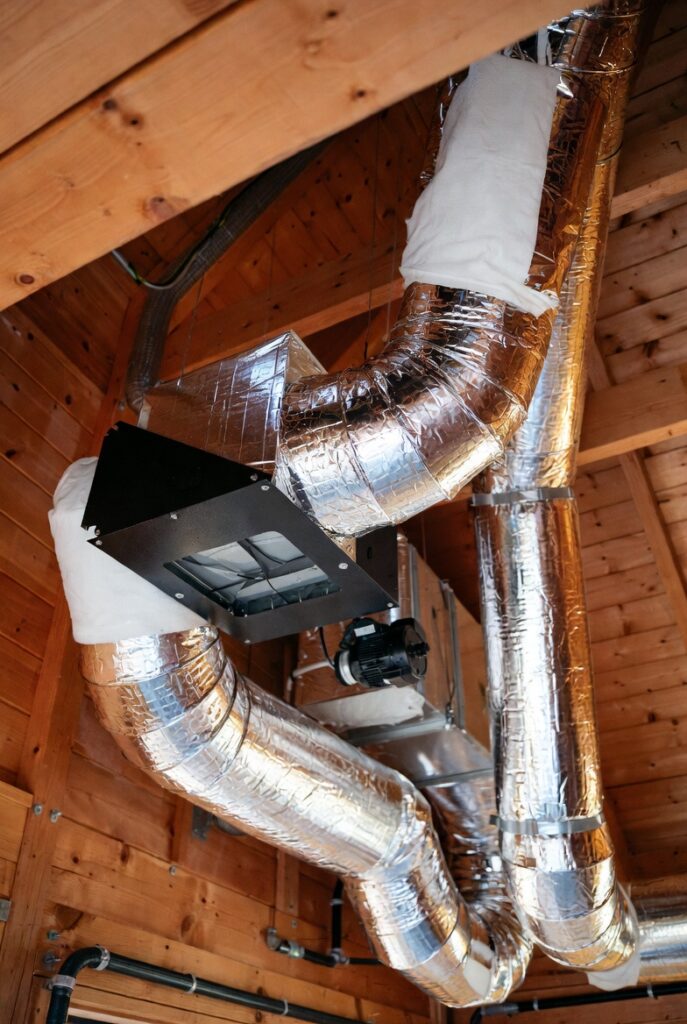
I helped him install a DC-native ERV with ECM motor. We ran dedicated ductwork from kitchen and bathrooms to the ERV core. We supplied fresh air to bedrooms and living room. His ERV recovers 78% of the heat from exhaust air before releasing it. His unit draws only 22W on low speed running 24/7. His total cost was $2,400 for unit, ductwork, and installation. His off-grid ventilation now exchanges air every 3 hours while recovering most of the heat he already paid to generate. For the heating system that works with this ventilation, The Off-Grid Heating Standard covers the approach.
Why Off-Grid Ventilation Prevents Humidity Buildup and CO2 Spikes
Off-grid ventilation prevents humidity buildup because mechanical air exchange removes moisture before it condenses on surfaces. The Haliburton owner’s 12 liters of daily moisture now exhausts through the ERV core. His off-grid ventilation maintains indoor humidity at 40-45% instead of 70%+ condensation levels.
CO2 from breathing exhausts with stale air and fresh oxygen enters. His morning CO2 now reads 650 ppm instead of 1,800 ppm.
Mechanical ventilation is mandatory for any airtight construction regardless of power source. The tighter your envelope, the more critical your ventilation system becomes.
The Airtight Problem: When Tight Construction Creates Moisture Traps
The airtight problem appears in modern construction because energy efficiency requires eliminating air leaks. Old drafty homes exchanged air naturally through gaps. Modern spray foam and tape sealing eliminate those gaps entirely.
Moisture from breathing, cooking, and bathing has nowhere to go. The Haliburton owner’s 4-person family produced 12 liters of moisture daily. His airtight envelope trapped every drop inside.
Mold, condensation, and CO2 buildup are symptoms of successful airtightness without mechanical ventilation. The solution is controlled air exchange, not leakier construction.
ERV vs HRV: Why ERV Is the 2026 Choice for Ontario Climate
I was helping a property owner near Bancroft in Hastings County, Ontario choose between ERV and HRV in fall 2025. His builder recommended an HRV because it was $300 cheaper. His indoor humidity in January dropped to 18% with his HRV running. His family experienced cracked lips, nosebleeds, and static shocks throughout winter. His off-grid ventilation was working but creating a different comfort problem. His HRV was dumping his indoor moisture outside and bringing in bone-dry winter air.
I examined his situation and explained the difference. His HRV recovered heat but not moisture. His ERV would recover both heat and moisture through a special membrane core. Ontario winter air at minus 20°C holds almost no moisture. His HRV brought that dry air inside after warming it. His indoor humidity plummeted because moisture left with every exhaust cycle. His off-grid ventilation needed moisture recovery to maintain comfort in Ontario winters.
I helped him swap the HRV core for an ERV core in the same housing. The ERV membrane transfers moisture from outgoing air to incoming air. His indoor humidity now stays at 35-40% through winter. His family comfort improved immediately. His total cost was $680 for the core swap. His off-grid ventilation now recovers 75% of heat AND 60% of moisture. The ERV is the 2026 standard for Ontario climate because it solves both the heat loss and humidity problems simultaneously.
OBC 2024/2026 Section 9.32: Ventilation Capacity Requirements
OBC 2024/2026 Section 9.32 mandates specific ventilation capacity based on bedroom count. A 1-bedroom home requires approximately 50 CFM continuous. A 3-bedroom home requires approximately 75-100 CFM continuous.
The Haliburton owner’s ERV delivers 90 CFM on low speed meeting code for his 3-bedroom cabin. Reference Ontario’s Building Code for current requirements.
Calculate your CFM requirement before selecting your unit size. Undersized units cannot meet code regardless of how efficiently they run.
DC-Native ECM Motors: 22W for 24/7 Air Exchange
DC-native ECM motors provide variable speed operation at a fraction of standard motor consumption. ECM stands for Electronically Commutated Motor. A standard PSC motor draws 80-120W continuously regardless of speed setting.
An ECM motor draws 15-30W on low speed scaling up only when boost is activated. The Haliburton owner’s ECM unit at 22W running 24/7 consumes only 528Wh daily.
The 78% energy savings makes 24/7 ventilation practical for off-grid systems. For the DC-native approach to other loads, The DC-Native Lighting Standard covers the same efficiency principle.
MERV 13 Filtration: Protection from Wildfire Smoke and Pollen
MERV 13 filters capture particles down to 0.3 microns including wildfire smoke and fine pollen. Ontario wildfire seasons now extend from April through October with increasing intensity.
Standard MERV 8 filters pass smoke particles through into living spaces. The Haliburton owner’s MERV 13 filters scrub smoke before it enters his home.
During the 2023 Quebec smoke event, his indoor air quality remained excellent while neighbors suffered. Filter replacement every 6-12 months costs $40-$80 depending on size.
Duct Placement: Intake from Wet Rooms and Supply to Living Spaces
Duct placement follows the moisture path through your home. Exhaust intakes belong in wet rooms where moisture originates. Kitchen, bathrooms, and laundry rooms should have exhaust ducts.
Fresh air supply belongs in bedrooms and living areas where occupants spend time. The Haliburton owner’s system exhausts from kitchen and two bathrooms.
Fresh air supplies to three bedrooms and living room. This arrangement pulls moisture at the source and delivers fresh oxygen where people breathe.
The Boost Switch: Evacuating Shower Steam in 20 Minutes
The boost switch provides temporary high-speed operation for moisture events. A 20-minute shower produces approximately 0.5 liters of steam. Normal ERV speed cannot remove steam fast enough to prevent condensation.
The boost switch increases CFM by 2-3x for rapid moisture removal. The Haliburton owner’s bathroom timer activates boost automatically when the light turns on.
His steam clears within 15 minutes instead of lingering for hours. Boost operation draws 45-60W but runs only 20-30 minutes per event.
CO2 Monitoring: Demand-Controlled Ventilation for Efficiency
CO2 monitoring enables demand-controlled ventilation that adjusts speed based on occupancy. An empty home needs minimal ventilation. A home with guests needs maximum ventilation.
CO2 sensors detect occupancy by measuring exhaled carbon dioxide. The Haliburton owner’s sensor triggers boost when CO2 exceeds 800 ppm.
His system drops to minimum speed when he leaves for work. Demand control can reduce daily energy consumption by 30-40% compared to constant-speed operation.
The Off-Grid Ventilation Strategy: ERV Selection and ECM Motors
The off-grid ventilation strategy combines ERV technology with ECM motors for maximum efficiency. ERV recovers both heat and moisture eliminating winter humidity problems. ECM motors enable 24/7 operation at 22W draw. MERV 13 filtration protects against wildfire smoke.
A Victron SmartShunt tracks ERV consumption and confirms efficiency targets. The monitoring verifies your system performs as designed.
The Haliburton owner’s complete strategy provides forest-grade air quality at 528Wh daily. His off-grid ventilation operates invisibly while his family breathes clean fresh air year-round.
Planning Your Off-Grid Ventilation System: Components and Costs
Planning your off-grid ventilation system starts with calculating CFM requirements from bedroom count. A 3-bedroom home needs 75-100 CFM continuous per OBC 9.32. Measure duct runs to size your system properly.
A Victron Cerbo GX can integrate CO2 sensor data for demand-controlled operation. The Haliburton owner’s system provides whole-home coverage with 90 CFM capacity.
Your off-grid ventilation investment pays back through improved air quality, moisture control, and family health within the first year.
Minimum Viable vs Full Standard: Choosing Your Air Quality Level
The off-grid ventilation approach offers two air quality levels depending on your efficiency requirements and budget. The minimum viable level provides code compliance with basic air exchange. The full standard delivers maximum efficiency with moisture recovery.
| Air Quality Level | Key Components | Cost | Daily Draw |
|---|---|---|---|
| Minimum Viable | HRV + PSC motor + MERV 8 + basic duct | $800-$1,200 | 2,400 Wh |
| Full Standard | ERV + ECM motor + MERV 13 + full duct + CO2 | $2,200-$3,500 | 528 Wh |
Both off-grid ventilation approaches meet OBC requirements for air exchange. The difference is energy efficiency and moisture recovery. Properties in Ontario should invest in ERV for winter humidity control.
Frequently Asked Questions
Q: How much energy does off-grid ventilation with ECM motors consume daily?
A: Off-grid ventilation with ECM motors consumes approximately 528Wh daily at continuous low-speed operation. The Haliburton owner’s ERV draws 22W running 24/7 for complete air exchange every 3 hours. A standard PSC motor equivalent would consume 2,400Wh daily. Off-grid ventilation with ECM technology uses 78% less energy than conventional motors while providing the same air quality.
Q: Why does off-grid ventilation require ERV instead of HRV in Ontario?
A: Off-grid ventilation requires ERV in Ontario because HRV dumps indoor moisture outside and brings in bone-dry winter air. The Bancroft owner’s HRV dropped indoor humidity to 18% causing nosebleeds and cracked lips. His ERV replacement recovers 60% of moisture along with 75% of heat. Off-grid ventilation with ERV maintains comfortable 35-40% humidity through Ontario winters while still providing full heat recovery.
Q: What CFM capacity does off-grid ventilation need for a 3-bedroom home?
A: Off-grid ventilation for a 3-bedroom home requires approximately 75-100 CFM continuous capacity per OBC 2024/2026 Section 9.32. The Haliburton owner’s ERV delivers 90 CFM on low speed meeting code for his 3-bedroom cabin. Off-grid ventilation capacity must match bedroom count regardless of power source. Calculate your requirement from OBC tables before selecting unit size.
Pro Tip: Your off-grid ventilation filter should be MERV 13 for wildfire smoke protection. The Haliburton owner’s MERV 13 filters kept his indoor air quality excellent during the 2023 Quebec smoke event while neighbors suffered. His off-grid ventilation scrubs particles down to 0.3 microns before they enter living spaces. Standard MERV 8 passes smoke through. Replace filters every 6-12 months at $40-$80 each. Clean air during smoke season is worth the filter upgrade.
Verdict
- The ERV Off-Grid Ventilation Standard. The Haliburton owner’s airtight cabin trapped 12 liters of moisture daily, fogging windows and growing mold while CO2 hit 1,800 ppm by morning. His $2,400 ERV installation with ECM motor draws only 22W running 24/7, exchanging air every 3 hours while recovering 78% of the heat. His off-grid ventilation now maintains 40-45% humidity and 650 ppm CO2 year-round.
- The Moisture Recovery Standard. The Bancroft owner’s HRV dropped indoor humidity to 18% through winter, causing nosebleeds and cracked lips despite working heat recovery. His $680 ERV core swap now recovers 60% of moisture along with 75% of heat. His indoor humidity stays at 35-40% through Ontario winters, eliminating the dry air symptoms his family suffered.
- The ECM Efficiency Standard. A standard PSC motor draws 80-120W continuously consuming 2,400Wh daily for ventilation. An ECM motor draws 15-30W on low speed consuming only 528Wh daily for the same air exchange. The 78% energy savings makes 24/7 ventilation practical for off-grid systems without compromising battery capacity.
This build is engineered within the 48V DC Safety Ceiling. Diagnostic logic is based on 20+ years of technical service experience. All structural and electrical installations must be verified by a Licensed Professional and comply with your Local AHJ.
Questions? Drop them below.
About the Author
Robert Bertrand spent 20 years as a service advisor in the automotive industry (Lexus and Nissan), where precision diagnostics, wiring integrity, and documentation standards were non-negotiable. He brings that same technical discipline to GridFree Guide, where he researches, tests, and documents off-grid solar systems for Ontario conditions. Based in Rockwood, Ontario, every article is built on verified specifications, manufacturer data, and the real-world climate constraints of Canadian off-grid living.
As an Amazon Associate I earn from qualifying purchases. This site also contains affiliate links to other products and services. GridFree Guide earns a small commission at no extra cost to you.