
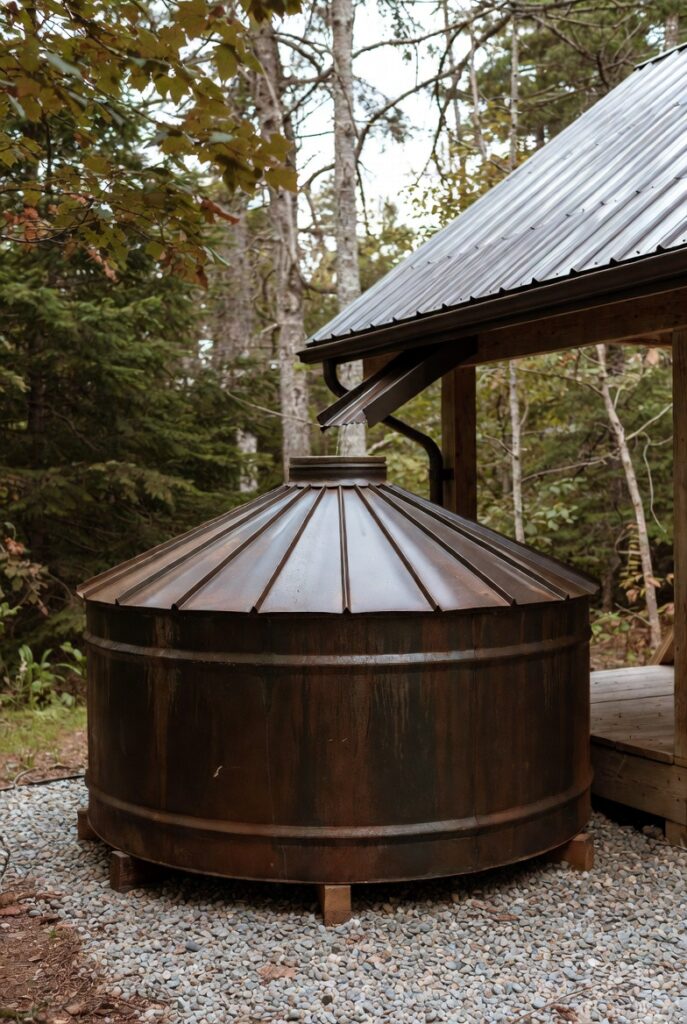
Off-grid rainwater provides water independence when wells fail or dry seasons extend beyond reserves. I helped a property owner near Haliburton in Haliburton County, Ontario investigate recurring digestive illness in his family during summer 2025. His 1,500-gallon cistern collected runoff from his metal roof. His system included a basic sediment filter before the pressure tank. His family had been drinking the water for three months. His off-grid rainwater system had no first flush diverter and no UV sterilization.
I examined his collection system and found the problem. His downspouts ran directly into the cistern with no diversion mechanism. The first gallons of every rainfall carried bird droppings, pollen, dust, and debris directly into his drinking water. His sediment filter caught particles but passed bacteria and viruses untouched. His off-grid rainwater was contaminated at the source before filtration even began. Lab testing confirmed coliform bacteria at 12x safe drinking limits.
I helped him install a complete potable filtration stack. We added first flush diverters on both downspouts sized for 10 gallons each. We installed a 5-micron sediment filter, activated carbon stage, and Class A UV sterilizer. His total cost was $1,800 for the complete upgrade. His off-grid rainwater now tests at zero coliform with quarterly monitoring. His family’s illness stopped immediately after the upgrade. For the pump system that pressurizes rainwater distribution, The Off-Grid Water Standard covers the approach.
Why Off-Grid Rainwater Requires Multi-Stage Treatment for Potable Use
Off-grid rainwater requires multi-stage treatment because roof runoff contains biological and chemical contaminants that single-stage filtration cannot address. The Haliburton owner’s sediment filter caught particles but passed bacteria and viruses untouched.
His off-grid rainwater needed first flush to remove initial contamination, carbon to remove chemicals, and UV to kill pathogens. Each stage addresses different contaminant categories.
Missing any stage leaves specific hazards untreated in your drinking water. The complete stack works as an integrated system where each component depends on the others.
The Contamination Problem: When Roof Runoff Makes Your Family Sick
The contamination problem exists because rainwater collects everything that accumulates on your roof between storms. Bird droppings contain coliform bacteria and potential pathogens. Pollen and dust create sediment that harbors bacterial growth.
Dead insects and debris decompose in standing water over time. The Haliburton owner’s family drank water with 12x safe coliform levels for three months.
Their recurring digestive illness stopped immediately after proper filtration was installed. The contamination was predictable and preventable with proper system design.
First Flush Diversion: Capturing the Dirty Gallons Before Storage
First flush diversion captures the initial contaminated runoff before it enters your cistern. The first 0.01 inches of rainfall carry 90% of accumulated roof debris. A mechanical diverter fills with dirty water and diverts clean water to storage once full.
Size the diverter for 10 gallons per 1,000 square feet of roof collection area. The Haliburton owner’s 1,200 square foot roof required two 10-gallon diverters.
His original system had zero first flush protection despite 1,500 gallons of storage. The missing diverters allowed every storm’s initial contamination directly into his drinking supply.
The Potable Filtration Stack: Sediment, Carbon, and UV
The potable filtration stack uses three stages in sequence to address different contaminant types. The 5-micron sediment filter removes physical particles including dirt, debris, and larger organic matter. The activated carbon stage removes chemicals, odors, and volatile organic compounds.
The UV stage kills bacteria, viruses, and protozoa that pass through physical filtration. The Haliburton owner installed all three stages after his single-stage sediment filter failed to protect his family.
Each stage depends on the previous stage working correctly. Sediment protects carbon from clogging. Carbon protects UV from organic interference. UV provides the final kill step.
Class A UV Sterilization: The Non-Negotiable Kill Step
Class A UV sterilization is the non-negotiable final stage for potable rainwater treatment. Class A delivers 40 millijoules per square centimeter, sufficient for primary disinfection. Class B delivers only 16 mJ/cm² for supplemental treatment only.
The Haliburton owner installed a Viqua VH200 Class A unit rated for 12 gallons per minute. The UV lamp requires annual replacement to maintain kill effectiveness.
Always verify Class A rating when purchasing UV equipment for drinking water treatment. Class B units cannot render water potable as a primary treatment method.
Cistern Materials: Food-Grade Poly vs Concrete vs Industrial Totes
Cistern material determines whether your stored water remains safe or becomes contaminated over time. Food-grade polyethylene is manufactured without plasticizers that leach into water. Concrete tanks are inert but require food-grade sealant on interior surfaces.
Recycled industrial totes may contain chemical residue from previous contents regardless of cleaning claims. The Dorset owner’s replacement tank uses food-grade concrete rated for potable storage.
Never use recycled industrial containers regardless of claimed cleaning or certification. The risk of chemical contamination is not worth the cost savings.
Roof Material Hierarchy: Metal, Tile, Asphalt, and Wood
Roof material determines whether collected rainwater can be treated to potable standards. Metal roofs are the gold standard because they shed debris and do not leach contaminants. Clay or concrete tile works well but costs significantly more than metal.
Asphalt shingles leach petroleum bitumens that pass through standard filtration systems. Wood shakes harbor mold and bacteria in their porous surface structure.
The Haliburton owner’s standing seam metal roof made potable treatment viable for his system. Properties with asphalt roofs should classify rainwater as non-potable only regardless of filtration.
Winterization: Frost Line Burial and Heat Trace Protection
I was responding to an emergency call from a property owner near Dorset in Muskoka District, Ontario in February 2025. His above-ground 2,500-gallon cistern had stopped delivering water to his cabin. His pump ran but produced no flow. His discharge line from cistern to cabin ran 25 feet above grade through an unheated crawlspace. The line had frozen solid during a minus 28°C cold snap. His off-grid rainwater system had become unusable for 11 days.
I examined his installation and identified multiple problems. His discharge line sat entirely above frost line with no insulation. His cistern itself had cracked at the outlet fitting from ice expansion. The crack leaked 200 gallons before he discovered the damage. His off-grid rainwater storage was compromised and his distribution was frozen. The total system failure left his family hauling water from town for nearly two weeks.
I helped him rebuild the system properly. We replaced the cracked cistern with a below-grade 2,000-gallon concrete tank. We buried the discharge line 52 inches deep to his crawlspace entry. We added heat trace on the final 8 feet that runs through the unheated crawlspace. His total cost was $4,200 for the tank replacement and $1,400 for excavation and line burial. His off-grid rainwater now operates reliably at minus 35°C without freeze risk. For the heating that keeps crawlspace components from freezing, The Off-Grid Heating Standard covers the approach.
The Off-Grid Rainwater Strategy: First Flush and UV Sterilization
The off-grid rainwater strategy combines first flush diversion with multi-stage filtration for potable independence. First flush diverters capture initial contaminated runoff before storage. Sediment filtration removes particles. Carbon removes chemicals. Class A UV kills pathogens.
A Victron SmartShunt tracks pump power consumption for pressurization systems. The monitoring ensures efficient operation of distribution pumps.
The Haliburton owner’s complete strategy now delivers water testing at zero coliform. His off-grid rainwater provides reliable potable supply meeting OBC 2024/2026 standards.
Planning Your Off-Grid Rainwater System: Components and Costs
Planning your off-grid rainwater system starts with calculating daily demand and storage requirements. A family of four requires approximately 450 litres daily for all uses. A 1,500 to 2,500-gallon cistern provides 2 to 4 weeks of dry season bridging.
A Victron Cerbo GX tracks water system power draw and pump cycles for optimization. Reference Ontario Building Code for current rainwater plumbing requirements including labeling and backflow prevention.
Your off-grid rainwater investment provides water security independent of wells or municipal supply. The cost is minimal compared to drilling a new well or extending municipal service.
Minimum Viable vs Full Standard: Choosing Your Treatment Level
The off-grid rainwater approach offers two treatment levels depending on your intended use. The minimum viable level provides non-potable water for irrigation and toilet flushing. The full standard provides safe drinking water meeting OBC requirements.
| Treatment Level | Key Components | Cost | Use Classification |
|---|---|---|---|
| Minimum Viable | First flush + screen + food-grade tank | $800-$1,500 | Non-potable |
| Full Standard | First flush + sediment + carbon + UV + winterization | $3,500-$6,000 | Potable |
Both off-grid rainwater approaches provide water security during dry seasons or well failures. The difference is whether you can safely drink the water or must use it for non-potable purposes only. Properties needing potable water should invest in the full standard from the start.
Frequently Asked Questions
Q: Why does off-grid rainwater require first flush diversion for potable use?
A: Off-grid rainwater requires first flush diversion because the initial runoff carries 90% of accumulated roof contamination including bird droppings, pollen, and dust. The Haliburton owner’s system without first flush delivered water with 12x safe coliform limits to his family. His two 10-gallon diverters now capture the dirty gallons before clean water enters storage. Off-grid rainwater cannot achieve potable quality without first flush regardless of downstream filtration.
Q: What UV class is required for off-grid rainwater drinking water?
A: Off-grid rainwater for drinking requires Class A UV sterilization delivering 40 millijoules per square centimeter minimum. Class B units deliver only 16 mJ/cm² for supplemental disinfection and cannot render water potable as a primary treatment. The Haliburton owner installed a Viqua VH200 Class A unit rated for 12 GPM. Off-grid rainwater treatment must verify Class A certification on UV equipment regardless of brand or price.
Q: How do you winterize off-grid rainwater systems in Ontario?
A: Off-grid rainwater winterization requires cistern placement below frost line or in heated space, plus discharge lines buried 48 to 52 inches deep. The Dorset owner’s above-ground tank cracked and his 18-inch deep line froze for 11 days at minus 28°C. His replacement system uses below-grade concrete storage with heat trace on the final crawlspace section. Off-grid rainwater systems with above-grade components become unusable during Ontario winters without proper thermal protection.
Pro Tip: Your off-grid rainwater is only as clean as your first flush allows. The Haliburton owner’s family drank contaminated water for three months because his system skipped this critical layer. His off-grid rainwater now tests at zero coliform after adding $200 of first flush diverters. Size your diverters for 10 gallons per 1,000 square feet of roof. The first flush captures 90% of contamination before clean water ever enters your tank.
Verdict
- The First Flush Off-Grid Rainwater Standard. The Haliburton owner’s family drank water with 12x safe coliform levels for three months because his system had no first flush diversion. His $1,800 complete filtration stack including two 10-gallon diverters, sediment, carbon, and Class A UV now delivers water testing at zero coliform. His off-grid rainwater provides potable supply meeting OBC 2024/2026 standards.
- The Winterization Depth Standard. The Dorset owner’s above-ground cistern cracked and his 18-inch deep discharge line froze solid for 11 days at minus 28°C. His $5,600 rebuild with below-grade concrete tank and 52-inch line burial now operates reliably at minus 35°C. Heat trace on the final 8 feet through his crawlspace eliminates the last freeze risk.
- The Class A UV Standard. Class A UV sterilization delivering 40 millijoules per square centimeter is the non-negotiable kill step for potable rainwater. Class B units at 16 mJ/cm² cannot render water safe for drinking as primary treatment. The Haliburton owner’s Viqua VH200 provides Class A certification with annual lamp replacement maintaining kill effectiveness.
This build is engineered within the 48V DC Safety Ceiling. Diagnostic logic is based on 20+ years of technical service experience. All structural and electrical installations must be verified by a Licensed Professional and comply with your Local AHJ.
Questions? Drop them below.
About the Author
Robert Bertrand spent 20 years as a service advisor in the automotive industry (Lexus and Nissan), where precision diagnostics, wiring integrity, and documentation standards were non-negotiable. He brings that same technical discipline to GridFree Guide, where he researches, tests, and documents off-grid solar systems for Ontario conditions. Based in Rockwood, Ontario, every article is built on verified specifications, manufacturer data, and the real-world climate constraints of Canadian off-grid living.
As an Amazon Associate I earn from qualifying purchases. This site also contains affiliate links to other products and services. GridFree Guide earns a small commission at no extra cost to you.