
Off-grid fire safety protects your family from two threats that grid-connected homes rarely face at the same intensity. I helped a property owner near Minden in Haliburton County, Ontario review his safety systems in fall 2025. His 20kWh lithium battery bank sat in a converted closet beside his living area. His propane backup heater provided heat during extended cloudy periods. His wood stove handled primary heating. He had one smoke alarm in the hallway. He had no CO alarm anywhere in the house. His off-grid fire safety was missing the most critical protection layer.
I examined his fuel-burning appliances and battery installation. His propane heater produced CO as a combustion byproduct. His wood stove produced CO during incomplete combustion. His bedroom was 12 feet from the propane heater with no CO alarm between them. His lithium batteries had no suppression system and no ventilation for off-gassing. His off-grid fire safety gaps created two separate life-threatening scenarios. The carbon monoxide risk was immediate. The thermal runaway risk was catastrophic.
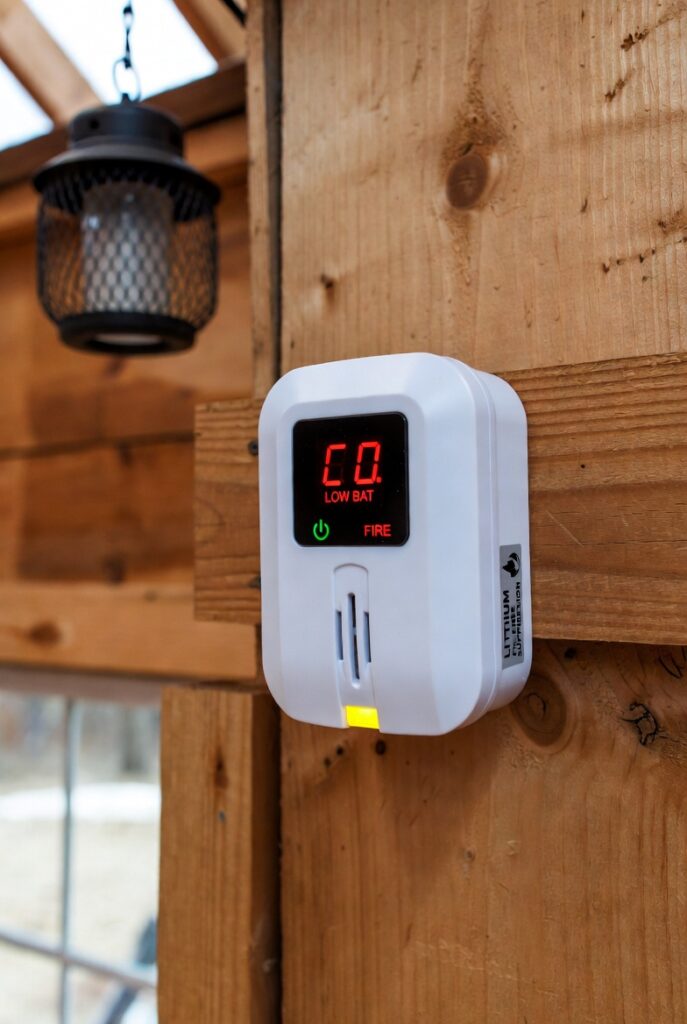
I helped him install CO alarms on every level of his home and adjacent to every sleeping area. We added a 10-year sealed battery CO alarm in his bedroom hallway. We added a combination smoke and CO alarm near his wood stove. His total cost was $180 for four alarms. His off-grid fire safety now meets 2026 Ontario Fire Code requirements. For the battery room ventilation that prevents gas accumulation, The Battery Room Ventilation Standard covers the approach.
Why Off-Grid Fire Safety Requires Protection for Two Separate Threats
Off-grid fire safety requires dual protection because lithium batteries and fuel-burning appliances create different hazard categories. The Minden owner faced CO risk from propane and wood combustion. He faced thermal runaway risk from lithium battery chemistry.
Neither threat would exist at the same intensity in a grid-connected home. His off-grid fire safety needed systems designed for both hazards simultaneously.
Most homes address one threat or neither. The combination of high-density lithium storage and multiple combustion appliances creates unique protection requirements.
The Double Threat: Lithium Thermal Runaway and Carbon Monoxide
The double threat exists because off-grid homes concentrate energy storage and combustion heating in close proximity. A 20kWh lithium bank contains enormous energy density in a small footprint. A propane heater produces CO continuously during operation.
A wood stove produces CO during incomplete combustion or when dampers restrict airflow. The Minden owner had all three hazards within 15 feet of his bedroom.
Grid-connected homes typically have neither lithium storage nor multiple combustion appliances. The off-grid configuration creates hazard density that requires specific protection systems.
Lithium Battery Fires: Why Traditional Extinguishers Fail
Traditional extinguishers fail against lithium fires because thermal runaway generates oxygen internally. The chemical reaction breaks down cathode material and releases oxygen from within the cell structure. Water cools the exterior but the internal reaction continues unaffected.
Dry chemical extinguishers suppress visible flames but propagation continues to adjacent cells. CO2 removes atmospheric oxygen but internal oxygen sustains the fire regardless.
The Gravenhurst owner’s ABC extinguisher would delay flames by seconds while thermal runaway spread through his entire 30kWh bank. The fire would consume every cell regardless of extinguisher application.
Thermal Runaway Propagation Prevention: The NFPA 855 Standard
I was reviewing a battery installation with a property owner near Gravenhurst in Muskoka District, Ontario in winter 2025. His 30kWh lithium battery bank was installed in an unventilated utility room. His only fire protection was a standard ABC dry chemical extinguisher mounted on the wall. I asked him what he would do if one of his battery cells entered thermal runaway. He said he would use the extinguisher. His off-grid fire safety plan would not work against lithium fires.
I explained the thermal runaway problem. A lithium cell in thermal runaway generates its own oxygen through chemical decomposition. Water cools the exterior but cannot stop the internal reaction. Dry chemical extinguishers suppress flames but do not stop propagation to adjacent cells. His ABC extinguisher would delay the fire by seconds while the reaction spread through his entire battery bank. His 30kWh of lithium in thermal runaway would release toxic gases and temperatures exceeding 600°C. His off-grid fire safety needed a system designed specifically for lithium chemistry.
I helped him install a Stat-X condensed aerosol unit in his battery room. The unit mounts on the ceiling and activates automatically at 175°F. The aerosol chemically interrupts combustion without using conductive water that could short remaining cells. We added a high-CFM exhaust fan with thermal fuse activation to ventilate off-gases. His total cost was $650 for suppression and $280 for ventilation. His off-grid fire safety now includes NFPA 855 compliant thermal runaway protection. For the inverter grounding that prevents electrical fires, The Inverter Grounding Standard covers the approach.
Carbon Monoxide Alarms: The 2026 Ontario Fire Code Requirement
The 2026 Ontario Fire Code requires CO alarms on every storey of any dwelling with fuel-burning appliances or attached garage. This includes wood stoves, propane heaters, natural gas furnaces, diesel generators, and oil furnaces. The alarm must be adjacent to each sleeping area.
Reference Ontario Fire Code for current requirements. The Minden owner’s propane heater and wood stove both triggered this requirement.
His missing alarms violated code and created life-threatening exposure risk while sleeping. The $180 investment in four alarms eliminated the immediate hazard and achieved code compliance.
DC-Native Detectors: Protection That Works When Your Inverter Does Not
DC-native detectors maintain protection when the inverter trips or shuts down. Standard plug-in CO and smoke detectors fail during inverter shutdowns. Off-grid homes experience shutdowns during low battery, faults, or maintenance.
A 10-year sealed battery detector operates independently of house power. Hardwired DC detectors running from 12V or 24V maintain protection during AC outages.
The Minden owner installed sealed battery units that operate regardless of system state. Fire safety depends on detectors that work when the power system does not.
Battery Room Ventilation: Preventing Combustible Gas Accumulation
Battery room ventilation prevents off-gassing from reaching explosive concentration. Lithium cells under stress release flammable gases including hydrogen and methane. A sealed room allows gases to accumulate toward lower explosive limit.
CCR (Combustible Concentration Reduction) ventilation provides high-CFM exhaust activated by thermal fuse or gas sensor. A Victron SmartShunt tracks battery state and identifies thermal anomalies before off-gassing occurs.
The Gravenhurst owner’s ventilation fan activates at 150°F or upon suppression system discharge. The combination prevents gas accumulation even during thermal events.
Smoke Alarm Placement: OBC 2024/2026 Requirements
Ontario Building Code 2024/2026 requires smoke alarms on every storey and in every bedroom. Alarms must be interconnected so activation of one triggers all units. Combination smoke and CO alarms satisfy both requirements in a single unit.
The Minden owner installed combination units meeting both OBC smoke requirements and Fire Code CO requirements. His interconnected system alerts the entire house regardless of which unit detects hazard first.
The combination approach reduces installation cost while providing comprehensive coverage for both smoke and CO hazards.
The Off-Grid Fire Safety Strategy: Lithium Suppression and CO Coverage
The off-grid fire safety strategy addresses both lithium and CO hazards with purpose-built protection. CO alarms on every level protect against combustion appliance hazards. Condensed aerosol suppression in the battery room stops thermal runaway propagation. CCR ventilation prevents explosive gas accumulation.
A Victron Cerbo GX provides remote alerts for battery temperature and system faults. The monitoring enables early intervention before thermal events escalate.
The complete off-grid fire safety strategy creates a lifeboat that protects your family regardless of grid status or system condition.
Planning Your Off-Grid Fire Safety System: Components and Costs
Planning your off-grid fire safety system starts with identifying your specific hazards. Count fuel-burning appliances to determine CO alarm requirements. Assess lithium battery capacity to determine suppression needs.
The Minden owner’s $180 CO alarm investment met code and eliminated immediate life safety risk. The Gravenhurst owner’s $930 suppression and ventilation investment protected $15,000 of battery equipment.
Your off-grid fire safety investment protects both lives and equipment. The cost is minimal compared to the consequences of inadequate protection.
Minimum Viable vs Full Standard: Choosing Your Protection Level
The off-grid fire safety approach offers two protection levels depending on your battery capacity and risk tolerance. The minimum viable level meets code requirements. The full standard provides lithium-specific suppression.
| Protection Level | Key Components | Cost | Coverage |
|---|---|---|---|
| Minimum Viable | CO alarms + smoke alarms + ABC extinguisher | $150-$300 | Code compliant |
| Full Standard | Suppression + ventilation + DC-native detectors | $800-$1,500 | NFPA 855 compliant |
Both off-grid fire safety approaches protect lives. The difference is lithium-specific suppression and ventilation coverage. Properties with battery banks exceeding 10kWh should consider the full standard for equipment protection.
Frequently Asked Questions
Q: What does off-grid fire safety require for lithium battery storage?
A: Off-grid fire safety for lithium battery storage requires suppression designed specifically for thermal runaway. Traditional ABC extinguishers fail because lithium fires generate internal oxygen. NFPA 855 recommends condensed aerosol units like Stat-X or encapsulator agents like F-500 EA. The Gravenhurst owner’s $650 Stat-X unit provides automatic activation at 175°F. Off-grid fire safety for lithium also requires CCR ventilation to prevent explosive gas accumulation.
Q: How many CO alarms does off-grid fire safety require under 2026 Ontario Fire Code?
A: Off-grid fire safety under 2026 Ontario Fire Code requires CO alarms on every storey of any dwelling with fuel-burning appliances or attached garage. Alarms must be adjacent to each sleeping area. Wood stoves, propane heaters, and diesel generators all trigger this requirement. The Minden owner installed four CO alarms to cover his two-storey home with three sleeping areas. Off-grid fire safety CO coverage costs $150 to $200 for typical installations.
Q: Why do off-grid fire safety detectors need to be DC-native or sealed battery?
A: Off-grid fire safety detectors need DC-native or sealed battery operation because standard plug-in units fail when the inverter shuts down. Off-grid homes experience inverter shutdowns during low battery, faults, or maintenance. A 10-year sealed battery detector operates independently of house power. The Minden owner’s sealed units protect his family regardless of inverter status. Off-grid fire safety depends on protection that works when the power system does not.
Pro Tip: Your off-grid fire safety should protect your family when you are sleeping and when your power system is down. The Minden owner’s sealed battery CO alarms work regardless of inverter status. His off-grid fire safety detects hazards even during system faults. Install DC-native or 10-year sealed battery detectors for every alarm in your home. Protection that depends on your inverter is not protection at all.
Verdict
- The CO Alarm Off-Grid Fire Safety Standard. The Minden owner’s propane heater and wood stove created CO exposure risk with his bedroom only 12 feet away and no alarm between them. His $180 investment in four sealed battery CO alarms met 2026 Ontario Fire Code requirements. His off-grid fire safety now detects hazards regardless of inverter status or system faults.
- The Lithium Suppression Standard. The Gravenhurst owner’s 30kWh battery bank had only an ABC extinguisher that would fail within seconds against thermal runaway. His $650 Stat-X condensed aerosol unit activates automatically at 175°F and chemically interrupts combustion without conductive water. His $280 CCR ventilation fan prevents explosive gas accumulation during thermal events.
- The DC-Native Detector Standard. Standard plug-in CO and smoke detectors fail when the inverter shuts down during low battery, faults, or maintenance. A 10-year sealed battery detector operates independently of house power. The Minden owner’s sealed units protect his family during the exact conditions when hazards are most likely to occur.
This build is engineered within the 48V DC Safety Ceiling. Diagnostic logic is based on 20+ years of technical service experience. All structural and electrical installations must be verified by a Licensed Professional and comply with your Local AHJ.
Questions? Drop them below.
About the Author
Robert Bertrand spent 20 years as a service advisor in the automotive industry (Lexus and Nissan), where precision diagnostics, wiring integrity, and documentation standards were non-negotiable. He brings that same technical discipline to GridFree Guide, where he researches, tests, and documents off-grid solar systems for Ontario conditions. Based in Rockwood, Ontario, every article is built on verified specifications, manufacturer data, and the real-world climate constraints of Canadian off-grid living.
As an Amazon Associate I earn from qualifying purchases. This site also contains affiliate links to other products and services. GridFree Guide earns a small commission at no extra cost to you.