
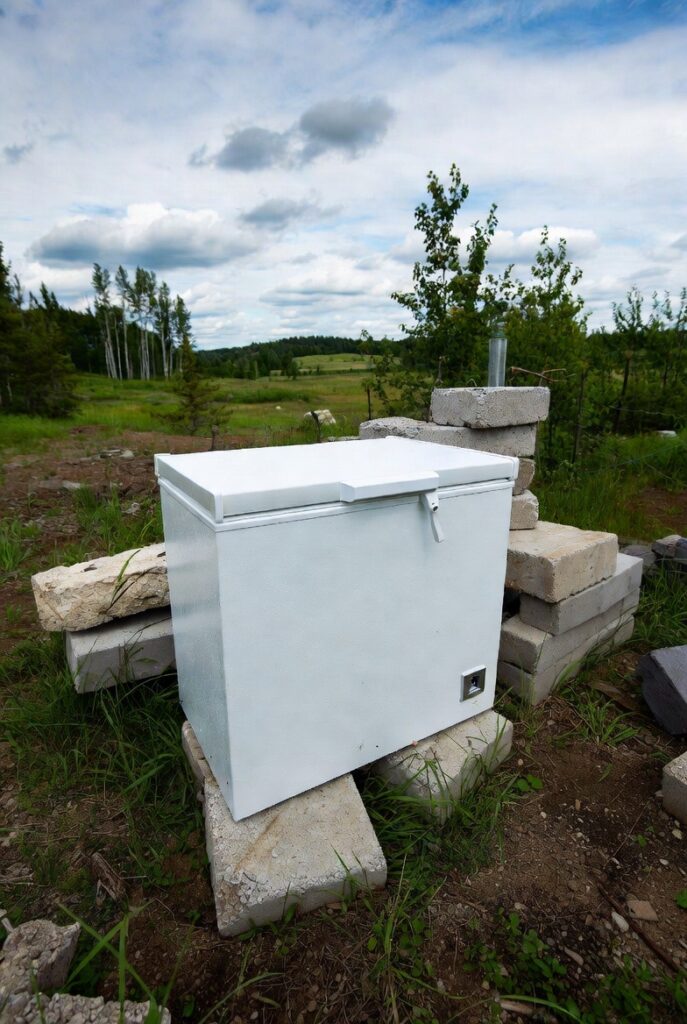
Off-grid refrigeration is the load that runs 24 hours a day, 365 days a year, whether you are home or away. I helped a property owner near Fenelon Falls in Kawartha Lakes, Ontario diagnose a winter production crisis in January 2025. His 4kW solar array produced 8 to 12kWh on clear winter days. His standard upright refrigerator consumed 1.8kWh daily. His freezer consumed another 1.2kWh. His cold chain alone consumed 3.0kWh per day, leaving barely enough for lights and communication.
I examined his refrigeration setup and measured actual consumption. His upright fridge ran its compressor for 45 minutes after every door opening. Cold air poured out onto the floor each time the door swung open because cold air is heavier than warm air. His compressor worked constantly to replace the lost cold. His freezer had the same problem. Both units were Energy Star rated but designed for unlimited grid power. His off-grid refrigeration was consuming more power than all other loads combined during the darkest months.
I helped him replace both units with a single DC-native chest freezer and a separate DC chest refrigerator. The chest freezer draws 0.55kWh daily. The chest refrigerator draws 0.45kWh daily. His total cold chain dropped from 3.0kWh to 1.0kWh daily. The replacement cost $1,800 for both DC units. His off-grid refrigeration now consumes one third the power of his previous setup. His battery reserves improved by two full days of autonomy during cloudy weather. For the load management that prioritizes refrigeration during low battery events, The Load Management Standard covers the automation.
Why Off-Grid Refrigeration Consumes Half Your Winter Production
Off-grid refrigeration consumes half your winter production because cold chain runs continuously while solar production drops to minimum. The Fenelon Falls owner’s 4kW array produced 8 to 12kWh on clear days but only 2 to 4kWh on cloudy days. His 3.0kWh cold chain consumed 75% to 100% of cloudy day production.
His off-grid refrigeration left nothing for other loads during extended overcast periods. The math becomes impossible without efficiency improvements. Standard refrigerators designed for grid power ignore efficiency entirely.
DC-native chest units cut consumption to levels that cloudy winter days can sustain. The efficiency difference determines whether your battery bank survives a cloudy week or crashes on day three.
The Cold Chain Problem: When Your Fridge Outdraws Everything Else
The cold chain problem exists because refrigeration designed for grid power ignores efficiency in favor of features. A standard upright fridge with ice maker, water dispenser, and auto-defrost draws 1.5 to 2.5kWh daily. A matching freezer adds another 1.0 to 1.5kWh.
Total cold chain exceeds 3kWh in many households. The Fenelon Falls owner’s cold chain at 3.0kWh exceeded his lights at 0.4kWh, water pump at 0.3kWh, and communication at 0.6kWh combined.
His refrigeration drew more than everything else in his house. The cold chain dominated his energy budget and determined his battery sizing requirements entirely.
DC-Native Chest Freezers: Bypassing the Inverter Entirely
DC-native chest freezers run directly from 12V or 24V battery voltage. Standard AC freezers require inverter power with 10% to 15% conversion losses. A DC unit eliminates the inverter from the circuit entirely.
The Unique 265L and similar models draw 0.5 to 0.7kWh daily. A Victron SmartShunt tracks refrigeration consumption and confirms efficiency improvements.
The Fenelon Falls owner’s DC chest freezer draws 0.55kWh compared to his previous AC unit at 1.2kWh. The efficiency gain comes from both DC-native operation and chest-style physics working together.
Chest vs Upright: Why Cold Air Stays in the Bucket
Chest freezers retain cold air when opened because cold air is heavier than warm air. The chest design creates a bucket that holds the cold. When you lift the lid, warm air cannot displace cold air that settles at the bottom.
An upright fridge opens from the side. Cold air pours out onto your feet like water draining from a tipped cup. The compressor runs 15 to 25 minutes to cool replacement air after each opening.
The Fenelon Falls owner’s upright fridge ran 45 minutes after each door opening. His replacement chest unit shows minimal temperature change with normal access. The physics difference translates directly to energy savings.
The Thermal Battery Hack: Salt-Water Jugs as Cold Reserve
I was reviewing compressor cycle data with a property owner near Peterborough in Peterborough County, Ontario in summer 2025. His DC chest freezer ran its compressor 8 to 10 times per day despite minimal door openings. Each cycle ran 15 to 20 minutes. His total daily consumption was 0.7kWh. He wanted to reduce overnight compressor cycles when his system ran on battery power only. His off-grid refrigeration worked well but he wanted to optimize further.
I examined his freezer contents. His food packages filled about 60% of the interior volume. The remaining 40% was empty air space. Every time the compressor shut off, the air temperature inside rose gradually. The food mass held cold but the air space warmed quickly. The compressor kicked on to cool the air back down. His empty space was forcing unnecessary compressor cycles. His off-grid refrigeration lacked thermal mass to stabilize temperature.
I helped him fill the bottom 20% of his freezer with salt-water jugs. We used 8 one-gallon jugs with water and 2 cups of salt each. The salt lowers the freezing point to approximately minus 6°C. The jugs freeze solid during sunny hours when solar is abundant. At night, the frozen jugs absorb heat from the air space, keeping temperature stable longer. His compressor cycles dropped from 8-10 to 4-5 daily. His overnight consumption dropped by 35%. The jugs cost $25 total for containers and salt. His off-grid refrigeration now uses the freezer itself as a thermal battery, storing cold during production hours and releasing it during dark hours. For the battery bank that supports refrigeration loads, The Budget Off-Grid System Standard covers the sizing.
Ventilation Clearance: The 5-Inch Service Gap
Ventilation clearance determines how efficiently the compressor can reject heat. A freezer moves heat from inside the cabinet to outside via condenser coils. If coils cannot breathe, heat accumulates and efficiency drops.
Placing a freezer tight against a wall or in a closet reduces efficiency by 25% to 35%. The compressor runs longer to achieve the same cooling effect.
The Fenelon Falls owner maintains 5 inches of clearance around his chest units. His compressor cycles are 20% shorter than the same model in tight installation. Always plan installation with adequate ventilation for condenser coils.
Manual vs Auto Defrost: The 100kWh Annual Difference
Manual defrost saves approximately 100kWh annually compared to auto-defrost models. Auto-defrost uses a 500W to 800W heating element to melt frost buildup. The element runs inside the cold cabinet fighting the cooling system directly.
A typical auto-defrost cycle consumes 0.3 to 0.5kWh and runs multiple times per week. Manual defrost requires 15 minutes of scraping once every 3 to 6 months.
The Peterborough owner’s manual defrost unit eliminates this energy waste entirely. The annual savings of 100kWh equals 8% of a typical off-grid property’s total consumption.
Ontario Regulation 399/24: Why Used Fridges Cost You $2,000 in Batteries
Ontario Regulation 399/24 updated efficiency standards for refrigeration equipment effective January 1, 2025. New units must meet stricter consumption limits. However, used fridges from Facebook Marketplace often predate these standards by a decade.
A 10-year-old fridge may consume 2x to 3x the energy of a current model. Reference Ontario Regulation for current efficiency requirements.
The Fenelon Falls owner calculated that a “free” used fridge would require $2,000 in additional battery capacity to support. The DC chest units he purchased cost $1,800 and reduced his battery requirements by two days of autonomy. The new equipment cost less than the battery expansion the old equipment would have required.
The Off-Grid Refrigeration Strategy: DC-Native and Thermal Mass
The off-grid refrigeration strategy combines DC-native chest design with thermal mass for maximum efficiency. The chest freezer runs directly from battery voltage without inverter losses. The chest design retains cold air during access. Salt-water jugs provide thermal mass that reduces compressor cycles overnight.
A Victron Cerbo GX tracks cold chain power draw and battery impact. The monitoring confirms efficiency improvements and identifies optimization opportunities.
The Fenelon Falls owner’s complete strategy dropped consumption from 3.0kWh to 1.0kWh daily. His off-grid refrigeration now provides food security with one third the energy investment of his previous setup.
Planning Your Off-Grid Refrigeration System: Components and Costs
Planning your off-grid refrigeration system starts with measuring your current cold chain draw and identifying efficiency opportunities. If you have standard AC units, DC-native replacements provide the largest single improvement. If you already have efficient units, thermal mass and ventilation optimization maximize performance.
The Fenelon Falls owner’s $1,800 investment in DC chest units saved him from a $3,000 battery expansion. The Peterborough owner’s $25 thermal mass investment reduced overnight consumption by 35%.
Your off-grid refrigeration investment pays back through reduced battery stress every day. The cold chain runs continuously, so efficiency improvements compound over every hour of operation.
Minimum Viable vs Full Standard: Choosing Your Cold Chain Level
The off-grid refrigeration approach offers two efficiency levels depending on your budget and existing equipment. The minimum viable level works with existing refrigerators through optimization. The full standard provides maximum efficiency with DC-native hardware.
| Cold Chain Level | Key Components | Cost | Daily Consumption |
|---|---|---|---|
| Minimum Viable | Thermal mass + ventilation + scheduling | $25-$100 | 2.0-2.5 kWh |
| Full Standard | DC chest units + thermal mass + manual defrost | $1,500-$2,500 | 0.8-1.2 kWh |
Both off-grid refrigeration approaches improve over standard grid-designed units. The difference is investment level and efficiency depth. The minimum viable approach extends battery life with existing equipment. The full standard transforms your cold chain into an efficiency asset.
Frequently Asked Questions
Q: How much power does off-grid refrigeration actually consume daily?
A: Off-grid refrigeration consumption varies dramatically by equipment choice. A standard AC upright fridge and freezer combination consumes 2.5kWh to 4.0kWh daily. DC-native chest units consume 0.8kWh to 1.2kWh for comparable storage capacity. The Fenelon Falls owner’s standard units consumed 3.0kWh daily. His DC replacements consume 1.0kWh daily. Your off-grid refrigeration power budget depends entirely on equipment selection and optimization.
Q: Why do chest freezers use less power than upright models for off-grid refrigeration?
A: Chest freezers use less power for off-grid refrigeration because cold air stays trapped inside the cabinet when opened. Cold air is heavier than warm air. When you lift a chest lid, the cold air remains at the bottom like water in a bucket. An upright fridge door releases cold air that pours out onto the floor. The compressor runs 15 to 45 minutes to replace lost cold after each door opening. Off-grid refrigeration benefits enormously from chest-style physics.
Q: Can thermal mass jugs really reduce off-grid refrigeration consumption?
A: Yes, thermal mass jugs reduce off-grid refrigeration consumption by 25% to 40% in typical installations. Salt-water jugs freeze solid during solar production hours. At night, the frozen mass absorbs heat from air space, keeping cabinet temperature stable longer. The Peterborough owner’s compressor cycles dropped from 8-10 to 4-5 daily after adding $25 of salt-water jugs. Off-grid refrigeration uses thermal mass to shift cooling work from battery hours to solar hours.
Pro Tip: Your off-grid refrigeration should work hardest when the sun is strongest. The Peterborough owner’s salt-water jugs freeze solid during solar hours and keep his freezer stable all night. His compressor cycles dropped by half with $25 of thermal mass. Your off-grid refrigeration becomes a thermal battery that stores cold the same way your battery bank stores electricity. Fill the empty space with mass and watch your overnight consumption drop.
Verdict
- The DC-Native Off-Grid Refrigeration Standard. The Fenelon Falls owner’s standard upright fridge and freezer consumed 3.0kWh daily, representing 75% to 100% of his cloudy day production and forcing constant battery stress. His $1,800 investment in DC chest units dropped consumption to 1.0kWh daily. His off-grid refrigeration now runs on one third the power while adding two days of battery autonomy.
- The Thermal Mass Standard. The Peterborough owner’s chest freezer cycled 8-10 times daily because 40% of interior volume was empty air space. Adding $25 of salt-water jugs to the bottom 20% dropped compressor cycles to 4-5 daily. His overnight consumption decreased by 35%. The jugs freeze during solar hours and release cold during battery hours.
- The Ventilation and Defrost Standard. Maintaining 5 inches of clearance around condenser coils shortens compressor cycles by 20% compared to tight installations. Manual defrost saves 100kWh annually compared to auto-defrost heating elements. Both optimizations cost nothing but deliver measurable efficiency improvements over the life of the equipment.
This build is engineered within the 48V DC Safety Ceiling. Diagnostic logic is based on 20+ years of technical service experience. All structural and electrical installations must be verified by a Licensed Professional and comply with your Local AHJ.
Questions? Drop them below.
About the Author
Robert Bertrand spent 20 years as a service advisor in the automotive industry (Lexus and Nissan), where precision diagnostics, wiring integrity, and documentation standards were non-negotiable. He brings that same technical discipline to GridFree Guide, where he researches, tests, and documents off-grid solar systems for Ontario conditions. Based in Rockwood, Ontario, every article is built on verified specifications, manufacturer data, and the real-world climate constraints of Canadian off-grid living.
As an Amazon Associate I earn from qualifying purchases. This site also contains affiliate links to other products and services. GridFree Guide earns a small commission at no extra cost to you.