
Off-grid security systems become invisible battery drains that never sleep. I helped a property owner near Collingwood in Simcoe County, Ontario diagnose an overnight battery drain mystery in fall 2025. His 25kWh battery bank dropped from 80% to 35% every night despite minimal household use after 10pm. He had unplugged the refrigerator, turned off all lights, and disabled the water heater. The drain continued unchanged. His off-grid security system was the ghost load he had never measured.
I examined his 8-camera NVR system with a power meter. His NVR box drew 45W continuous. His 8 PoE cameras drew 8W each for 64W total. His spinning hard drive added 12W. His system pulled 121W around the clock. Over 10 hours of darkness, that equals 1.21kWh consumed. Over a cloudy week with minimal solar recovery, his security system alone consumed 8.5kWh. His off-grid security was designed for grid power assumptions, not battery efficiency.
I helped him rebuild his security system for off-grid efficiency. We replaced his AC-powered NVR with a 12V DC-native unit drawing 8W. We switched from 8 cameras to 4 strategically placed 4K units drawing 4W each. We replaced his spinning HDD with an SSD drawing 2W instead of 12W. His total system draw dropped from 121W to 26W. His overnight consumption dropped from 1.21kWh to 0.26kWh. The rebuild cost $680 for the DC NVR and SSD. His off-grid security now runs on less power than a single LED light bulb. For the load management that prioritizes security during low battery events, The Load Management Standard covers the automation.
Why Off-Grid Security Systems Drain Batteries Overnight
Off-grid security systems drain batteries overnight because they never turn off. The Collingwood owner’s system pulled 121W continuously. Over 10 hours of darkness, that equals 1.21kWh consumed. Over a week of cloudy weather, the drain compounds rapidly.
His off-grid security consumed more power than his refrigerator. Standard security hardware assumes unlimited grid power. The design priority is features, not efficiency.
Off-grid security requires different hardware choices from the start. The difference between 121W and 26W determines whether your batteries last one night or one week during cloudy weather.
The Ghost Load Problem: When Cameras Never Sleep
The ghost load problem exists because security cameras process video continuously. A camera does not rest between motion events. It captures frames, analyzes content, compresses video, and transmits data around the clock.
A typical PoE camera draws 6W to 12W depending on features. An NVR draws 20W to 60W depending on drive count and processing. Wall adapters add conversion losses.
The Collingwood owner’s 8-camera system drew 121W total. Most property owners never measure this load because it disappears into the background. The drain continues whether you are home or away.
PoE vs WiFi: Why Wired Cameras Use Less Power
PoE cameras use less power than WiFi cameras because they eliminate radio transmission overhead. A WiFi camera must maintain a constant wireless connection with handshakes, acknowledgments, and retransmissions. This radio activity adds 2W to 4W per camera.
A PoE camera sends data over the same cable that provides power. The transmission is efficient and stable. PoE also eliminates individual wall adapters with their conversion losses.
The Collingwood owner’s PoE cameras drew 8W each. Equivalent WiFi cameras would draw 10W to 12W each. The difference adds up across multiple cameras over 24 hours of continuous operation.
DC-Native NVRs: Bypassing the Inverter Entirely
DC-native NVRs run directly from 12V or 48V battery voltage. Standard NVRs use internal AC-to-DC conversion. Running an AC NVR through an inverter creates double conversion loss. The inverter converts DC to AC. The NVR converts AC back to DC.
Each conversion loses 10% to 15% efficiency. A DC-native NVR eliminates both conversions. A Victron SmartShunt tracks overnight battery drain and identifies ghost loads before they become problems.
The Collingwood owner’s AC NVR drew 45W through the inverter. His DC replacement draws 8W directly from batteries. The efficiency gain is dramatic when measured over 24 hours of continuous operation.
SSD vs HDD: The 10-Watt Storage Difference
SSD storage draws 2W to 3W compared to 8W to 15W for spinning hard drives. The difference comes from mechanical motion. An HDD spins platters continuously at 5400 or 7200 RPM. The motor and bearings consume power whether reading, writing, or idle.
An SSD has no moving parts. Power consumption drops dramatically. The Collingwood owner saved 10W by switching from HDD to SSD. Over 24 hours, that equals 0.24kWh saved.
The SSD also survives vibration and temperature extremes better than spinning drives. Reference ESA for Ontario electrical installation standards.
Canadian Winter Proofing: IP67 and Minus 40°C Ratings
I was reviewing camera footage gaps with a property owner near Gravenhurst in Muskoka District, Ontario in January 2025. His security system had worked flawlessly through fall. When temperatures dropped below minus 20°C, three of his four cameras stopped recording. His footage showed gaps of 4 to 8 hours during the coldest overnight periods. His cameras were rated to minus 10°C. His off-grid security failed precisely when security mattered most.
I examined his camera specifications and installation. His budget cameras were rated IP65 and minus 10°C operating temperature. Gravenhurst regularly hits minus 25°C to minus 30°C in January. His cameras entered thermal shutdown to protect internal components. The manufacturer specifications were accurate. His cameras simply could not operate in Ontario winter conditions. His off-grid security needed Canadian-rated hardware.
I helped him replace his cameras with IP67-rated units tested to minus 40°C. The new cameras included internal heating elements that activate below minus 20°C. The heaters add 2W per camera during cold operation. His footage gaps disappeared completely. His cameras now record continuously through minus 30°C nights. The replacement cost $420 for 4 winter-rated cameras. His off-grid security now provides year-round coverage regardless of temperature. For the heating system that keeps indoor equipment warm during extreme cold, The Off-Grid Heating Standard covers the approach.
Solar Standalone Cameras: Coverage Without Trenching
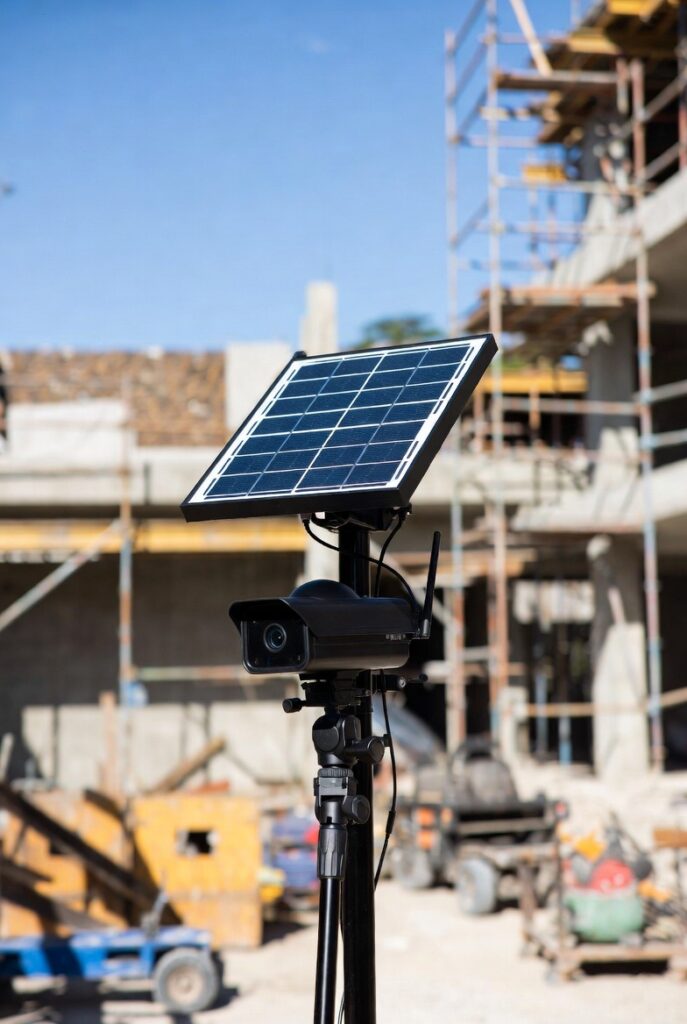
Solar-powered cameras with integrated batteries work for remote locations without wired power. A quality solar camera with 10W panel and 10,000mAh battery maintains charge through Ontario winters. South-facing mounting at 45 degrees maximizes winter sun capture.
The camera draws 2W to 4W average. The panel produces 3W to 5W average even in January. The math works if the panel gets 4+ hours of direct sun daily.
The Gravenhurst owner uses solar cameras for his detached garage 200 feet from the main system. No trenching was required. The solar cameras integrate with his main NVR over WiFi for centralized viewing.
Local Storage: No Subscriptions and No Cloud Dependency
Local storage eliminates monthly subscription fees and cloud dependency. Cloud-based security systems require constant internet upload. If your Starlink goes down during a storm, your cameras may record but you cannot access footage remotely.
Local NVR storage keeps all footage on-site. You access recordings through your local network or VPN. No monthly fees accumulate. No company can discontinue service or raise prices.
The Collingwood owner’s system stores 30 days of footage on a 2TB SSD. His recordings exist regardless of internet status. Local storage provides sovereignty over your security data.
The Off-Grid Security Strategy: DC-Native and Under 30 Watts
The off-grid security strategy uses DC-native hardware to minimize power consumption while maximizing coverage. The NVR runs directly from battery voltage. The cameras connect via PoE for efficient power delivery. The storage uses SSD instead of spinning drives. The total system draw stays under 30W.
A Victron Cerbo GX tracks system power consumption and enables remote monitoring of your entire off-grid system. The monitoring ensures you catch ghost loads before they drain your batteries.
The Collingwood owner’s rebuild dropped from 121W to 26W. His off-grid security now runs indefinitely on battery power that previously lasted only one night.
Planning Your Off-Grid Security System: Components and Costs
Planning your off-grid security system starts with measuring your current draw or specifying efficient components from the start. If you have existing cameras, measure total system watts with a power meter. If building new, select DC-native NVR, PoE cameras rated for Canadian winters, and SSD storage.
The Collingwood owner’s $680 rebuild saved him from a much larger battery upgrade. The Gravenhurst owner’s $420 camera replacement eliminated winter footage gaps.
Your off-grid security investment pays back through reduced battery drain every night. For the battery bank that supports security loads, The Budget Off-Grid System Standard covers the sizing.
Minimum Viable vs Full Standard: Choosing Your Coverage Level
The off-grid security approach offers two coverage levels depending on your integration needs and power budget. The minimum viable level draws zero watts from your main system. The full standard provides centralized recording under 30W total.
| Coverage Level | Key Components | Cost | Total Power Draw |
|---|---|---|---|
| Minimum Viable | 2 solar cameras + SD storage | $300-$500 | 0W from main system |
| Full Standard | DC-native NVR + PoE + SSD + winter-rated | $800-$1,500 | Under 30W |
Both off-grid security approaches provide functional coverage. The difference is centralization, continuous recording, and integration depth. The minimum viable approach works for properties needing basic monitoring without system integration. The full standard provides professional-grade surveillance that runs indefinitely on battery power.
Frequently Asked Questions
Q: How much power does a typical off-grid security system actually use?
A: A typical off-grid security system with DC-native hardware uses 20W to 35W total for 4-6 cameras. Standard AC systems designed for grid power use 80W to 150W. The Collingwood owner’s original system drew 121W. His rebuilt system draws 26W. The difference comes from DC-native NVR, efficient PoE cameras, and SSD storage. Your off-grid security power budget depends entirely on hardware selection.
Q: Will my off-grid security cameras work in Ontario winter temperatures?
A: Your off-grid security cameras will work in Ontario winters only if rated for the temperatures. Standard cameras rated to minus 10°C will fail during cold snaps. The Gravenhurst owner lost footage during minus 25°C nights because his cameras entered thermal shutdown. Cameras rated IP67 with minus 40°C operating temperature handle Ontario winters reliably. Some include internal heaters that add 2W during extreme cold. Off-grid security in Canada requires Canadian-rated hardware.
Q: Can I run off-grid security without internet or subscriptions?
A: Yes, you can run off-grid security without internet or subscriptions using local NVR storage. All footage records to an on-site SSD or HDD. You access recordings through your local network. No cloud upload is required. No monthly fees accumulate. The Collingwood owner stores 30 days of footage locally. His off-grid security works regardless of Starlink status or internet outages. Local storage provides complete sovereignty over your security system.
Pro Tip: Your off-grid security system should be the last thing to shut down when batteries get low, not the first. The Collingwood owner’s 121W system was his biggest overnight drain. His rebuilt 26W system now runs indefinitely on battery reserves that previously lasted one night. Design your off-grid security for minimum power draw from the start. When everything else goes dark during a storm, your cameras should still be watching. Security is about uptime.
Verdict
- The DC-Native Off-Grid Security Standard. The Collingwood owner’s 8-camera system pulled 121W continuous, draining his 25kWh battery from 80% to 35% every night. His $680 rebuild dropped total draw to 26W. His DC-native NVR draws 8W instead of 45W. His SSD draws 2W instead of 12W. His off-grid security now runs on less power than a single LED light bulb and operates indefinitely on battery reserves that previously lasted one night.
- The Canadian Winter Rating Standard. The Gravenhurst owner’s minus 10°C rated cameras stopped recording during minus 25°C nights. His footage showed gaps of 4 to 8 hours during the coldest periods. His $420 replacement with IP67 cameras rated to minus 40°C eliminated the gaps completely. His cameras now include internal heaters that add 2W during extreme cold. His off-grid security provides year-round coverage regardless of temperature.
- The Local Storage Sovereignty Standard. Local NVR storage eliminates monthly subscriptions and cloud dependency. All footage records to an on-site SSD accessible through your local network. No Starlink connection is required for recording. No company can discontinue service or raise prices. The Collingwood owner stores 30 days of footage locally with complete sovereignty over his security data.
This build is engineered within the 48V DC Safety Ceiling. Diagnostic logic is based on 20+ years of technical service experience. All structural and electrical installations must be verified by a Licensed Professional and comply with your Local AHJ.
Questions? Drop them below.
About the Author
Robert Bertrand spent 20 years as a service advisor in the automotive industry (Lexus and Nissan), where precision diagnostics, wiring integrity, and documentation standards were non-negotiable. He brings that same technical discipline to GridFree Guide, where he researches, tests, and documents off-grid solar systems for Ontario conditions. Based in Rockwood, Ontario, every article is built on verified specifications, manufacturer data, and the real-world climate constraints of Canadian off-grid living.
As an Amazon Associate I earn from qualifying purchases. This site also contains affiliate links to other products and services. GridFree Guide earns a small commission at no extra cost to you.