
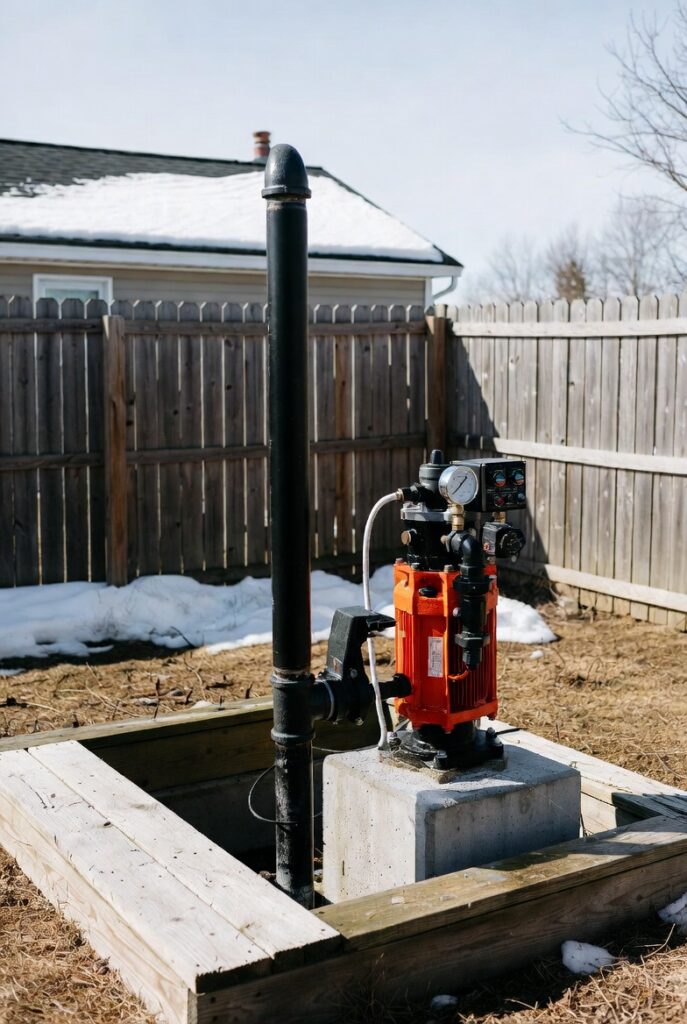
Off-grid water is the resource that exposes every weakness in your power system. It is the moment a property owner realizes his 3kW inverter cannot handle a 1HP well pump that draws 6,800W on startup. I helped a property owner near Bobcaygeon in Kawartha Lakes, Ontario diagnose a frustrating problem in summer 2025. Every time his well pump kicked on, his inverter shut down on overcurrent protection. His Starlink rebooted. His refrigerator lost power for 30 seconds. His family had learned to expect the lights to flicker whenever someone flushed a toilet or started a shower.
I measured the startup surge with a clamp meter. His 1HP 240V AC submersible pump drew 28A at 240V for the first 2 seconds of every cycle. That translated to 6,720W of instantaneous demand. His 3kW inverter was rated for 6kW surge, but only for 100 milliseconds. The pump needed 2 full seconds at peak draw. His inverter tripped every time. His battery voltage sagged from 52V to 44V during the surge, triggering low-voltage protection on his Starlink power supply.
I helped him convert to DC-direct pumping over a weekend. We replaced his 1HP AC submersible with a 48V DC brushless pump rated at 800W continuous. The new pump connects directly to his battery bank with no inverter in the path. The soft-start controller ramps the motor from 0 to full speed over 3 seconds, eliminating the current spike. His peak draw dropped from 6,720W to 1,200W during startup. His inverter no longer trips. His Starlink stays connected. The conversion cost $1,850 for the pump and controller plus $280 for the well service call. His off-grid water now runs independently of his inverter. For the battery bank that powers DC-direct equipment, The Budget Off-Grid System Standard covers the sizing.
Why Off-Grid Water Systems Expose Inverter Weaknesses
Off-grid water systems expose inverter weaknesses because well pumps are the largest surge loads most systems face. A refrigerator compressor draws 3x running current for a fraction of a second. A well pump draws 3x to 5x running current for 2 to 3 full seconds. Inverters are sized for continuous loads with surge ratings that assume brief spikes.
The mismatch between pump startup duration and inverter surge tolerance causes trips, voltage sags, and cascading failures to sensitive equipment. The Bobcaygeon owner’s Starlink rebooted because his battery voltage sagged below its 44V threshold during every pump cycle. His communication system failed multiple times per day.
His off-grid water system was undermining every other system in his home. The refrigerator cycled off during pump starts. The router rebooted. The inverter logged overcurrent faults that accumulated in the error history. A single problematic load was stressing the entire electrical infrastructure.
The Startup Surge Problem: Why AC Pumps Trip Inverters
A standard AC induction motor draws 3x to 5x its running current during startup. The motor needs high current to overcome static friction and accelerate the pump impeller to operating speed. A 1HP pump rated at 10A running can draw 30A to 50A for the first 1 to 3 seconds. At 240V, that translates to 7,200W to 12,000W instantaneous demand.
Most off-grid inverters have surge ratings measured in milliseconds, not seconds. The 100ms surge capacity on spec sheets does not match the 2-3 second startup requirement of induction motors. The numbers look compatible on paper but fail in practice.
The result is inverter trips, battery voltage sags, and stress on every component in the system. The Bobcaygeon owner’s inverter was correctly sized for his continuous loads. It simply could not sustain the 2-second surge his pump demanded every cycle.
The Off-Grid Water Advantage: DC-Direct Pumping Efficiency
The off-grid water advantage of DC-direct pumping eliminates two problems simultaneously. First, brushless DC motors start gradually with soft-start controllers that ramp speed over 3 to 5 seconds. There is no current spike. The motor accelerates smoothly under electronic control.
Second, the pump connects directly to the battery bank with no inverter conversion. Every watt goes directly to pumping water. A Victron SmartShunt monitors battery state and confirms the pump draws expected current without inverter involvement.
The efficiency gain is substantial over time. AC pumping through an inverter loses 10% to 15% to conversion inefficiency. DC-direct pumping eliminates this loss entirely. Over a pump lifetime running 2 hours daily, the savings compound to hundreds of kilowatt-hours per year. The off-grid water system becomes more efficient and more reliable simultaneously.
Soft-Start Controllers: Eliminating the Current Spike
Soft-start controllers solve the surge problem for both AC and DC pumps through different mechanisms. For AC pumps, an EasyStart soft-start device reduces startup current by 65% to 75%. The device limits initial current and ramps voltage gradually over 2 to 3 seconds.
A pump that drew 6,720W on hard start may draw only 2,000W to 2,500W with soft-start installed. This brings many pumps within range of smaller inverters that would otherwise trip on startup. The soft-start device costs $350 to $450 installed.
For DC pumps, soft-start is typically integrated into the pump controller from the factory. The brushless DC motor accelerates gradually under electronic control with no external device required. Both approaches protect the inverter, reduce battery stress, and eliminate water hammer in the plumbing.
Elevated Cistern Storage: Gravity as Your Pressure Source
An elevated cistern provides water pressure through gravity with no electricity required. Water creates 0.433 PSI per foot of elevation above the fixture. A 1,000-gallon cistern elevated 30 feet above the house provides 13 PSI constantly. This pressure is lower than typical municipal supply but adequate for most fixtures.
The pump fills the cistern during sunny hours when solar production is high. Gravity delivers pressure 24 hours per day regardless of battery state or inverter condition. The cistern acts as a water battery that decouples pumping from usage.
Even if the entire electrical system fails, water flows from the cistern until it empties. A 1,000-gallon cistern provides 3 to 5 days of supply for a typical household. This passive reliability is the ultimate backup for critical water supply. For the expandable system that can accommodate cistern pumping loads, The Expandable Solar System Standard covers the design.
Ontario PTTW Compliance: Permit Requirements for Water Taking
Ontario requires a Permit to Take Water for withdrawals exceeding 50,000 litres per day. A typical off-grid household uses 200 to 500 litres per day per person. A family of four at 400 litres each uses 1,600 litres daily. This is well below the permit threshold.
Large-scale irrigation or commercial operations may exceed 50,000 litres and require an online ministry application through the Environmental Registry of Ontario. The permit process takes 6 to 12 months for new applications.
For the standard residential off-grid property, no permit is required. Reference Ontario’s water taking requirements for current regulations and thresholds. The 50,000 litre threshold applies to any single source including wells, surface water, and cistern collection.
Winterizing the Wellhead: Preventing Freeze Damage
I received an emergency call from a property owner near Minden in Haliburton County, Ontario in January 2025. His off-grid water had stopped flowing the previous night during a cold snap. The temperature had dropped to minus 34°C. He had wrapped his wellhead with fibreglass insulation the previous fall but had not installed heat tape. The pitless adapter and pressure line had frozen solid. His family had been without water for 18 hours.
I drove out to assess the damage. The ice had expanded inside the pressure line and cracked the fitting at the pitless adapter. The adapter itself had split along one side. Thawing the line with a propane torch took 3 hours of careful work. The cracked fitting required a well service company to pull the pump and replace the adapter. His repair bill totalled $4,800 including the service call, new pitless adapter, replacement pressure line, and reinstallation. His off-grid water system had been vulnerable to a single cold night because the winterization was incomplete.
I helped him rebuild with proper cold-weather protection. We installed R-20 rigid foam insulation around the entire wellhead enclosure. We added self-regulating heat tape on the pressure line from the pitless adapter to where it enters the heated crawlspace. The heat tape draws 45W when active and cycles automatically based on temperature. A small thermostat-controlled enclosure heater provides backup protection during extreme cold. The winterization upgrade cost $380 in materials. His off-grid water system has survived two winters since the repair without incident. The $380 investment prevents the $4,800 repair.
Planning Your Off-Grid Water System: Investment vs Reliability
Planning your off-grid water system starts with understanding your reliability requirements. A property used seasonally in warm months needs less winterization than a year-round residence. A property with reliable grid-tied backup has different priorities than a fully off-grid homestead.
The Bobcaygeon owner’s conversion to DC-direct cost $2,130 and eliminated daily inverter trips. The Minden owner’s winterization cost $380 and prevented a $4,800 repair. Your off-grid water investment should match your usage pattern and climate exposure.
A Victron MPPT 100/50 can power DC pumps directly from solar panels during daylight for maximum efficiency. The sizing depends on pump wattage and daily water requirements. Direct solar pumping during peak production hours minimizes battery cycling and maximizes system longevity.
Minimum Viable vs Full Standard: Choosing Your System Level
The off-grid water approach offers two levels depending on budget and reliability requirements. The minimum viable level keeps existing AC equipment with surge mitigation. The full standard converts to DC-direct with gravity backup.
| System Level | Key Components | Cost | Reliability Gain |
|---|---|---|---|
| Minimum Viable | Soft-start + winterization | $400-$700 | Reduced trips + freeze protection |
| Full Standard | DC pump + cistern + winterization | $3,500-$6,000 | Inverter-independent + gravity backup |
The minimum viable off-grid water includes adding soft-start to existing AC pump and proper winterization with insulation and heat tape. It costs $400 to $700. It reduces inverter stress and prevents freeze damage but does not eliminate inverter dependency.
The full off-grid water standard includes brushless DC submersible pump with soft-start controller, direct battery connection, elevated cistern for gravity pressure, and complete winterization. It costs $3,500 to $6,000 depending on well depth and cistern requirements. It eliminates inverter dependency, maximizes efficiency, and provides water during electrical failures. Both approaches improve reliability over unmodified AC systems. The difference is inverter dependency and backup capability. For the budget system that accommodates water pumping loads, The Budget Off-Grid System Standard covers the electrical sizing.
Frequently Asked Questions
Q: Can I run my existing AC well pump on off-grid water power?
A: You can run an existing AC pump on off-grid water power if your inverter can handle the startup surge. A 1HP pump may draw 6,000W to 8,000W for 2 to 3 seconds on startup. Adding a soft-start device reduces this surge by 65% to 75%. If your inverter still trips after soft-start installation, the pump requires more surge capacity than your system provides. Converting to DC-direct pumping eliminates the inverter dependency entirely.
Q: How much does a DC-direct pump cost for off-grid water systems?
A: DC-direct pumps for off-grid water systems cost $1,200 to $3,500 depending on well depth and flow requirements. A shallow well under 100 feet can use a $1,200 to $1,800 pump. Deep wells over 200 feet require $2,500 to $3,500 pumps with higher lift capacity. Installation by a well service company adds $250 to $400. The total conversion from AC to DC costs $1,500 to $4,000 including pump, controller, and installation.
Q: Do I need an elevated cistern for off-grid water reliability?
A: An elevated cistern is not required but provides the highest reliability for off-grid water systems. Without a cistern, your water supply depends on the pump running and the electrical system functioning. With an elevated cistern, gravity delivers pressure even during complete electrical failure. A 1,000-gallon cistern provides 3 to 5 days of supply for a typical household. The cistern and tower installation adds $2,000 to $4,000 depending on size and elevation.
Pro Tip: Your off-grid water system should be the last thing that fails during a power crisis. The DC-direct pump runs from battery without inverter involvement. The elevated cistern delivers pressure from gravity without any electricity. The heat tape protects against freeze damage with minimal power draw. If your off-grid water still depends on your main inverter, consider the conversion. The Bobcaygeon owner’s daily inverter trips and Starlink reboots disappeared after his $2,130 DC conversion. Water is too critical to run through your weakest electrical link.
Verdict
- The Bobcaygeon Off-Grid Water Standard. The property owner’s 1HP AC pump drew 6,720W on startup and tripped his 3kW inverter every flush. His Starlink rebooted multiple times daily from battery voltage sag. Converting to a 48V DC brushless pump with soft-start controller cost $2,130 total. His peak startup draw dropped to 1,200W. The inverter trips stopped. His off-grid water now runs independently of his main inverter.
- The Minden Winterization Standard. The property owner’s incomplete winterization left his wellhead vulnerable to minus 34°C. The pitless adapter cracked and the pressure line split. His repair bill totalled $4,800 including pump pull and replacement parts. Rebuilding with R-20 insulation and self-regulating heat tape cost $380. His system has survived two winters since without incident.
- The Gravity Backup Standard. An elevated cistern provides water pressure through gravity with no electricity required. Water at 30 feet elevation delivers 13 PSI constantly. The cistern fills during sunny hours and delivers pressure 24 hours per day. Even during complete electrical failure, water flows until the cistern empties. This passive reliability costs $2,000 to $4,000 but eliminates the single point of electrical failure.
This build is engineered within the 48V DC Safety Ceiling. Diagnostic logic is based on 20+ years of technical service experience. All structural and electrical installations must be verified by a Licensed Professional and comply with your Local AHJ.
Questions? Drop them below.
About the Author
Robert Bertrand spent 20 years as a service advisor in the automotive industry (Lexus and Nissan), where precision diagnostics, wiring integrity, and documentation standards were non-negotiable. He brings that same technical discipline to GridFree Guide, where he researches, tests, and documents off-grid solar systems for Ontario conditions. Based in Rockwood, Ontario, every article is built on verified specifications, manufacturer data, and the real-world climate constraints of Canadian off-grid living.
As an Amazon Associate I earn from qualifying purchases. This site also contains affiliate links to other products and services. GridFree Guide earns a small commission at no extra cost to you.