
Off-grid lighting efficiency is not about buying better bulbs or switching to LED. It is about eliminating the inverter tax that drains your battery overnight. I helped a property owner near Minden in Haliburton County diagnose his overnight battery drain in fall 2025. He had a 3000W inverter powering his cabin. His evening loads were modest: four 10W LED bulbs in the living area, a 5W LED in the bathroom, and a 3W phone charger. His total load was 48W. By morning his 200Ah battery bank had dropped from 100% to 58%. The math did not add up.
I measured his inverter idle current with a clamp meter. His 3000W inverter drew 35W just to stay powered on with no load at all. Add the 48W of actual lighting and charging, and his true overnight draw was 83W. Over 10 hours of darkness, that totalled 830Wh consumed. His 200Ah 12V bank held 2,400Wh. The 830Wh draw represented 35% of his capacity. The inverter idle tax accounted for 420Wh of that drain. His lights and charger used only 480Wh. The inverter was consuming nearly as much power as his actual loads. The off-grid lighting setup was backwards.
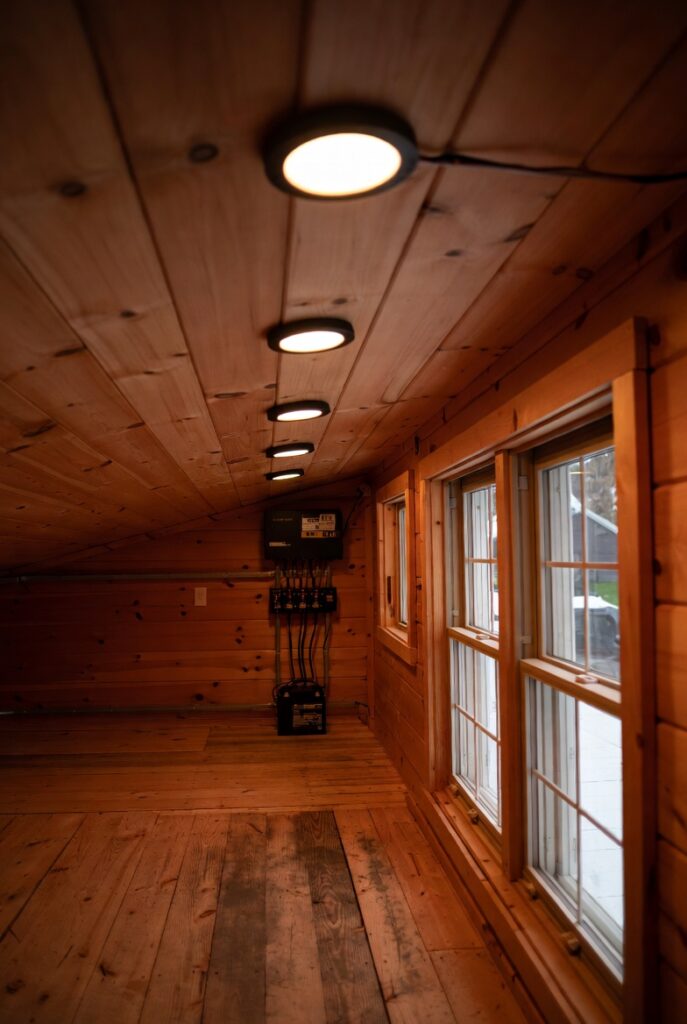
I installed a dedicated 12V DC lighting circuit using LED puck lights wired directly to his battery bank through a fuse block. The same light output now drew 45W with zero inverter overhead. His overnight consumption dropped from 830Wh to 450Wh. His morning battery state of charge improved from 58% to 81%. The inverter now stays off from 10 PM to 6 AM unless he needs AC power. The DC off-grid lighting conversion cost $185 in parts and two hours of installation. His effective battery capacity increased by 23% without adding a single cell. For the DC distribution that powers lighting circuits safely, The Solar DC Distribution Standard covers fusing and wiring requirements.
Why Off-Grid Lighting Efficiency Starts at the Inverter
The off-grid lighting efficiency problem is not the bulbs. It is the inverter that powers them. Every inverter draws idle current just to stay powered on. A 3000W inverter draws 25 to 50W idle. A 2000W inverter draws 15 to 35W idle. Running a 10W LED through a 3000W inverter creates a 350% overhead tax. The bulb uses 10W. The inverter uses 35W to deliver it.
DC-native off-grid lighting eliminates this conversion overhead entirely. The same 10W of light draws exactly 10W from the battery. The Minden cabin owner proved this math with real measurements. A Victron SmartShunt reveals the true overnight consumption pattern. The display shows exactly how much current flows from the battery each hour. The difference between expected lighting load and actual draw is the inverter tax.
The inverter idle tax is invisible until you measure it. Most cabin owners assume their inverter draws power proportional to load. A 10W bulb should draw 10W from the battery. Reality is different. The inverter transformer must stay energized. The control circuits must stay powered. The cooling fan cycles even at low loads. These baseline draws are fixed regardless of load size.
The Inverter Idle Tax: 35W to Power a 10W Bulb
The inverter idle tax math is stark when you see the numbers. A 3000W inverter drawing 35W idle to power a 10W bulb means 78% of the energy goes to the inverter, not the light. Over a 10-hour night, that 35W idle draw consumes 350Wh from your battery. The 10W bulb consumes only 100Wh. The total draw is 450Wh for 100Wh of useful light.
Scale this to a typical cabin evening with 50W of lighting loads. The inverter still draws its 35W idle regardless of the light load. The total draw becomes 85W for 50W of useful light. The overhead drops to 41% but remains significant. The Minden owner’s 48W of actual loads plus 35W of inverter overhead meant he paid a 73% tax on every watt of light.
DC-native lighting eliminates this tax completely. The 50W of DC lights draws exactly 50W from the battery. The savings compound every night. Over a month of 10-hour nights, the 350Wh nightly inverter tax becomes 10.5kWh of wasted battery capacity. That wasted energy could power 105 additional hours of lighting or extend battery life by reducing depth of discharge cycles.
The Ghost Load Kill: Turning Off the Inverter at Night
In a properly designed system, the inverter can be turned completely off at night while DC circuits continue operating. The battery powers only actual loads with zero conversion overhead. Morning coffee requires the inverter for the AC coffee maker. Evening TV requires the inverter for the entertainment system. The hours between 10 PM and 6 AM can run entirely on DC circuits.
DC lights, DC fans, DC phone chargers, and DC USB outlets handle overnight needs without the inverter. The inverter powers down completely. The ghost load disappears. The Minden owner now gains an extra 420Wh of battery capacity every night simply by turning off equipment he was not using.
This strategy works best when DC circuits cover the overnight essentials. Reading lights, bathroom lights, hallway lights, phone charging, and ventilation fans can all run on 12V DC. The morning inverter startup powers the coffee maker and kitchen appliances. The evening inverter runtime covers entertainment and cooking. The overnight hours stay completely DC-native.
The Off-Grid Lighting Setup: DC Circuits and Fuse Blocks
The off-grid lighting setup starts at the fuse block. DC lighting circuits need dedicated protection separate from high-current inverter and battery circuits. A fuse block provides multiple protected outputs from a single battery connection. Each lighting circuit gets its own fuse sized to the wire gauge and expected load. A 12V LED circuit on 14AWG wire with 3A load gets a 5A fuse.
The fuse protects the wire from short circuits and overloads. A Blue Sea fuse block provides up to 12 individual fused circuits for lighting, fans, USB outlets, and DC accessories. A Victron Lynx Distributor handles higher-current distribution with integrated fusing for battery and inverter connections while also providing outputs for DC accessory circuits.
Every DC off-grid lighting circuit requires fuse protection at the battery end of the wire. The fuse must be within 7 inches of the positive battery terminal or busbar. This placement protects the entire wire run from short circuit damage. Without proper fusing, a pinched wire or failed connection can draw hundreds of amps from the battery. The wire overheats. The insulation melts. Fire becomes possible. Reference NFPA for fusing requirements and wire protection standards in low-voltage DC systems.
Off-Grid Lighting Wire Sizing: Preventing Voltage Drop Flicker
I was troubleshooting a flickering light problem at a cabin near Bobcaygeon in Kawartha Lakes, Ontario in summer 2025. The owner had installed 12V DC puck lights throughout his cabin. The lights worked perfectly most of the time. However, every few minutes they would dim noticeably for 2 to 3 seconds, then return to full brightness. The pattern repeated all evening. He suspected a bad LED driver or loose connection.
I traced the problem to voltage drop in his off-grid lighting circuit. His farthest light was 65 feet from the fuse block. He had used 18AWG wire for the run, the same gauge that came with the lights. At 65 feet round-trip of 130 feet, the 18AWG wire dropped 1.8V under the 2A lighting load. His 12.8V battery voltage arrived at the distant light as 11.0V. The light worked but was dim. When his 12V fridge compressor kicked in, the battery voltage sagged to 12.4V. The distant light now received only 10.6V and flickered visibly. The off-grid lighting installation had a wire gauge problem, not a component problem.
I replaced the 18AWG run with 14AWG wire for the main trunk and 16AWG for the final 10-foot drops to each fixture. The voltage drop on the same 65-foot run fell from 1.8V to 0.4V. The farthest light now received 12.4V even when the fridge was running. The flicker disappeared completely. The rewiring cost $45 in wire and took 90 minutes. The lesson for off-grid lighting is to size wire for distance, not just amperage. A 2A load seems small, but 130 feet of undersized wire creates visible problems. For the wire sizing calculations that prevent voltage drop issues, The Solar DC Distribution Standard covers the formulas.
Dimmers and EMI: Why Cheap Controllers Kill Your Starlink
Cheap PWM dimmers for 12V LED lighting create radio frequency interference that disrupts communication equipment. The interference appears as static on AM/FM radios, buzzing on weather radios, and intermittent connection drops on Starlink satellite internet. The cause is unfiltered high-frequency switching in the dimmer circuit. The dimmer pulses the LED on and off thousands of times per second to create the dimming effect.
Without filtering, these pulses radiate as electromagnetic interference throughout the cabin. EMI-suppressed dimmers include filtering capacitors and inductors that contain the interference within the dimmer housing. The price difference is $8 to $15 per dimmer. The filtering components add manufacturing cost but eliminate the radio interference problem.
For off-grid lighting in cabins with radio communication or satellite internet, the EMI-suppressed dimmer is mandatory. The $15 premium prevents the $200 troubleshooting session to find the interference source. Many cabin owners have spent hours hunting for the device that disrupts their Starlink before tracing it to a $5 dimmer switch.
Minimum Viable vs Full Standard: Choosing Your DC Coverage
The off-grid lighting approach offers two levels depending on your commitment and budget. The minimum viable setup proves the concept in one room. The full standard eliminates overnight inverter runtime entirely.
| Coverage Level | Components | Cost | Inverter Savings | Payback |
|---|---|---|---|---|
| Minimum Viable | Single room DC circuit + inline fuse | $50-$100 | 20-30% overnight | 3-6 months |
| Full Standard | Whole-cabin DC + fuse block + dimmers + fan | $300-$600 | 40-50% overnight | 12-18 months |
The minimum viable off-grid lighting setup includes a single 12V LED puck light circuit with inline fuse and existing battery wiring. Cost runs $50 to $100. It proves the concept and eliminates inverter overhead for one room. Payback through reduced inverter runtime is 3 to 6 months.
The full off-grid lighting standard includes dedicated fuse block, 12V LED fixtures throughout, properly sized wiring for all runs, EMI-suppressed dimmers, and DC ceiling fan. Cost runs $300 to $600. It allows turning the inverter off completely overnight. Payback through extended battery life and reduced depth of discharge is 12 to 18 months. Both approaches eliminate some inverter overhead. The difference is whether you reduce the tax or eliminate it entirely. For the battery sizing that determines how much the inverter tax matters, The Solar Sizing Guide covers capacity calculations. For the payback math on efficiency investments, The Solar Payback Standard covers ROI analysis.
Frequently Asked Questions
Q: How much power does off-grid lighting save compared to AC bulbs?
A: Off-grid lighting using 12V DC LEDs saves 20% to 50% compared to the same bulbs on AC, depending on inverter size. The savings come from eliminating inverter idle draw, not from the bulbs themselves. A 3000W inverter draws 25 to 50W idle. Running 50W of DC lights directly from the battery uses 50W. Running 50W of AC lights through the inverter uses 75 to 100W total. The larger your inverter relative to your lighting load, the greater the DC efficiency advantage.
Q: What wire gauge should I use for off-grid lighting runs?
A: Off-grid lighting runs over 25 feet should use 14AWG or 12AWG wire to prevent voltage drop. The wire gauge depends on distance and load. A 2A load at 25 feet can use 16AWG. The same 2A load at 50 feet needs 14AWG. At 75 feet, use 12AWG. Undersized wire causes visible dimming and flicker when other loads activate. The Bobcaygeon owner’s 65-foot run on 18AWG dropped 1.8V and flickered. The same run on 14AWG dropped only 0.4V with no flicker.
Q: Can I dim 12V LED lights in an off-grid lighting system?
A: Yes, but use EMI-suppressed dimmers to avoid radio frequency interference. Cheap PWM dimmers create static on AM/FM radios and can disrupt Starlink satellite internet. EMI-suppressed dimmers cost $8 to $15 more than basic dimmers. The filtering components contain the high-frequency switching noise. For off-grid lighting in cabins with radio or satellite communication, the EMI-suppressed dimmer is mandatory.
Pro Tip: Before you install any off-grid lighting circuit, measure your inverter idle draw with a clamp meter or battery monitor. The Minden owner assumed his 48W of lights used 48W from his battery. His actual draw was 83W because of the 35W inverter tax. Knowing your specific inverter idle draw tells you exactly how much an off-grid lighting conversion will save. Some inverters draw 20W idle. Others draw 50W. The savings from DC conversion scale directly with your inverter’s idle appetite.
Verdict
- The Minden Off-Grid Lighting Standard. The cabin owner’s 3000W inverter drew 35W idle all night just to power 48W of lights and chargers. His 830Wh overnight consumption included 420Wh of pure inverter tax. Converting to 12V DC lighting for $185 dropped his overnight draw to 450Wh. His morning battery state improved from 58% to 81%. The conversion paid for itself in reduced inverter runtime within six months.
- The Bobcaygeon Voltage Drop Standard. The flickering lights traced to 18AWG wire on a 65-foot run dropping 1.8V under load. When the fridge kicked in, battery voltage sagged and the distant lights received only 10.6V. Replacing with 14AWG wire reduced the drop to 0.4V and eliminated the flicker. The $45 fix took 90 minutes. The lesson is to size off-grid lighting wire for distance, not just amperage.
- The EMI Dimmer Standard. Cheap PWM dimmers create radio frequency interference that disrupts AM/FM radios and Starlink satellite internet. EMI-suppressed dimmers cost $8 to $15 more but include filtering components that contain the high-frequency noise. The premium prevents the expensive troubleshooting session when communication equipment stops working.
This build is engineered within the 48V DC Safety Ceiling. Diagnostic logic is based on 20+ years of technical service experience. All structural and electrical installations must be verified by a Licensed Professional and comply with your Local AHJ.
Questions? Drop them below.
About the Author
Robert Bertrand spent 20 years as a service advisor in the automotive industry (Lexus and Nissan), where precision diagnostics, wiring integrity, and documentation standards were non-negotiable. He brings that same technical discipline to GridFree Guide, where he researches, tests, and documents off-grid solar systems for Ontario conditions. Based in Rockwood, Ontario, every article is built on verified specifications, manufacturer data, and the real-world climate constraints of Canadian off-grid living.
As an Amazon Associate I earn from qualifying purchases. This site also contains affiliate links to other products and services. GridFree Guide earns a small commission at no extra cost to you.