
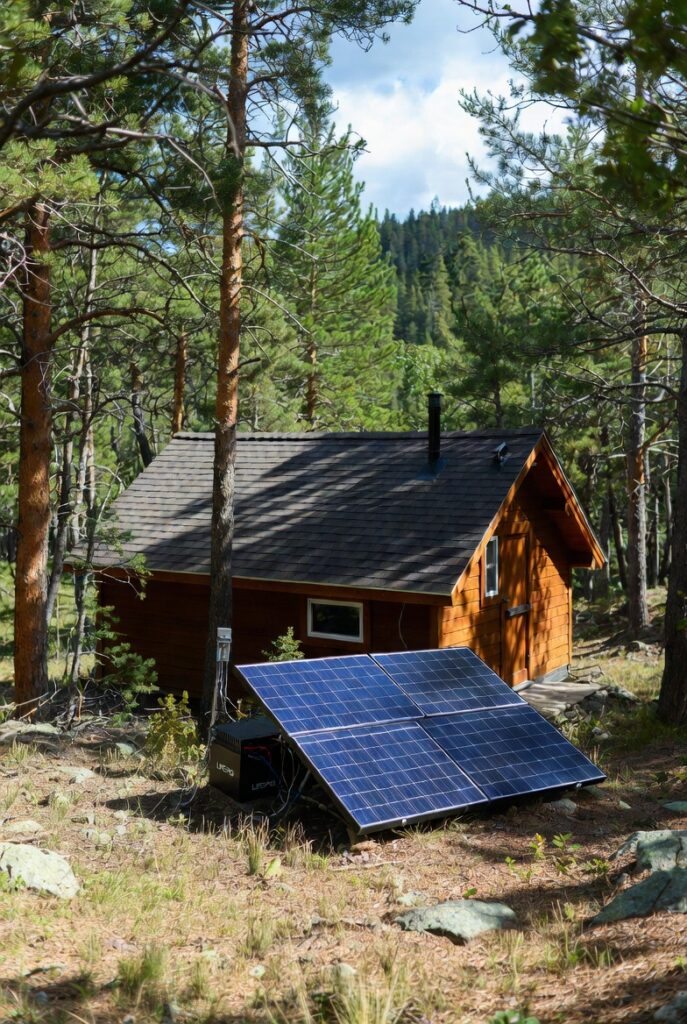
Budget off-grid system builds are not about cutting corners or accepting inferior equipment. They are the moment a cabin owner realizes he can power his weekend retreat for under $3,000 using the same battery chemistry and panel technology as $15,000 systems. I helped a property owner near Haliburton in the Kawartha Highlands build a complete 2.5kWh system in fall 2025. He had a three-season cabin with no grid connection. His needs were simple: LED lighting, phone and laptop charging, a 12V compressor fridge, and occasional power tool use.
The contractor quotes he received ranged from $8,500 to $12,000 for installed systems. We designed a budget off-grid system using components he could install himself with basic tools. The panel array was two 425W N-Type TOPCon panels purchased from a local Ontario supplier at $0.58 per watt, totalling $493 for 850W of capacity. The battery was a 12V 200Ah LiFePO4 with built-in low-temperature heating for $1,050 including shipping. The charge controller was a Victron MPPT 100/30 at $285. The inverter was a 2000W pure sine wave inverter-charger combo at $680. The racking was pressure-treated 4×4 posts with aluminum rails at $320 in materials. The wiring, fuses, breakers, and connectors totalled $290. His complete budget off-grid system cost $3,118.
The system has operated through one full winter. The cabin stays powered during weekend visits from November through March. The 200Ah battery with heating element charges properly even when temperatures drop to minus 25°C. The two 425W panels produce approximately 3.5 kWh on clear winter days, fully recharging the battery from 50% depth of discharge in 3 to 4 hours. His weekend loads average 1.8 kWh per day. The system carries him through cloudy weekends without generator backup. He saved approximately $6,000 compared to the lowest contractor quote by following the budget off-grid system approach. For the system sizing principles that determine your panel and battery capacity, The Solar Sizing Guide covers the full specification.
Why a Budget Off-Grid System Works for Cabin Power
The budget off-grid system approach works because cabin power needs are modest. A weekend cabin does not need 10kW of panels and 20kWh of batteries. It needs enough power for lights, charging, a small fridge, and occasional tools. The 2.5kWh sweet spot covers these needs with margin for cloudy days.
The same LiFePO4 chemistry in premium systems costs the same per kWh in budget systems. The same panel technology produces the same watts regardless of brand name. The savings come from value-priced components and DIY installation, not inferior technology. A $300 panel produces the same watts as a $500 panel with a fancier logo.
This approach is ideal for cabin owners who want reliable power without contractor markup. It provides a balance between cost and performance, ensuring you get the most out of your investment. For those looking to split labour with an electrician for the wiring while doing mechanical work themselves, The Hybrid DIY Solar Standard covers the split-labour approach.
The Budget Off-Grid System Component List: 2026 Ontario Pricing
The complete budget off-grid system component breakdown for 2026 Ontario pricing shows where every dollar goes. Panels: two 425W N-Type TOPCon at $0.55 to $0.70 per watt equals $470 to $595 for an 850W array. Battery: 12V 200Ah LiFePO4 with heater equals $950 to $1,200. Charge controller: Victron MPPT 100/30 equals $280 to $320. Inverter: 2000W pure sine inverter-charger combo equals $650 to $850. Racking: PT 4×4 ground mount materials equals $280 to $400. Wiring and safety: 4AWG cable, fuses, breakers, and connectors equals $250 to $350.
Total range: $2,880 to $3,715. The Haliburton build came in at $3,118 by shopping local suppliers and timing sales. This system provides 2.5 kWh of usable storage, enough for a weekend cabin’s needs.
The variance between low and high end comes primarily from battery pricing and timing. LiFePO4 prices fluctuate seasonally. Spring sales often drop battery prices by $150 to $200. Panel pricing is more stable but varies by supplier relationship. Shopping three suppliers before purchasing typically saves $200 to $400 on the complete build.
Panel Selection: N-Type TOPCon at $0.50 to $0.70 per Watt
The 2026 panel market has changed dramatically from even two years ago. N-Type TOPCon panels that cost $1.00+ per watt in 2024 now sell for $0.50 to $0.70 per watt from Ontario distributors. A 425W panel costs $215 to $300 depending on supplier and volume. The efficiency is 21% to 23%, matching premium brands exactly.
The difference between budget and premium panels is warranty terms and brand recognition, not performance. A no-name TOPCon panel produces the same watts per square foot as the premium brand. For a budget off-grid system, two 425W panels provide 850W of capacity for under $600. A single weekend of production covers a full week of cabin loads.
The value pricing makes oversizing affordable. Adding a third panel for $250 provides 50% more production capacity and faster recharge after cloudy periods. The marginal cost per additional watt drops as the array grows. Most budget builds benefit from slightly oversizing the panel array relative to battery capacity.
Battery Selection: Heated LiFePO4 for Ontario Winters
LiFePO4 is the only chemistry for a budget off-grid system in Ontario. Lead-acid costs less upfront but provides half the usable capacity and lasts one-third as long. Over 10 years, LiFePO4 costs less per kWh stored. The total cost of ownership makes LiFePO4 the budget choice despite higher initial price.
The critical requirement for Ontario installations is heating. LiFePO4 cannot charge below 0°C without cell damage. Ontario cabins see minus 20°C to minus 30°C in winter. A battery without heating charges once incorrectly and dies. The BMS should prevent cold charging, but some budget BMS units fail to protect properly.
Two Battle Born heated LFP modules in parallel provide 200Ah with integrated heating and BMS protection. The $200 premium over unheated batteries prevents the $1,800 replacement cost when cells are damaged by cold-weather charging. The heating element draws from the battery itself, activating automatically when temperatures drop below 5°C.
Inverter Selection: The 2000W Combo Unit Value
The inverter-charger combo unit saves money and complexity compared to separate components. A standalone inverter at $400 plus a separate charger at $300 equals $700 with two units to wire and manage. A combo unit at $680 does both functions with automatic switching between solar, generator, and grid charging.
The 2000W capacity handles all cabin loads including power tools up to 15A draw. Pure sine wave output protects sensitive electronics like laptops and phone chargers. Modified sine wave inverters cost less but damage some electronics over time and create audible hum in audio equipment.
The combo unit also enables future grid connection if utility service ever reaches the property. The automatic transfer switch built into quality combo units handles the switchover seamlessly. For a budget off-grid system with occasional generator backup or future grid plans, the combo is the value choice.
Racking: Pressure-Treated Ground Mount for Under $350
Ground mount racking costs less than roof mount and works better for cabin systems. Pressure-treated 4×4 posts set in concrete deck blocks provide the foundation. Aluminum rails bolt to the posts at the desired tilt angle. Panels bolt to the rails using standard mid and end clamps. Total materials cost $280 to $400 for an 850W array.
The ground mount allows seasonal tilt adjustment for snow shedding and optimal angle. Winter tilt at 60 degrees sheds snow automatically. Summer tilt at 30 degrees maximizes production. The adjustment takes 10 minutes with a socket wrench.
Ground mounting keeps panels accessible for cleaning and snow clearing after storms. It avoids roof penetrations on cabin roofs that may not be engineered for additional loads. Many cabin roofs use lighter framing than residential construction. For the ground mount engineering that prevents wind damage and ensures stability, The Solar Ground Mount Standard covers foundation requirements and tilt angles.
Budget Off-Grid System Safety: Where You Cannot Cut Corners
I was called to diagnose a failed system at a hunting camp near Bancroft in Hastings County, Ontario in winter 2025. The owner had built his own budget off-grid system the previous summer for approximately $2,400. His battery bank was destroyed. The charge controller had melted internally. The system had been offline for two months during hunting season. He wanted to know what went wrong.
I traced the failure to two cost-cutting decisions. First, he had used 14AWG wire for the battery-to-inverter run instead of the required 4AWG. The 2000W inverter pulling 170A at 12V created voltage drop and heat buildup in the undersized wire. Second, he had skipped the DC fuse between battery and inverter to save $45. When the inverter failed internally, the battery dumped its full capacity through the short circuit. The wire insulation melted. The charge controller caught the backfeed. The LiFePO4 battery BMS eventually disconnected, but not before the cells were damaged by overcurrent.
His $2,400 budget off-grid system was destroyed because he saved $65 on proper wire and fusing. The rebuild cost $1,850 in replacement components plus the $2,400 he had already spent. His total investment reached $4,250 for a system that should have cost $3,200 if built correctly the first time. A Blue Sea 600A fuse between battery and inverter costs $45 and would have limited the failure to the inverter alone. For the DC fuse sizing and wire gauge requirements that protect your investment, The Solar DC Distribution Standard covers the full specification. Reference NFPA for electrical safety codes that apply to off-grid installations.
Minimum Viable vs Full Standard: Choosing Your Build Level
The budget off-grid system approach offers two levels depending on your needs and budget. The minimum viable build suits cabin owners testing solar before larger investment. The full standard suits cabin owners wanting reliable weekend independence through all seasons.
| Build Level | Panel Array | Battery | Inverter | Total Cost | Usable Storage |
|---|---|---|---|---|---|
| Minimum Viable | 400-600W | 100Ah LiFePO4 | 1000W | $1,800-$2,200 | 1.2 kWh |
| Full Standard | 800-1000W | 200Ah heated LiFePO4 | 2000W combo | $2,800-$3,500 | 2.5 kWh |
The minimum viable budget off-grid system includes 400W to 600W panels, 100Ah LiFePO4, PWM charge controller, and 1000W inverter. Cost runs $1,800 to $2,200. Storage is 1.2kWh usable. It powers lights, charging, and small 12V loads. It does not support power tools or large AC loads. This level works for summer-only cabins or very light usage.
The full budget off-grid system standard includes 800W to 1000W panels, 200Ah heated LiFePO4, MPPT charge controller, and 2000W inverter-charger combo. Cost runs $2,800 to $3,500. Storage is 2.5kWh usable. It powers all cabin loads including fridge, tools, and entertainment. It handles cloudy stretches without generator. Both levels use the same LiFePO4 chemistry and the same safety requirements. The difference is capacity and load support. For the payback calculation comparing solar cost to generator fuel over time, The Solar Payback Standard covers the ROI analysis.
Frequently Asked Questions
Q: Can I build a budget off-grid system for under $2,000?
A: Yes, but with reduced capacity. A minimum viable budget off-grid system with 400W panels, 100Ah battery, and 1000W inverter costs $1,800 to $2,200. It provides 1.2kWh usable storage for lights, charging, and small loads. It does not support power tools or large AC appliances. For full cabin independence, the $2,800 to $3,500 range provides the 2.5kWh capacity most weekend users need.
Q: Do I need a heated battery for a budget off-grid system in Ontario?
A: Yes. LiFePO4 batteries cannot charge below 0°C without cell damage. Ontario cabin temperatures regularly drop to minus 20°C or colder. A budget off-grid system without a heated battery works only in summer. The $200 premium for a heated battery prevents the $900+ replacement cost when cells are damaged by cold-weather charging.
Q: What is the most important safety component in a budget off-grid system?
A: The DC fuse between battery and inverter. This single component prevents catastrophic failure when any downstream component shorts. The Bancroft hunting camp owner skipped this $45 fuse and lost his entire $2,400 budget off-grid system when the inverter failed. A properly sized fuse limits damage to the failed component and protects the battery, wiring, and other equipment.
Pro Tip: Before you finalize your budget off-grid system component list, price check three Ontario suppliers for each major component. Panel pricing varies by $50 to $100 per unit between suppliers. Battery pricing varies by $150 to $300 for the same capacity. I have seen identical budget off-grid system builds cost $2,900 at one supplier and $3,600 at another with the same components. The 30 minutes of price comparison can save $500 or more. Get quotes, compare, and buy the same quality for less.
Verdict
- The Haliburton Budget Off-Grid System Standard. The cabin owner built a complete 2.5kWh system for $3,118 using N-Type TOPCon panels at $0.58 per watt, heated LiFePO4 battery, and MPPT charge controller. The system has operated through one full Ontario winter with weekend visits from November through March. He saved $6,000 compared to the lowest contractor quote by doing his own installation with basic tools.
- The Bancroft Safety Failure Standard. The hunting camp owner lost his entire $2,400 system because he saved $65 on proper wire gauge and DC fusing. The 14AWG wire overheated under 170A load. The missing fuse allowed the battery to dump full capacity through the short circuit. His rebuild cost $1,850, bringing his total investment to $4,250 for a system that should have cost $3,200 built correctly the first time.
- The Heated Battery Non-Negotiable Standard. LiFePO4 batteries cannot charge below 0°C without cell damage. Ontario winter temperatures regularly reach minus 20°C to minus 30°C. The $200 premium for a heated battery with integrated low-temperature protection prevents the $1,800 replacement cost when cells are damaged by a single cold-weather charging attempt.
This build is engineered within the 48V DC Safety Ceiling. Diagnostic logic is based on 20+ years of technical service experience. All structural and electrical installations must be verified by a Licensed Professional and comply with your Local AHJ.
Questions? Drop them below.
About the Author
Robert Bertrand spent 20 years as a service advisor in the automotive industry (Lexus and Nissan), where precision diagnostics, wiring integrity, and documentation standards were non-negotiable. He brings that same technical discipline to GridFree Guide, where he researches, tests, and documents off-grid solar systems for Ontario conditions. Based in Rockwood, Ontario, every article is built on verified specifications, manufacturer data, and the real-world climate constraints of Canadian off-grid living.
As an Amazon Associate I earn from qualifying purchases. This site also contains affiliate links to other products and services. GridFree Guide earns a small commission at no extra cost to you.