
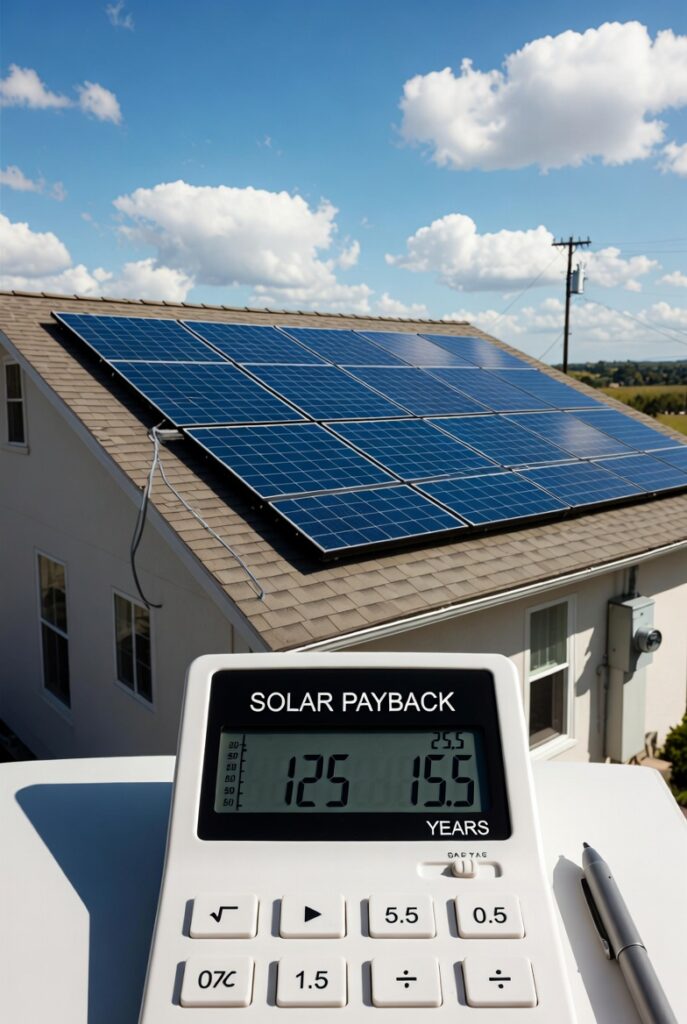
Solar payback calculations are not about dividing cost by savings and calling it done. They are the moment a property owner realizes the 8-year payback his contractor promised was based on assumptions that do not match his actual electricity use. I was helping a property owner near Georgetown in Halton Hills, Ontario evaluate a 7kW system quote in spring 2025. The contractor had provided a slick proposal showing $18,500 net cost after rebates and 8.2-year payback. The homeowner wanted a second opinion before signing.
I asked the contractor three questions. First, what annual production did they assume? They assumed 8,400 kWh based on optimal south-facing roof. The homeowner’s roof faced southwest with 15-degree azimuth offset, reducing production to approximately 7,600 kWh. Second, what electricity rate did they use? They used the blended TOU average of 13.2 cents per kWh. The homeowner was on ULO rates and exported most production during off-peak hours at 8.7 cents. Third, did they account for panel degradation? They did not. The solar payback calculation in the proposal was optimistic by at least 3 years.
I rebuilt the calculation with accurate inputs. The 7kW system on the southwest roof would produce 7,600 kWh in year one. At the homeowner’s actual consumption pattern and ULO rate structure, the annual savings came to $785, not the $1,150 the contractor claimed. The accurate solar payback period was 11.8 years, not 8.2 years. The homeowner did not cancel the project. He renegotiated the price down by $2,800 based on the accurate math. His final solar payback period was 9.4 years with honest numbers. For the Ontario rebate programs that reduce your upfront cost and accelerate payback, The Ontario Solar Rebate Standard covers the current incentives.
The Solar Payback Formula: System Cost Minus Rebates Divided by Annual Savings
The basic solar payback formula is straightforward. Total System Cost minus Available Rebates divided by Annual Electrical Savings equals Payback Years. A $22,000 system with $8,000 in rebates and $1,400 annual savings has a payback of ($22,000 – $8,000) / $1,400 = 10 years. The formula is simple. The inputs are where accuracy matters.
Annual savings depends on actual production, actual consumption pattern, and actual rate structure. The solar payback calculation is only as accurate as its inputs. A contractor using optimistic assumptions will show faster payback than reality delivers. A homeowner using his own electricity bills will see the truth.
The Georgetown homeowner learned this lesson. His contractor’s 8.2-year projection became 11.8 years with accurate inputs. The formula was identical. The inputs told different stories. For the solar system sizing that determines your production input, The Solar Sizing Guide covers the full specification.
Why Most Solar Payback Calculators Are Wrong: The Three Missing Factors
Three factors that most solar payback calculators ignore make projections unreliable. First, panel degradation at 0.5% annually reduces Year 25 output to 88% of Year 1. Second, maintenance reserve at 1% annually accounts for inverter replacement and repairs. Third, consumption pattern mismatch between when you produce and when you consume reduces effective savings on TOU rates.
A calculator showing 8-year solar payback with these factors ignored becomes 10-year payback with accurate modeling. The Georgetown homeowner discovered this gap firsthand. His contractor’s proposal included none of these factors. The accurate calculation included all three.
Most online calculators and contractor proposals use best-case assumptions. They assume constant production for 25 years. They assume zero maintenance costs. They assume perfect alignment between production and consumption. Reality includes degradation, repairs, and timing mismatches.
The 0.5% Degradation Factor: What Your Contractor Did Not Tell You
Panel degradation is unavoidable physics. Manufacturers warrant 80% to 85% output at year 25, implying 0.5% to 0.8% annual degradation. A 6kW system producing 7,200 kWh in year one produces 6,840 kWh in year 10 and 6,340 kWh in year 25. The cumulative production loss over 25 years is approximately 2,000 kWh compared to constant-output assumptions.
A Victron MPPT 100/50 tracks daily production so you can monitor actual degradation against your solar payback projections year over year. Most contractor quotes assume flat production. Reality degrades. The degradation does not change whether the system pays for itself. It changes when the system pays for itself.
Ignoring degradation makes solar payback estimates 1 to 2 years optimistic. Honest calculations reduce annual production by 0.5% each year and show a slightly longer path to break-even.
The 1% Maintenance Reserve: Keeping Your ROI Honest
Component replacement is inevitable over a 25-year system lifespan. String inverters last 10 to 15 years and cost $1,500 to $3,000 to replace. Monitoring equipment fails. Connections require retorquing. Microinverters and optimizers occasionally need replacement.
A 1% annual reserve on a $20,000 system is $200 per year or $5,000 over 25 years. This reserve reduces your effective annual savings from $1,400 to $1,200. The solar payback extends by 12 to 18 months compared to calculations that ignore maintenance entirely.
Ignoring maintenance makes your calculation look better than reality. Reality includes repairs. The Georgetown homeowner’s accurate calculation included the maintenance reserve. His contractor’s proposal did not.
Accelerating Your Solar Payback: The ULO Arbitrage Strategy
I helped a property owner near Bobcaygeon in Kawartha Lakes, Ontario recalculate his solar payback after he enrolled in the ULO rate program in late 2025. He had installed a 6kW system with 10kWh battery two years earlier. His original solar payback calculation showed 10.5 years based on standard TOU rates. He had been disappointed with the slow progress toward break-even. His monthly savings were running 15% below the contractor’s projections.
The ULO rate changed his math completely. He now charged his battery at 3.9 cents per kWh from 11 PM to 7 AM. He discharged during peak hours when rates reached 28.6 cents. The arbitrage value was 24.7 cents per kWh of shifted consumption. His 10kWh battery cycling daily shifted approximately 300 kWh per month. The monthly arbitrage savings added $74 to his solar production savings. His annual savings jumped from $1,080 to $1,970. The solar payback period dropped from the original 10.5 years to 6.8 years with the same equipment.
He had already owned the system for 2 years. At the new savings rate, his remaining payback period was 4.8 years instead of the 8.5 years he had been expecting. The ULO enrollment was free. The rate switch took effect on his next billing cycle. The solar payback acceleration cost him nothing except the awareness that the option existed. A Victron SmartShunt tracks exactly how much you save with each charge-discharge cycle. A Victron MultiPlus-II manages the automatic scheduling that maximizes arbitrage value. For current ULO program details, visit Ontario Electricity Rates.
The Inflation Hedge: Why Rising Hydro Rates Improve Your Return
Ontario electricity rates have increased 3% to 5% annually over the past decade. A solar payback calculation using today’s rates underestimates future savings. If rates increase 4% annually, your Year 10 savings are 48% higher than Year 1 savings on the same production.
The panels produce the same kWh each year minus degradation. The value of those kWh increases as grid rates rise. Solar is a prepaid utility bill at today’s rates. Every rate increase makes your decision look smarter. The system you buy in 2026 produces power at 2026 prices for 25 years while the grid charges 2051 prices.
Conservative solar payback calculations use flat rates. Accurate calculations model 3% to 4% annual increases and show payback accelerating over time. The inflation hedge is real. Your contractor probably did not include it because it makes projections look optimistic. But unlike degradation and maintenance, the inflation hedge works in your favour.
Minimum Viable vs Full Standard: Choosing Your Calculation Depth
The minimum viable solar payback calculation requires roof orientation, local production factor at 1,150 to 1,250 kWh per kW in Southern Ontario, and current electricity rate. Calculation time is 5 minutes with a calculator. Accuracy falls within 2 to 3 years of actual payback.
The full solar payback analysis standard requires 12 months of electricity bills, hour-by-hour consumption data if available, accurate roof survey with shading analysis, current rebate details, and spreadsheet modeling with degradation, maintenance, and rate inflation factors. Calculation time is 2 to 4 hours. Accuracy falls within 6 to 12 months of actual payback.
| Calculation Level | Inputs Required | Time | Accuracy |
|---|---|---|---|
| Minimum Viable | Roof orientation, production factor, rate | 5 minutes | ±2-3 years |
| Full Standard | 12-month bills, shading analysis, all factors | 2-4 hours | ±6-12 months |
Both solar payback calculation approaches use the same basic formula. The difference is input accuracy and factor inclusion. For the DIY vs contractor cost comparison that affects your total system cost input, The DIY Solar Cost Standard covers the analysis. For the hybrid approach that can reduce your cost input further, The Hybrid DIY Solar Standard covers the split-labour option.
Frequently Asked Questions
Q: What is the average solar payback period in Ontario in 2026?
A: The average solar payback period for a residential system in Ontario ranges from 7 to 12 years depending on system cost, rebates captured, roof orientation, and rate structure. Systems with battery storage on ULO rates can achieve solar payback in 6 to 8 years. Systems on standard TOU rates without battery typically take 9 to 12 years.
Q: How does the ULO rate affect my solar payback calculation?
A: The ULO rate can shave 1.5 to 2.5 years off your solar payback period by enabling arbitrage. Charging batteries at 3.9 cents overnight and discharging at 28.6 cents peak creates 24.7 cents per kWh in value beyond simple solar production savings. A 10kWh battery on ULO adds approximately $900 annually to your savings.
Q: Should I factor panel degradation into my solar payback estimate?
A: Yes. Panel degradation of 0.5% annually means your Year 10 production is 95% of Year 1, and Year 25 production is approximately 88% of Year 1. Ignoring degradation makes solar payback estimates 1 to 2 years optimistic. Honest calculations reduce annual production by 0.5% each year.
Pro Tip: Before you sign any solar contract, rebuild the solar payback calculation yourself with your actual electricity bills and roof orientation. I have reviewed dozens of contractor proposals that showed 7 to 8 year payback using optimistic assumptions. The accurate solar payback with honest inputs was typically 9 to 11 years. The difference is not fraud. It is aggressive assumptions about production, rates, and consumption patterns. Your 12 months of electricity bills tell the truth. Use them.
Verdict
- The Georgetown Solar Payback Standard. The Halton Hills homeowner discovered his contractor’s 8.2-year payback was actually 11.8 years with accurate inputs. He renegotiated the $18,500 quote down by $2,800 based on honest math. His final solar payback period was 9.4 years with a $15,700 net cost. Accurate inputs saved him $2,800 and set realistic expectations.
- The Bobcaygeon ULO Acceleration Standard. The Kawartha Lakes property owner watched his solar payback drop from 10.5 years to 6.8 years with zero additional investment. The ULO rate enrollment was free. His annual savings jumped from $1,080 to $1,970 through the 24.7 cents per kWh arbitrage value. With 2 years already behind him, his remaining payback dropped to 4.8 years.
- The Three Factor Accuracy Standard. Panel degradation at 0.5% annually, maintenance reserve at 1% annually, and rate inflation at 3% to 4% annually separate accurate calculations from contractor optimism. Including all three factors typically extends the projected payback by 12 to 18 months compared to proposals that ignore them. Honest math prevents disappointment.
This build is engineered within the 48V DC Safety Ceiling. Diagnostic logic is based on 20+ years of technical service experience. All structural and electrical installations must be verified by a Licensed Professional and comply with your Local AHJ.
Questions? Drop them below.
About the Author
Robert Bertrand spent 20 years as a service advisor in the automotive industry (Lexus and Nissan), where precision diagnostics, wiring integrity, and documentation standards were non-negotiable. He brings that same technical discipline to GridFree Guide, where he researches, tests, and documents off-grid solar systems for Ontario conditions. Based in Rockwood, Ontario, every article is built on verified specifications, manufacturer data, and the real-world climate constraints of Canadian off-grid living.
As an Amazon Associate I earn from qualifying purchases. This site also contains affiliate links to other products and services. GridFree Guide earns a small commission at no extra cost to you.