
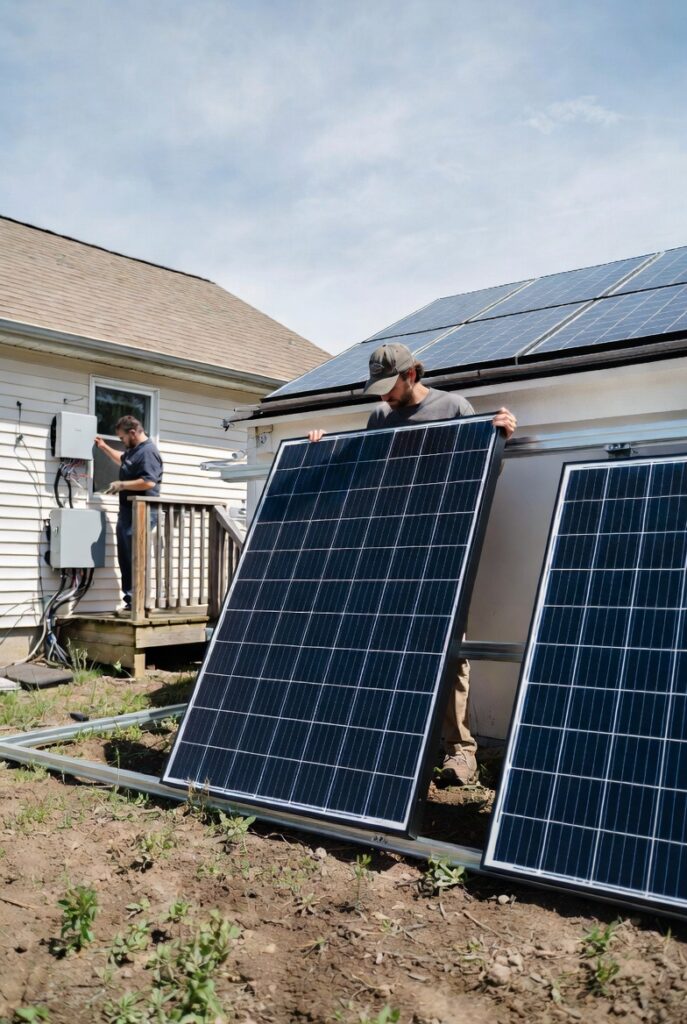
Hybrid diy solar installations are not about saving money by skipping the electrician. They are the moment a property owner realizes he can build his own racking and mount his own panels while a licensed electrician handles the wiring that keeps his insurance valid. I helped a property owner near Fergus in Wellington County, Ontario install a 6kW ground-mount array in summer 2025. He had framing experience from building two decks and a garden shed. He had zero electrical experience beyond changing outlets. He wanted to save money but not at the cost of his homeowner insurance or ESA compliance.
We structured the project as a hybrid diy solar installation. He handled the mechanical work: digging the 24-inch trench for conduit, pouring the concrete footings, assembling the galvanized steel racking, and bolting all 16 panels to the rails. I connected him with a licensed electrical contractor before he started. The LEC reviewed his conduit routing plan, specified the junction box locations, and scheduled the rough-in inspection for before the trench was backfilled. The homeowner provided the labour. The LEC provided the expertise and the ESA permit. The handoff point was clearly defined before the first shovel hit the ground.
The full contractor quote for the same 6kW system was $18,400. The hybrid diy solar approach cost $11,200 total. The homeowner paid $7,800 for equipment and materials. He paid the LEC $3,400 for inverter installation, AC disconnect, main panel connection, and ESA permit with inspection. His labour contribution was 38 hours across 4 weekends. The $7,200 savings represented his compensation for the mechanical work at approximately $190 per hour of his time. More importantly, he has an ESA Certificate of Acceptance. His insurance is intact. The system passed inspection on the first attempt. For the wiring standards the LEC followed on the electrical side, The Solar DC Distribution Standard covers the full specification.
Why Hybrid DIY Solar Works: The Split-Labour Logic
The hybrid diy solar approach recognizes that solar installation contains two distinct skill sets. Mechanical work includes mounting rails, bolting panels, digging trenches, and running conduit. Electrical work includes inverter wiring, AC disconnects, main panel integration, and grounding verification. A homeowner who can frame a deck has the skills for mechanical work. Electrical work requires licensing, insurance, and ESA certification. The split-labour approach matches skills to tasks.
The homeowner saves money on the portion he can do. The LEC ensures code compliance on the portion that requires it. Neither party does work outside their competence. This division of labour is practical and efficient. Homeowners with basic construction skills can handle the mechanical tasks, which are straightforward and require no specialized knowledge.
The electrical work must be done by a licensed professional to ensure safety and compliance. By splitting the labour this way, homeowners can save a significant amount of money while maintaining the integrity and legality of their solar installation. For the solar system sizing that determines how many panels belong in your hybrid diy solar project, The Solar Sizing Guide covers the full specification.
The Timing Rule: Call the Electrician Before You Dig
The critical mistake in failed hybrid diy solar projects is timing. The homeowner completes mechanical work then calls the electrician. The electrician finds code violations in conduit routing, junction box placement, or grounding paths. The homeowner faces rework or refusal. The solution is coordination from day one.
The LEC must review and approve the mechanical plan before construction begins. The LEC must specify conduit paths that meet code. The LEC must schedule rough-in inspection before the trench is backfilled. The hybrid approach is not “do the mechanical work then hand off to electrical.” It is “plan together, build in parallel, inspect at milestones.”
ESA Notification and Permit Requirements for Split-Labour Installations
I received a call from a property owner near Owen Sound in Grey County, Ontario in early 2026. He had attempted a hybrid diy solar installation the previous fall. He mounted the panels himself, ran the conduit himself, and then called an electrician to “just connect the inverter and pull the permit.” The electrician refused. The conduit routing violated code. The junction boxes were wrong. The grounding was incomplete. The electrician would not put his license on work he had not overseen from the beginning.
The property owner had two choices. He could tear out the conduit and junction boxes and redo them under the electrician’s supervision at additional cost. Or he could find an electrician willing to sign off on substandard work, which no reputable LEC would do. He chose the first option. The rework cost him $1,800 in materials he had already purchased once and $2,200 in additional LEC time to supervise the redo. His hybrid diy solar installation that was supposed to save $5,000 ended up costing $4,000 more than if he had coordinated with the LEC from the start.
In Ontario, any electrical work requires notification to the Electrical Safety Authority. Even if you do the work yourself, you must file notification. However, the ESA inspection requires the work to meet code. Most LECs will not sign off on a final connection for work they did not oversee from the rough-in stage. The hybrid diy solar approach works only when the LEC is involved from the planning stage, not called in at the end. For the grounding requirements the LEC will enforce, The Off-Grid Grounding Standard covers the full specification.
The Hybrid DIY Solar Handoff: What You Do vs What the LEC Does
The hybrid diy solar handoff requires a clear division of work. Homeowner mechanical tasks include structural mounting, rail alignment, panel lifting and bolting, digging trenches at 24 inches minimum for frost protection, running conduit under LEC specification, and pulling bonding conductors under LEC specification. LEC electrical tasks include inverter installation and configuration, AC disconnect installation, main panel integration, overcurrent protection, grounding verification, ESA permit filing, and final inspection coordination.
The Victron MultiPlus-II inverter installation includes the critical neutral-ground bond configuration that only the LEC should perform. The handoff point is not a moment in time. It is ongoing coordination throughout the project with the LEC approving mechanical work before it is buried or covered.
The homeowner’s role is to follow the plan provided by the LEC. This includes digging trenches, pouring concrete footings, assembling and mounting racking, and bolting panels to the rails. The LEC ensures that all electrical connections are made correctly and safely. By working together, the homeowner can save money on labour while ensuring the project meets all code requirements.
Grounding and Bonding: ESA Bulletin 64-5-4 Compliance
ESA Bulletin 64-5-4 specifies grounding requirements for solar installations. All metallic racking, panel frames, and equipment enclosures must bond to the building grounding electrode system. Minimum conductor size is 6AWG copper. The homeowner can install the bonding conductors as part of mechanical work. The LEC must verify continuity before energizing.
A Blue Sea 600A fuse provides overcurrent protection in the DC system, connected to the same grounding system. The panels can be perfectly mounted. The racking can be level and secure. But the system will not pass ESA inspection until grounding continuity is verified by the LEC. This is not optional. It is code.
Grounding is a critical safety measure that ensures your hybrid diy solar system operates safely and reliably. The homeowner can install the bonding conductors, but the LEC must verify that they are correctly connected to the building’s grounding electrode system. This verification is essential for passing ESA inspection and maintaining insurance coverage.
Hybrid DIY Solar Cost Savings: The 25% Labour Capture
The hybrid diy solar cost math breaks down clearly. Full-service installation in Ontario runs $2.42 to $3.50 per watt. On a 6kW system, that is $14,500 to $21,000 total. Approximately 25% is mechanical labour. Approximately 75% is equipment, electrical labour, permits, and overhead. The homeowner who handles mechanical work captures that 25% savings.
On an $18,000 quote, mechanical labour is approximately $4,500. A Victron SmartShunt lets the homeowner monitor system performance after the LEC completes connection. The hybrid diy solar savings is real but requires honest time accounting. The Fergus installation required 38 hours of homeowner labour. At $7,200 savings, that is $190 per hour. Most homeowners consider that rate worthwhile.
By handling the mechanical work, homeowners can save a significant amount of money. For example, on an $18,000 full-service quote, capturing 25% of the labour costs translates to a savings of $4,500. This approach not only saves money but also provides a sense of accomplishment and control over the project. For the full DIY approach including electrical work (and why it often fails), The DIY Solar Cost Standard covers the comparison.
Minimum Viable vs Full Standard: Choosing Your Coordination Level
The minimum viable hybrid diy solar coordination requires one planning meeting with LEC, their conduit and junction box specs in writing, and their commitment to permit and final connection. Coordination fee runs $200 to $400 beyond connection work. This level suits homeowners with construction experience and confidence following written specifications.
The full hybrid diy solar coordination standard requires 2 to 3 LEC site visits during the mechanical phase, ongoing availability for questions, and documented approval at each stage. Coordination fee runs $600 to $1,200 beyond connection work. This level eliminates rework risk and guarantees first-attempt pass.
| Coordination Level | LEC Involvement | Coordination Fee | Rework Risk | Best For |
|---|---|---|---|---|
| Minimum Viable | 1 planning meeting + final connection | $200-$400 | Moderate | Experienced builders |
| Full Standard | 2-3 site visits + ongoing oversight | $600-$1,200 | Near zero | First-time solar installers |
Both hybrid diy solar paths can include the same Victron MultiPlus-II inverter. The coordination level determines whether the homeowner has backup when questions arise. For the ground mount foundation that many hybrid projects use, The Solar Ground Mount Standard covers concrete footings and racking options.
Frequently Asked Questions
Q: How much can I save with a hybrid diy solar installation compared to full contractor?
A: A hybrid diy solar approach typically saves $4,000 to $7,000 on a residential system by capturing the 25% of project cost that is mechanical labour. On an $18,000 full-service quote, the homeowner handling mounting, racking, and trenching can reduce total cost to $11,000 to $14,000 while keeping ESA compliance and insurance coverage intact.
Q: Do I need to hire an electrician for a hybrid diy solar project in Ontario?
A: Yes. The electrical portion of a hybrid diy solar installation requires a Licensed Electrical Contractor to pull the ESA permit, wire the inverter and AC disconnect, integrate with the main panel, and verify grounding. No LEC means no ESA Certificate of Acceptance, and no certificate means insurance claims can be denied if something goes wrong.
Q: When should I contact the electrician for a hybrid diy solar project?
A: Contact the LEC before you start any work. The hybrid diy solar approach requires the electrician to approve your conduit routing, junction box placement, and grounding plan before you build. Calling after the mechanical work is complete often results in code violations, rework costs, or electrician refusal to sign off on work they did not oversee.
Pro Tip: Before you commit to a hybrid diy solar project, have one honest conversation with the electrician about their comfort level with homeowner-installed mechanical work. Some LECs welcome hybrid diy solar projects because they get the electrical work without the mechanical labour. Others refuse to sign off on any work they did not supervise from day one. Find the right LEC before you buy materials. I have seen homeowners purchase $8,000 in equipment and then discover no local electrician would work with them. The LEC relationship is the foundation of the hybrid approach. Confirm it first.
Verdict
- The Fergus Hybrid DIY Solar Standard. The Wellington County property owner saved $7,200 on a 6kW system by handling mechanical tasks while an LEC handled electrical work. His total cost was $11,200 compared to the $18,400 full contractor quote. His ESA Certificate of Acceptance ensured insurance coverage and passed inspection on the first attempt. The 38 hours of labour earned him $190 per hour in effective savings.
- The Owen Sound Coordination Failure. The Grey County property owner faced $4,000 in rework costs because he called the electrician after completing the mechanical work. His conduit routing violated code. His junction boxes were wrong. His grounding was incomplete. The $5,000 he expected to save became $4,000 in additional expense because no LEC would sign off on work they had not overseen from the start.
- The 25% Labour Capture Standard. By handling mechanical work under LEC coordination, homeowners can capture 25% of the project cost as labour savings. On a typical $18,000 installation, that represents $4,000 to $7,000 in real savings while maintaining ESA compliance and insurance coverage. The key is coordination from day one, not handoff at the end.
This build is engineered within the 48V DC Safety Ceiling. Diagnostic logic is based on 20+ years of technical service experience. All structural and electrical installations must be verified by a Licensed Professional and comply with your Local AHJ.
Questions? Drop them below.
About the Author
Robert Bertrand spent 20 years as a service advisor in the automotive industry (Lexus and Nissan), where precision diagnostics, wiring integrity, and documentation standards were non-negotiable. He brings that same technical discipline to GridFree Guide, where he researches, tests, and documents off-grid solar systems for Ontario conditions. Based in Rockwood, Ontario, every article is built on verified specifications, manufacturer data, and the real-world climate constraints of Canadian off-grid living.
As an Amazon Associate I earn from qualifying purchases. This site also contains affiliate links to other products and services. GridFree Guide earns a small commission at no extra cost to you.