
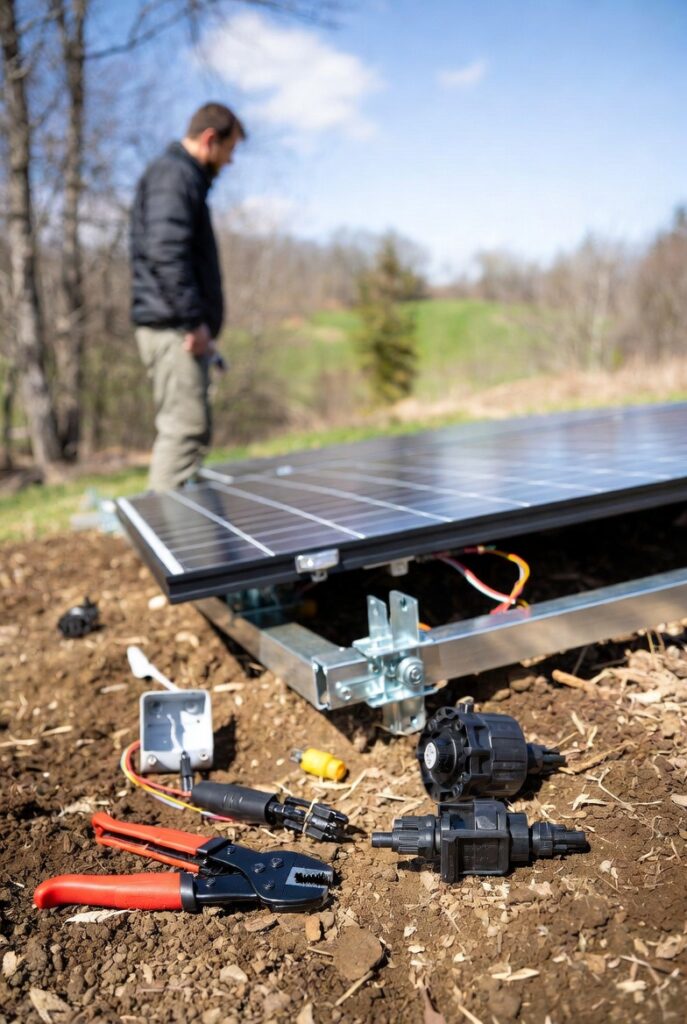
DIY solar cost calculations are not labour savings minus panel prices. I was helping a property owner near Caledon in Peel Region, Ontario install a 5kW ground-mount array in summer 2024. He had received contractor quotes ranging from $18,000 to $24,000 for the complete installation. He decided to DIY after watching YouTube videos and calculating he could buy the same equipment for $11,500 and save $6,500 to $12,500 in labour costs. He did not include tools in his diy solar cost calculation.
By the end of the project, he had purchased a hydraulic cable crimper for $340 that he used for 12 crimps total. He bought an MC4 assembly tool kit for $89 that he used for 20 connections. He purchased a torque wrench with solar-specific sockets for $165 that he used for 16 bolts. He bought a cable cutting tool rated for 4/0 gauge for $78 that he used twice. He purchased a multimeter with DC clamp capability for $220 that he already owned a lesser version of. He bought safety equipment including fall arrest harness and roof anchors for $355 that he used for 6 hours of roof work. The tools totalled $1,247. His actual diy solar cost savings dropped from $6,500 to $5,253 before counting his time.
The installation took him 47 hours across 9 weekends. He tracked his hours because I asked him to. At $50 per hour, which is below what most skilled tradespeople charge, his time was worth $2,350. His actual savings after tools and time was $2,903 for a 5kW system. The contractor quote he rejected included a 10-year workmanship warranty, ESA permit and inspection, and a system that would not void his homeowner insurance. His DIY installation included none of those protections. The $2,903 he saved bought him liability exposure and 47 hours of labor on his weekends. For the solar system sizing standard that determines what size array you need before choosing your installation path, The Solar Sizing Guide covers the full specification.
The Real DIY Solar Cost: Tools, Time, and Hidden Expenses
Most diy solar cost calculations include only equipment. The hydraulic crimper, MC4 tools, torque wrench, cable cutter, quality multimeter, and safety equipment add $800 to $1,500 for a proper installation. Cheap tools create poor connections that fail under thermal cycling. Quality tools cost money. Time is the invisible cost. First-time installers take 40 to 80 hours. Learning curve, mistakes, rework, weather delays. A $50/hour value on that time adds $2,000 to $4,000 to the true cost. The apparent $8,000 savings becomes $4,000 to $5,000 after honest accounting.
For example, a WBHome crimper kit costs $85 and performs 12 crimps on a residential system. The tool sits in the garage for 20 years after the installation. MC4 assembly tools, torque wrenches with solar sockets, DC-rated cable cutters, fall protection equipment. None of these tools have significant reuse value for a homeowner. Contractors spread tool cost across hundreds of installations. DIY installers absorb the full cost on one project. This is the fundamental economics that YouTube videos skip.
The hidden expenses do not stop at tools and time. Unpermitted installations can void homeowner insurance coverage and create complications when selling the property. The contractor path includes ESA permits, inspections, and insurance-compliant documentation. For the wiring standards that apply whether you DIY or hire a contractor, The Solar DC Distribution Standard covers the full specification.
The Single-Use Tool Problem: $1,200 for 47 Hours of Work
A WBHome crimper kit costs $85 and performs 12 crimps on a residential system. The tool sits in the garage for 20 years after the installation. MC4 assembly tools cost $60 to $120 and assemble perhaps 20 to 40 connectors. A torque wrench with the correct socket sizes costs $120 to $200 and torques perhaps 16 to 32 fasteners. The tools sit in the garage for years after the installation. Renting is rarely available for specialized solar tools. The tool cost disappears from most diy solar cost calculations because homeowners assume they already own what they need or will use the tools again. They do not.
The time value illusion adds another layer of hidden costs. DIY installers rarely count their own time as a cost. A first-time solar installation takes 40 to 80 hours for a typical residential system. The learning curve is steep. Mistakes require rework. Weather delays extend the timeline. A homeowner who earns $40 per hour at his job and spends 60 hours on a DIY installation has contributed $2,400 in labour value. That labour is invisible in the diy solar cost calculation but very real in lost weekends, delayed projects, and family time.
The contractor completes the same installation in 2 to 3 days with a trained crew. The homeowner’s time is not free. He simply chooses not to count it.
DIY Solar Cost Savings That Disappear: The Permit and Insurance Problem
I received a call from a property owner near Fenelon Falls in Kawartha Lakes, Ontario in winter 2025. He had installed a 4kW roof-mount system himself 18 months earlier. A junction box connection had failed and started a small fire that damaged his garage roof and attic insulation. The fire department extinguished it quickly. The damage was approximately $23,000 in repairs. He had filed a claim with his homeowner insurance and been denied.
The insurance adjuster had asked for the ESA permit and inspection certificate. The homeowner had never pulled a permit. He had assumed that because he owned the property and did the work himself, no permit was required. In Ontario, any electrical work over 50 volts requires ESA notification and inspection. Solar installations connecting to the electrical panel always require permits regardless of who performs the work. The insurance policy contained standard language excluding coverage for unpermitted electrical work. The adjuster cited this exclusion and denied the claim.
The failed connection was a push-in wire connector that had loosened over 18 months of thermal cycling. A licensed contractor would have used a properly torqued terminal block or compression connector. The junction box would have been inspected by ESA before energizing. The permit documentation would have satisfied the insurance requirement. The homeowner had saved $4,000 and lost $23,000. His true diy solar cost was negative $19,000. He is now paying for the repairs out of pocket and hiring a licensed electrician to properly permit and inspect his rebuilt system. For Ontario permit requirements, contact the Electrical Safety Authority. For the ground fault and safety standards that prevent these failures, The Off-Grid Grounding Standard covers the full specification.
The Contractor Value Proposition: Warranty, Permits, and Speed
What the contractor premium actually buys is clear. A 10-year workmanship warranty covers any defects in installation. Manufacturer warranty support through installer relationships ensures timely repairs. ESA permits are pulled and inspections scheduled to ensure code compliance. Insurance-compliant documentation protects homeowner policies. Installation completes in 2 to 3 days, not 9 weekends. Professional liability insurance covers any failures.
For complex systems with battery backup, the contractor path becomes even more valuable. The $4,000 to $8,000 premium is not pure profit. It buys protection, speed, and accountability. The homeowner who values time over learning will find significant value in the full contractor standard.
When DIY Solar Cost Makes Sense: The Knowledge Advantage
The real case for DIY is not cost savings. It is knowledge. The homeowner who installs his own system can diagnose problems at 4 AM when the grid fails. He can replace a failed charge controller without waiting 3 days for a service call. He can expand the system without paying mobilization fees. A Victron SmartShunt gives him the same diagnostic visibility that a contractor would charge $150/hour to interpret.
The property owner near Caledon now has the knowledge to diagnose and repair his own system. The DIY advantage is self-reliance, not dollars. For homeowners who value that knowledge, the true diy solar cost includes education that has value for decades. For the Ontario rebates that apply to both DIY and contractor installations, The Ontario Solar Rebate Standard covers the current programs.
Minimum Viable vs Full Standard: Choosing Your Installation Path
The minimum viable DIY path requires a homeowner with electrical experience, proper tools, and willingness to pull permits. A 3kW to 5kW ground-mount system with string inverter and simple wiring is a good starting point. True diy solar cost savings after honest accounting run $1,500 to $4,000 compared to contractor installation.
| Cost Category | DIY Path | Contractor Path | Difference |
|---|---|---|---|
| Equipment | $11,500 | $18,000 | -$6,500 |
| Tools | $1,247 | Included | -$1,247 |
| Time (47 hrs @ $50) | $2,350 | Included | -$2,350 |
| Permits | $200 | Included | -$200 |
| Total | $15,297 | $18,000 | -$2,703 |
The full contractor standard is for homeowners prioritizing warranty coverage, permit documentation, and professional liability. The same 3kW to 5kW system installed by a licensed contractor includes a 10-year workmanship warranty, ESA permit and inspection, insurance-compliant documentation, and completion in 2 to 3 days. Cost premium runs $4,000 to $8,000 over equipment-only pricing.
Neither path is wrong. The wrong choice is believing DIY saves $10,000 when honest accounting shows $3,000. Both paths can include the same Victron MPPT 100/50 charge controller. The difference is who configures and warrants it.
Frequently Asked Questions
Q: How much does DIY solar actually save compared to hiring a contractor?
A: After accounting for tools ($800 to $1,500) and time (40 to 80 hours at $40 to $60/hour), DIY solar typically saves $1,500 to $4,000 on a residential installation, not the $8,000 to $12,000 that initial calculations suggest. The honest diy solar cost comparison includes single-use tools you will never use again and weekend hours you will never get back.
Q: Do I need a permit for DIY solar installation in Ontario?
A: Yes. Any electrical work over 50 volts requires ESA notification and inspection in Ontario. Solar installations connecting to the electrical panel always require permits regardless of who performs the work. Unpermitted installations can void homeowner insurance coverage and create complications when selling the property.
Q: What is the real advantage of DIY solar installation?
A: The real advantage is knowledge, not cost savings. A homeowner who installs his own system understands how it works, can diagnose problems without a service call, and can expand or repair the system independently. This self-reliance has value when the grid fails at 4 AM and no contractor is coming. The diy solar cost includes education that pays dividends for decades.
Pro Tip: Before committing to DIY, price out every tool you do not already own. Include the hydraulic crimper, MC4 assembly tools, torque wrench with solar sockets, DC-rated cable cutter, quality multimeter with DC clamp, and fall protection if you are going on the roof. Add up the total. Then ask yourself how many times you will use each tool after this project. I have watched homeowners spend $1,200 on tools they used for one weekend and never touched again. The contractor already owns those tools and spreads the cost across hundreds of jobs. Your honest diy solar cost includes that $1,200. Count it.
Verdict
- The Caledon Tool Cost Standard. The property owner who calculated $6,500 in diy solar cost savings spent $1,247 on single-use tools and 47 hours of his weekends. His actual savings was $2,903 for a 5kW system. The contractor quote he rejected included a 10-year warranty, ESA permit, and insurance-compliant documentation. His DIY installation included none of those protections.
- The Fenelon Falls Insurance Standard. The property owner who saved $4,000 on contractor labour skipped the ESA permit. When a junction box connection failed and started a fire 18 months later, his insurance denied the $23,000 claim. His true diy solar cost was negative $19,000. The $200 permit would have satisfied the insurance requirement.
- The Knowledge Advantage Standard. The real case for DIY is not cost savings. It is self-reliance. A Victron SmartShunt gives homeowners the diagnostic visibility to manage their system at 4 AM when the grid fails and no contractor is coming. The true diy solar cost includes education that pays dividends for decades.
This build is engineered within the 48V DC Safety Ceiling. Diagnostic logic is based on 20+ years of technical service experience. All structural and electrical installations must be verified by a Licensed Professional and comply with your Local AHJ.
Questions? Drop them below.
About the Author
Robert Bertrand spent 20 years as a service advisor in the automotive industry (Lexus and Nissan), where precision diagnostics, wiring integrity, and documentation standards were non-negotiable. He brings that same technical discipline to GridFree Guide, where he researches, tests, and documents off-grid solar systems for Ontario conditions. Based in Rockwood, Ontario, every article is built on verified specifications, manufacturer data, and the real-world climate constraints of Canadian off-grid living.
As an Amazon Associate I earn from qualifying purchases. This site also contains affiliate links to other products and services. GridFree Guide earns a small commission at no extra cost to you.