
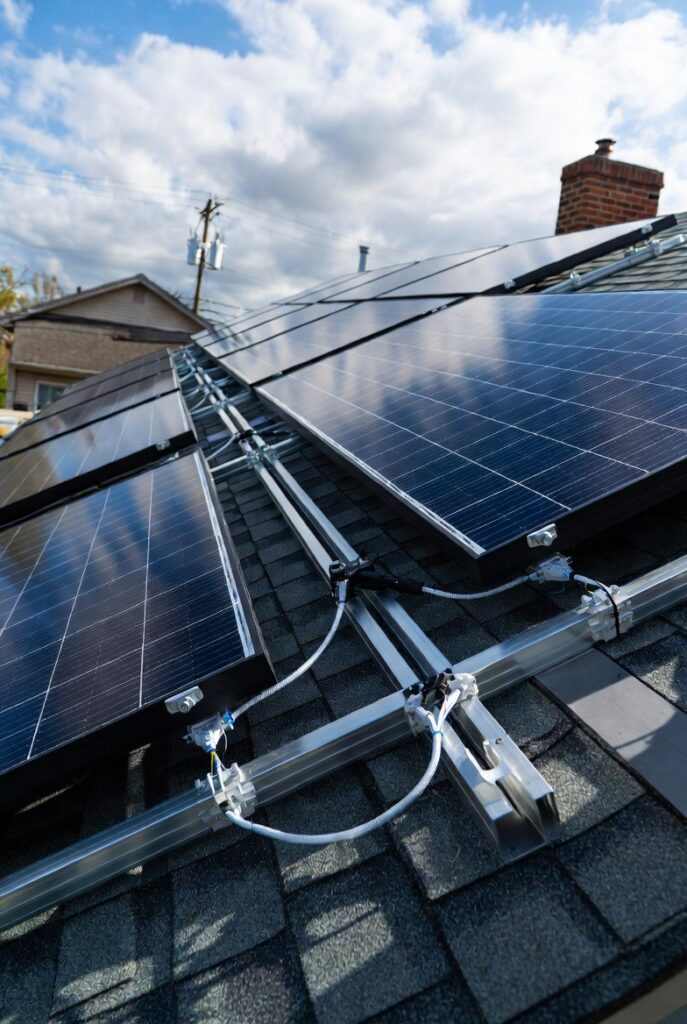
Solar panel wiring failures in residential rooftop arrays are not panel failures or inverter failures. They are the moment a property owner checks his monitoring app at 2:30 PM on a clear July afternoon and sees his 1,200W array producing 680W. I was called to diagnose an underperforming solar system at a century home on Tower Street in Fergus, Ontario. The owner had installed four 300W panels on a south-facing roof slope. The installer wired all four panels in series to a Victron MPPT 100/30 charge controller. The system produced its rated 1,200W from 10 AM to 1:45 PM. At 1:45 PM every afternoon, the production dropped to 680W and stayed there until 5 PM.
When I arrived at 2 PM, the chimney shadow was crossing the lower third of panel 3. The shadow covered approximately 8 cells in one bypass diode group. The series string voltage had dropped from 148V open circuit to 112V because the shaded panel was dragging down the entire string. The MPPT controller was tracking the reduced voltage and producing 680W from what should have been a 1,200W array. The shaded panel was not dead. Its bypass diode was conducting and letting current flow around the shaded cells. But the voltage drop from that single shaded panel was costing the owner 43% of his afternoon production every day.
I rewired the array from 4S to 2S2P. Two panels in series on the east side of the chimney, two panels in series on the west side, and the two series strings paralleled at the combiner box. The rewiring took 3 hours and cost $180 in MC4 branch connectors and combiner hardware. The next afternoon at 2:30 PM, the chimney shadow crossed panel 3 exactly as before. The east string voltage dropped to 56V. The west string held at 74V. The MPPT controller tracked both strings through the parallel connection and produced 1,040W instead of 680W. The 2S2P configuration recovered 360W of the 520W the series string was losing. The $180 rewiring investment will recover its cost in increased production value within 14 months. For the solar system monitoring and MPPT tracking standard that covers the same charge controller optimization, Article 249 covers the full specification.
Why Solar Panel Wiring Determines Array Performance
Solar panel wiring configuration determines whether shade on one panel kills the entire array or only reduces output from the affected panel. The difference between series and parallel is the difference between old Christmas lights and modern LED strings. In the old incandescent Christmas lights, one dead bulb broke the circuit and the entire string went dark. In modern LED strings, one dead bulb stays dark while the rest keep shining. Series solar panel wiring works like the old Christmas lights. One shaded panel drags down the voltage of every panel in the string.
| Configuration | Voltage | Current | Shade Tolerance |
|---|---|---|---|
| Series | High | Low | Poor |
| Parallel | Low | High | Good |
| 2S2P Hybrid | Medium | Medium | Excellent |
A Victron MPPT 100/30 charge controller tracks maximum power point by varying the load impedance until it finds the voltage and current combination producing maximum watts. When a series string voltage drops because one panel is shaded, the MPPT finds the new lower maximum and produces reduced power. The controller is working correctly. The solar panel wiring configuration is the problem.
Parallel wiring works like modern Christmas lights. Each panel operates independently. When one panel is shaded, only that panel’s output drops. The unshaded panels continue producing at full voltage and full current. A Renogy 100W panel in shade produces reduced output while its parallel neighbours produce full output. The MPPT controller sees the combined current from all panels at the unshaded panel voltage. For the solar DC distribution and battery bank wiring standard that covers the same current combination at the charge controller input, Article 248 covers the full specification.
The Series String and the Old Christmas Lights Problem
A series string adds the voltage of each panel while keeping the current constant at the lowest-producing panel’s output. Four 300W panels at 37V each produce 148V in series at 8.1A. If one panel drops to 28V from partial shade, the string voltage drops to 139V and the current drops to whatever the shaded panel can produce at its reduced output. The MPPT controller sees 139V at 5.8A instead of 148V at 8.1A. The 43% production loss at the Fergus installation came from one panel’s shade affecting all four panels’ output.
In parallel, those same four panels would produce 37V at 32.4A with all panels unshaded. When one panel drops to 28V and 5.8A from shade, the parallel combination produces 37V at 30.1A. Only the shaded panel’s current drops. The unshaded panels continue at full output. The production loss is 7% instead of 43%.
The Parallel Configuration and Shade Tolerance
Parallel wiring adds the current of each panel while keeping the voltage constant at the lowest-producing panel’s voltage. This creates shade tolerance because each panel operates at its own maximum power point. However, parallel wiring requires heavier gauge wire to carry the combined current. Four 300W panels at 8.1A each produce 32.4A in parallel. At 30 feet of wire run, 32.4A requires 6AWG copper wire to keep voltage drop below 3%. The same four panels in series produce 8.1A and require only 10AWG wire for the same run.
Parallel wiring also produces lower voltage, which means the MPPT controller may not reach its startup threshold as early in the morning or as late in the evening. The shade tolerance benefit comes with a wire gauge cost and a charge window cost.
The Bypass Diode Mechanism and MPPT Tracking
Every modern solar panel contains bypass diodes wired across groups of cells. A typical 60-cell panel has 3 bypass diode groups of 20 cells each. When cells in one group become shaded, the shaded cells become high-resistance loads that would otherwise consume power from the unshaded cells and generate heat. The bypass diode conducts and allows current to flow around the shaded group at approximately 0.7V forward drop. The bypass diode acts like a check valve letting current skip over the obstruction.
However, the bypassed cell group produces zero power while bypassed. The MPPT controller must be sophisticated enough to find the new maximum power point on the reduced voltage curve. A basic PWM controller cannot track the new peak and will produce even less power than the bypass diode allows. A quality MPPT controller like the Victron MPPT 100/30 sweeps the voltage range and finds the new maximum within seconds of the shade event.
The MPPT Startup Threshold and Early Morning Charging
I reviewed a charge timing complaint at an off-grid cabin near Dwight in Muskoka District, Ontario. The owner had installed six 200W panels in parallel feeding a Victron MPPT 150/35 charge controller. The owner was frustrated that his neighbour’s smaller array with four panels started charging at 7:15 AM while his larger array did not begin charging until 7:45 AM despite having more total wattage. The owner assumed his charge controller was defective.
When I measured the array at 7:20 AM, the parallel configuration was producing 18V at 2.4A. The MPPT controller requires minimum 5V above battery voltage to begin power conversion. The 24V battery bank at 26.4V resting voltage needed 31.4V minimum from the array to start charging. The parallel configuration would not reach 31.4V until the sun angle increased enough to push each individual panel above 31.4V.
I reconfigured the array from 6P to 3S2P. Three panels in series on the east section, three panels in series on the west section, and the two series strings paralleled with MC4 branch connectors. The series strings now produced 54V at 7:20 AM. The MPPT controller began charging at 7:18 AM, 27 minutes earlier than the parallel configuration. The 3S2P configuration added 27 minutes of morning charge time and 34 minutes of evening charge time. The total daily charge window increased by approximately 1 hour. The reconfiguration cost nothing beyond the 2 hours of labour and $45 in MC4 branch connectors. The charge window improvement paid for the hardware in increased winter production within 6 weeks. For the cottage winterization solar charge timing standard that covers the same early morning startup optimization for seasonal properties, Article 240 covers the full specification.
The 2S2P Hybrid Configuration for Residential Rooftops
The 2S2P configuration captures both the voltage benefit of series and the shade tolerance of parallel. Two panels wire in series to create a high-voltage string. A second pair wires in series to create a matched string. The two series strings then parallel at the combiner box using MC4 branch connectors. The result is a four-panel array producing double the single-panel voltage at double the single-panel current.
When shade crosses one panel, only its series partner is affected. The parallel string continues at full output. The Fergus Tower Street installation lost 43% production from a series string. The 2S2P rewire recovered 360W of the 520W loss because the shaded string dropped while the unshaded string continued producing. The 3S2P configuration at the Dwight cabin added 1 hour of daily charge window while maintaining shade tolerance between the east and west string groups.
The Solar Panel Wiring Decision: Minimum Viable vs Full String Configuration Standard
The decision follows whether the installation has shade obstructions and whether the wire run length requires voltage optimization.
The minimum viable solar panel wiring for a small off-grid system with zero shade and short wire runs includes panels wired in parallel for maximum simplicity. Capital cost runs $20 to $40 in MC4 connectors. It provides plug-and-play expansion where additional panels connect in parallel without reconfiguration. The parallel configuration sacrifices early morning charge window for installation simplicity.
The full string configuration standard for a residential rooftop with partial shade includes a hybrid 2S2P or 3S2P configuration matching series pairs by orientation and paralleling at the combiner. Capital cost runs $60 to $120 in MC4 branch connectors and combiner hardware. A Victron SmartShunt confirms the charge window improvement and logs the daily production recovery from shade events. It provides the morning startup benefit of series wiring with the shade tolerance of parallel for installations where obstructions cross the array at predictable times each day.
NEC and CEC: What the Codes Say About Solar Panel Wiring
NEC 690 governs photovoltaic systems including all solar panel wiring configurations for series, parallel, and hybrid arrays. NEC 690.7 specifies maximum system voltage calculations for series strings, requiring the sum of individual panel open-circuit voltages multiplied by temperature correction factors. NEC 690.8 specifies conductor sizing for both series and parallel configurations based on short-circuit current. NEC 690.9 requires overcurrent protection for parallel-connected strings to prevent backfeed through a faulted string. Contact the NFPA for current NEC 690 requirements applicable to solar panel wiring installations.
In Ontario, the solar array wiring is subject to CEC Section 64 requirements for photovoltaic systems. CEC Section 64-062 specifies conductor ampacity requirements for parallel string combiners. CEC Section 64-064 specifies overcurrent protection requirements for each parallel-connected source circuit. Contact the Electrical Safety Authority Ontario for current permit requirements applicable to solar panel wiring modifications at Ontario residential and agricultural properties.
Frequently Asked Questions
Q: Why does my solar array produce less power in the afternoon even though the sun is still bright?
A: If your panels are wired in series, a shadow crossing any single panel reduces the voltage of the entire string. A chimney, vent pipe, tree branch, or neighbouring roofline casting a shadow on one panel at 2 PM drags down all panels in the series string. The Fergus installation lost 43% of its afternoon production from a chimney shadow crossing one of four series-wired panels. A 2S2P hybrid configuration limits the shadow loss to one series pair while the parallel string continues at full output.
Q: Should I wire my solar panels in series or parallel for an off-grid cabin?
A: Series wiring reaches the MPPT startup threshold earlier in the morning, adding 20 to 40 minutes of charge time at each end of the day. For an off-grid cabin with limited winter daylight, the extended charge window from series or hybrid wiring can represent 8 to 15% more daily energy capture. If your site has no shade obstructions, series wiring is optimal. If you have shade crossing the array at predictable times, a hybrid 2S2P or 3S2P configuration balances the morning startup benefit against shade tolerance.
Q: Can I mix different wattage panels in the same array?
A: In series, the entire string current is limited by the lowest-performing panel. A 300W panel in series with a 280W panel will produce current limited by the 280W panel. In parallel, each panel operates independently at its own maximum power point. Mixed panels perform better in parallel because the stronger panels are not dragged down by the weaker ones. For arrays using salvaged or mismatched panels, parallel wiring prevents the weakest panel from limiting the entire array.
Pro Tip: Before finalizing any solar panel wiring configuration, stand at the array location at 10 AM, 12 PM, 2 PM, and 4 PM on a sunny day and photograph the shadow patterns. The chimney shadow that does not exist at noon may cross two panels at 3 PM. The tree branch that clears the array in summer may shade a corner panel in winter when the sun angle drops. I have rewired arrays that the installer commissioned in October and the owner discovered were losing 40% production by February because nobody checked the winter shadow line. The shadow survey costs nothing but an afternoon. The rewire costs $180. Check the shadows before you finalize the string configuration.
Verdict
- The Fergus Tower Street Standard. The $180 rewire from 4S to 2S2P recovered 360W of the 520W afternoon production loss from a chimney shadow crossing one panel. The investment recovers its cost in increased production value within 14 months.
- The Dwight Muskoka Standard. The $45 reconfiguration from 6P to 3S2P added 27 minutes of morning charge time and 34 minutes of evening charge time. The 1-hour daily charge window improvement paid for the hardware in increased winter production within 6 weeks.
- The Shadow Survey Standard. Never mix panels of different wattages or manufacturers in a series string. Check shadow patterns at 10 AM, 12 PM, 2 PM, and 4 PM before finalizing configuration. The shadow survey costs nothing. The rewire costs $180.
This build is engineered within the 48V DC Safety Ceiling. Diagnostic logic is based on 20+ years of technical service experience. All structural and electrical installations must be verified by a Licensed Professional and comply with your Local AHJ.
Questions? Drop them below.
About the Author
Robert Bertrand spent 20 years as a service advisor in the automotive industry (Lexus and Nissan), where precision diagnostics, wiring integrity, and documentation standards were non-negotiable. He brings that same technical discipline to GridFree Guide, where he researches, tests, and documents off-grid solar systems for Ontario conditions. Based in Rockwood, Ontario, every article is built on verified specifications, manufacturer data, and the real-world climate constraints of Canadian off-grid living.
As an Amazon Associate I earn from qualifying purchases. This site also contains affiliate links to other products and services. GridFree Guide earns a small commission at no extra cost to you.