
Low frequency inverter failures in off-grid systems are not inverter failures at all. They are the moment a property owner plugs his well pump into a high-frequency inverter rated at 3000W, presses the pressure switch, and watches the inverter screen flash an overload fault and go dark 400 milliseconds after the pump motor tries to start. I was called to diagnose a failed solar system at a hobby farm on Concession Road 2 near Puslinch in Wellington County, Ontario. The owner had installed a 3000W high-frequency inverter from Amazon, a 400Ah LFP battery bank, and a 1 HP submersible well pump. The owner did the math correctly. The well pump nameplate showed 1100W running power. The inverter was rated at 3000W. The math said he had 1900W of headroom. On the first test, the inverter died.
The owner assumed he had received a defective unit and ordered a replacement. The second inverter died on the first well pump start attempt. The owner had now spent $780 on two dead inverters. When I arrived, the third inverter was still in its box. I explained that the 1100W pump nameplate was the running wattage after the motor reached operating speed. The locked rotor current at startup was 6.2 times the running current. The pump needed 6,820W for the first 400 milliseconds. The 3000W high-frequency inverter had no transformer mass to deliver that surge. The inverter output stage MOSFETs failed from overcurrent on both units within half a second of the pump start signal.
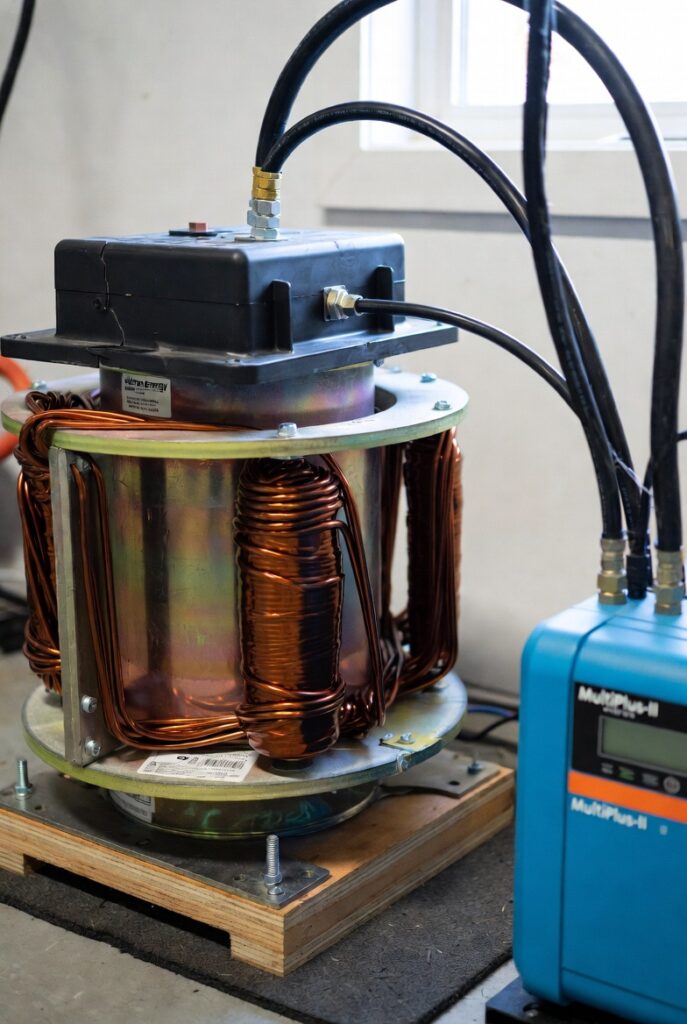
I replaced the high-frequency inverter with a Victron MultiPlus-II 3000VA low frequency inverter with a 70-pound copper transformer capable of delivering 6,000W surge for 30 seconds. The MultiPlus-II cost $1,400 compared to $390 for the failed Amazon units. The well pump started on the first attempt without the inverter voltage sagging below 108V. The system has run 847 pump cycles in 14 months without a single overload fault. The $1,400 low frequency inverter investment replaced $780 in dead high-frequency units and ended the startup failures permanently. For the cottage winterization solar self-heating LFP and charge lockout standard that covers the same critical load protection principles for unoccupied winter properties, Article 240 covers the full specification.
Why a Low Frequency Inverter Survives Motor Startup
A low frequency inverter uses a massive iron-core copper-wound transformer operating at 60 Hz between the switching stage and the AC output. The transformer stores magnetic energy that acts as a flywheel during motor surge events. When a well pump demands 6,820W for 400 milliseconds, the transformer delivers current from stored magnetic energy while the battery and DC bus catch up. This magnetic momentum is the difference between a successful motor start and a dead inverter.
A high-frequency inverter has no transformer and no magnetic energy storage. The output MOSFETs must source the full surge current instantaneously from the DC bus. When the surge exceeds the MOSFET current rating, the devices fail from thermal runaway in milliseconds. The spec sheet surge rating on most high-frequency units shows 2x for 5 seconds, which handles resistive load transients but fails instantly on motor locked rotor current requiring 5x to 7x for under 1 second.
The Victron MultiPlus-II with its 70-pound transformer delivers the surge the Puslinch well pump needed on 847 consecutive startups. A Victron Bat Sense bonded to the battery terminal confirms the bank voltage holds above 12.0V during surge events, verifying the low frequency inverter is drawing from the transformer’s magnetic reserve rather than collapsing the DC bus. For the solar air conditioning compressor surge management standard that covers the same locked rotor phenomenon for mini-split and window AC installations, Article 250 covers the full specification.
| Cell Temperature | Safe Charging Current | Surge Delivery Method |
|---|---|---|
| High-Frequency | MOSFET direct, no buffer | 2x for 5 seconds max |
| Low-Frequency | Transformer magnetic reserve | 2-3x for 30 seconds |
The Locked Rotor Surge and Why High-Frequency Inverters Fail in Milliseconds
When an induction motor starts, the rotor is stationary with near-zero back-EMF. The stator current is limited only by winding resistance and leakage reactance. Starting current runs 5 to 7 times full-load running current for 200 to 800 milliseconds until the rotor accelerates. A 1 HP well pump rated at 1,100W draws 6,000 to 7,700W at startup. A refrigerator compressor rated at 150W draws 900 to 1,050W at startup. A window air conditioner rated at 1,200W draws 7,200 to 8,400W at startup.
The high-frequency inverter spec sheet surge rating is typically 2x for 5 seconds, which covers resistive load transients but fails instantly on motor locked rotor current. The 2x rating assumes a gradual ramp, not the instantaneous 5x to 7x spike that motor starting demands. The MOSFETs see the full current with no magnetic buffer and fail from thermal runaway before the motor rotor even begins turning.
An EasyStart soft starter installed on the compressor reduces the locked rotor current by 65 to 75%, bringing a 7,200W surge down to 1,800 to 2,500W and allowing smaller inverters to start motor loads that would otherwise destroy them. For the generator ground bonding standard that covers backup power connections to the same motor loads, Article 245 covers the specification.
The Magnetic Momentum Advantage of a Copper Transformer
The copper transformer in a low frequency inverter stores energy in its magnetic core proportional to the inductance and the square of the magnetizing current. During a surge event, the transformer delivers current from this stored magnetic energy. The energy release is nearly instantaneous. The transformer acts as a buffer between the surge demand and the DC bus.
A 3000W low frequency inverter with a 70-pound transformer delivers 6,000W surge for 30 seconds because the transformer does the work. A 3000W high-frequency inverter weighing 12 pounds has no magnetic storage. The MOSFETs must handle the full surge current with no buffer. The weight difference is the diagnostic.
If you can lift a 3000W inverter with one finger, it has no transformer and will fail on motor loads. The 70-pound Victron MultiPlus-II requires two hands and a solid stance. That weight is the copper transformer that saves your well pump from destroying the inverter on every startup cycle.
The Thermal Mass Problem and Continuous Duty Derating
I reviewed a cooling system failure at a remote cabin near Kearney in Parry Sound District, Ontario. The owner had installed a 2000W high-frequency inverter to run a 1,200W window air conditioner during July visits. The system worked correctly for the first 2 hours of each afternoon run. By hour 3, the cabin temperature would begin rising despite the air conditioner running continuously. The owner assumed the AC unit was undersized.
When I inspected the system, I measured the inverter output at 1,180W at hour 1 and 840W at hour 3. The high-frequency inverter was thermally derating to protect its output transistors. The AC compressor was cycling on and off because the reduced inverter output could not sustain the compressor running current. The cabin never reached the thermostat setpoint because the inverter was quietly throttling the cooling system. The $1,800 air conditioner was useless for afternoon cooling because of a $300 inverter that could not hold its rated output.
I replaced the 2000W high-frequency inverter with a 3000VA low frequency inverter with a 45-pound transformer that serves as a thermal mass absorbing and dissipating heat without derating. The low frequency inverter maintained 1,200W output for 9 continuous hours in July ambient temperatures without any capacity reduction. The replacement cost $1,100. The thermal derating problem that made the air conditioner useless for afternoon cooling disappeared completely. The cabin reaches its thermostat setpoint in 45 minutes and holds it through the afternoon.
The Weight Test: How to Identify Inverter Topology Before You Buy
The weight test is the simplest diagnostic for inverter topology. A 3000W low frequency inverter with a copper transformer weighs 65 to 85 pounds. A 3000W high-frequency inverter weighs 10 to 18 pounds. The difference is the transformer. If the inverter weight in pounds is less than the wattage divided by 200, the unit is high-frequency with no transformer mass.
A 3000W inverter should weigh at least 15 pounds at absolute minimum for any transformer content. If it weighs under 15 pounds, it is certainly high-frequency and should not be connected to motor loads. Check the shipping weight before ordering. The Amazon listing headline wattage means nothing without the transformer mass to deliver it during motor surge events.
The Puslinch hobby farm owner trusted a 12-pound inverter with a 3000W sticker. The weight test would have told him in 2 seconds that his well pump would destroy it. The $1,400 Victron MultiPlus-II weighs 70 pounds. That weight is why it has run 847 pump cycles without complaint.
The Low Frequency Inverter Decision: Minimum Viable vs Full Transformer Standard
The decision follows whether the installation includes any motor loads and whether continuous duty operation is required.
The minimum viable inverter selection for an off-grid system running only resistive and electronic loads includes a high-frequency pure sine wave inverter sized at 1.5 times maximum simultaneous load. Capital cost runs $150 to $300 for a 1500W unit. Weight is 8 to 15 pounds. It provides adequate capacity for LED lighting, laptop chargers, routers, and electronics with no startup inrush.
The full transformer standard for an off-grid system running any motor load includes a low frequency inverter with copper transformer sized at 2 to 3 times the largest motor running wattage. A Victron MultiPlus-II 3000VA unit costs $1,400 to $1,600. Weight is 70 pounds. It delivers 6,000W surge for 30 seconds with zero thermal derating at continuous rated load. A Victron SmartShunt logs the surge events and confirms the inverter is handling motor startups without voltage sag.
NEC and CEC: What the Codes Say About Low Frequency Inverter Installation
NEC 710 governs stand-alone systems including any off-grid installation with a low frequency inverter as the AC power source. The inverter, battery bank, and associated overcurrent protection are subject to NEC 710 requirements for stand-alone system disconnecting means, grounding, and conductor sizing. The inverter output circuits are subject to NEC 210 branch circuit requirements. Motor loads connected to inverter output must comply with NEC Article 430 for motor circuit conductors and overload protection. Contact the NFPA for current NEC requirements applicable to stand-alone inverter installations.
In Ontario, the solar array and battery storage feeding the inverter are subject to CEC Section 64 requirements for PV systems. The inverter AC output circuits are subject to CEC Section 26 general wiring requirements and CEC Section 28 for motors where applicable. Contact the Electrical Safety Authority Ontario for current permit requirements applicable to stand-alone low frequency inverter installations at Ontario residential and agricultural properties.
Frequently Asked Questions
Q: Why did my 3000W inverter die trying to start a 1100W well pump?
A: The 1,100W rating is the running wattage after the motor reaches operating speed. At startup, the locked rotor current is 5 to 7 times higher because the stationary rotor provides no back-EMF to limit current. Your 1,100W pump needed 6,000 to 7,700W for the first 400 milliseconds. A high-frequency inverter rated at 3000W cannot deliver that surge because it has no transformer mass for magnetic energy storage. The output MOSFETs failed from overcurrent in milliseconds.
Q: How can I tell if an inverter is high-frequency or low-frequency before I buy it?
A: Check the weight. A 3000W low frequency inverter with a copper transformer weighs 65 to 85 pounds. A 3000W high-frequency inverter weighs 10 to 18 pounds. If the inverter weighs less than the wattage divided by 200, it is high-frequency with no transformer. The Amazon listing headline wattage means nothing without the transformer mass to deliver it during motor startup.
Q: Can I use a soft starter to run motor loads on a high-frequency inverter?
A: An EasyStart soft starter reduces compressor locked rotor current by 65 to 75%, which can bring some motor loads within range of a larger high-frequency inverter. A refrigerator compressor with a 900W surge reduced to 250W can start on a 1500W high-frequency unit. However, the soft starter does not solve the thermal derating problem. For continuous duty motor loads like well pumps running multiple cycles per hour, the low frequency inverter topology remains the reliable solution.
Pro Tip: Before connecting any motor load to an inverter, do the weight test. Pick up the inverter. If a 3000W unit feels like a car battery, it has the transformer. If it feels like a laptop bag, it has no transformer and your well pump will destroy it on the first start attempt. I have seen property owners burn through three high-frequency inverters at $400 each before they called me. The $1,400 Victron MultiPlus-II they should have bought on day one would have cost less than the three dead Amazon units combined. The transformer is not optional for motor loads. The weight is the diagnostic.
Verdict
- The Puslinch Hobby Farm Standard. The $1,400 Victron MultiPlus-II replaced $780 in dead high-frequency inverters and has run 847 well pump cycles in 14 months without a single overload fault. The 70-pound transformer delivers the 6,820W locked rotor surge the 1100W pump demands on every startup.
- The Kearney Cabin Standard. The $1,100 low frequency inverter solved the thermal derating problem that made a $1,800 air conditioner useless for afternoon cooling. The 45-pound transformer maintains 1,200W output for 9 continuous hours without capacity reduction.
- The Weight Test Standard. If a 3000W inverter weighs under 15 pounds, it has no transformer and will fail on motor loads. Check the shipping weight before ordering. The headline wattage means nothing without the copper mass to deliver it.
This build is engineered within the 48V DC Safety Ceiling. Diagnostic logic is based on 20+ years of technical service experience. All structural and electrical installations must be verified by a Licensed Professional and comply with your Local AHJ.
Questions? Drop them below.
About the Author
Robert Bertrand spent 20 years as a service advisor in the automotive industry (Lexus and Nissan), where precision diagnostics, wiring integrity, and documentation standards were non-negotiable. He brings that same technical discipline to GridFree Guide, where he researches, tests, and documents off-grid solar systems for Ontario conditions. Based in Rockwood, Ontario, every article is built on verified specifications, manufacturer data, and the real-world climate constraints of Canadian off-grid living.
As an Amazon Associate I earn from qualifying purchases. This site also contains affiliate links to other products and services. GridFree Guide earns a small commission at no extra cost to you.