
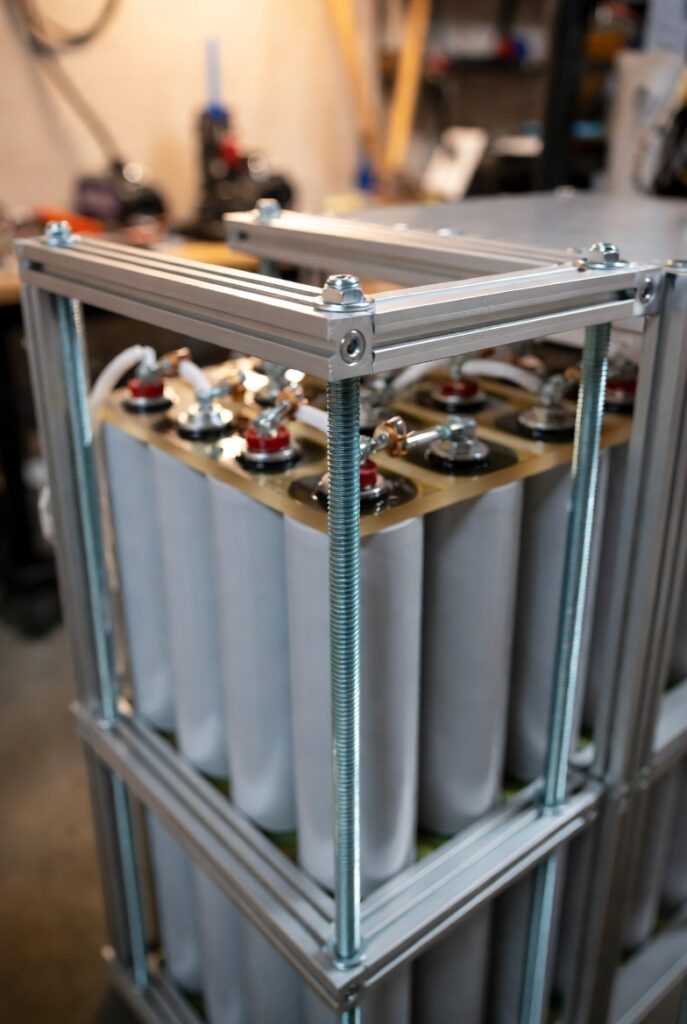
LFP cell compression failures are not battery failures. They are a DIY 8-cell 24V 280Ah EVE prismatic bank assembled in a Barrie garage with two ratchet straps for compression that stretched 18mm over 8 months while the middle four cells bulged 3.8mm and the Victron SmartShunt quietly recorded a 23% capacity reduction from the rated 280Ah before the owner noticed anything wrong. I was called to inspect a DIY prismatic cell battery bank at a rural property on the 3rd Line of Oro-Medonte Township in Simcoe County, Ontario north of Barrie where the owner had assembled an 8-cell 24V 280Ah LFP bank from EVE LiFePO4 280Ah prismatic cells purchased from a Canadian cell supplier in February. The owner had assembled the cells in a plywood enclosure using the factory blue PVC wrap as the primary insulation and two 50mm ratchet straps over the top of the cell stack as the compression system, following a YouTube build video. The bank had performed normally through the first 3 months of spring and summer operation with daily charge and discharge cycles from a 600W solar array. By October the owner noticed that cells 3, 4, 5, and 6 in the 8-cell stack were visibly bulging the cell faces had expanded 3.8mm beyond the flat profile of cells 1, 2, 7, and 8 at the ends of the stack.
The Victron SmartShunt was showing the bank delivering 215Ah before reaching the low-voltage disconnect threshold, a 23% reduction from the rated 280Ah. The ratchet straps had stretched 18mm from their original tension position over 8 months of cell expansion and contraction cycling, providing approximately 0 PSI of compression force on the cell faces at the point of inspection. The EVE 280Ah cell specification requires 12 PSI of compression force across the full 174mm x 71mm cell face throughout the entire charge and discharge cycle, a continuous force of 104 kg per cell face that the two stretched ratchet straps were no longer delivering. Each charge cycle had expanded the cells by 3.4% of their face thickness and each discharge cycle had contracted them, producing cumulative delamination of the graphite anode layers from the aluminium current collector foil that increased internal resistance from 0.18 milliohms per cell to 0.74 milliohms per cell on the affected cells.
I rebuilt the LFP cell compression system using 6mm threaded steel rods through 10mm aluminium end plates with 12mm Belleville spring washers at each rod end to maintain constant 12 PSI compression force through the full expansion and contraction cycle of the cells. Each Belleville washer stack provides 4mm of travel at constant force, accommodating the 3.4% cell face expansion at full charge without losing compression pressure. I also installed 1.5mm FR4 fibreglass insulation sheets between each cell face to prevent chassis shorts if the blue PVC wrap abraded through at the aluminium end plate contact points. The four bulging cells had sustained permanent delamination damage that the compression rebuild could not reverse they retained 215Ah capacity and did not improve to 280Ah after the rebuild, confirming the delamination was permanent. The compression rebuild cost $180. The four replacement cells the owner would need to restore full capacity would cost $320. The $180 LFP cell compression standard applied at initial build would have cost less than one of those replacement cells. For the full system sizing hub that covers the load calculation foundation, the hub covers the numbers.
Why LFP Cell Compression Prevents Delamination and Cycle Life Loss
The EVE 280Ah prismatic cell specification requires 300 kPa of compression pressure across the full cell face, equivalent to 12 PSI or 104 kg of continuous force on a 174mm x 71mm face, because the LiFePO4 cathode and graphite anode expand by 3.4% in the Z-axis dimension during charging as lithium ions intercalate into the graphite anode lattice and expand the lattice spacing from 3.35 Angstroms to 3.70 Angstroms. Without 12 PSI of external compression force the cell face expansion during charging lifts the electrode layers away from the aluminium current collector foil, creating micro-gaps of 0.001 to 0.005mm at the electrode-to-collector interface. These micro-gaps produce localised contact resistance of 0.003 to 0.010 ohm at each delamination point, generating I²R heating of 0.3 to 1.0W per gap at 10A discharge current, concentrated in a cell rated for 0.18 milliohm total internal resistance. Correct LFP cell compression eliminates these micro-gaps by maintaining constant mechanical contact between the electrode layers and the current collector foil throughout every charge and discharge cycle.
The cycle life extension from correct LFP cell compression is quantifiable from EVE’s own published specification data. EVE specifies 3,500 cycle life at 80% capacity retention with 300 kPa compression applied. The same cell without compression degrades to 80% capacity retention in approximately 800 to 1,200 cycles from progressive delamination accumulating with each charge and discharge event. As a result an uncompressed EVE 280Ah bank cycling once per day loses 20% of its capacity in 2.2 to 3.3 years while a correctly compressed bank retains 80% capacity for 9.6 years on the same daily cycle schedule.
The visual indicator of insufficient LFP cell compression is cell bulging beyond the flat profile of adjacent cells. Cells 3, 4, 5, and 6 in the Oro-Medonte bank had bulged 3.8mm beyond cells 1, 2, 7, and 8 because the end cells had partial restraint from the end plates while the middle cells had only the stretched ratchet straps. The bulge is not cosmetic it represents permanent delamination of the electrode layers from the current collector foil that cannot be reversed by subsequent compression because the delaminated surfaces have oxidised and lost electrical contact. For the BMS battery protection cell voltage monitoring and internal resistance standard that covers the same internal resistance increase from cell-level damage, Article 254 covers the full specification.
| LFP Cell Compression | Cycle Life at 80% Capacity | Internal Resistance |
|---|---|---|
| Zero compression — ratchet straps only | 800 to 1,200 cycles — 2.2 to 3.3 years daily | Increases from 0.18 to 0.74 milliohm per cell at 8 months |
| 12 PSI — Belleville spring washers | 3,500 cycles — 9.6 years daily | Stable at 0.18 to 0.22 milliohm per cell through rated life |
| Over-compression above 20 PSI | Separator damage — sudden internal short risk | Never exceed manufacturer specification |
The Threaded Rod and End Plate Build: Spring-Loaded vs Rigid Compression
A rigid LFP cell compression system using threaded rods torqued to a fixed tension and locked with jam nuts applies 12 PSI at one point in the charge cycle and less than 12 PSI when the cells contract during discharge, because the cell face moves 3.4% relative to the end plate and a rigid rod cannot follow that movement at constant force. A spring-loaded system using Belleville washer stacks at each rod end maintains constant 12 PSI through the full 3.4% expansion and contraction range because the Belleville washers deflect proportionally to the cell movement, maintaining their rated force throughout the travel range. The correct hardware specification for an 8-cell 280Ah bank is four 6mm M6 threaded rods through 10mm aluminium end plates measuring 200mm x 180mm, with four Belleville washer stacks of three washers each in parallel configuration at each rod end. This provides 4mm of travel at 26 kg per washer stack, totalling 104 kg of compression force across each 174mm x 71mm cell face.
The FR4 fibreglass insulation sheet between each cell face prevents chassis shorts if the factory blue PVC wrap abrades through at the metal end plate contact points. FR4 has a dielectric strength of 20 kV/mm at 1.5mm thickness, which is sufficient to isolate cells operating at 3.2 to 3.65V per cell from any inadvertent metal-to-metal contact in the compression frame. For the solar fuse sizing overcurrent protection and contact resistance standard that covers the same I²R heating from loose contact resistance at battery connections, Article 253 covers the full specification.
The Factory Blue Wrap Fallacy and Insulation Requirements
LFP cell compression insulation failures are the chassis short that happens at 2 AM on a February night when the battery bank is at 100% SoC and maximum cell expansion pressure, and the factory blue PVC wrap on cell 4 has abraded through at the aluminium end plate contact point from 14 months of 3.4% expansion and contraction cycling. I reviewed a chassis short failure at an off-grid workshop at a rural property on the 8th Concession of Mapleton Township in Wellington County, Ontario near Drayton where the owner had assembled a 48V 280Ah DIY LFP bank from 16 EVE cells in a steel enclosure using 8mm aluminium end plates and 6mm threaded rods without FR4 insulation sheets between the cell faces and the end plates. The bank had been correctly compressed at 12 PSI using Belleville spring washers and had operated normally for 14 months. In February the Victron MultiPlus-II AC output dropped to zero at 2 AM and the Cerbo GX was showing a BMS protection event.
On inspection the factory blue PVC wrap on cell 4 had abraded through at the aluminium end plate contact point, producing a 0.3 ohm chassis short between cell 4 positive terminal area and the aluminium end plate. The chassis short had drawn 10.7A continuously through the 0.3 ohm resistance path until the BMS detected the cell 4 voltage collapse and opened the protection circuit. The I²R heating at the short point was 10.7² × 0.3 = 34.3W concentrated in a 2cm² contact area for approximately 22 minutes before the BMS opened, producing visible carbon scoring on both the cell wrap and the aluminium end plate. The bank was undamaged beyond the abraded wrap because the BMS responded correctly.
I replaced the factory blue PVC wrap on all 16 cells with 1.5mm FR4 fibreglass sheet cut to cell face dimensions and bonded with VHB tape, installed new compression hardware with FR4 between all cell-to-end-plate contact surfaces, and retorqued the Belleville washer stacks to the correct 12 PSI specification. The 14 months of correct LFP cell compression had maintained the cells at 0.19 milliohm average internal resistance, confirming no delamination damage had occurred during the operating period. The FR4 insulation retrofit cost $40. The Victron Bat Sense bonded to the battery terminal detects the I²R heating at delamination hot spots before they progress to cell damage, showing the temperature differential between healthy and delaminating cells in the VRM portal. For the BMS battery protection cell voltage collapse and protection event standard that covers the same BMS protection event triggered by the chassis short cell voltage collapse, Article 254 covers the full specification.
The LFP Cell Compression System: Minimum Viable vs Full Compression Standard
The LFP cell compression decision follows whether the bank is being newly assembled or already installed without correct compression hardware, and whether the cells show visible bulging indicating delamination has begun.
The minimum viable LFP cell compression for a new DIY prismatic bank includes 6mm M6 threaded rods through 8mm aluminium end plates with Belleville spring washer stacks maintaining 12 PSI across each cell face, and 1.5mm FR4 fibreglass insulation sheets between each cell face. Capital cost runs $80 to $140 for an 8-cell 24V bank. It provides the EVE-specified 300 kPa compression that delivers 3,500 cycle rated life rather than the 800 to 1,200 cycle uncompressed life, and the FR4 insulation permanently eliminates the chassis short failure mode that destroyed the Mapleton Township bank’s PVC wrap at 14 months.
The full LFP cell compression standard for a new build at a year-round off-grid residence includes the compression frame hardware above, a Victron SmartShunt logging daily capacity to detect delamination before visual bulging appears, monthly internal resistance measurement using the BMS Bluetooth app to confirm cells remain within 0.05 milliohm of initial commissioning values, and Battle Born 100Ah cylindrical-cell modules as the correct alternative for owners who do not want to build and maintain a compression frame. Capital cost for the Battle Born alternative runs $1,200 to $2,400 for equivalent capacity. It provides factory-compressed cylindrical cells with zero field compression maintenance required and zero chassis short risk from abraded wrapping.
NEC and CEC: What the Codes Say About LFP Cell Compression
NEC 706 governs energy storage systems including DIY LFP battery banks assembled from prismatic cells. NEC 706.15 requires the battery management system to be listed and labelled for the application, and a DIY prismatic cell bank assembled from bare EVE cells with a third-party BMS is subject to NEC 706 regardless of whether the compression frame is professionally built or field-assembled. The compression frame itself is structural hardware subject to the mechanical installation requirements of the local Authority Having Jurisdiction. A compression frame that does not maintain the manufacturer-specified 300 kPa across the cell face does not constitute compliance with the manufacturer’s installation requirements referenced in NEC 706. Contact the NFPA for current NEC 706 and NEC 706.15 requirements applicable to DIY prismatic cell LFP battery installations at Ontario residential and rural properties.
In Ontario a DIY LFP battery bank assembled from prismatic cells is subject to CEC Section 26 for storage battery systems. CEC Section 26 requires the battery installation to be constructed and maintained in accordance with the manufacturer’s specifications, which for EVE 280Ah prismatic cells includes the 300 kPa compression requirement as a mandatory mechanical installation condition. A DIY bank assembled without the manufacturer-specified compression does not meet the CEC Section 26 construction standard and may not qualify for ESA permit approval at an Ontario residential or rural property. Contact the Electrical Safety Authority Ontario for the current permit requirements applicable to DIY prismatic cell LFP battery installations at Ontario residential and rural properties before assembling or connecting any prismatic cell bank.
Pro Tip: Before purchasing EVE or REPT prismatic cells for a DIY LFP bank, download the manufacturer’s specification sheet and locate the compression pressure specification it will be listed as 300 kPa or 12 PSI for most 280Ah cells. I have inspected DIY banks where the builder had read the spec sheet carefully for voltage and capacity but had never seen the compression requirement because it appears in the mechanical specifications section rather than the electrical specifications section. The compression specification is not optional guidance. It is the mechanical condition that the cycle life rating is measured under. A cell rated to 3,500 cycles at 12 PSI with zero cycles of compression is a different product from what the specification sheet describes. Read the mechanical specs before you buy the end plates.
The Verdict
A LFP cell compression system built to the compression standard means the Oro-Medonte Township Simcoe County owner never watches the Victron SmartShunt record a 23% capacity reduction from 280Ah to 215Ah over 8 months because two ratchet straps stretched 18mm and delivered 0 PSI of compression force while the middle four cells delaminated permanently at 0.74 milliohm internal resistance, and the Mapleton Township Wellington County owner never wakes to a 2 AM BMS protection event from 34.3W of I²R heating at a chassis short where abraded PVC wrap met an aluminium end plate after 14 months of 3.4% expansion and contraction cycling without FR4 insulation.
- Build the compression frame before the first charge cycle not after the cells start bulging. The Oro-Medonte bank had sustained 23% permanent capacity loss before the owner saw the first visual indication of a problem. The Victron SmartShunt would have shown the capacity reduction 6 to 8 weeks before the bulging became visible. The compression frame costs $80 to $140 for an 8-cell bank. One replacement cell costs $80. The correct LFP cell compression standard costs less than the first cell it saves.
- Install FR4 fibreglass insulation sheets between every cell face and every metal surface in the compression frame before the first charge cycle. The Mapleton Township chassis short produced 34.3W of heat for 22 minutes from a single abraded contact point. The FR4 retrofit cost $40. It permanently eliminates the failure mode that the factory blue PVC wrap cannot prevent after 12 to 18 months of compression cycling. The dielectric strength of 1.5mm FR4 at 20 kV/mm is not something the factory wrap was designed to provide.
- Check the Victron SmartShunt daily capacity reading and the BMS Bluetooth internal resistance values monthly for the first year of any DIY prismatic cell bank. The Oro-Medonte bank’s internal resistance had increased from 0.18 to 0.74 milliohm per cell before the visual bulging appeared. The SmartShunt capacity reading shows the degradation trend 6 to 8 weeks before the eye can see it. Monthly Bluetooth resistance checks confirm whether the LFP cell compression is maintaining the cells within 0.05 milliohm of their commissioning baseline.
In the shop we do not skip the torque spec on a head bolt because the engine is running fine today. At the prismatic cell bank we do not skip the compression spec because the cells look fine today. The compression spec is the torque spec. Apply it before the first cycle.
Frequently Asked Questions
Q: Do I need a compression frame for prismatic LFP cells or is the factory blue wrap enough? A: The factory blue wrap provides cell-to-cell insulation but zero compression force. EVE 280Ah prismatic cells require 300 kPa of continuous compression force across the full cell face to achieve the rated 3,500 cycle life. Without a compression frame using Belleville spring washers the cells delaminate progressively from the first charge cycle, reducing rated cycle life from 3,500 cycles to 800 to 1,200 cycles. The $80 to $140 compression frame is not optional hardware it is the mechanical condition the 3,500 cycle specification was measured under.
Q: How do I know if my prismatic cells have already been damaged by insufficient compression? A: Connect a Bluetooth BMS monitoring app and check the internal resistance of each cell. A healthy EVE 280Ah cell has 0.18 to 0.22 milliohm internal resistance at commissioning. A cell with delamination damage shows 0.40 milliohm or higher. Also check the Victron SmartShunt daily capacity reading a reduction from the rated Ah value indicates delamination has reduced active electrode surface area. Visual bulging of 2mm or more beyond adjacent cells confirms delamination is advanced and the capacity loss is permanent.
Q: What is the difference between a rigid compression frame and a spring-loaded Belleville washer system? A: A rigid frame torqued to 12 PSI applies correct compression when the cells are at the specific state of charge where the torque was set, but applies less than 12 PSI when the cells contract during discharge because the rigid rod cannot follow the 3.4% dimensional change. A Belleville washer stack deflects proportionally to cell movement and maintains constant 12 PSI through the full expansion and contraction range. For EVE 280Ah cells the Belleville system requires 4mm of washer travel at the specified washer stack force to maintain constant compression across the full charge and discharge cycle.
Questions? Drop them below.
Master Tech Advisory: This build is engineered within the 48V DC Safety Ceiling. Diagnostic logic is based on 20+ years of technical service experience. All structural and electrical installations must be verified by a Licensed Professional and comply with your Local Authority Having Jurisdiction (AHJ).
This post contains affiliate links. If you purchase through our links, we may earn a small commission at no extra cost to you.
About the Author
Robert Bertrand spent 20 years as a service advisor in the automotive industry (Lexus and Nissan), where precision diagnostics, wiring integrity, and documentation standards were non-negotiable. He brings that same technical discipline to GridFree Guide, where he researches, tests, and documents off-grid solar systems for Ontario conditions. Based in Rockwood, Ontario, every article is built on verified specifications, manufacturer data, and the real-world climate constraints of Canadian off-grid living.
As an Amazon Associate I earn from qualifying purchases. This site also contains affiliate links to other products and services. GridFree Guide earns a small commission at no extra cost to you.