
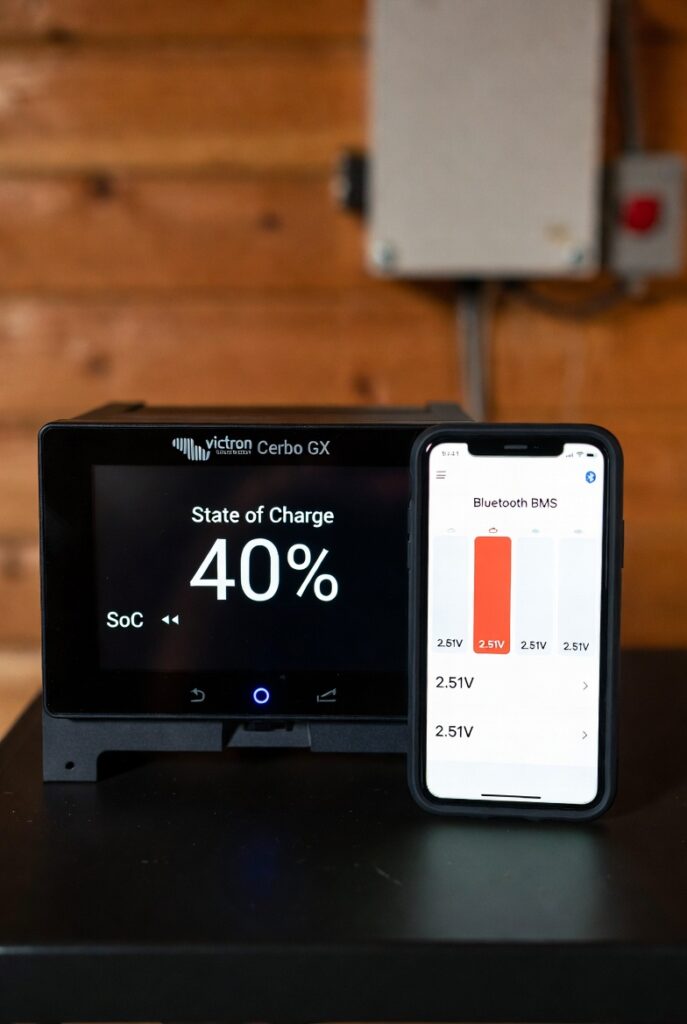
BMS battery protection failures are not battery failures. They are a 200Ah 12V LFP battery bank that reads 12.1V at the terminals and 40% SoC on the Cerbo GX display, then goes completely dead 30 seconds later when the owner turns on the morning coffee maker, and the owner drives 80 kilometres to the battery supplier convinced the cells are defective. I was called to diagnose a battery shutdown event at an off-grid seasonal property on the 4th Line of Innisfil Township in Simcoe County, Ontario south of Barrie where the owner had installed a 200Ah 12V LFP battery bank using two Battle Born 100Ah modules, a Victron MultiPlus-II 12/3000, and a Victron Cerbo GX monitoring system. The system had been operating for 14 months without any issues. On a November morning the Cerbo GX displayed 12.1V and 40% SoC when the owner turned on the electric kettle drawing 10A at 12V, and the battery immediately went to 0V and the MultiPlus-II shut down completely. The owner had attempted the same kettle startup 8 times over 3 days, each time receiving the same immediate shutdown, and had purchased a $640 replacement battery from the supplier that performed identically.
I arrived and connected a Bluetooth BMS monitoring app to the original battery bank. The individual cell voltages showed cell 1 at 2.51V, cell 2 at 3.18V, cell 3 at 3.19V, and cell 4 at 3.20V. The terminal voltage of 12.08V was the arithmetic sum of all four cells: 2.51 + 3.18 + 3.19 + 3.20 = 12.08V. The BMS was reading cell 1 at 2.51V and correctly opening the discharge MOSFET transistors to prevent cell 1 from discharging below the 2.5V threshold where the LiFePO4 cathode olivine crystal lattice begins structural collapse, an irreversible phase transition that produces 3 to 8% permanent capacity loss per over-discharge event from crystal structure damage that no subsequent charging cycle can reverse. The owner’s Cerbo GX was displaying 40% SoC based on the 12.08V terminal voltage with no visibility into cell 1’s individual voltage. The other three cells at 3.18 to 3.20V had approximately 60% of their capacity remaining and the BMS battery protection circuit was functioning exactly as designed.
I replaced cell 1’s internal cell group within the Battle Born module under warranty, equalised all four cells to within 0.02V through a controlled balance charge at 14.4V absorption voltage, and confirmed the bank returned to full 200Ah capacity on the first discharge cycle after the repair. In 2 subsequent winters including one with a 23-day grey-sky period the bank has not produced a single premature BMS battery protection shutdown event. The replacement battery the owner had purchased cost $640. The balance charge and cell replacement under warranty cost $0. The Bluetooth BMS monitoring that would have shown cell 1 diverging from 3.15V to 2.95V to 2.75V over the 6 weeks before the shutdown event cost $0 on the existing Battle Born module it was already there and nobody had looked at it. For the full system sizing hub that covers the load calculation foundation, the hub covers the numbers.
Why BMS Battery Protection Shuts Down at 40% SoC
The LFP cathode olivine lattice collapse mechanism at 2.5V per cell explains why the BMS battery protection circuit opens the discharge path at a terminal voltage that reads 40% SoC on a voltage-based display. Below 2.5V per cell the lithium content in the LiFePO4 cathode has been depleted to the point where the olivine crystal structure, which depends on lithium ion occupancy to maintain its three-dimensional lattice geometry, begins an irreversible phase transition to an amorphous structure. This transition produces 3 to 8% permanent capacity loss per over-discharge event because the collapsed lattice sites cannot accept full lithium re-insertion during subsequent charging, permanently reducing active cathode surface area. The BMS low-voltage cutoff at 2.5V protects the lattice by opening the discharge circuit 50 to 100mV above the collapse threshold, a margin that accounts for the IR voltage drop across the cell’s internal resistance at the discharge current in use.
Cell voltage divergence means the terminal voltage at the moment of BMS battery protection shutdown is 2.51 + 3.18 + 3.19 + 3.20 = 12.08V, which reads as 40% SoC on any voltage-based SoC estimation including the Cerbo GX, SmartShunt, and MultiPlus-II. The pack terminal voltage cannot reveal which cell triggered the shutdown or what that cell’s individual voltage is. A Battle Born 100Ah module with factory Bluetooth BMS shows all four individual cell voltages in real time and reveals the cell 1 divergence to 2.51V that caused the Innisfil Township shutdown, information completely invisible to the terminal voltage display that the owner was relying on.
The MOSFET gate driver in the BMS battery protection circuit requires a minimum supply voltage of 4 to 6V derived from the battery pack voltage to generate the gate-source differential needed to close the discharge MOSFET transistors and reconnect the discharge path after a protection event. When a pack is deeply discharged to 9.6 to 10.0V total from cells at or below 2.5V each, the gate driver supply voltage may fall below its 4V minimum operating threshold, leaving the discharge path open even after the fault condition is corrected. The recovery procedure is to apply 12 to 13V at 1 to 3A from a current-limited external source to the battery terminals for 15 to 30 minutes, raising the cells above the 2.8V per cell threshold where the gate driver regains sufficient supply voltage to close the discharge MOSFETs and restore normal BMS battery protection function. For the cold weather solar charging lithium plating mechanism and BMS charge lockout standard that covers the same LiFePO4 electrochemical damage mechanism from below-zero charging, Article 244 covers the full specification.
| Scenario | Terminal Voltage | BMS Response |
|---|---|---|
| All 4 cells balanced at 3.2V | 12.8V — displays as 100% SoC | No action — normal operation |
| Cell 1 at 2.51V, cells 2-4 at 3.19V average | 12.08V — displays as 40% SoC | Discharge MOSFETs open — complete shutdown |
| All 4 cells at 2.5V — deeply discharged | 10.0V — gate driver below 4V threshold | Bank reads 0V — external recovery charge required |
The Low-Voltage Cutoff and MOSFET Recovery Protocol
A MOSFET-based BMS battery protection circuit and a relay-based BMS have different recovery procedures after a deep discharge shutdown because they use different circuit elements to open and close the battery discharge path. A MOSFET BMS opens the discharge circuit by removing the gate-source voltage from the P-channel MOSFETs, a purely electronic state that resets when external charging voltage raises the pack above the 2.8V per cell gate driver recovery threshold. A relay-based BMS opens the discharge circuit by de-energising the relay coil, which requires 8 to 10V minimum coil voltage to re-energise, and a pack discharged to 9.6V may not supply sufficient coil voltage to close the relay without an external boost. For both types the recovery procedure is identical: apply 12 to 13V at 1 to 3A from a current-limited bench supply or charged battery to the terminals for 15 to 30 minutes. Do not exceed 13V and limit current to 1 to 5A to avoid damaging cells during recovery. If the BMS shows no response after 30 minutes of controlled voltage application the cells may be discharged below the 2.0V per cell threshold where permanent anode copper dissolution has begun and the bank requires professional assessment before further charging. For the solar parasitic load standby current and deep discharge prevention standard that covers the standby draw events that lead to deep discharge BMS lockout, Article 252 covers the full specification.
The Temperature Protection and LiFePO4 Charge Inhibit
The BMS charge inhibit below 0°C prevents lithium plating at the graphite anode by the same electrochemical mechanism described in Article 244 the lithium-ion insertion rate into the graphite lattice decreases exponentially with temperature, and any charging current above the reduced insertion capacity at sub-zero temperatures deposits metallic lithium on the anode surface rather than inserting into the graphite, permanently increasing internal resistance and reducing capacity. At minus 10°C the safe charging current for a standard LFP cell is approximately 8% of the room-temperature rated value, meaning a cell rated for 50A charging at 25°C can only safely accept 4A at minus 10°C. A Victron Bat Sense bonded directly to the battery terminal gives the Victron MPPT 100/30 the actual cell temperature to within 2°C rather than the controller enclosure temperature, which runs 6 to 14°C warmer than the battery cells on a cold clear Ontario morning when the sun has warmed the controller enclosure before the battery thermal mass has risen from the overnight minimum of minus 11°C.
The high-temperature BMS battery protection cutoff at 45°C prevents electrolyte decomposition and separator damage. Electrolyte decomposition begins at 48°C and separator shrinkage begins at 60°C, both of which reduce cell capacity permanently and increase internal short-circuit risk. An unventilated battery enclosure on a south-facing wall in a Muskoka July heat dome absorbs direct solar gain that can raise cell temperature 12°C above the 36°C ambient to 48°C, triggering the BMS high-temperature cutoff on a bank that the owner believes is operating normally because the air temperature seems moderate. For the cold weather solar charging Bat Sense cell temperature differential standard that covers the same 6 to 14°C controller-to-cell temperature differential causing partial below-zero charging events, Article 244 covers the full specification.
The Balance Lead Inspection and Voltage Divider Collapse
BMS battery protection balance lead failures produce exactly the same symptom as a genuinely weak cell premature shutdown at progressively higher displayed SoC but the cause is a $1.40 connection problem rather than a failed cell, and the owner who replaces the battery without testing the balance lead connections has spent $640 on a new battery and still has the original problem. I reviewed a balance lead failure at an off-grid rural property on the 9th Concession of Amaranth Township in Dufferin County, Ontario near Orangeville where the owner had assembled a DIY 4-cell 12V LFP battery bank from 100Ah prismatic cells in a custom steel enclosure. The bank had performed normally for 8 months before beginning to shut down at progressively higher displayed SoC values, first at 25%, then at 35%, then at 48% SoC over a 6-week period. This progressive worsening pattern is the diagnostic signature of a deteriorating connection rather than a genuinely failing cell, because a weak cell degrades gradually while a cracking connector deteriorates faster with each thermal cycle.
The BMS had four balance lead connections in 28AWG wire crimped into JST PH 2.0 connectors plugged into the BMS balance header, with the balance lead for cell 3 running through a connector that had developed a hairline crack in the housing from 14 thermal cycles between minus 8°C and 42°C. The JST connector crack was producing a contact resistance that varied from 0.5 kilohms on warm days to 620 kilohms during cold nights. The BMS voltage sense input for cell 3 has an input impedance of approximately 100 kilohms, meaning when the balance lead contact resistance reached 620 kilohms the voltage divider ratio collapsed: the BMS was reading cell 3 at 3.18 × (100 / 720.5) = 0.44V instead of its actual 3.18V, well below the 2.5V low-voltage cutoff threshold. The BMS battery protection circuit was correctly triggering shutdown based on this false 0.44V reading, progressively earlier as the connector deteriorated and contact resistance increased through each thermal cycle.
I replaced the JST connector with a new crimped connector using 26AWG wire and a fresh JST PH housing rated for minus 40°C to plus 85°C thermal cycling, then retested all four balance lead connections by pulling each connector gently while watching the Bluetooth BMS cell voltage display. A genuine cell voltage remains stable at its actual value when the connector is pulled. A false reading from a cracked connector drops toward 0V when disturbed. All four cells showed stable readings with no intermittent dropout. The bank has operated normally for 18 subsequent months without a single premature BMS battery protection shutdown event. The JST connector and replacement wire cost $1.40. The $640 replacement battery the owner was about to purchase used the same JST connector format from the same BMS manufacturer and would have experienced the same failure at 8 to 14 months of Ontario thermal cycling.
The BMS Battery Protection System: Minimum Viable vs Full Monitoring Standard
The BMS battery protection decision follows whether the shutdown is being diagnosed for the first time or whether the system requires ongoing cell-level monitoring to catch voltage divergence trends before the first shutdown event occurs.
The minimum viable BMS battery protection diagnostic for a battery bank shutting down at unexpectedly high displayed SoC includes connecting a Bluetooth BMS monitoring app to read individual cell voltages under a moderate 10 to 20A load, and performing the balance lead pull test on each JST connector while watching the cell voltage display. Capital cost runs $0 on Battle Born modules with factory Bluetooth BMS and $20 to $40 for a standalone Bluetooth BMS adapter on DIY banks. It identifies in 15 minutes whether the shutdown is caused by a genuinely weak cell, a cracked balance lead connector producing a voltage divider collapse, or correct low-voltage cutoff protection behaviour, before spending $640 on a replacement battery.
The full BMS battery protection monitoring standard for a complete off-grid system includes a Victron Bat Sense bonded to the battery terminal providing actual cell temperature to the MPPT controller for charge inhibit below 0°C, a Victron SmartShunt logging total system current to catch parasitic loads accelerating cell voltage divergence, and a monthly Bluetooth BMS cell voltage review to catch divergence trends before the first premature shutdown event. Capital cost runs $240 to $380 in hardware. It provides complete visibility into cell-level health before any BMS battery protection event occurs and eliminates the $640 replacement battery purchased for correct BMS behaviour.
NEC and CEC: What the Codes Say About BMS Battery Protection
NEC 706 governs energy storage systems including the BMS battery protection requirements for all residential and commercial battery installations in North America. NEC 706.15 requires that battery management systems for energy storage be listed and labelled for the application, meaning the BMS must meet UL 1973 or equivalent listing requirements for the battery chemistry and voltage rating. The low-voltage cutoff, high-temperature cutoff, and charge inhibit functions required by NEC 706.15 are mandatory protective functions, they cannot be disabled or bypassed to recover a bank from a protection event or to increase available capacity. NEC 706.20 requires a disconnect means for the battery bank rated for the maximum available fault current, which must be installed within 18cm of the battery positive terminal as covered in Article 253. Contact the NFPA for current NEC 706, NEC 706.15, and NEC 706.20 requirements applicable to BMS battery protection systems at Ontario residential and rural properties.
In Ontario, the battery storage installation including the BMS is subject to CEC Section 26 for storage battery systems, which requires the BMS to provide low-voltage disconnect, overtemperature protection, and overcurrent protection as minimum protective functions rated for the battery bank voltage and capacity. A DIY LFP battery bank assembled from prismatic cells with a third-party BMS is subject to CEC Section 26 requirements regardless of the cell source, and the BMS must meet CSA or equivalent listing requirements before the installation qualifies for ESA permit approval. An unlisted third-party BMS on a DIY prismatic cell bank is the most common reason ESA inspectors reject off-grid solar battery installations in Ontario residential properties. Contact the Electrical Safety Authority Ontario for the current permit requirements applicable to BMS battery protection and energy storage installations at Ontario residential and rural properties before assembling or modifying any LFP battery bank.
Pro Tip: Before concluding that a LFP battery bank is defective, connect a Bluetooth BMS monitoring app and read individual cell voltages under a 10 to 20A load. I have visited properties where the owner had already ordered a $640 replacement battery after a premature shutdown, and the Bluetooth display showed one cell at 2.52V and three cells at 3.18V the exact signature of olivine lattice depletion in one cell that the BMS was correctly protecting while the other three cells had 60% capacity remaining. The replacement was cancelled. The warranty claim on the weak cell was filed. The bank was restored for $0. The Bluetooth check takes 3 minutes. Three minutes versus $640 is the most asymmetric diagnostic in off-grid solar.
The Verdict
A BMS battery protection system understood to the silent guardian standard means the Innisfil Township Simcoe County owner never drives 80 kilometres to spend $640 on a replacement battery for a bank where cell 1 was at 2.51V and the BMS was correctly preventing the olivine lattice collapse that would have permanently destroyed 3 to 8% of that cell’s capacity per discharge event, and the Amaranth Township Dufferin County DIY bank owner never spends $640 on a replacement with the same JST connector format that would have failed at 8 to 14 months of Ontario thermal cycling from minus 8°C to 42°C.
- Connect a Bluetooth BMS monitoring app and read individual cell voltages before concluding any LFP battery bank is defective. The Innisfil Township bank was showing 40% SoC and shutting down because cell 1 was at 2.51V three cells were healthy at 3.18 to 3.20V. The BMS battery protection circuit was correct. The $640 replacement battery had identical BMS behaviour because the replacement had the same weak cell signature. The Bluetooth check cost $0 and took 3 minutes. It identified the exact olivine lattice depletion that the Cerbo GX terminal voltage display could not see.
- Pull each balance lead connector gently while watching the Bluetooth cell voltage display before replacing any battery showing progressively earlier BMS shutdowns over weeks or months. The Amaranth Township bank was shutting down at 48% SoC because a JST connector crack was producing 620 kilohms of series resistance that collapsed the voltage divider ratio to 0.44V on a healthy cell at 3.18V. The $1.40 connector replacement cost less than the wire used to install the original. The voltage divider collapse diagnostic takes 5 minutes per connector and identifies the fault that $640 cannot fix.
- Install a Victron Bat Sense bonded to the battery terminal before the first winter commissioning of any off-grid system in an unheated Ontario enclosure. The BMS charge inhibit below 0°C is correct protective behaviour. The problem occurs when the MPPT controller reads its own enclosure at 4°C and delivers charging current to cells at minus 7°C because no cell temperature data exists. Safe charging current at minus 10°C is 8% of room temperature rated value. The Bat Sense costs $140. The olivine lattice damage from 14 partial below-zero charge cycles costs more than the Bat Sense on the first winter.
In the shop, we do not replace a battery because a warning light came on. We connect the scanner, read the cell codes, and find the fault. At the off-grid property, we do not replace a battery because the BMS shut it down. We connect the Bluetooth app, read the cell voltages, and find the weak cell or the cracked balance lead.
Frequently Asked Questions
Q: Why did my battery shut down at 40% SoC? A: Your BMS battery protection circuit is protecting a weak cell from permanent olivine lattice collapse. One cell in the pack has reached its 2.5V minimum safe discharge voltage while the other cells still have capacity remaining. The terminal voltage reads 12.08V which displays as 40% SoC on a voltage-based monitor, but the BMS is reading individual cell voltages and opening the discharge circuit when any single cell reaches 2.5V. Connect a Bluetooth BMS app to read individual cell voltages under a 10 to 20A load and identify which cell is at 2.51V before purchasing a replacement battery.
Q: How do I wake up a BMS that has gone completely dead at 0V? A: Apply a current-limited external charge source at 12 to 13V and 1 to 3A to the battery positive and negative terminals for 15 to 30 minutes. This raises the cell voltages above the 2.8V per cell threshold where the MOSFET gate driver regains sufficient supply voltage to close the discharge path, or provides the 8 to 10V the relay coil needs to re-energise on a relay-based BMS. Do not exceed 13V and do not apply more than 5A during recovery to avoid damaging deeply discharged cells. If the BMS shows no response after 30 minutes the cells may be below 2.0V where copper dissolution has begun.
Q: What is a balance lead and how do I test if a connector crack is causing false shutdowns? A: A balance lead is the thin 28AWG sense wire connecting each individual cell to the BMS voltage monitoring input. A cracked JST connector produces a high series resistance that collapses the BMS voltage divider ratio, causing the BMS to read 0.04 to 0.44V on a healthy cell and trigger its low-voltage cutoff protection. To test, pull each balance lead connector gently one at a time while watching the Bluetooth BMS cell voltage display. A genuine cell voltage remains stable at its actual value when the connector is pulled. A false reading from a cracked connector drops toward 0V when disturbed. A $1.40 replacement connector fixes the fault permanently.
Questions? Drop them below.
Master Tech Advisory: This build is engineered within the 48V DC Safety Ceiling. Diagnostic logic is based on 20+ years of technical service experience. All structural and electrical installations must be verified by a Licensed Professional and comply with your Local Authority Having Jurisdiction (AHJ).
This post contains affiliate links. If you purchase through our links, we may earn a small commission at no extra cost to you.
About the Author
Robert Bertrand spent 20 years as a service advisor in the automotive industry (Lexus and Nissan), where precision diagnostics, wiring integrity, and documentation standards were non-negotiable. He brings that same technical discipline to GridFree Guide, where he researches, tests, and documents off-grid solar systems for Ontario conditions. Based in Rockwood, Ontario, every article is built on verified specifications, manufacturer data, and the real-world climate constraints of Canadian off-grid living.
As an Amazon Associate I earn from qualifying purchases. This site also contains affiliate links to other products and services. GridFree Guide earns a small commission at no extra cost to you.