
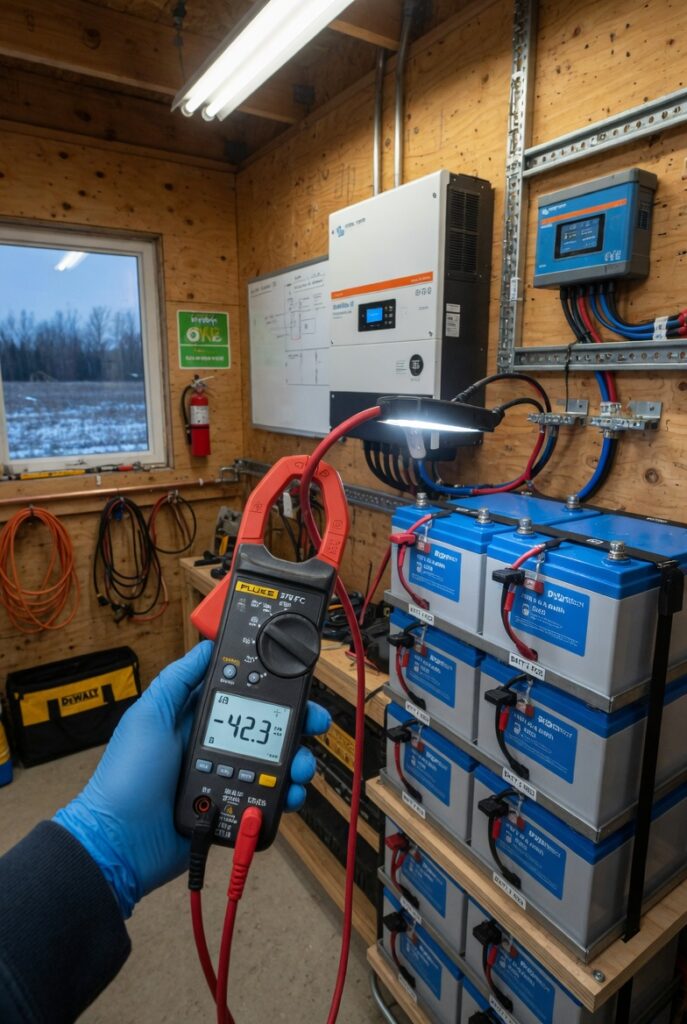
Solar parasitic load failures are not battery failures. They are a $10,000 battery bank at 10% SoC after a 28-day unoccupied period that the owner cannot explain because he turned off every light, every appliance, and every circuit breaker before locking the door in October, and the only thing running was the inverter display blinking in the dark utility room at 1.5A of continuous idle current that nobody had calculated. I was called to diagnose a battery depletion event at an off-grid seasonal property on the 2nd Line of Springwater Township in Simcoe County, Ontario north of Barrie where the owner had installed a 400Ah 24V LFP battery bank, a Victron MultiPlus-II 24/3000, a Victron MPPT 100/50 charge controller, and a Victron Cerbo GX monitoring system. The system had operated normally through the summer. The owner had closed the property on October 14, switching off all appliances and leaving the MultiPlus-II in standby mode with the DC bus energised for VRM winter monitoring.
On November 11 the owner checked the VRM portal and found the battery SoC at 10% and still falling. The MPPT was producing zero because the panels were under 8cm of snow. The system had no AC loads because everything was switched off. However, the MultiPlus-II in standby mode was drawing 1.5A continuously, 36Wh per hour, 864Wh per day. The Cerbo GX was drawing 700mA at 24V continuously for VRM communication, 403Wh per day. The BMS monitoring circuit in the Battle Born LFP modules was drawing 45mA at 24V, 26Wh per day. The refrigerator thermostat control board, though the compressor was off, was maintaining its clock circuit at 35mA, 20Wh per day. The total standby draw with every visible load switched off was 1,313Wh per day. The 400Ah 24V LFP bank’s usable capacity at 50% DoD is 4,800Wh. At 1,313Wh per day the bank depleted from 95% SoC to 10% SoC in exactly 28 days from October 14 to November 11. The batteries were not defective. Nobody had calculated the standby draw before closing the property.
I installed a Blue Sea 600A main disconnect on the battery positive bus and provided the owner with a pre-departure checklist: open the main disconnect before locking the door, leave the MPPT connected on its own dedicated circuit through a secondary disconnect so the panels continue to trickle-charge the bank through the winter without powering the MultiPlus-II, Cerbo GX, or refrigerator thermostat board. The standby draw from the trickle-charge circuit alone is 12mA, 7Wh per day, compared to 1,313Wh per day from the full energised system. In the subsequent winter the battery SoC at the November check was 82% rather than 10%. The main disconnect installation cost $180. The $10,000 battery bank it protected from deep discharge cycling through an Ontario winter paid for it 56 times over. For the solar DC distribution Lynx busbar and main disconnect architecture that covers the same Blue Sea disconnect installation principle for DC bus isolation, Article 248 covers the full specification. For the full system sizing hub that covers the load calculation foundation, the hub covers the numbers.
Why Solar Parasitic Load Depletes a Bank With Every Load Switched Off
The Victron MultiPlus-II draws 1.5A at 24V in normal standby mode regardless of whether any loads are connected, 36Wh per hour and 864Wh per day, because the internal control electronics, transformer magnetising current, and output stage gate driver circuits remain active to keep the inverter ready to supply AC output within 20 milliseconds of a load connection. The Victron SmartShunt measures this draw to 0.01A resolution at the battery negative cable, providing the baseline current reading that reveals whether the total standby draw matches the calculated expectation or contains an abnormal phantom draw from an unidentified circuit. The expected standby baseline for a full Victron system is MultiPlus-II at 1.5A plus Cerbo GX at 0.7A plus BMS circuits at 0.1A, totalling 2.3A at 24V, 1,325Wh per day. Any SmartShunt reading above 2.3A with every appliance circuit fuse removed indicates an abnormal solar parasitic load on one of the remaining circuits.
For the solar system monitoring Cerbo GX VRM real-time current display standard that covers the same SmartShunt baseline current monitoring principle for system health tracking, Article 249 covers the full specification.
| Component | Standby Current | Daily Wh Draw |
|---|---|---|
| Victron MultiPlus-II – standby mode AC output enabled | 1.5A at 24V | 864Wh per day |
| Victron Cerbo GX – VRM communication active | 0.7A at 24V | 403Wh per day |
| Battle Born BMS monitoring circuits | 0.1A at 24V | 26Wh per day |
| Refrigerator thermostat clock circuit – compressor off | 0.035A at 120V AC | 20Wh per day |
The Inverter Search Mode Trap and Idle Current Management
The MultiPlus-II search mode reduces inverter standby current from 1.5A to approximately 0.3A by switching the output stage off and polling for connected loads every 3 seconds. However, search mode causes three specific problems with common off-grid loads: refrigerator compressors that require continuous AC voltage presence before the thermostat calls for cooling will not start correctly on a 3-second polling cycle, digital clocks and timers reset on every 3-second power interruption producing incorrect time displays, and CPAP and medical devices fault on the momentary power gap producing an error log that requires manual reset. As a result search mode is not a universal standby solution.
The correct architecture for long-term unoccupied properties is a Blue Sea 600A disconnect that removes the MultiPlus-II from the DC bus entirely rather than relying on search mode to reduce standby draw. The MPPT remains connected through its own dedicated secondary disconnect, trickle-charging the bank at 12mA wake circuit draw rather than 1,500mA inverter standby draw, protecting the bank through the full unoccupied winter period. For the solar DC distribution main disconnect and Lynx busbar isolation architecture that covers the same Blue Sea 600A disconnect installation principle, Article 248 covers the full specification.
The Fuse-Pulling Diagnostic Method
Solar parasitic load diagnostic failures are the moment the owner clamps a meter on the battery cable, reads 3.8A with everything supposedly off, and has no idea which of the 14 circuits on the fuse block is responsible for 1.5A of abnormal draw above the expected 2.3A baseline. I was called to diagnose an abnormal standby draw at a year-round off-grid home on the 7th Line of Mulmur Township in Dufferin County, Ontario where the owner had noticed the battery bank SoC dropping by 18% per day during a 5-day absence with all appliances switched off manually. The SmartShunt was showing a continuous 3.8A draw at 24V with every circuit breaker in the off position except the inverter and the MPPT. The expected standby draw for the MultiPlus-II at 24V plus the Cerbo GX plus the BMS circuits was 2.3A. The actual draw of 3.8A indicated 1.5A of abnormal phantom draw above the expected baseline.
I began the fuse-pulling diagnostic by removing MIDI fuses from the Lynx Distributor one circuit at a time while watching the SmartShunt current reading on the Cerbo GX app. The inverter output circuits, the MPPT input circuit, and the lighting circuits all showed no change when their fuses were pulled. At the sixth fuse, the circuit feeding the owner’s chest freezer, the SmartShunt current dropped from 3.8A to 2.3A, a drop of exactly 1.5A. The chest freezer had been switched off at its power switch but not unplugged. The freezer’s electronic control board was maintaining a continuous 1.5A draw through its standby power supply to keep the clock, display, and wireless temperature sensor active. The freezer compressor was off. The electronic board was not off.
I reconfigured the freezer circuit to route through a switched outlet rather than a direct fuse block connection, allowing the owner to cut board power at the outlet switch before leaving the property. The phantom draw dropped from 3.8A to 2.3A and the battery SoC loss during a 5-day absence dropped from 18% per day to 11% per day, within the expected standby baseline for the energised Cerbo GX monitoring circuit. The outlet switch installation cost $40. The Victron Cerbo GX displays the SmartShunt current reading in real time on the VRM portal during the fuse-pulling test, allowing the technician to watch the current drop from a phone screen while pulling fuses at the distribution board without needing a second person to read a clamp meter at the battery cable simultaneously. For the solar DC distribution MIDI fuse architecture and circuit isolation standard that covers the same fuse-pulling circuit isolation principle for DC distribution boards, Article 248 covers the full specification.
The Pre-Departure Shutdown Checklist
A pre-departure checklist for a long-term unoccupied off-grid property must account for every circuit with a standby power supply that does not respond to the appliance’s own off switch. Chest freezers, refrigerators with electronic controls, smart speakers, WiFi routers, and any device with a clock or wireless sensor fall into this category. The correct shutdown sequence for a property being closed for more than 7 days is: switch off all appliances at their power switches, pull the fuse for every appliance circuit at the Lynx Distributor, confirm the SmartShunt reading drops to the expected 2.3A baseline after all appliance fuses are pulled, then open the main Blue Sea 600A disconnect to isolate the MultiPlus-II and Cerbo GX from the battery bus entirely.
The MPPT secondary circuit remains connected through its own dedicated 10A fuse to provide winter trickle charging at 12mA wake circuit draw. As a result the battery arrives at spring commissioning at 80 to 90% SoC from winter trickle charging rather than at 10% from inverter and monitoring standby draw. For the solar system monitoring VRM pre-departure SoC check and grey-sky depletion alert standard that covers the same VRM three-number pre-departure habit, Article 249 covers the full specification.
The Solar Parasitic Load Diagnostic: Minimum Viable vs Full Phantom Draw Standard
The decision follows whether the unexplained depletion is being diagnosed for the first time or whether the system requires permanent standby draw management for repeated unoccupied periods.
The minimum viable solar parasitic load diagnostic for a property with unexplained battery depletion includes a DC clamp meter on the battery positive cable measuring total standby current, compared against the calculated expected baseline of inverter standby plus BMS circuits plus monitoring circuits, followed by the fuse-pulling isolation method to identify the responsible circuit. Capital cost runs $60 to $120 for the clamp meter. It identifies whether abnormal draw exists and which circuit is responsible in 15 minutes without any permanent hardware changes.
The full phantom draw standard for a year-round off-grid property with multiple circuits and long unoccupied periods includes a Victron SmartShunt providing 0.01A resolution current monitoring, a Blue Sea 600A main disconnect for full system isolation during extended absences, a secondary MPPT trickle-charge circuit through its own dedicated disconnect, and a pre-departure shutdown checklist configured as a VRM reminder. Capital cost runs $280 to $480 in hardware. It eliminates unplanned deep discharge events from standby loads during every future unoccupied period and provides real-time phantom draw detection for any new circuit added to the system.
NEC and CEC: What the Codes Say About Solar Parasitic Load Management
NEC 690 governs the overcurrent protection and disconnecting means for solar DC distribution systems including the main battery disconnect. NEC 690.15 requires a means to disconnect all current-carrying conductors of a solar system from the premises wiring, and a Blue Sea 600A main disconnect installed on the battery positive bus satisfies this requirement for the DC bus isolation function. The inverter standby current draw and the MPPT wake circuit are low-level DC loads that do not require separate overcurrent protection beyond the main system fusing under NEC 690.9. Contact the NFPA for current NEC 690.15 and NEC 690.9 requirements applicable to solar DC system disconnecting means and standby load management at Ontario residential and rural properties.
In Ontario, the solar DC system main disconnect is subject to CEC Section 64 for PV source circuits and CEC Section 26 for battery storage installations. The main disconnect must be rated for the battery bank’s maximum available fault current and installed in an accessible location. Contact the Electrical Safety Authority Ontario for the current permit requirements applicable to solar DC system disconnecting means at Ontario residential and rural properties before modifying any existing solar battery installation.
Pro Tip: Before closing any off-grid property for more than 7 days, pull the SmartShunt app and write down the total standby current reading with every appliance switched off at its power switch. I have reviewed properties where the owner believed the standby draw was 2.3A and the SmartShunt was reading 4.1A because a network-attached storage device, a WiFi range extender, and a smart thermostat were each drawing 300 to 500mA through their standby power supplies without showing any visible sign of being powered. Write down the SmartShunt reading before you leave. If it is more than 0.5A above your calculated baseline, pull fuses until you find the circuit. The fuse-pulling test takes 10 minutes. The deep discharge cycle it prevents takes 6 months off the battery bank’s cycle life.
The Verdict
A solar parasitic load system built to the phantom draw standard means the Springwater Township Simcoe County owner never arrives at a November VRM check to find the $10,000 battery bank at 10% SoC from 1,313Wh per day of MultiPlus-II plus Cerbo GX plus BMS plus refrigerator thermostat clock draw that depleted the 4,800Wh usable bank in exactly 28 days while every visible load was switched off, and the Mulmur Township Dufferin County owner never loses 18% SoC per day during a 5-day absence from a chest freezer control board drawing 1.5A at 24V through its standby power supply while the appliance power switch showed off and the SmartShunt showed 3.8A total.
- Calculate the expected standby baseline for every off-grid system before closing the property for any period exceeding 7 days. The Springwater Township system had 1,313Wh of standby draw that nobody had calculated. MultiPlus-II at 1.5A plus Cerbo GX at 0.7A plus BMS at 0.1A equals 2.3A before any appliance clocks are counted. At 2.3A on a 24V system the bank loses 1,325Wh per day. On a 400Ah 24V bank at 50% DoD that is a full depletion in 3.6 days with no solar. Calculate it before you lock the door.
- Install a Blue Sea 600A main disconnect and run the MPPT on its own secondary circuit before the first unoccupied winter season. The Springwater Township main disconnect cost $180 and changed the November SoC from 10% to 82%. The MPPT trickle-charge circuit draws 12mA instead of the full system’s 1,313Wh per day. That single hardware change is the entire solution for unoccupied winter battery protection.
- Run the fuse-pulling diagnostic on any system showing standby draw more than 0.5A above the calculated baseline before assuming the batteries are defective. The Mulmur Township chest freezer took 6 fuse pulls and 10 minutes to identify. The outlet switch that fixed it cost $40. The battery bank the owner was about to replace because he thought it was junk cost $8,400.
In the shop, we do not replace a battery because a car drains overnight without running a drain test first. We clamp the cable, pull fuses, and find the draw. At the off-grid property, we do not replace a $10,000 LFP bank because it depleted over a month without calculating the standby draw first. We clamp the SmartShunt, pull the MIDI fuses, and find the circuit.
Frequently Asked Questions
Q: Why is my off-grid battery bank depleting even when I have every appliance switched off? A: Every component in a solar system that remains energised draws standby current regardless of whether connected loads are active. A Victron MultiPlus-II draws 1.5A at 24V in standby, a Cerbo GX draws 0.7A, and BMS monitoring circuits draw 0.1A, a combined 2.3A that consumes 1,325Wh per day with zero visible loads. Adding appliance standby power supplies from refrigerators, freezers, and smart devices can push total standby draw above 3.5A, depleting a 400Ah 24V LFP bank from full to the low-voltage disconnect threshold in under 6 days with no solar production.
Q: How do I find which circuit is causing an abnormal phantom draw in my solar system? A: Clamp a DC current meter on the battery positive cable to establish the total standby draw baseline. If the reading exceeds the expected inverter plus monitoring baseline by more than 0.3A an abnormal draw exists. Pull fuses from the distribution block one at a time while watching the meter, waiting 10 seconds after each pull for capacitive hold-up circuits to discharge. The circuit whose fuse removal causes a measurable drop in the current reading is the circuit with the abnormal standby draw. A Victron SmartShunt and Cerbo GX allow the same test from a phone screen via the VRM portal.
Q: Should I use search mode on my Victron MultiPlus-II to reduce standby draw when the property is unoccupied? A: Search mode reduces inverter standby current from 1.5A to approximately 0.3A but causes problems with loads that require continuous AC voltage presence, including refrigerator compressors that need AC before the thermostat calls, digital clocks that reset every 3 seconds, and medical devices that fault on the polling gap. For properties unoccupied for more than 7 days the correct solution is a main DC disconnect that isolates the MultiPlus-II from the battery bus entirely, with the MPPT remaining connected through a dedicated secondary circuit for winter trickle charging.
Questions? Drop them below.
Master Tech Advisory: This build is engineered within the 48V DC Safety Ceiling. Diagnostic logic is based on 20+ years of technical service experience. All structural and electrical installations must be verified by a Licensed Professional and comply with your Local Authority Having Jurisdiction (AHJ).
This post contains affiliate links. If you purchase through our links, we may earn a small commission at no extra cost to you.
About the Author
Robert Bertrand spent 20 years as a service advisor in the automotive industry (Lexus and Nissan), where precision diagnostics, wiring integrity, and documentation standards were non-negotiable. He brings that same technical discipline to GridFree Guide, where he researches, tests, and documents off-grid solar systems for Ontario conditions. Based in Rockwood, Ontario, every article is built on verified specifications, manufacturer data, and the real-world climate constraints of Canadian off-grid living.
As an Amazon Associate I earn from qualifying purchases. This site also contains affiliate links to other products and services. GridFree Guide earns a small commission at no extra cost to you.