
Solar system monitoring failures are not discovered when they happen. They are discovered on a Friday evening when the owner arrives at a seasonal property on the 7th Line of Adjala-Tosorontio Township in Simcoe County, Ontario to find the cabin at 4°C, the battery bank at 0% SoC, and the Victron MultiPlus-II sitting on a fault code that has been flashing in the empty utility room since Tuesday at 3:14 AM. The owner had installed a 400W solar array, a 200Ah 12V LFP battery bank, and a Victron MultiPlus-II 12/3000 as the primary inverter-charger for the seasonal property, commissioned in June and operating without issues through July and August. The monitoring architecture was a walk-by inspection the owner had no remote visibility into the system between visits.
On the Tuesday before the Labour Day weekend the MultiPlus-II experienced a sustained inverter overload from the chest freezer compressor starting simultaneously with an electric kettle on a timer circuit, tripped on overload at 3:14 AM, entered its automatic restart sequence, tripped again on the second restart attempt, and entered a fault lockout state. The MPPT continued charging the battery bank through Tuesday and Wednesday, but the fault lockout prevented the AC output from supplying the 12W standby draw on the Dometic refrigerator thermostat controller. By Thursday the MPPT production dropped below the 12W standby draw from a 3-day grey sky period and the battery began discharging. By 11 PM Thursday the battery reached the 10% SoC low-voltage disconnect threshold and the system shut down entirely. The MultiPlus-II fault code indicated overload at 3:14 AM Tuesday, but without VRM logging there was no timestamp, no load data, no SoC trend, and no notification to the owner’s phone.
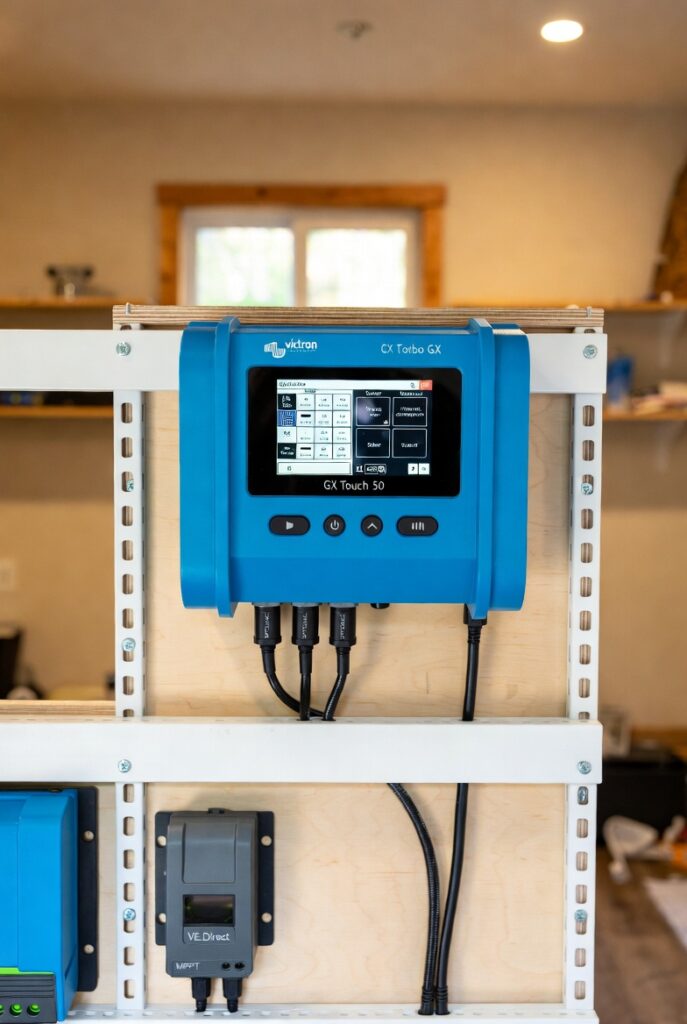
I installed a Victron Cerbo GX on the system, connected the Victron MultiPlus-II via VE.Bus and the MPPT and SmartShunt via VE.Direct, and configured the VRM portal with a Low SoC alert at 30% SoC and an Inverter Overload alert for any MultiPlus-II fault event. The Cerbo GX polls the MultiPlus-II via VE.Bus at 250-millisecond intervals, detecting any fault state within one polling cycle. Six weeks after installation when the same freezer and kettle combination triggered a 3,400W simultaneous load, the system produced a push notification on the owner’s phone at 2:48 AM from Adjala-Tosorontio Township, 80 kilometres from Barrie. The owner remotely reduced the MultiPlus-II AC output current limit via VRM and the system resumed normal operation without a property visit. The Cerbo GX installation cost $340. For the cottage winterization solar Cerbo GX LTE-M unoccupied property monitoring standard that covers the same VRM push notification principle for unoccupied winter properties, Article 240 covers the full specification. For the full system sizing hub that covers the load calculation foundation, the hub covers the numbers.
Why Solar System Monitoring Fails Without the Cerbo GX
A Victron MultiPlus-II displaying a fault code in an empty utility room is not solar system monitoring. It is a fault log with no audience. The Victron Cerbo GX connects to the Victron MultiPlus-II via VE.Bus and polls its state at 250-millisecond intervals, detecting any overload, high temperature, or low battery fault within one quarter of a second of occurrence. The VRM portal receives the fault notification within 30 seconds and sends a push notification to the owner’s phone that includes the fault type, the battery SoC at the time of the fault, and the AC load at the time of the fault. As a result the owner in Barrie receives diagnostic information for an Adjala-Tosorontio fault event before the MultiPlus-II has completed its first automatic restart attempt.
For the solar DC distribution Lynx busbar and SmartShunt current monitoring standard that covers the same VE.Direct data feed from the SmartShunt to the Cerbo GX for circuit-level current logging, Article 248 covers the full specification.
| Monitoring Method | Fault Detection Time | Alert Delivery |
|---|---|---|
| Walk-by inspection | Days or weeks – fault only visible on-site | None – owner discovers on next visit |
| Cerbo GX with WiFi | 30 seconds from fault occurrence | Push notification to owner’s phone with fault type, SoC, and load at time of event |
| Cerbo GX with LTE-M | 30 seconds – independent of router or grid power | Push notification through cellular during grid outages when WiFi is unavailable |
The VRM Data Logging and Grey-Sky Production Deficit
Solar system monitoring VRM data logging failures are not the failure to log data. They are the failure to review the 6 months of data sitting in the VRM portal that would have predicted the February SoC crash 3 weeks in advance if the owner had known where to look. I reviewed a recurring February battery depletion pattern at an off-grid residential property on the 5th Sideroad of Amaranth Township in Dufferin County, Ontario near Shelburne where the owner had a fully functioning Cerbo GX and VRM portal but had never configured any alerts and had never reviewed the historical production data. The property had a 600W solar array, a 400Ah 24V LFP battery bank, and a Victron MultiPlus-II 24/3000. The owner had experienced complete battery depletion three times in the previous two February periods, each time requiring a 90-minute generator run to recover the bank from the low-voltage disconnect threshold.
I opened the VRM portal historical data for the previous 14 months and ran the daily energy balance report for each month. The data showed that November through January the property averaged 1.8kWh of daily solar production from the 600W array under Ontario grey-sky winter conditions, while the property’s daily consumption averaged 2.4kWh. The daily production deficit of 0.6kWh meant the battery bank was depleting at 0.6kWh per day from November through January without any grey-sky buffer. The 400Ah 24V bank’s usable capacity at 50% DoD is 4.8kWh. At 0.6kWh per day depletion the bank reaches the low-voltage disconnect threshold in exactly 8 days of consecutive grey sky without any generator supplementation. The February depletion events had each occurred after 7 to 9 consecutive overcast days, which the VRM historical data confirmed had occurred in each February. The battery bank was not undersized. The grey-sky production deficit had been documented in the VRM data for 14 months and nobody had read it.
I configured a VRM alert set to notify the owner when the battery SoC dropped below 40% on any day when solar production for the day was below 1.0kWh, the threshold indicating a grey-sky production day rather than a normal winter day. The combined alert fires only during the specific condition that precedes the depletion event, giving the owner 3 to 5 days of advance warning to run the generator before the bank reaches the low-voltage disconnect threshold. In the subsequent February the alert fired on February 4th when the battery reached 38% SoC on the third consecutive grey-sky day. The owner ran the generator for 90 minutes that evening and the battery recovered to 78% SoC. The depletion event that had occurred every previous February did not occur. The VRM alert configuration cost nothing. The Victron SmartShunt feeds real-time SoC and current data to the Cerbo GX via VE.Direct for inclusion in the 15-minute interval VRM dataset, and the Victron MPPT 100/50 feeds real-time solar production data via VE.Direct to complete the daily energy balance calculation that reveals the grey-sky deficit. For the cold weather solar charging Bat Sense temperature monitoring and VRM pre-depletion alert standard that covers the same VRM alert configuration principle for temperature-triggered charge events, Article 244 covers the full specification.
The LTE-M Cellular Backup and Grid Outage Continuity
A Cerbo GX connected to the VRM portal through the cottage’s WiFi router goes silent at exactly the moment monitoring is most critical: a February grid outage that simultaneously discharges the battery and disconnects the router from power. Without cellular backup the owner receives no alerts, no SoC updates, and no push notifications throughout the outage, and the system is as invisible as it was before the Cerbo GX was installed. The GX LTE 4G modem installed in the Cerbo GX expansion slot connects directly to the cellular network using a built-in M2M SIM and transmits battery SoC, solar production, inverter state, and load draw to the VRM portal every 15 minutes regardless of whether the cottage router or grid power is active.
As a result the owner receives push notifications throughout the outage, the Low SoC alert when the bank approaches the disconnect threshold, and the all-clear notification when grid power is restored. For the cottage winterization solar Cerbo GX LTE-M cellular monitoring and LVD triage standard that covers the same cellular backup and pre-depletion alert principle for unoccupied winter properties, Article 240 covers the full specification.
The Solar System Monitoring Setup: Minimum Viable vs Full Monitoring Standard
The decision follows whether the property is occupied daily or visited periodically, and whether the site loses WiFi connectivity during the grid outages that also discharge the battery.
The minimum viable solar system monitoring installation for an occupied off-grid property with daily access includes a Victron Cerbo GX connected to the MultiPlus-II via VE.Bus and the MPPT and SmartShunt via VE.Direct, registered on the VRM portal with a Low SoC alert at 30% and an Inverter Overload alert. Capital cost runs $340 to $480. It provides remote push notification of every critical system event to the owner’s phone within 30 seconds of occurrence and 12 months of 15-minute interval data for grey-sky production deficit diagnosis.
The full monitoring standard for an unoccupied or remotely managed property includes a Victron Cerbo GX with GX LTE 4G modem for cellular backup, VRM portal with Low SoC alert at 40%, Inverter Overload alert, and a Grey-Sky Production alert configured for days when production falls below 50% of rated daily output. Capital cost runs $640 to $920. It provides continuous monitoring through grid outages, cellular push notifications every 15 minutes during any critical event, and advance warning of grey-sky depletion events 3 to 5 days before they reach the low-voltage disconnect threshold.
NEC and CEC: What the Codes Say About Solar System Monitoring
NEC 690 governs the solar array, battery bank, and inverter installation in any solar system monitoring deployment. The Cerbo GX and associated VE.Bus and VE.Direct communication cables are low-voltage data circuits that are not subject to NEC 690 overcurrent protection requirements but must be installed with appropriate separation from high-voltage DC and AC conductors under NEC 725 for Class 2 and Class 3 circuits. The GX LTE 4G modem antenna installation is subject to the modem manufacturer’s installation requirements and must not be installed near high-current DC conductors that could induce RF interference on the cellular communication circuit. Contact the NFPA for current NEC 690 and NEC 725 requirements applicable to solar system monitoring and communications installations at Ontario residential and rural properties.
In Ontario, the solar array, battery bank, and inverter installation are subject to CEC Section 64 for PV source circuits and CEC Section 26 for battery storage. The Cerbo GX and VE.Direct data cables are low-voltage signal circuits that do not require ESA permit under the Ontario Electrical Safety Code when installed as part of a permitted solar installation and separated from high-voltage conductors. Contact the Electrical Safety Authority Ontario for the current permit requirements applicable to solar system monitoring installations at Ontario residential and rural properties before connecting any monitoring system to a fixed solar installation.
Pro Tip: Before leaving any off-grid property unattended for more than 48 hours, open the VRM portal dashboard and check three numbers: current SoC, average daily solar production for the past 7 days, and average daily load for the past 7 days. I have arrived at properties for commissioned system reviews to find the VRM dashboard showing a 7-day average production of 0.8kWh against a 7-day average load of 2.1kWh, a 1.3kWh daily deficit that the owner had been leaving unattended for 3-day weekends for 6 weeks. The battery was at 22% SoC when I arrived. The VRM had been recording the deficit every 15 minutes for 42 days. Checking three numbers before you leave takes 20 seconds and it is the most reliable solar system monitoring habit available.
The Verdict
A solar system monitoring installation built to the monitoring standard means the Adjala-Tosorontio Township Simcoe County owner never arrives on a Friday evening to a 4°C cabin and a MultiPlus-II fault code that has been flashing since 3:14 AM Tuesday without a single notification, and the Amaranth Township Dufferin County owner never runs the generator for the fourth February in a row because 14 months of VRM data documenting a 0.6kWh daily grey-sky deficit was sitting in the portal unread.
- Install a Victron Cerbo GX on every off-grid system before the first unattended weekend. The Adjala-Tosorontio MultiPlus-II had been in fault lockout since 3:14 AM Tuesday and the owner had no way to know until Friday evening. The Cerbo GX detects the fault in 250 milliseconds and delivers the push notification in 30 seconds. The installation cost $340. The cold cabin it prevents justified the cost entirely on the first event.
- Configure VRM alerts for Low SoC at 40% and Inverter Overload before the first grey-sky winter period. The Amaranth Township owner had 14 months of data documenting the February depletion pattern and had never configured a single alert. A grey-sky production alert set at 1.0kWh daily production combined with 40% SoC fired on February 4th and gave 3 to 5 days of advance warning. The configuration cost nothing. The data was already there.
- Install the GX LTE 4G modem on every property where a grid outage discharges the battery and simultaneously disconnects the WiFi router. A Cerbo GX on WiFi only goes silent at the exact moment the grid fails and the battery begins discharging. The LTE-M modem maintains VRM communication throughout the outage on the cellular network. The modem costs approximately $120. The blind grid outage it prevents is the event the whole monitoring system exists to catch.
In the shop, we do not clear a fault code on the scanner and send the vehicle home without confirming the root cause is resolved. At the off-grid property, we do not commission a system and leave without confirming the VRM portal is receiving data and the alerts are configured. The fault code in the empty utility room is not a monitoring system. It is a receipt for a problem that already happened.
Frequently Asked Questions
Q: What does the Victron Cerbo GX actually monitor and how does it send alerts to my phone? A: The Cerbo GX connects to the MultiPlus-II via VE.Bus and to the MPPT and SmartShunt via VE.Direct, polling each device at 250-millisecond intervals to collect battery SoC, solar production, AC load, inverter state, and charge controller state. This data is transmitted to the VRM portal via WiFi or cellular and stored at 15-minute intervals. The VRM portal’s alert system sends push notifications to the owner’s phone within 30 seconds of any configured threshold being crossed, including Low SoC, Inverter Overload, and custom production alerts.
Q: Why do I need the GX LTE 4G modem if I already have WiFi at the property? A: A grid outage that discharges the battery simultaneously disconnects the WiFi router from power, cutting the Cerbo GX’s VRM communication at exactly the moment monitoring is most critical. The GX LTE 4G modem connects directly to the cellular network using a built-in M2M SIM that operates independently of the property’s internet service and router. As a result the Cerbo GX continues transmitting battery SoC updates and fault alerts throughout the grid outage regardless of router or internet status.
Q: How do I use the VRM historical data to predict and prevent February battery depletion? A: Download the daily energy balance data from the VRM portal CSV export for the previous November through January period. Sum the daily solar production and daily load columns to calculate the daily surplus or deficit for each day. If the average daily deficit during grey-sky periods exceeds 0.5kWh per day, configure a VRM alert to notify you when the battery SoC drops below 40% on any day with production below 1.0kWh. This alert fires 3 to 5 days before the battery reaches the low-voltage disconnect threshold, providing time to run the generator before the depletion event occurs.
Questions? Drop them below.
Master Tech Advisory: This build is engineered within the 48V DC Safety Ceiling. Diagnostic logic is based on 20+ years of technical service experience. All structural and electrical installations must be verified by a Licensed Professional and comply with your Local Authority Having Jurisdiction (AHJ).
This post contains affiliate links. If you purchase through our links, we may earn a small commission at no extra cost to you.
About the Author
Robert Bertrand spent 20 years as a service advisor in the automotive industry (Lexus and Nissan), where precision diagnostics, wiring integrity, and documentation standards were non-negotiable. He brings that same technical discipline to GridFree Guide, where he researches, tests, and documents off-grid solar systems for Ontario conditions. Based in Rockwood, Ontario, every article is built on verified specifications, manufacturer data, and the real-world climate constraints of Canadian off-grid living.
As an Amazon Associate I earn from qualifying purchases. This site also contains affiliate links to other products and services. GridFree Guide earns a small commission at no extra cost to you.