
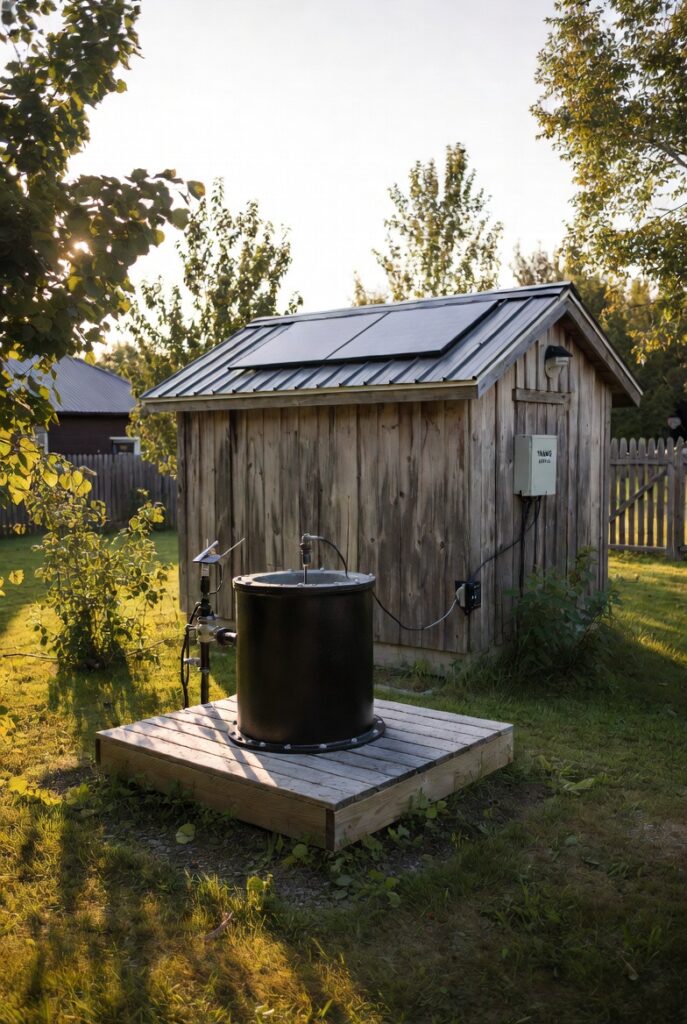
Solar water pump system failures on an off-grid homestead are not single events. They are a pressure gauge that drops to 35 PSI, a pressure switch that closes, an inverter that flickers and resets, and a household that loses water pressure 8 to 20 times per day. I was asked to review the water system at an off-grid homestead on the 4th Concession of Kincardine Township in Bruce County, Ontario where a retired couple had installed a 4,800W pure sine wave high-frequency inverter, a 400Ah 24V LFP battery bank, and a 600W solar array to power a 1-horsepower 240V single-phase AC deep well submersible pump in a 55-metre drilled well. The pump had been in the well since 2019 and performed normally on grid power. However, every time the pressure tank dropped below 40 PSI and the pressure switch closed to start the pump the inverter would trip on overload within 200 milliseconds, reset itself, and attempt to start the pump again.
The 1-horsepower pump draws 7.5A at 240V running, producing a steady-state load of 1,800W. However, its locked rotor amperage at pressure switch startup is 45A at 240V for 280 milliseconds, producing a peak startup demand of 10,800W, which is 2.25 times the inverter’s 4,800W continuous rating and exceeds its 6,000W 2-second surge capacity by 4,800W. The HF inverter’s FET transistors were absorbing 4,800W of excess demand on every pressure switch cycle, accumulating thermal damage at a rate the manufacturer had not designed for repetitive pressure switch cycling. After 6 weeks of operation the inverter’s input FET board failed silently during a startup cycle. Replacement cost was $680.
I replaced the HF inverter with a Victron MultiPlus-II 24/3000 and installed a Victron EasyStart 004 soft-starter on the pump motor circuit at the pressure tank. The EasyStart limits the pump motor startup current to 1.4 times running current by controlling the voltage ramp applied to the motor at the pressure switch closure, reducing the peak startup demand from 10,800W to 2,520W over a controlled 3-second ramp. The MultiPlus-II LF transformer absorbs the 2,520W startup demand without any FET component stress. In 14 subsequent months of operation including full-use summer periods with simultaneous dishwasher and shower demand the pressure switch has cycled approximately 2,400 times without a single inverter trip or FET failure. The MultiPlus-II and EasyStart installation cost $1,240. The $680 HF inverter board and the inverter reset loop it eliminates justified the cost within the first winter. For the full system sizing hub that covers the load calculation foundation, the hub covers the numbers.
Why Your Solar Water Pump System Is Killing Your Inverter
A 1HP AC well pump draws 40 to 50A at 240V for 200 to 400 milliseconds at each pressure switch closure because the motor is at rest and must accelerate from zero RPM against the full static water column head pressure at the pump intake. This produces a 9,600 to 12,000W startup demand 8 to 20 times per day on a residential pressure tank system. A HF inverter sized for the 1,800W running load absorbs 5.3 to 6.7 times its rated power as an instantaneous demand on every pressure switch cycle, accumulating FET transistor thermal damage that reaches the failure threshold in weeks. However, a Victron MultiPlus-II LF transformer absorbs the inrush through copper transformer windings with no FET involvement.
The Victron EasyStart reduces the startup demand from 10,800W to 2,520W over a 3-second controlled ramp before the pump motor has a chance to draw locked rotor current. For the workshop solar power EasyStart compressor soft-start and LF versus HF inverter topology standard that covers the same inrush reduction and copper transformer physics for repetitive motor startup, Article 243 covers the full specification.
| Pump Type | Startup Demand | System Efficiency |
|---|---|---|
| AC induction well pump through HF inverter | 9,600 to 12,000W peak at each pressure switch closure | 75 to 80% inverter conversion losses plus induction motor inefficiency |
| DC permanent magnet submersible direct from LFP bank | 1.4x running current with EasyStart – no locked rotor surge | 90 to 95% – no inverter stage, DC motor direct electromagnetic conversion |
The DC Pump Direct Drive and Inverter Bypass
Solar water pump voltage drop failures on a long wire run to the well head are the failure that the installer never calculates and the homeowner never suspects until the pump runs continuously, the pressure never builds above 28 PSI, and a plumber finds the motor running at 9.8V instead of 12V consuming double the rated current with half the flow rate. I reviewed a DC pump installation at an off-grid property on the 8th Line of Brant Township in Bruce County, Ontario near Walkerton where a hobbyist homesteader had installed a 24V DC submersible pump in a 38-metre drilled well to supply household water through a 110-metre wire run from the battery enclosure to the well head at the back of the property. The pump was rated for 25 litres per minute at 24V at 8.5A, requiring 204W of input power for full flow at rated voltage.
The homesteader had installed 14AWG stranded wire for the 110-metre run because it was the wire available in the shop. At 8.5A over a 220-metre round-trip wire run in 14AWG conductor the voltage drop is 3.8V, producing a pump input voltage of 20.2V instead of 24V. At 20.2V the permanent magnet DC pump motor draws 11.2A instead of 8.5A to produce the same torque, running at 32% above rated current and generating 26°C above rated motor temperature continuously. The pump had been running for 4 months before the motor winding insulation failed from continuous over-temperature. The pump replacement including pulling the pump string from the 38-metre casing cost $840.
I redesigned the wire run replacing the 14AWG with 8AWG marine-grade tinned copper wire for the 110-metre run from the battery enclosure to the well head. At 8.5A over a 220-metre round-trip run in 8AWG conductor the voltage drop is 0.9V, producing a pump input voltage of 23.1V. The pump draws 8.6A at 23.1V, within 1.2% of rated current and within 3°C of rated motor temperature continuously. In 18 subsequent months of operation the pump has not overheated and the motor winding resistance has not changed measurably from the installation baseline. The wire upgrade cost $280. The $840 pump motor replacement it prevents paid for it 3 times over on the first event. The DC pump running directly from the 24V LFP bank through the Victron MPPT 100/50 achieves 15 to 25% better system efficiency than the equivalent AC pump through an inverter because the inverter conversion losses and AC induction motor inefficiency add 40 to 80W of system loss that the DC permanent magnet motor eliminates entirely. For the remote well solar 48V DC architecture and voltage drop reduction standard that covers the same DC direct-drive pump principle for remote pasture livestock installations, Article 241 covers the full specification.
The Voltage Drop Calculation and Wire Sizing
The most commonly miscalculated parameter in a DC pump installation is the voltage drop in the wire run from the battery bank to the well head because most homesteaders apply the 3% voltage drop rule to the one-way wire distance rather than the two-way round-trip distance, underestimating the actual voltage drop by exactly 50%. A 110-metre wire run from the battery to the well head is a 220-metre round-trip for the pump current, and the voltage drop calculation must use 220 metres as the conductor length. At 8.5A over 220 metres in 14AWG copper the voltage drop is 3.8V on a 24V system, producing 60% of rated flow and 132% of rated current.
In contrast, 10AWG marine cable over the same 220-metre round trip drops only 0.9V, within the 3 to 5% design target for DC pump systems and maintaining pump motor temperature within 3°C of rated operating temperature. As a result the correct wire gauge for a DC well pump installation is always calculated using the round-trip wire length at maximum pump operating current, not the one-way distance or the running current alone. For the remote well solar 48V voltage drop reduction architecture standard that covers the same voltage drop physics and 48V bus advantage for long wire runs, Article 241 covers the full specification.
The Solar Water Pump System: Minimum Viable vs Full Solar Water Pumping Standard
The decision follows whether the homestead has an existing 240V AC well pump or is commissioning a new build, and whether the wire run from the battery bank to the well head exceeds 30 metres.
The minimum viable solar water pump system for an off-grid homestead with an existing 240V AC well pump includes a Victron MultiPlus-II 24/3000 LF transformer-based inverter-charger and a Victron EasyStart 004 soft-starter on the pump motor circuit. Capital cost runs $1,040 to $1,400 in hardware. It eliminates the HF inverter reset loop and FET burnout from pressure switch cycling while keeping the existing pump and pressure tank system intact.
The full solar water pumping standard for a new build or pump replacement includes a 24V or 48V DC permanent magnet submersible pump, a correctly sized wire run in 8AWG or 10AWG marine-grade tinned copper using the round-trip distance for voltage drop calculation, a Victron MPPT 100/50 charge controller, and a Victron SmartShunt monitoring pump current for dry-run detection. Capital cost runs $1,200 to $2,400. It provides 15 to 25% better system efficiency than AC inverter pumping, no startup surge on any pressure switch cycle, and dry-run current detection before the motor burns out.
NEC and CEC: What the Codes Say About Solar Water Pump Systems
NEC 690 governs the PV source circuits of any solar water pump installation. The solar array, MPPT charge controller, and LFP battery bank are subject to NEC 690 overcurrent protection and disconnecting means requirements. The AC well pump motor circuit is subject to NEC 430 for motor circuit overcurrent protection, disconnecting means, and motor controller requirements. The EasyStart soft-starter is subject to NEC 430.52 for motor branch circuit protection when installed as a motor controller. Contact the NFPA for current NEC 690 and NEC 430 requirements applicable to solar-powered well pump installations at Ontario residential and rural properties.
In Ontario, a solar-powered well pump installation is subject to CEC Section 64 for the PV source circuits and CEC Section 28 for motor circuits including the submersible pump motor and any soft-starter motor controller. Any pump installed in a drilled well must be done by or under the supervision of a licensed pump installer under Ontario Regulation 903 under the Ontario Water Resources Act. Contact the Electrical Safety Authority Ontario for the current permit requirements applicable to solar-powered well pump installations at Ontario residential properties before connecting any solar power system to a fixed well pump circuit.
Pro Tip: Before specifying wire gauge for any DC pump installation, calculate the voltage drop using the full round-trip wire length, not the one-way distance, at the maximum pump operating current. I have reviewed DC pump specifications where the installer used the one-way 60-metre distance and specified 12AWG wire, then arrived at commissioning to find the pump drawing 14.2A instead of 8.5A because the actual round-trip drop was 5.1V on a 24V system. The pump was running at 167% of rated current and 38°C above rated motor temperature on day one. The correct wire for a 60-metre one-way run at 8.5A is 8AWG, not 12AWG. Use the round-trip distance. Every time.
The Verdict
A solar water pump system built to the solar water pumping standard means the Kincardine Township Bruce County retired couple never hears the inverter reset 8 to 20 times per day because a 1HP AC well pump draws 10,800W at pressure switch startup through a HF inverter rated 4,800W, and the Brant Township Walkerton homesteader never pulls a $840 pump motor from a 38-metre casing because 14AWG wire on a 110-metre run dropped 3.8V and ran the motor at 132% rated current for 4 months.
- Replace every HF inverter connected to a 240V AC well pump with a Victron MultiPlus-II LF transformer-based unit and install an EasyStart on the pump motor circuit before the first pressure switch cycle. The Kincardine Township HF inverter absorbed 10,800W on every pressure switch closure and failed after 6 weeks from FET thermal damage. The EasyStart reduces that demand to 2,520W. The copper transformer handles it indefinitely. The $1,240 installation paid for itself on the first winter.
- Calculate voltage drop for every DC pump wire run using the round-trip distance at maximum pump current before specifying wire gauge. The Walkerton homesteader specified 14AWG for 110 metres because that was what was in the shop. The round-trip drop was 3.8V and the motor ran at 26°C above rated temperature for 4 months. The 8AWG upgrade cost $280. The motor replacement it prevents costs $840. Use the round-trip. Every time.
- Specify a DC permanent magnet submersible pump for every new build or pump replacement where the well depth and daily volume allow it. The DC pump eliminates the inverter conversion stage and the AC induction motor inefficiency simultaneously, producing 15 to 25% better system efficiency from the same solar array and battery bank. The efficiency advantage compounds every day of the pump’s service life.
In the shop, we do not spec a fuel pump for the average current in the line. We spec it for the peak current at startup and the voltage at the end of the longest run. At the well head, we do not spec an inverter for the running wattage and a wire gauge for the one-way distance. We spec for the LRA at startup and the round-trip drop at maximum current.
Frequently Asked Questions
Q: Why does a well pump reset the inverter every time the pressure switch clicks on? A: A residential AC well pump draws 40 to 50A at 240V at startup due to locked rotor amperage, producing 9,600 to 12,000W of instantaneous demand for 200 to 400 milliseconds. An inverter sized for the 1,800W running load is overwhelmed by this startup surge on every pressure switch cycle. A Victron EasyStart soft-starter reduces the startup demand to 1.4 times running current over a 3-second controlled ramp, dropping the peak demand to 2,520W and eliminating the inverter trip entirely.
Q: Is a DC submersible pump more efficient than a standard AC well pump on a solar system? A: A DC permanent magnet submersible pump running directly from the LFP battery bank eliminates the DC-to-AC inverter conversion loss of 6 to 12% and the AC induction motor inefficiency of 10 to 15% above an equivalent DC motor at the same power level. The combined efficiency advantage is 15 to 25% in favour of the DC pump, meaning the DC system needs 15 to 25% less solar panel capacity and battery bank capacity to supply the same daily water volume.
Q: Why did my DC pump lose pressure and burn out after working fine for 4 months? A: Voltage drop on a long wire run from the battery bank to the well head reduces the pump input voltage below the rated operating point, causing the permanent magnet DC motor to draw above-rated current to maintain torque. Most homesteaders calculate voltage drop on the one-way wire distance rather than the round-trip distance, underestimating the actual drop by 50%. The correct wire gauge is always calculated using the round-trip distance at maximum pump current. Upgrading from 14AWG to 8AWG on a 110-metre run drops the voltage loss from 3.8V to 0.9V and keeps the motor within 3°C of rated temperature.
Questions? Drop them below.
Master Tech Advisory: This build is engineered within the 48V DC Safety Ceiling. Diagnostic logic is based on 20+ years of technical service experience. All structural and electrical installations must be verified by a Licensed Professional and comply with your Local Authority Having Jurisdiction (AHJ).
This post contains affiliate links. If you purchase through our links, we may earn a small commission at no extra cost to you.
About the Author
Robert Bertrand spent 20 years as a service advisor in the automotive industry (Lexus and Nissan), where precision diagnostics, wiring integrity, and documentation standards were non-negotiable. He brings that same technical discipline to GridFree Guide, where he researches, tests, and documents off-grid solar systems for Ontario conditions. Based in Rockwood, Ontario, every article is built on verified specifications, manufacturer data, and the real-world climate constraints of Canadian off-grid living.
As an Amazon Associate I earn from qualifying purchases. This site also contains affiliate links to other products and services. GridFree Guide earns a small commission at no extra cost to you.