
Cold weather solar charging failures in a Wellington County February are not system failures. They are the moment a property owner opens the monitoring app, sees the battery at 94% SoC and zero charge current for 11 days, and assumes the solar system is broken, when the system is working perfectly and the BMS is doing exactly what it was designed to do. I was called to diagnose a non-charging solar system at a rural property on the 5th Line of Erin Township in Wellington County, Ontario where the owner had installed a 400W solar array, a 200Ah 12V standard LFP battery bank in an unheated utility shed, and a Victron MPPT 100/30 charge controller in November. The system had been working correctly on the commissioning day when the shed temperature was 6°C. By February 8 the owner was reporting zero charge current despite clear sunny days. The MPPT controller was showing 280W of panel production and zero battery charging simultaneously. The owner had paid $3,800 for the complete installation.
When I arrived on February 9 the utility shed ambient temperature was minus 11°C and the battery bank surface temperature measured minus 9°C with an infrared thermometer. The MPPT controller was correctly reading the battery voltage at 13.1V open circuit and correctly producing 280W but inhibiting charging based on its own enclosure temperature, which was above the 0°C LFP charge inhibit threshold while the battery cells themselves were at minus 9°C. Over the 11 days of apparent non-charging period the controller had delivered 14 partial charge cycles to cells below 0°C, accumulating lithium plating on the graphite anode at an estimated 0.3 to 0.6% permanent capacity loss per partial cycle. The battery bank had already sustained an estimated 4 to 8% permanent capacity loss before I identified the fault.
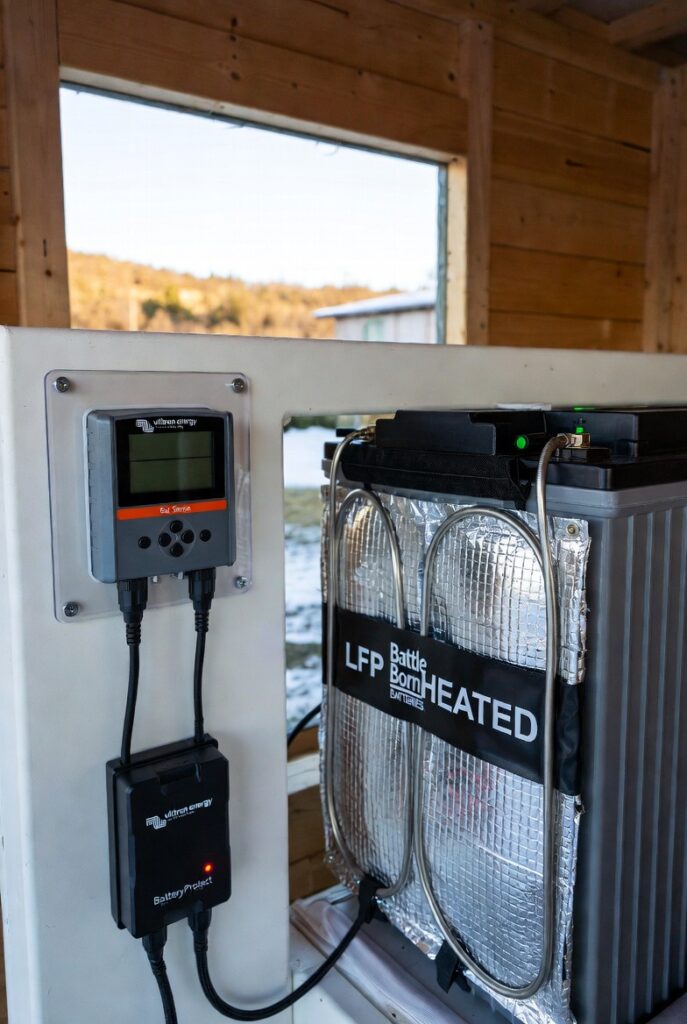
I installed a Victron Bat Sense temperature sensor directly on the battery terminal to give the MPPT controller the actual cell temperature rather than the controller enclosure temperature, and installed a 100W silicone heater pad on the battery case bottom wired through a BatteryProtect to warm the cells from minus 11°C to above 5°C before the MPPT was permitted to deliver charging current. The heater pad consumes 8.3A at 12V, drawing 100W from the battery bank itself to warm the cells from the overnight ambient minimum to 5°C in approximately 18 to 24 minutes, consuming 25 to 40Wh of stored energy. After the Bat Sense and heater pad installation the MPPT controller inhibits charging precisely at 0°C battery cell temperature and the heater pad activates automatically when the Bat Sense reading drops below 2°C. The 11 days of partial below-zero charging never repeated. The Bat Sense and heater pad installation cost $280. The $3,800 battery bank it stopped degrading was losing an estimated 0.5% permanent capacity per incorrect cycle. For the cottage winterization solar Battle Born heated LFP and cell temperature charge inhibit standard that covers the same cold-start battery protection principle for unoccupied winter properties, Article 240 covers the full specification. For the full system sizing hub that covers the load calculation foundation, the hub covers the numbers.
Why Cold Weather Solar Charging Destroys LFP Cells at Minus 10°C
Lithium plating occurs at the graphite anode during charging below 0°C because the lithium-ion insertion rate into the graphite lattice decreases exponentially with temperature. When the charging current exceeds the reduced insertion capacity excess lithium ions deposit as metallic lithium on the anode surface rather than inserting into the graphite. At minus 10°C the safe charging current is approximately 8% of the 0°C rated value, meaning a cell that accepts 50A at 25°C can only safely accept 4A at minus 10°C before plating begins. As a result any charging current above 4A to a cell at minus 10°C deposits metallic lithium permanently, and the damage is not reversible by subsequent warm-temperature cycling because the dendritic lithium is physically deposited on the anode surface.
The Victron Bat Sense bonded directly to the battery terminal gives the Victron MPPT 100/30 the actual cell temperature to within 2°C, enforcing the 0°C charge inhibit on cell temperature rather than the controller enclosure temperature that caused the Erin Township degradation. For the remote telecom solar Cerbo GX LTE-M monitoring and charge lockout standard that covers the same below-zero charge inhibit and self-heating protocol for unmanned remote sites, Article 232 covers the full specification.
| Cell Temperature | Safe Charging Current | Lithium Plating Risk |
|---|---|---|
| 25°C | 100% rated – 50A for a 50A rated cell | None – normal lithium-ion lattice insertion rate |
| 0°C | Charge inhibit threshold – BMS closes charge gate | None if inhibit is enforced correctly at cell temperature |
| Minus 10°C | 8% of rated – 4A maximum before plating begins | High – any current above 4A deposits metallic lithium permanently |
The Lithium Plating Mechanism and Permanent Cell Damage
Cold weather solar charging permanent cell damage is not visible on the battery’s voltage curve or SoC percentage until the capacity loss reaches 15 to 20% of rated capacity. At that point the bank can no longer supply its rated discharge current without voltage sag and the owner assumes the battery is defective. I reviewed a battery bank failure at a remote monitoring installation on a Crown land ridge in Simcoe County, Ontario north of Barrie where an environmental monitoring contractor had installed a 200W solar array, a 100Ah 12V standard LFP battery, and a PWM charge controller in a weatherproof enclosure in September. The installation had no temperature-based charge inhibit because the PWM controller specified had no temperature sensor input.
In December the overnight temperatures at the Barrie Environment Canada station were averaging minus 12°C. The PWM controller charged the battery at whatever voltage and current the panel produced regardless of cell temperature. By March the battery was reporting 100Ah capacity on a full charge followed by voltage collapse to 11.4V under 20A load at what the BMS reported as 40% SoC. The capacity test confirmed the bank had lost 38% of its rated capacity from 3 months of continuous charging at cell temperatures between minus 4°C and minus 14°C. The lithium plating had deposited metallic lithium on the graphite anode in dendritic formations that increased internal resistance from 8 milliohm per cell to 31 milliohm per cell. The battery required full replacement at a cost of $680. The monitoring station delivered unreliable data for the final 6 weeks as the battery voltage instability corrupted the data logger readings.
I rebuilt the installation with a Victron MPPT 100/30 with temperature-compensated charging, a Victron Bat Sense bonded to the battery terminal, and a 60W silicone heater pad wired to activate when the Bat Sense temperature dropped below 2°C. The Bat Sense feeds the actual cell temperature to the MPPT controller, which uses the temperature reading to enforce the 0°C charge inhibit and apply temperature-compensated absorption voltage above 0°C. In 2 subsequent winters including one with a 14-day period where the cell temperature never exceeded 2°C during daylight hours the heater pad maintained the cells above 5°C before each solar production window and the battery has not lost a measurable percentage of capacity. The Bat Sense and heater pad installation cost $240. The $680 battery replacement it prevents on the first unprotected winter paid for it 2.8 times over. For the farm solar power BatteryProtect and LVD principle standard that covers the same BatteryProtect low-voltage disconnect principle for protecting electrical loads at a critical voltage threshold, Article 235 covers the full specification.
The Internal Heated Cell vs External Heater Pad Decision
The decision between a factory-integrated heated LFP module and an external silicone heater pad retrofit follows three questions: whether the battery bank is being newly commissioned or already installed, whether the installation site reaches minus 20°C or colder, and whether the owner has tolerance for external wiring and a BatteryProtect relay in the power circuit. A Battle Born heated LFP module integrates the heating element inside the cell case with a PCB-controlled activation circuit that draws 15W from the cell itself and warms from minus 40°C to 5°C in 8 to 15 minutes. However, the factory heated module costs $480 to $640 more per 100Ah than a standard LFP module at current pricing.
An external 100W silicone heater pad bonded to the battery case bottom and wired through a BatteryProtect provides equivalent thermal protection at approximately $80 to $120 in hardware per battery, a 75 to 85% cost reduction from the factory heated option, with the trade-off of an additional wiring circuit and relay in the power path. As a result the factory heated module is the correct choice for new builds at sites below minus 20°C and for installations where field-installed external wiring is impractical, while the heater pad retrofit is the correct choice for existing standard LFP installations and sites where minus 10°C to minus 20°C represents the cold extreme. For the cottage winterization solar self-heating LFP and charge lockout standard that covers the same factory heated cell versus heater pad decision for unoccupied winter cottage applications, Article 240 covers the full specification.
The BatteryProtect Heater Control and Overnight Drain Prevention
An external heater pad drawing 100W from a 100Ah 12V LFP bank continuously overnight consumes 1,200Wh in a 12-hour Ontario winter night, the full usable capacity of the bank at 50% depth of discharge. As a result an uncontrolled heater pad at a site without overnight solar production will fully deplete the bank before morning, leaving no energy for the heating cycle needed before the first solar production window. A BatteryProtect configured to open the heater circuit at 30% SoC prevents this failure mode by cutting heater power when the bank reaches 30% SoC, preserving the remaining 30% for the morning heating cycle.
As a result the bank arrives at dawn with 30% SoC remaining, the heater pad activates on the first solar production and warms the cells to 5°C using solar energy rather than stored battery energy, and the MPPT begins charging the bank from its 30% reserve. The Victron SmartShunt logs the heater pad current draw and the BatteryProtect activation events, providing the owner with a daily record confirming the heater circuit is functioning before each cold morning charge window. For the fire tower solar BatteryProtect and Arctic-pack LFP charge management standard that covers the same LVD heater control principle for unmanned boreal installations, Article 228 covers the full specification.
The Cold Weather Solar Charging System: Minimum Viable vs Full Battery Heat Standard
The decision follows whether the battery bank is a new build or an existing standard LFP installation, whether the site reaches minus 20°C or below, and whether external wiring and a BatteryProtect relay are acceptable.
The minimum viable cold weather solar charging protection for a single battery bank in an unheated Ontario enclosure includes a Victron Bat Sense bonded to the battery terminal, a 60W silicone heater pad on the battery case bottom, a BatteryProtect wired to disconnect the heater at 30% SoC, and a Victron MPPT 100/30 configured to read cell temperature from the Bat Sense for charge inhibit. Capital cost runs $240 to $320 in retrofit hardware. It provides temperature-accurate charge inhibit and cell warming from the overnight ambient minimum to 5°C before each solar production window at any Ontario outdoor temperature.
The full battery heat standard for a new build or battery replacement in a cold climate includes four Battle Born heated LFP modules with factory-integrated PCB heating elements, a Victron Bat Sense bonded to the lead cell in the bank, and a Victron SmartShunt logging the heating element current draw. Capital cost runs $1,800 to $2,400 in battery cost premium over standard LFP. It provides zero external wiring, zero BatteryProtect relay, and factory-verified heating element performance at minus 40°C without any field-installed components.
NEC and CEC: What the Codes Say About Cold Weather Solar Charging
NEC 706 governs energy storage systems including LFP battery banks in any cold weather solar charging installation. The battery bank, BMS, and associated BatteryProtect low-voltage disconnect are subject to NEC 706 requirements for battery management systems, overcurrent protection, and disconnecting means. The heater pad circuit is a DC load circuit subject to NEC 690 branch circuit requirements for conductor sizing and overcurrent protection. The Bat Sense and MPPT temperature compensation function are part of the charge controller system subject to NEC 690 requirements for charge controller installation. Contact the NFPA for current NEC 706 and NEC 690 requirements applicable to cold weather solar charging installations in Ontario and across North America.
In Ontario, the solar array and battery storage installation are subject to CEC Section 64 for PV source circuits and CEC Section 26 for the battery installation including ventilation and clearance requirements. The heater pad circuit connecting to the battery bank requires overcurrent protection sized for the heater pad current draw under CEC Section 14. Contact the Electrical Safety Authority Ontario for the current permit requirements applicable to battery storage and heater pad installations at Ontario residential, agricultural, and commercial properties before connecting any heater circuit to a fixed solar battery system.
Pro Tip: Before commissioning any solar battery installation in an unheated Ontario enclosure, bond a Bat Sense to the battery terminal on the commissioning day and check the differential between the controller enclosure temperature and the cell temperature on the first cold morning. I have commissioned systems in October when the differential was under 2°C and returned in January to find the differential was 11°C, the controller was reading 4°C and charging the cells at minus 7°C. The differential grows through the winter as the controller absorbs solar heat faster than the thermal mass of the battery warms. Check the differential in January, not October. If it exceeds 4°C, the Bat Sense is not optional.
The Verdict
A cold weather solar charging system built to the battery heat standard means the Erin Township 5th Line property owner never discovers that 11 days of sunny February charging degraded a $3,800 battery bank by 4 to 8% permanently because the MPPT controller was reading its own enclosure at minus 4°C while charging cells at minus 9°C, and the Simcoe County Crown land weather station never loses 38% of its battery capacity from 3 months of unprotected PWM charging that raised internal resistance from 8 milliohm to 31 milliohm per cell and produced corrupted data logger readings for 6 weeks before the battery failed.
- Bond a Victron Bat Sense to the battery terminal before the first cold morning of every new solar installation in an unheated Ontario enclosure. The Erin Township MPPT was reading 11°C warmer than the battery cells in January because it absorbed morning solar heat while the battery thermal mass remained at the overnight minimum. The Bat Sense costs $140. The 0.5% permanent capacity loss per incorrect charge cycle it prevents costs more than the Bat Sense on the twentieth cycle.
- Pair the Bat Sense with a heater pad and BatteryProtect on every existing standard LFP installation at a site that reaches minus 10°C or below. The Simcoe County PWM controller had no temperature inhibit at all and charged at minus 12°C for 3 months. A $240 Bat Sense plus heater pad installation would have prevented the full $680 battery replacement. The retrofit hardware pays for itself on the first winter it would have caused a failure.
- Specify factory-heated Battle Born LFP modules for every new build at a site below minus 20°C. The heater pad retrofit is correct for existing installations and mild cold climates. At minus 28°C and below the factory PCB element warming from ambient to 5°C in 8 to 15 minutes is the only reliable solution. The cost premium over standard LFP is $480 to $640 per 100Ah. The battery replacement it prevents costs more than the premium on the first unprotected winter.
In the shop, we do not spec a battery for a vehicle without checking the cold cranking amps against the worst-case January temperature at the owner’s location. At the solar installation, we do not commission a battery bank in an unheated Ontario shed without checking the worst-case February cell temperature against the charge controller’s inhibit threshold.
Frequently Asked Questions
Q: Why does a standard LFP battery stop charging in winter when the solar panels are producing power? A: LFP cells lock out charging below 0°C to prevent lithium plating on the graphite anode. At sub-zero temperatures the lithium-ion insertion rate into the graphite lattice is too slow to accommodate normal charging current and excess lithium deposits as metallic crystals on the anode surface rather than entering the lattice. The BMS closes the charge gate and refuses current from the MPPT controller until the cell temperature rises above 0°C. This is correct protective behaviour. The damage comes from charge controllers that bypass or ignore the temperature inhibit.
Q: What is the difference between a Victron Bat Sense and the temperature sensor built into the MPPT controller? A: An MPPT controller’s internal temperature sensor reads the temperature at the controller enclosure, which can be 6 to 14°C warmer than the battery cells on a cold clear morning. The Bat Sense bonds directly to the battery terminal lug and reads the actual cell surface temperature to within 2°C of the core temperature. As a result the Bat Sense prevents partial below-zero charging events that an enclosure temperature sensor would allow. The $280 Bat Sense installation stops the same degradation mechanism that destroyed 38% of the Simcoe County weather station battery capacity.
Q: How does a silicone heater pad retrofit compare to a factory-heated Battle Born LFP module for cold weather protection? A: A factory-heated LFP module integrates the heating element inside the cell case with a PCB-controlled activation circuit that warms the cells from minus 40°C to 5°C in 8 to 15 minutes with zero external wiring. An external silicone heater pad provides equivalent thermal protection at 75 to 85% lower hardware cost but requires a BatteryProtect relay to prevent overnight heater drain and a Bat Sense for accurate temperature inhibit. The factory-heated module is the correct choice for new builds at sites below minus 20°C. The heater pad retrofit is the correct choice for existing standard LFP installations where replacing the cells is not practical.
Questions? Drop them below.
Master Tech Advisory: This build is engineered within the 48V DC Safety Ceiling. Diagnostic logic is based on 20+ years of technical service experience. All structural and electrical installations must be verified by a Licensed Professional and comply with your Local Authority Having Jurisdiction (AHJ).
This post contains affiliate links. If you purchase through our links, we may earn a small commission at no extra cost to you.
About the Author
Robert Bertrand spent 20 years as a service advisor in the automotive industry (Lexus and Nissan), where precision diagnostics, wiring integrity, and documentation standards were non-negotiable. He brings that same technical discipline to GridFree Guide, where he researches, tests, and documents off-grid solar systems for Ontario conditions. Based in Rockwood, Ontario, every article is built on verified specifications, manufacturer data, and the real-world climate constraints of Canadian off-grid living.
As an Amazon Associate I earn from qualifying purchases. This site also contains affiliate links to other products and services. GridFree Guide earns a small commission at no extra cost to you.