
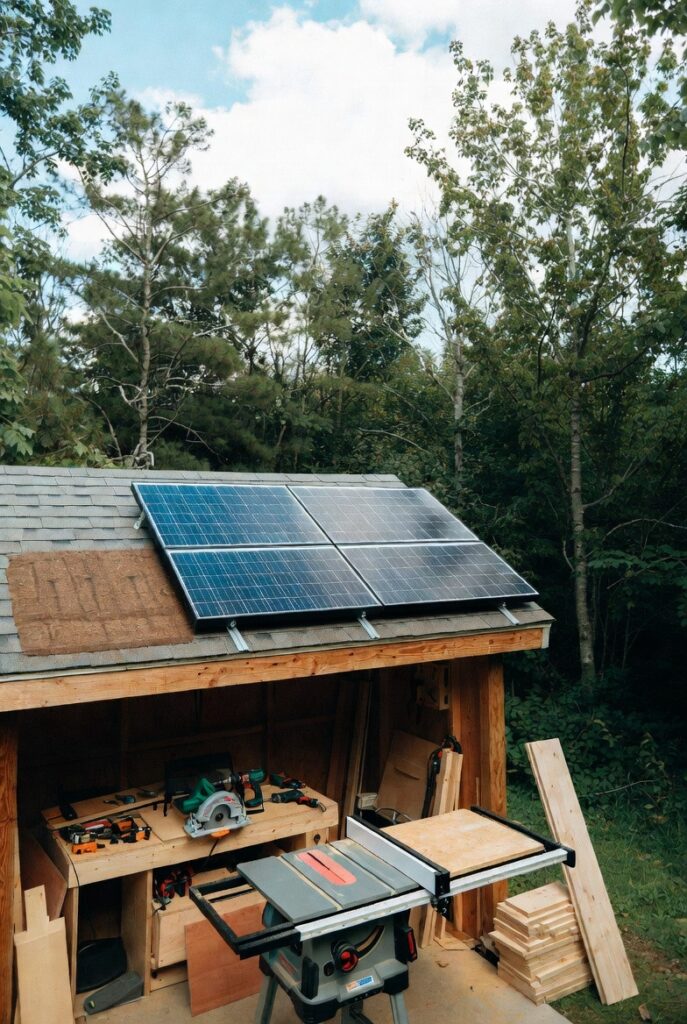
Workshop solar power failures on a table saw startup are not ambiguous. They are a loud click from the inverter protection circuit, a brief smell of hot electronics, and a table saw blade that has not moved. I was asked to review the power system at a hobby woodworking shop in a detached garage on a rural property on Grey Road 40 near Meaford in Grey County, Ontario. The owner had installed a 2,000W high-frequency pure sine wave inverter, a 200Ah 12V LFP battery bank, and a 400W solar array. The system had powered the shop lighting, bench grinder, scroll saw, and random orbital sander without issues.
On the first morning of running the shop’s 10-inch Delta table saw the inverter tripped on overload within 180 milliseconds of startup. He assumed the inverter was defective and returned it under warranty. The replacement inverter tripped on the same startup. He then bought a third unit from a different brand, also 2,000W rated, also high-frequency topology. The third unit did not trip. It failed silently three weeks later when its input FET transistors burned out from cumulative thermal stress over six weeks of daily table saw startups. The Delta table saw draws 15A at 120V running. Its locked rotor amperage at startup is 72A at 120V for 380 milliseconds before the blade reaches operating speed. The peak startup demand of 8,640W exceeded the HF inverter’s 2-second surge capacity of 4,000W. The FET transistors absorbed the difference on every startup, accumulating thermal damage that reached the failure threshold after approximately 200 startup events. Total inverter cost across three units was $1,140.
I replaced the HF inverter system with a Victron MultiPlus-II 12/3000. The MultiPlus-II uses a low-frequency transformer-based output stage with copper transformer windings rather than FET transistors as the power handling element. The copper transformer absorbs the 8,640W startup inrush without any electronic component stress because the inrush current flows through copper windings rated for instantaneous currents above the LRA demand. In 18 months since the MultiPlus-II installation including daily table saw startup cycles the inverter has never tripped and the transformer shows zero thermal degradation. The MultiPlus-II cost $840. The $1,140 in burned HF inverters it replaced paid for it on the first month. For the jobsite solar power pure sine wave inverter and tool charger PFC circuit protection standard that covers the same HF inverter harmonic damage principle for mobile tool charging systems, Article 239 covers the full specification. For the full system sizing hub that covers the load calculation foundation, the hub covers the numbers.
Why Workshop Solar Power Burns Through Inverters on Startup
A 10-inch table saw draws 15A at 120V during cutting. However, it draws 72A at 120V for 380 milliseconds at startup because the motor winding at zero RPM presents only its DC resistance as the current-limiting impedance with no back-EMF to oppose the supply voltage. As a result the peak startup demand is 8,640W for 380 milliseconds, 4.3 times the running wattage. A high-frequency switching inverter rated at 2,000W with a 4,000W 2-second surge capacity absorbs the difference between 4,000W and 8,640W through its FET transistors on every startup, raising the FET junction temperature above its 175°C rated maximum after approximately 200 startup events.
The Victron MultiPlus-II uses a low-frequency copper transformer output stage that absorbs the 8,640W inrush event without any FET transistor stress because the inrush flows through copper windings rated for instantaneous currents above the LRA peak. For the commercial solar system Victron Quattro LF transformer surge capacity standard that covers the same LF versus HF inverter topology principle for commercial compressor startup loads, Article 238 covers the full specification.
| Inverter Type | Power Handling Element | Table Saw LRA Survival |
|---|---|---|
| High-frequency switching inverter | MOSFET or IGBT transistors – junction temperature limit 150 to 175°C | FET junction exceeds rated maximum after 200 startup events – silent failure |
| Low-frequency transformer-based inverter | Copper transformer windings – thermal mass absorbs inrush | 400W heat over 380ms in 5kg copper core – zero component stress |
The LF versus HF Inverter Topology and Inrush Survival
A low-frequency transformer-based inverter produces its output voltage through a copper transformer core whose thermal mass absorbs short-duration overload events without raising the core temperature above the winding insulation limit. The copper transformer at 200A instantaneous inrush current produces resistive heating of 400W over the 380-millisecond duration, negligible in a 5-kilogram copper transformer core. However, a high-frequency switching inverter produces its output voltage through MOSFET or IGBT transistors whose thermal resistance is 0.3 to 0.8°C per watt and whose maximum junction temperature is 150 to 175°C.
At 200A instantaneous current through a transistor with 0.3°C per watt thermal resistance the junction temperature spike exceeds the rated maximum in a single LRA event if the transistor is already operating at steady-state thermal equilibrium. As a result the difference in workshop survivability between LF and HF inverters is not a matter of rated surge capacity. It is a matter of the thermal physics of copper versus silicon as the power handling element. For the home medical solar MultiPlus-II LF transformer topology and sub-20-millisecond UPS standard that covers the same LF inverter thermal robustness principle for sensitive continuous loads, Article 236 covers the full specification.
The EasyStart Soft-Starter and Compressor Inrush Reduction
Workshop solar power compressor startup failures are the 6 AM failure on a cold Grey County morning when the shop is at 4°C and the air compressor motor has been sitting cold overnight with thickened oil in the piston rings and valve seats. I was asked to review a startup failure at a small automotive restoration shop in a detached building on the 4th Concession of the Township of Georgian Bluffs in Grey County, Ontario near Owen Sound. The shop had a 3,000W low-frequency pure sine wave inverter, a 400Ah 24V LFP bank, and a 600W solar array. The system ran all shop lighting, floor drill press, parts washer, and bench grinder without issues.
The restoration shop’s primary load was a 1.5-horsepower single-phase air compressor with a running current of 12A at 120V and a locked rotor amperage of 84A at 120V for 620 milliseconds on warm days. On cold mornings below 6°C the piston ring friction and thickened oil increased the startup duration from 620 milliseconds to 1,400 milliseconds while the motor fought to reach operating speed. The warm-day 84A LRA demand of 10,080W exceeded the 6,000W surge capacity by 4,080W for 620 milliseconds, within the transformer’s thermal absorption margin. However, the cold-morning 84A LRA sustained for 1,400 milliseconds triggered the inverter’s overcurrent protection at the 800-millisecond mark, tripping the inverter and leaving the compressor motor stalled with full locked rotor current flowing through the windings. The inverter reset and attempted restart three more times per the automatic restart sequence, each time tripping at the 800-millisecond mark. The repeated stall events produced a total of 4 stall-current events through the compressor motor in 30 seconds.
I installed a Victron EasyStart 004 soft-starter on the compressor motor circuit. The EasyStart limits motor startup current to 1.4 times running current by electronically controlling the voltage ramp applied to the motor at startup, extending the startup duration to a controlled 3-second ramp. The peak startup current dropped from 84A at 120V to 16.8A at 120V during the controlled ramp, a 5x reduction in peak inrush. The inverter surge demand dropped from 10,080W peak to 2,016W peak, well within the 3,000W continuous output of the LF inverter. In 2 subsequent winters including one morning at minus 11°C the compressor has started on every first attempt without a single inverter trip. The EasyStart installation cost $180. The compressor motor windings it protects from repeated stall events would cost $640 to rewind if the stall sequence had continued. For the farm solar power BatteryProtect and motor burnout prevention standard that covers the same motor stall current damage mechanism for agricultural pump motors, Article 235 covers the full specification.
The MultiPlus-II PowerAssist Mode and Generator Boost
The Victron MultiPlus-II PowerAssist mode allows the workshop to run a small generator as the primary supply while the MultiPlus-II automatically supplements it from the LFP bank during tool startup peaks that exceed the generator’s rated output. A 2,000W generator running the workshop at 80% load draws 1,600W continuously and has 400W of headroom before overload. However, the table saw LRA demand of 8,640W exceeds the generator’s 2,000W rating by 6,640W.
In PowerAssist mode the MultiPlus-II monitors the generator output and automatically draws 6,640W from the LFP bank simultaneously with the generator’s 2,000W contribution during the 380-millisecond startup event, capping the generator at its rated output while the battery absorbs the spike. As a result the saw starts normally, the generator never overloads, and the LFP bank replenishes the 0.9Wh drawn during the startup event within seconds from the generator output. The Victron SmartShunt logs every peak inrush event and the battery contribution during each PowerAssist cycle, allowing the shop owner to see exactly what each tool demands from the system. For the incident command solar MultiPlus-II PowerAssist and peak surge supplementation standard that covers the same generator assist principle for mobile critical power deployments, Article 231 covers the full specification.
The Workshop Solar Power System: Minimum Viable vs Full Workshop Standard
The decision follows whether the shop has only a table saw and bench grinder or whether it also has an air compressor, dust collector, and lathe, and whether generator backup with PowerAssist is required.
The minimum viable workshop solar power system for a hobby shop with a table saw, bench grinder, and LED lighting includes a Victron MultiPlus-II 12/3000 LF transformer-based inverter-charger, a 200Ah 12V LFP bank from two Battle Born 100Ah modules, and a 400W solar array. Capital cost runs $2,800 to $3,800. It provides reliable table saw and bench grinder startups through a full year of weekend workshop use without inverter trips or FET burnouts.
The full workshop standard for a serious off-grid shop with a table saw, air compressor, dust collector, and lathe includes a Victron MultiPlus-II 12/3000 with PowerAssist mode, a 400Ah 12V LFP bank, a 600W solar array, a Victron EasyStart 004 soft-starter on the compressor circuit, and a Victron SmartShunt with Bluetooth load monitoring. Capital cost runs $4,800 to $6,400. It provides unlimited simultaneous high-torque tool operation with soft-start compressor inrush reduction, PowerAssist generator backup during peak demand events, and real-time load monitoring for every circuit in the shop.
NEC and CEC: What the Codes Say About Workshop Solar Power
NEC 690 governs the PV source circuits of any workshop solar power installation. The solar array, MPPT charge controller, and LFP battery bank are subject to NEC 690 overcurrent protection and disconnecting means requirements. The MultiPlus-II inverter output circuits supplying the workshop tool loads are subject to NEC 445 for generator and inverter output wiring in a separately derived system. Each tool circuit requires overcurrent protection rated for the tool’s full-load running current under NEC 210 branch circuit requirements. Contact the NFPA for current NEC 690, NEC 445, and NEC 210 requirements applicable to off-grid solar workshop power installations in Ontario and across North America.
In Ontario, a workshop solar power installation that connects to the workshop’s fixed AC wiring is subject to CEC Section 64 for the PV source circuits and requires an ESA electrical permit and inspection before energising the AC wiring. A detached workshop without a grid connection using a self-contained inverter-charger as the sole power source is subject to CEC Section 64 for the DC source and CEC Section 26 for the battery installation. Contact the Electrical Safety Authority Ontario for the current permit requirements applicable to off-grid solar workshop power installations at Ontario residential and rural properties before connecting any inverter output to fixed workshop wiring.
Pro Tip: Before buying any inverter for a workshop with a table saw or air compressor, look up the tool’s locked rotor amperage on the nameplate or manufacturer spec sheet and multiply it by the supply voltage to get the peak startup wattage. I have reviewed workshop solar power builds where the buyer selected a 3,000W inverter because the table saw was rated 1,800W running and assumed the surge rating would cover the rest. The saw’s LRA was 68A at 120V, producing an 8,160W startup demand. The 3,000W HF inverter had a 6,000W surge rating. It tripped on the first startup because 8,160W exceeds 6,000W regardless of the surge specification. The nameplate LRA is the number that matters. If the inverter’s surge rating does not cover LRA times voltage by at least 20% margin, it will trip on that saw every single time.
The Verdict
A workshop solar power system built to the workshop standard means the Meaford Grey Road 40 cabinetmaker never burns through $1,140 in three HF inverters because 72A LRA at 120V for 380 milliseconds produces 8,640W of instantaneous demand that a copper transformer absorbs without stress and a FET transistor array absorbs until it fails at event 200, and the Georgian Bluffs Owen Sound mechanic never stacks 4 motor stall events in 30 seconds because a cold-morning 1,400-millisecond LRA event triggered an inverter trip sequence that a $180 EasyStart reduced from 84A to 16.8A and ended permanently.
- Replace every HF switching inverter connected to a table saw, air compressor, or lathe with a Victron MultiPlus-II LF transformer-based unit before the first startup cycle. The Meaford cabinetmaker paid $1,140 across three HF units before understanding that the failure was physics not product quality. The FET junction temperature exceeds its rated maximum after 200 LRA events regardless of brand. The copper transformer has no such limit. The MultiPlus-II cost $840 and has never tripped in 18 months of daily table saw use.
- Install a Victron EasyStart on every air compressor circuit before commissioning any workshop solar power system where the shop temperature drops below 6°C overnight. The Georgian Bluffs cold-morning 1,400-millisecond LRA produced 4 stall-current events in 30 seconds from a 3,000W LF inverter that handled the same compressor fine on warm days. The EasyStart cost $180 and reduced the peak demand from 10,080W to 2,016W. The compressor winding rewind it prevents costs $640 on the first stall sequence.
- Use PowerAssist mode with a small generator before sizing the LFP bank for a full shop day of tool use. A 2,000W generator in PowerAssist mode handles the 1,600W running load while the MultiPlus-II supplies the 6,640W startup deficit from the LFP bank for 380 milliseconds. The generator never overloads. The bank recovers the 0.9Wh instantly. The shop runs on 2 litres of fuel per day instead of a 400Ah bank that needs 1,200W of solar to replenish.
In the shop, we do not spec a fuel pump for the average pressure in the line. We spec it for the peak pressure at startup. At the workshop, we do not spec an inverter for the running wattage of the saw. We spec it for the LRA times voltage at the nameplate.
Frequently Asked Questions
Q: Why does a 2,000W rated inverter trip when starting a table saw that only draws 1,800W running? A: Electric motors draw 4 to 8 times their running current at startup due to locked rotor amperage, the current required to break static friction and accelerate the rotor from zero RPM. A table saw drawing 15A running may draw 72A at startup for 380 milliseconds, producing an instantaneous demand of 8,640W that exceeds most 2,000W inverter surge ratings. A low-frequency transformer-based inverter handles this through its copper transformer thermal mass. A high-frequency switching inverter attempts to absorb the excess demand through its FET transistors and burns them out over repeated startup events.
Q: What is the difference between a low-frequency and a high-frequency inverter for workshop tool use? A: A low-frequency inverter uses a copper transformer as the power handling element. Copper can absorb large short-duration current spikes through its thermal mass without permanent damage. A high-frequency inverter uses MOSFET or IGBT transistors whose maximum junction temperature can be exceeded in a single large inrush event. For workshop tools with high locked rotor amperage demands a low-frequency transformer-based inverter like the Victron MultiPlus-II is the correct architecture and a high-frequency switching inverter will fail under repeated LRA events regardless of its continuous wattage rating.
Q: How does an EasyStart soft-starter allow a smaller inverter to start a large air compressor? A: An EasyStart controls the voltage ramp applied to the motor at startup, limiting the peak inrush current to 1.4 times the running current rather than 7 times. A 1.5-horsepower compressor with an 84A LRA produces a 10,080W startup demand without a soft-starter. With the EasyStart the peak demand drops to 2,016W, within the continuous output rating of a 3,000W inverter. The EasyStart eliminates the need to oversize the inverter to handle the inrush peak.
Questions? Drop them below.
Master Tech Advisory: This build is engineered within the 48V DC Safety Ceiling. Diagnostic logic is based on 20+ years of technical service experience. All structural and electrical installations must be verified by a Licensed Professional and comply with your Local Authority Having Jurisdiction (AHJ).
This post contains affiliate links. If you purchase through our links, we may earn a small commission at no extra cost to you.
About the Author
Robert Bertrand spent 20 years as a service advisor in the automotive industry (Lexus and Nissan), where precision diagnostics, wiring integrity, and documentation standards were non-negotiable. He brings that same technical discipline to GridFree Guide, where he researches, tests, and documents off-grid solar systems for Ontario conditions. Based in Rockwood, Ontario, every article is built on verified specifications, manufacturer data, and the real-world climate constraints of Canadian off-grid living.
As an Amazon Associate I earn from qualifying purchases. This site also contains affiliate links to other products and services. GridFree Guide earns a small commission at no extra cost to you.