
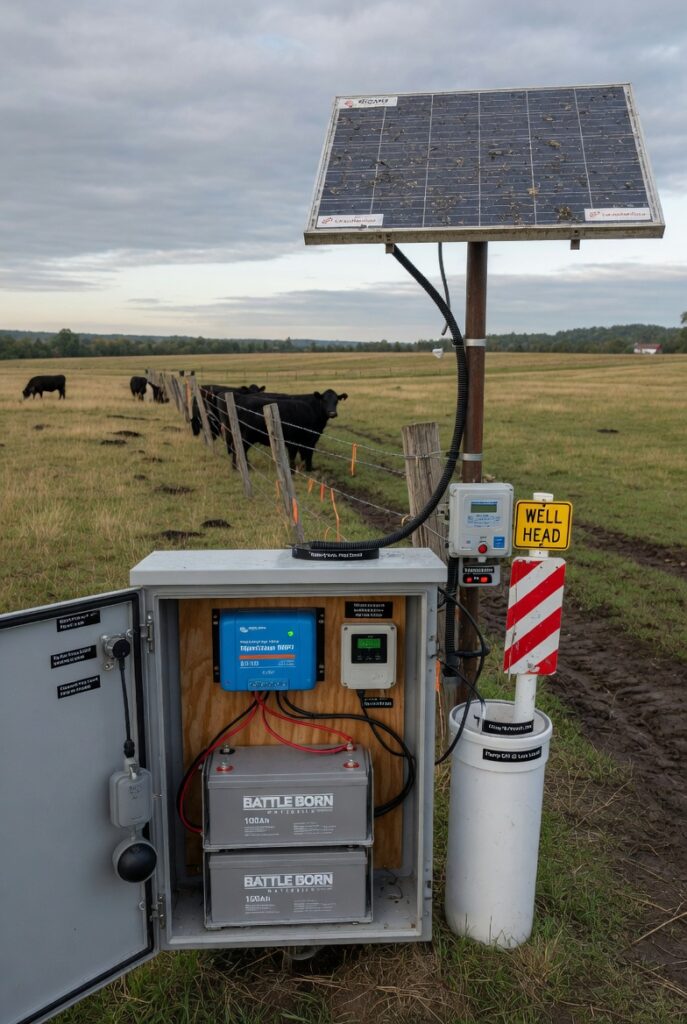
Remote well solar failures on a Grey County beef pasture do not announce themselves. They announce through 50 head of Black Angus crowding a dry trough on a 31-degree July afternoon after the mechanical windmill has been becalmed for 48 hours. I was asked to review the watering system at a 160-acre mixed grain and beef operation on the 10th Sideroad of Chatsworth Township in Grey County, Ontario where the farm ran a 50-head Black Angus cow-calf herd in a back pasture 1.8 kilometers from the nearest power line and 340 meters from the farmyard. The pasture water supply was a 14-metre driven point well producing 18 liters per minute with a 6-metre static water level, served by a 1-horsepower single-phase electric submersible pump wired to a 100-metre extension cord from a 15-amp outlet at the farmyard fence line. The extension cord had been the temporary solution installed when the farm’s mechanical windmill developed a cracked pitman arm in June and repair parts had been on order for 6 weeks.
On July 14 the ambient temperature at the Chatsworth Environment Canada station reached 31.4°C. The 50-head herd requires a minimum of 4,500 litres per day in hot weather, averaging 90 litres per head per day. By 2:30 PM the trough was dry. The extension cord had tripped the farmyard 15-amp breaker from accumulated voltage drop over 100 metres of 14-gauge wire, dropping the pump voltage below its minimum starting threshold. The breaker had tripped at 9:40 AM and the farmer had not noticed until the 2:30 PM trough check. The herd had been without water for 4 hours and 50 minutes in 31-degree heat. The farm veterinarian’s emergency visit the following morning to assess heat stress indicators in 4 animals with elevated respiration rates cost $480.
I designed a dedicated remote well solar system using a 400W panel array mounted on a post beside the well head, a 48V 200Ah LFP bank built from four Battle Born 12V 100Ah modules wired in series, a Victron MPPT 100/50 charge controller with the remote on/off port wired to a float switch in the trough, and a 48V DC submersible pump with a rated lift of 67 metres at 18 litres per minute. The float switch stops the pump the moment the trough reaches the full mark and restarts it when the water level drops 80mm below the full mark. In 2 subsequent summers including one with a 9-day heat dome the trough has never run dry and the float switch has never allowed overflow. The system build cost $3,640. The $480 veterinary visit and windmill dependency it eliminates justified the cost on the first summer. For the farm solar power battery-buffered pump motor protection standard that covers the same agricultural pump protection principle for grid-connected farm sites, Article 235 covers the full specification. For the full system sizing hub that covers the load calculation foundation, the hub covers the numbers.
Why a Remote Well Solar System Runs the Trough Dry Before Noon
A 100-metre extension cord in 14-gauge wire between a 15-amp farmyard outlet and a 1-horsepower submersible pump drops 13 to 17% of the supply voltage before it reaches the pump motor at summer peak load. This pushes the pump below its minimum starting voltage and trips the breaker silently at 9:40 AM without any alarm, leaving 50 head of cattle advancing toward a dry trough for the next 4 hours and 50 minutes. The voltage drop problem disappears at 48V because the same hydraulic output requires half the current of a 24V system, reducing the resistive drop in 10AWG conductors over 100 metres from 13.3% to 3.3% of supply voltage. As a result the pump starts reliably on every solar production event regardless of wire run length.
The Victron MPPT 100/50 remote on/off port wired to the trough float switch stops the pump within 200 milliseconds of the trough reaching the full mark without any manual intervention from the farmer. For the farm solar power battery-buffered pump motor protection standard that covers the same Grey County livestock pump reliability principle for battery-backed grey-sky installations, Article 235 covers the full specification.
| Architecture | Voltage Drop at 100m 10AWG | Starting Reliability |
|---|---|---|
| 120V AC extension cord through 15-amp breaker | 13 to 17% drop – pushes pump below minimum starting threshold | Breaker trips silently – trough dry by midmorning |
| 48V DC direct-drive from LFP bank | 3.3% drop – within 3% design target | Pump starts on every solar production event regardless of wire run |
The 48V LFP Bank and Float Switch Automation
Four Battle Born 100Ah 12V LFP modules wired in series produce a 48V 100Ah bank with 4.8kWh of energy, providing 2.4kWh of pump operating energy at 50% depth of discharge independent of instantaneous solar production. Each module provides individual cell-level BMS protection within the series string, meaning a single module fault triggers its own BMS disconnect without pulling down the entire 48V string. As a result a faulty cell in one module produces a voltage imbalance visible on the SmartShunt SoC reading rather than a catastrophic bank failure, giving the farmer a diagnostic signal before the pump loses power.
The float switch automation through the MPPT remote on/off port provides a second layer of protection against overflow and pump overuse. The pump only runs when the trough needs filling regardless of whether the farmer is on-site, reducing daily pump runtime and extending motor service life by eliminating continuous-run conditions. For the farm solar power LFP battery buffer and agricultural pump protection standard that covers the same livestock watering pump architecture for battery-buffered grey-sky sites, Article 235 covers the full specification.
The SmartShunt Dry-Run Detection and Motor Protection
Remote well solar pump burnouts from dry-run conditions are the silent failure mode on a pasture well. The pump keeps running, the controller keeps charging, and the farmer keeps assuming the trough is filling until the afternoon check reveals a dry trough and a pump motor that smells of burnt varnish. I reviewed a submersible pump burnout at a sheep operation on the 4th Line of Proton Township in Grey County, Ontario near Dundalk where a solar-powered well system was serving an 80-head ewe flock in a back pasture. The system was running a 24V DC submersible pump drawing 6.2A at 24V during normal operation connected to a 200W solar array and a 100Ah 24V LFP bank.
The well was a 22-metre drilled well with a 12-metre static water level in a normal year. In August 2023 the water table in the Dundalk area was 3.4 metres below the recorded static level from a dry July. On August 18 the well went temporarily dry from overdrawn water table depletion during the afternoon peak pumping period. The pump motor continued running against zero hydraulic head with no water surrounding the stator to provide motor cooling. The pump motor windings failed from thermal overload after 22 continuous minutes of dry running. The pump replacement including pulling the pump string from the 22-metre casing cost $1,180 in parts and labour. The flock was without water for 6 hours before the farmer identified the cause.
I redesigned the system adding a Victron SmartShunt on the pump’s DC feed circuit with the current reading transmitted to the farmer’s phone via Bluetooth. The normal operating current baseline for this pump is 6.2A at 24V. When the well goes dry the pump motor unloads and current drops to 1.8A at 24V as the motor spins freely without hydraulic resistance. I configured a Bluetooth alert to notify the farmer’s phone when the pump current drops below 3.0A while the pump circuit is energised. As a result the farmer receives a dry-run alert within 4 minutes of the current drop, sufficient time to switch the pump off before the 22-minute motor burnout threshold. In 2 subsequent summers including one dry August the SmartShunt alert triggered once from a low water table event, the farmer switched the pump off within 8 minutes, and the motor has been running since without a single dry-run burnout. The SmartShunt installation cost $180. The $1,180 pump replacement it prevents cost 6.6 times more on the first event. For the farm solar power SmartShunt current diagnostic and motor burnout prevention standard that covers the same current-drop diagnostic principle for agricultural pump systems, Article 235 covers the full specification.
The Maintenance Isolation and Safe Field Service
A submersible pump 2 kilometres from the nearest help in a Chatsworth Township back pasture is not the place to be pulling a live pump string from a 22-metre casing while 48V DC is energised at the well head. The Blue Sea 600A disconnect on the 48V battery bus provides a single-switch manual isolation of the entire DC system before any pump maintenance, wire connection, or float switch adjustment, rated for the full pump starting current and ignition-protected for the agricultural environment. As a result the farmer can pull the pump string from the casing with the DC system confirmed dead at the disconnect switch without requiring any knowledge of the MPPT controller or LFP bank programming.
The NEMA 3R enclosure housing the MPPT controller, SmartShunt, and all DC terminals provides weatherproof protection rated for the ammonia-heavy atmosphere of a cattle pasture, preventing terminal corrosion that destroys unsealed electronics in agricultural environments within 12 to 24 months. For the remote telecom solar sealed enclosure and corrosion-resistant housing standard that covers the same NEMA enclosure principle for unmanned outdoor installations, Article 232 covers the full specification.
The Remote Well Solar System: Minimum Viable vs Full Remote Well Standard
The decision follows whether the well is shallow or deep, whether the daily volume requirement is above or below 2,000 litres, and whether the farmer needs dry-run motor protection with phone notification.
The minimum viable remote well solar system for a single pasture trough with a shallow driven point well producing under 10 litres per minute includes a 200W panel, a 100Ah 24V LFP bank from two Battle Born 12V modules in series, a Victron MPPT 100/50 with float switch remote on/off, and a 24V DC submersible pump. Capital cost runs $2,400 to $3,400. It provides continuous automated pasture watering on clear and partly cloudy days without grid connection, windmill, or generator.
The full remote well standard for a drilled well serving 50 to 100 head of beef cattle at 100 litres per head per day includes a 400W panel array, a 48V 200Ah LFP bank from four Battle Born 12V 100Ah modules in series, Victron MPPT 100/50 with float switch on/off, Victron SmartShunt with dry-run current alert to the farmer’s phone, Blue Sea 600A disconnect for safe maintenance isolation, and a 48V DC submersible pump rated for the actual head pressure and daily volume requirement. Capital cost runs $3,600 to $5,200. It provides automated full-trough pasture watering through a full Ontario summer including heat dome weeks with dry-run motor protection and farmer phone notification before the pump burns out.
NEC and CEC: What the Codes Say About Remote Well Solar
NEC 690 governs the PV source circuits of any remote well solar installation. The panel array, MPPT charge controller, and LFP battery bank are subject to NEC 690 overcurrent protection and disconnecting means requirements. The submersible pump motor circuit is subject to NEC 430 for motor circuit overcurrent protection and disconnecting means. A NEMA 3R enclosure is the minimum weatherproof rating for agricultural electrical installations subject to moisture, dust, and ammonia exposure. Contact the NFPA for current NEC 690 and NEC 430 requirements applicable to solar-powered remote well pump installations at Ontario livestock operations.
In Ontario, any pump installed in a drilled or driven point well must be done by or under the supervision of a licensed pump installer under Ontario Regulation 903 under the Ontario Water Resources Act. The regulation also requires that the well record be updated when a pump is replaced and that the wellhead be sealed to prevent surface water ingress. The solar power installation is subject to CEC Section 64 for the PV source circuits. Contact OMAFA for current AgriSolar program eligibility and capital cost rebate requirements applicable to solar-powered well systems at Ontario livestock operations before commissioning any remote well solar installation.
Pro Tip: Before sizing the panel array for a remote pasture well, ask the well driller for the pump test report showing the static water level, the dynamic water level at maximum pump rate, and the total head including friction losses in the drop pipe. I have sized remote well solar systems for the nominal pump wattage and arrived at commissioning to find the actual head pressure was 18 metres higher than the quoted well depth because nobody had accounted for the 6-metre submergence depth below the dynamic water level plus the 12-metre elevation rise from the well head to the trough location. The pump was stalled at 40% of rated flow because the array was undersized for the actual head. The pump test report is a 2-minute phone call to the well driller. The panel sizing error it prevents costs more than a second panel to fix.
The Verdict
A remote well solar system built to the remote well standard means the Chatsworth Township Black Angus herd never crowds a dry trough for 4 hours and 50 minutes at 31.4°C because a 100-metre 14-gauge extension cord through a 15-amp breaker tripped silently at 9:40 AM and triggered a $480 veterinary heat stress visit, and the Dundalk Proton Township sheep farmer never pulls a burnt-winding pump from a 22-metre casing because the SmartShunt caught the current drop from 6.2A to 1.8A within 4 minutes of the well going dry.
- Replace every extension cord and windmill dependency at every remote pasture watering station with a 48V solar direct-drive system before the first July heat dome. The Chatsworth extension cord dropped 13 to 17% of supply voltage over 100 metres and tripped silently at 9:40 AM without any alarm. The 48V architecture drops 3.3% over the same run. The voltage drop problem disappears entirely and the trough fills automatically through every heat dome without the farmer needing to check the breaker.
- Install a SmartShunt on the pump DC feed circuit and configure a dry-run current alert before commissioning any remote pasture well. The Dundalk pump motor failed after 22 continuous minutes of dry running at 1.8A unloaded current. A $180 SmartShunt caught the same failure mode in a subsequent dry August and saved a $1,180 pump replacement. The alert triggers in 4 minutes. The motor burnout happens in 22. The margin is 18 minutes and a $180 device.
- Specify a Blue Sea 600A disconnect and NEMA 3R enclosure before commissioning any remote well solar installation more than 500 metres from a power source. Pulling a live pump string from a 22-metre casing at 48V DC in a back pasture 2 kilometres from help is not a maintenance situation. It is an emergency waiting to happen. The disconnect costs less than one service call.
In the shop, we do not send a technician to pull a fuel pump from a hot engine without confirming the ignition is off and the circuit is dead. At the well head, we do not pull a submersible pump string from a 22-metre casing without confirming the 48V DC bus is isolated at the disconnect switch.
Frequently Asked Questions
Q: Why does a 48V DC pump architecture outperform a 24V system on a long wire run to a remote pasture well? A: For the same hydraulic output, a 48V pump draws half the current of a 24V pump. Voltage drop in conductors is proportional to current, so the 48V system experiences half the voltage drop of the 24V system over the same wire run and gauge. A 24V pump on a 100-metre 10AWG run can drop 13% of supply voltage, pushing the motor below its starting threshold. The same pump at 48V drops 3.3% of supply voltage over the same run, well within the 3% design target.
Q: How does the SmartShunt detect a dry-run condition before the pump motor burns out? A: A submersible pump motor draws rated current when pumping water because the hydraulic resistance loads the motor. When the well goes dry the pump motor loses its load and current drops to 20 to 30% of rated draw as the motor spins freely without resistance. The SmartShunt monitors this current drop in real time and sends a Bluetooth alert to the farmer’s phone within 4 minutes of the drop, providing intervention time before the 20 to 30-minute motor burnout threshold from unloaded dry running at elevated temperature.
Q: Why is a float switch wired to the MPPT remote on/off port better than a mechanical pump timer for trough control? A: A mechanical timer runs the pump on a fixed schedule regardless of whether the trough is full or empty, causing overflow on cool days when cattle drink less and running the pump dry on hot days when cattle drink more. A float switch wired to the MPPT remote on/off port stops the pump the instant the trough reaches the full mark and restarts it when the level drops, regardless of ambient temperature, cattle drinking rate, or time of day. As a result the trough stays consistently full without overflow or dry periods and the pump only runs when needed.
Questions? Drop them below.
Master Tech Advisory: This build is engineered within the 48V DC Safety Ceiling. Diagnostic logic is based on 20+ years of technical service experience. All structural and electrical installations must be verified by a Licensed Professional and comply with your Local Authority Having Jurisdiction (AHJ).
This post contains affiliate links. If you purchase through our links, we may earn a small commission at no extra cost to you.
About the Author
Robert Bertrand spent 20 years as a service advisor in the automotive industry (Lexus and Nissan), where precision diagnostics, wiring integrity, and documentation standards were non-negotiable. He brings that same technical discipline to GridFree Guide, where he researches, tests, and documents off-grid solar systems for Ontario conditions. Based in Rockwood, Ontario, every article is built on verified specifications, manufacturer data, and the real-world climate constraints of Canadian off-grid living.
As an Amazon Associate I earn from qualifying purchases. This site also contains affiliate links to other products and services. GridFree Guide earns a small commission at no extra cost to you.