
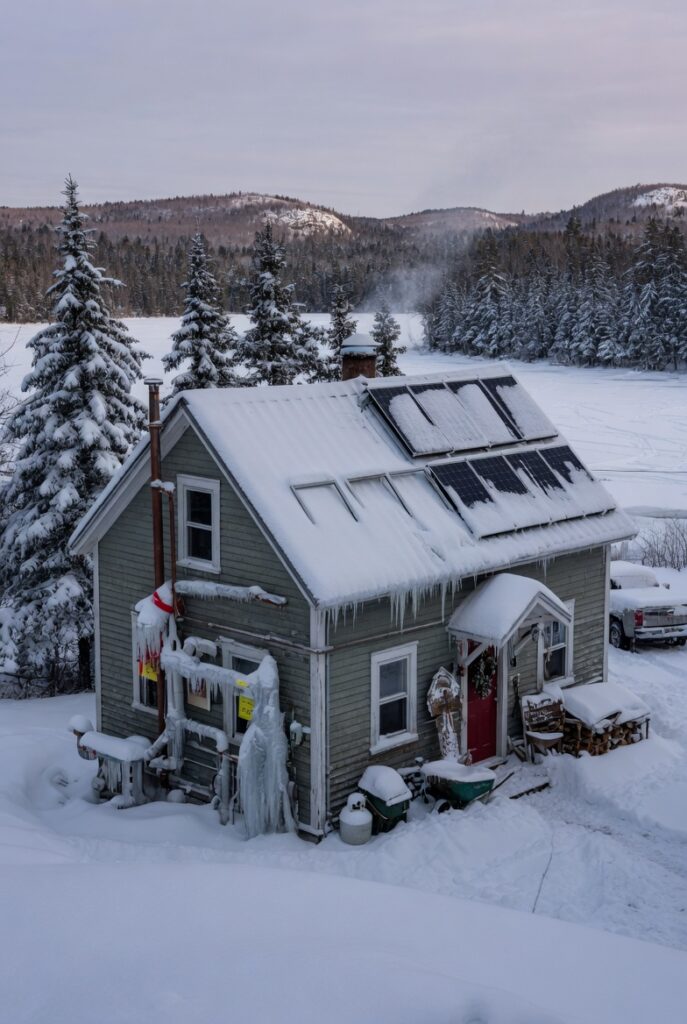
Cottage winterization solar failures in a Haliburton February are not discovered in real time. They are discovered 11 days later when the owner arrives to find the crawlspace floor wet, the pressure tank drained into the floor drain, and a 340mm section of copper supply line split from ice expansion behind the utility room wall. I was asked to review the winterization setup at a 3-bedroom cottage on Kashagawigamog Lake Road in Dysart et al Township in Haliburton County, Ontario that the owners used from May through October and left unoccupied from November through April. The cottage had a propane forced-air furnace set to 10°C as the backup heat source for winter, a 120V heat tape on the crawlspace supply line, and a standard 1,500VA modified sine wave UPS on the heat tape circuit rated for 2 hours of runtime.
On February 11 a freezing rain event coated the Haliburton County grid infrastructure and a transformer failure knocked out power to the cottage road for 17 hours and 42 minutes. The modified sine wave UPS kept the heat tape running for 1 hour and 58 minutes before the battery was depleted. The furnace igniter had failed to restart on the modified sine wave UPS output at the 22-minute mark when a voltage spike from the UPS battery changeover tripped the furnace control board’s fault protection. The crawlspace temperature dropped from 6°C to minus 14°C over the following 9 hours without either the heat tape or the furnace operating. The 340mm copper split in the supply line occurred at approximately hour 7 when the crawlspace crossed minus 8°C at the uninsulated pipe section behind the exterior wall. The owners arrived 11 days later and found the pressure tank drained, the split pipe, and water damage to the crawlspace subfloor. Plumber repair cost was $1,840. Subfloor remediation cost was $2,600. Insurance deductible was $1,000. Total unoccupied outage cost was $5,440 for a 17-hour grid failure that a $0 monitoring alert would have prompted a 3-hour drive north.
I designed a dedicated cottage winterization solar backup system for the Dysart cottage using a Victron MultiPlus-II 12/3000 inverter-charger, a 200Ah 12V self-heating LFP bank, a Victron Cerbo GX with GX LTE 4G modem transmitting battery SoC and crawlspace temperature to the owners’ phones, and a Victron SmartShunt calculating the remaining hours of heat tape runtime from the current SoC. The MultiPlus-II UPS function transfers to battery in less than 20 milliseconds, below the fault protection threshold of the furnace control board. In 2 subsequent winter seasons including a 23-hour grid outage the previous February the heat tape has never lost power, the furnace has never faulted, and the owners have received battery SoC and crawlspace temperature updates every 15 minutes throughout every outage. The system build cost $3,200. The $5,440 pipe and subfloor repair it prevents on the first qualifying outage justified the build cost on the first event. For the seasonal cottage solar summer startup and Victoria Day battery hibernation standard that covers the same cottage LFP bank management principle for occupied seasonal use, Article 234 covers the full specification. For the full system sizing hub that covers the load calculation foundation, the hub covers the numbers.
Why Cottage Winterization Solar Fails at Minus 28°C
A modified sine wave UPS on a cottage heat tape circuit fails in two ways simultaneously during a winter grid outage. It depletes its small battery within 90 to 120 minutes under the continuous heat tape load, and its modified sine wave output trips the furnace control board fault protection on the first voltage transient from the UPS battery changeover. As a result the cottage loses both the heat tape and the furnace within the first 30 minutes of the outage without the owner receiving any notification. A standard unheated LFP battery fails differently at minus 19°C: the BMS locks out charging to protect the cells from lithium plating, and the battery silently self-discharges through the winter without accepting any solar production.
The Victron MultiPlus-II produces less than 1.5% THD and transfers from grid to battery in less than 20 milliseconds, keeping the furnace control board below its fault protection threshold and the heat tape circuit live through any grid dropout. For the home medical solar MultiPlus-II sub-20-millisecond UPS transfer standard that covers the same furnace control board hold-up time principle, Article 236 covers the full specification.
| Protection System | Grid Outage Response | Crawlspace Temperature at Hour 9 |
|---|---|---|
| Modified sine wave UPS 1,500VA | Heat tape fails at 1 hour 58 minutes, furnace faults at 22 minutes | Minus 14°C – pipe split at hour 7 |
| Cottage winterization solar MultiPlus-II | Sub-20ms transfer heat tape and furnace continuous | 6°C maintained – pipes protected through full 17-hour outage |
The Self-Heating LFP Bank and Minus 28°C Cold-Start
Cottage winterization solar battery failures at minus 28°C are not dramatic. They are a VRM dashboard showing battery SoC frozen at 34% for 6 consecutive days in January because the standard LFP bank locked out charging at 0°C on the first cold night of the season and has been slowly self-discharging without a single amp of solar recharge. I reviewed a winterization solar failure at a 2-bedroom cottage on Eagle Lake in Algonquin Highlands Township in Haliburton County, Ontario where a retired couple had installed a 400W solar array, a 200Ah 12V standard LFP bank, and a Cerbo GX monitoring system for unoccupied winter protection. The system had performed normally through November when daytime temperatures were above 0°C. On December 14 the overnight temperature at the Haliburton Environment Canada station dropped to minus 19°C.
The Cerbo GX VRM dashboard showed the battery SoC at 71% on December 14 at 8 PM. On December 15 at 9 AM the VRM showed the battery SoC at 68% with zero solar production and zero charge current. The charge controller had correctly locked out charging at 0°C per the LFP charge inhibit protocol. However, the battery self-discharge at minus 19°C was drawing the bank down at 0.6% per hour without any solar charge replenishment because the lockout remained active for the entire winter period. By January 18 the VRM showed the battery SoC at 34% and still falling. The heat tape was drawing 14W continuously and the battery would reach the low-voltage disconnect threshold at approximately 18% SoC within 11 days.
I replaced the standard LFP bank with four Battle Born heated LFP modules. The integrated self-heating element in each module draws 15W from the battery to warm the cell temperature from the overnight ambient minimum to 5°C, after which the BMS closes the charge gate and the MPPT controller resumes normal charging. The self-heating energy cost is 6 to 10Wh per morning heating event at minus 28°C, representing less than 0.5% of the daily bank throughput. In 2 subsequent winter seasons including a January cold snap that reached minus 31°C at the Haliburton station the Eagle Lake battery bank has accepted morning solar charge on every clear day and never dropped below 58% SoC through any January. The heated bank replacement cost $1,960. The heat tape failure it prevents on the next deep freeze cold snap would cost more than the bank on the first plumbing event. For the fire tower solar Arctic-pack LFP self-heating standard that covers the same BMS cold-start lockout and heating element protocol for unmanned northern installations, Article 228 covers the full specification.
The Cerbo GX LTE-M Cellular Monitoring and LVD Triage
An unoccupied cottage 3 hours from Rockwood during a February ice storm has one question the owner needs answered every 15 minutes: is the heat tape still running. The Victron Cerbo GX with GX LTE 4G modem connects directly to the cellular network and transmits battery SoC, crawlspace temperature, heat tape load draw, and furnace status to the VRM portal without requiring the cottage’s internet service or powered router. As a result the cottage owner in Rockwood receives 15-minute interval updates throughout the entire grid outage regardless of whether the cottage WiFi is active.
The LVD configured at 20% SoC in the Cerbo GX provides a triage hierarchy when the battery approaches depletion: the heating loads are disconnected at 20% SoC while the Cerbo GX, Victron SmartShunt, and temperature sensors remain powered from the reserved 20% capacity. As a result the owner receives an LVD alert with 4 to 8 hours of monitoring-only reserve remaining, providing a known intervention window before the system goes dark. For the remote telecom solar Cerbo GX LTE-M cellular monitoring and pre-depletion alert standard that covers the same cellular heartbeat and LVD triage principle for unmanned critical sites, Article 232 covers the full specification.
The Heat Tape Load and 48-Hour Autonomy Sizing
A standard 120V heat tape on a 6-metre crawlspace supply line draws 8 to 14W continuous at ambient temperatures below 4°C, consuming 192 to 336Wh per 24-hour day. A sump pump draws 8W running and 48W at startup for 1.4 seconds on a 15-minute cycle, consuming approximately 192Wh per 24-hour day at a 20% duty cycle. A propane furnace igniter and control board draw 180W for 90 seconds per ignition cycle, consuming approximately 90Wh per 24-hour day at a typical 6-ignition-per-day winter rate. The combined winterization thermal load is approximately 474 to 618Wh per 24-hour day.
A 200Ah 12V LFP bank at 50% depth of discharge provides 1,200Wh of usable capacity, sustaining the full thermal load for 1.9 to 2.5 days of autonomy from stored energy alone before the LVD disconnects the heating loads at 20% SoC and the monitoring system operates on the reserved 240Wh. As a result the owner has approximately 48 hours of full winterization protection from a fully charged 200Ah bank, plus a 4 to 8-hour monitored LVD alert window, producing a total 52 to 56-hour intervention timeline from a grid failure before the crawlspace temperature becomes a risk. For the cottage solar system battery sizing and depth of discharge standard that covers the same usable capacity and LVD sizing principle for seasonal residential LFP banks, Article 234 covers the full specification.
The Cottage Winterization Solar System: Minimum Viable vs Full Winterization Standard
The decision follows whether the cottage has a sump pump in addition to heat tape, whether 48-hour autonomy is required, and whether crawlspace temperature monitoring with LTE-M cellular alerts is needed.
The minimum viable cottage winterization solar system for an unoccupied cottage with heat tape and a furnace includes a Victron MultiPlus-II 12/1200 with UPS function, a 100Ah 12V self-heating LFP bank, a Victron Cerbo GX with GX LTE modem, and a Victron SmartShunt with LVD at 20% SoC. Capital cost runs $2,400 to $3,200. It provides sub-20-millisecond transfer, self-heating LFP cold-start acceptance at minus 28°C, LTE-M cellular monitoring, and 12 to 16 hours of heat tape and furnace autonomy with monitoring visibility through the full outage.
The full winterization standard for an unoccupied cottage with heat tape, sump pump, crawlspace temperature monitoring, and 48-hour autonomy includes a Victron MultiPlus-II 12/3000, a 200Ah 12V self-heating LFP bank using four Battle Born heated modules, Victron Cerbo GX with GX LTE modem and VRM portal monitoring, Victron SmartShunt with LVD at 20% SoC, and Bluetooth temperature sensors in the crawlspace and utility room. Capital cost runs $3,200 to $4,800. It provides 48-hour full heating load autonomy, LTE-M cellular monitoring, crawlspace temperature alerts, and LVD triage ensuring monitoring visibility through the complete grid outage.
NEC and CEC: What the Codes Say About Cottage Winterization Solar
NEC 706 governs energy storage systems including the LFP battery bank in any cottage winterization solar installation. The LFP bank, LVD, and associated overcurrent protection are subject to NEC 706 requirements for battery management systems, disconnecting means, and cell temperature monitoring. The MultiPlus-II inverter-charger AC output circuit is subject to NEC 702 for optional standby systems in a seasonal residential application. The solar array source circuits are subject to NEC 690 overcurrent protection and disconnecting means requirements. Contact the NFPA for current NEC 706, NEC 702, and NEC 690 requirements applicable to cottage winterization solar backup installations in Ontario and across North America.
In Ontario, a cottage winterization solar installation that connects to the cottage’s fixed AC wiring is subject to CEC Section 64 for the PV source circuits and CEC Section 26 for storage battery ventilation and clearance requirements, and requires an ESA electrical permit and inspection. A self-contained portable system with no fixed wiring connection is exempt from ESA permit requirements under the Ontario Electrical Safety Code as a portable power assembly. Contact the Electrical Safety Authority Ontario for the current permit requirements applicable to winterization solar backup installations at seasonal cottages in Ontario before connecting any system to fixed cottage wiring. Insurance providers for unoccupied dwellings in Ontario may require documented ESA permit and inspection for electrical backup systems as a condition of coverage during the unoccupied winter period.
Pro Tip: Before leaving the cottage for the last time in October, walk the full crawlspace perimeter with a flashlight and a can of spray foam and seal every air gap you can find at the rim joist and around every pipe penetration. I have reviewed cottage winterization solar systems that were correctly sized for the thermal load but were losing so much heat through unsealed rim joists that the heat tape was running at 100% duty cycle in January to compensate, consuming 336Wh per day instead of the 192Wh design load and cutting the battery autonomy from 2.5 days to 1.4 days. The spray foam costs $18 and takes 40 minutes. It is the most cost-effective winterization upgrade available. The $18 can of foam changes the autonomy calculation more than adding a second battery at $480.
The Verdict
A cottage winterization solar system built to the winterization standard means the Dysart Kashagawigamog Lake Road owners arrive in February to a dry crawlspace and a furnace that has been running continuously instead of a 340mm split pipe and a $5,440 plumber and subfloor bill from a 17-hour outage that a modified sine wave UPS covered for 1 hour and 58 minutes, and the Eagle Lake retired couple never watches a VRM dashboard frozen at 34% SoC for 6 weeks in January because a standard LFP bank locked out charging at minus 19°C and silently drained toward the heat tape disconnect threshold.
- Replace every modified sine wave UPS on every cottage heat tape and furnace circuit with a Victron MultiPlus-II before the first October freeze. The Dysart cottage lost both the heat tape and the furnace within 22 minutes of a 17-hour outage because a voltage transient tripped the furnace control board and a 1,500VA battery depleted in 1 hour 58 minutes. The MultiPlus-II transfers in less than 20 milliseconds and produces less than 1.5% THD. Neither failure mode exists with the correct inverter in place.
- Replace every standard LFP bank at every unoccupied winter cottage with self-heating modules before commissioning any winterization solar system. The Eagle Lake standard LFP bank locked out charging on December 14 and self-discharged from 71% to 34% SoC through January without accepting a single solar production event. Four Battle Born heated modules solved the problem permanently at a cost of $1,960. The heat tape failure they prevent costs more on the first event.
- Install the Cerbo GX with GX LTE modem and configure the LVD triage at 20% SoC before the first unoccupied winter season at any cottage more than 90 minutes from the owner. The LVD alert provides 4 to 8 hours of monitoring reserve after the heating loads are shed. That window is the difference between a managed situation and a plumber bill discovered 11 days later.
In the shop, we do not send a customer north in January without confirming the battery is charged and the heater is working. At the cottage, we do not leave for Rockwood in October without confirming the winterization system will still be talking to us in February.
Frequently Asked Questions
Q: Why does a standard modified sine wave UPS fail to protect a cottage furnace during a winter grid outage? A: A modified sine wave UPS produces voltage transients during the battery changeover that trip modern furnace control board fault protection circuits within 15 to 30 minutes of outage onset. The UPS then runs the heat tape alone for 90 to 120 minutes before its small battery depletes, leaving both the furnace and the heat tape without power for the remainder of the outage. A Victron MultiPlus-II transfers to battery in less than 20 milliseconds without any voltage transient, keeping the furnace control board below its fault threshold throughout the outage.
Q: Why does a standard unheated LFP battery stop accepting solar charge in a Haliburton winter? A: Standard LFP cells lock out charging below 0°C to prevent lithium plating on the graphite anode. At minus 19°C the BMS maintains this lockout continuously while the battery self-discharges at 0.5 to 0.8% per hour, drawing the bank toward the heat tape LVD threshold without accepting any solar production. A Battle Born heated LFP module warms the cell temperature from the overnight ambient minimum to 5°C before the charge gate opens, capturing every available solar production window regardless of overnight ambient temperature.
Q: How does the LVD triage preserve monitoring visibility when the battery is nearly depleted? A: The Low-Voltage Disconnect configured at 20% SoC in the Cerbo GX disconnects the heating loads when the battery reaches that threshold, reserving the remaining 240Wh exclusively for the Cerbo GX, SmartShunt, and temperature sensor circuits. The owner receives an LVD alert indicating the heating loads have been shed, with 4 to 8 hours of monitoring-only reserve remaining. This provides a known intervention window before the system goes completely dark, allowing the owner to decide whether to drive north or arrange a local service visit.
Questions? Drop them below.
Master Tech Advisory: This build is engineered within the 48V DC Safety Ceiling. Diagnostic logic is based on 20+ years of technical service experience. All structural and electrical installations must be verified by a Licensed Professional and comply with your Local Authority Having Jurisdiction (AHJ).
This post contains affiliate links. If you purchase through our links, we may earn a small commission at no extra cost to you.
About the Author
Robert Bertrand spent 20 years as a service advisor in the automotive industry (Lexus and Nissan), where precision diagnostics, wiring integrity, and documentation standards were non-negotiable. He brings that same technical discipline to GridFree Guide, where he researches, tests, and documents off-grid solar systems for Ontario conditions. Based in Rockwood, Ontario, every article is built on verified specifications, manufacturer data, and the real-world climate constraints of Canadian off-grid living.
As an Amazon Associate I earn from qualifying purchases. This site also contains affiliate links to other products and services. GridFree Guide earns a small commission at no extra cost to you.