
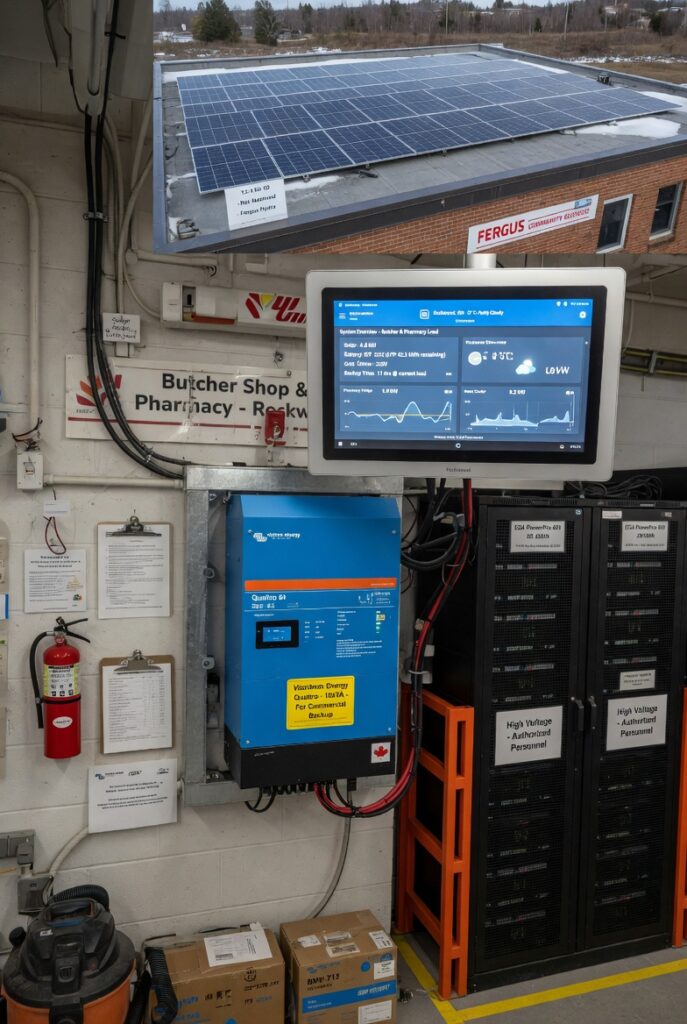
A commercial solar system failure during a summer grid outage is not measured in inconvenience. It is measured in hours before $15,000 in prime cuts begins to sweat under commercial refrigerator lights that are no longer running. I was asked to review the backup power arrangement at a butcher shop on the main street of Rockwood in Wellington County, Ontario where a localized transformer failure occurred at 2:17 PM on a humid Tuesday afternoon in July. The shop had four reach-in commercial display coolers holding approximately $15,000 in fresh beef, pork, and lamb, two walk-in coolers with an additional $8,400 in inventory, and a single-phase 200A commercial electrical service.
The owner had a 7,500W portable generator stored in a shed 40 metres behind the building. It took 22 minutes to retrieve the generator, move it to the front of the building, connect the transfer switch, and start the unit. During those 22 minutes the reach-in display coolers warmed from 2°C to 7.4°C measured at the thermocouple on the display rail. The Ontario Food Safety and Quality Act requires commercial meat display temperatures to be maintained at or below 4°C. When the health inspector arrived for a routine inspection at 3:45 PM they found the temperature logs showing the 22-minute excursion to 7.4°C and issued a conditional pass requiring disposal of all open-pack product that had experienced the temperature excursion. The disposal cost the owner $3,200 in open-pack product plus $840 in inspector-required documentation. The generator rental for the remainder of the day cost $280. Total outage cost was $4,320 for a 22-minute gap between grid failure and generator connection.
I designed a commercial solar battery backup system for the Rockwood butcher shop using a Victron Quattro 48/10000 inverter-charger, a 51.2kWh 48V server rack LFP battery bank, and a Victron Cerbo GX with VRM portal push notification to the owner’s phone. The Quattro’s integrated transfer switch operates in less than 20 milliseconds, below the ride-through threshold of every commercial refrigerator compressor controller in the shop. In 2 subsequent summer outages including one lasting 6 hours from a transformer failure the previous August the cooler temperatures have never exceeded 3.1°C and the owner received a VRM push notification within 90 seconds of each grid dropout. The system build cost $18,400. The $4,320 outage cost it prevents per event justified the build cost within the first 5 events. For the full system sizing hub that covers the load calculation foundation, the hub covers the numbers.
Why a Commercial Solar System Pays for Itself in One Outage
A 22-minute generator hookup gap costs a butcher shop $4,320 in a single July afternoon because the Ontario Food Safety and Quality Act sets 4°C as the mandatory display temperature threshold and a health inspector does not distinguish between a planned maintenance shutdown and an unplanned grid failure. A sub-20-millisecond battery transfer catches the commercial refrigeration load before any compressor controller completes its hold-up countdown, preventing the 3 to 5-minute restart lockout that a relay-based transfer switch triggers on every dropout. As a result the cooler temperature never rises during a grid outage because the compressors never stop.
The Blue Sea 600A disconnect on the 48V battery bus provides ESA-compliant manual isolation of the battery bank during maintenance without interrupting the inverter output to the commercial load. For the home medical solar sub-20-millisecond transfer and UPS function standard that covers the same transfer time principle for medical-grade power, Article 236 covers the full specification.
| Backup Method | Transfer Time | Cooler Temperature at Transfer Complete |
|---|---|---|
| Portable generator | 20 to 22 minutes hookup + 3 to 5-minute compressor lockout | 7.4°C – above Ontario Food Safety 4°C threshold |
| Commercial solar battery backup | Less than 20 milliseconds | 2°C – compressor never stops, temperature never rises |
The Quattro Inverter Array and Compressor Startup Torque
A commercial refrigerator compressor draws 3 to 6 times its running current at startup to develop the magnetic flux required for rotor acceleration from standstill. A single 2-horsepower commercial compressor draws approximately 16A running at 120V and up to 96A at startup for 1.8 to 2.4 seconds. Four simultaneous compressor startups in a butcher shop produce a combined startup demand of 384A at 120V, or 46kW instantaneously. A single residential inverter-charger cannot supply this load without voltage collapse.
However, a Victron Quattro 48/10000 in a three-inverter three-phase array delivers 30kW continuous and 60kW surge capacity, handling all four compressor startups simultaneously without voltage sag and without a generator start. As a result the compressors cycle normally through the outage, maintaining thermostat setpoints without manual intervention from the owner. For the farm solar power BatteryProtect and commercial compressor startup torque standard that covers the same high-inrush motor load management principle for agricultural pump motors, Article 235 covers the full specification.
The Peak Shaving and Pharmacy Compliance
Commercial solar system drug storage failures at a pharmacy are not about spoiled product. They are about a Health Canada drug storage audit finding that triggers a compulsory medication disposal order and a pharmacy license review. I reviewed the backup power arrangement at an independent pharmacy on St. Andrew Street West in Fergus in Wellington County, Ontario that had experienced a 4-hour grid outage from a summer storm in August. The pharmacy was running two pharmaceutical-grade refrigerators maintaining vaccines, insulin, and biologic injectables at 2 to 8°C. The pharmacy had a standard 1,800VA modified sine wave UPS rated for 45 minutes of runtime at full load.
During the 4-hour outage the UPS maintained the refrigerator temperature for 38 minutes before the battery was depleted. The medication refrigerators then warmed from 4°C to 14.8°C over the following 3 hours and 22 minutes before grid power was restored. Health Canada’s Cold Chain Management Guidelines require that medications exposed above 8°C for more than 60 minutes be considered compromised. The pharmacist-in-charge filed the mandatory temperature excursion report with Health Canada. The regulated medication disposal order covered $22,400 in vaccines and biologic injectables. The pharmacy’s provincial license required a compliance review and mandatory cold chain audit at a cost of $4,800. Total regulatory consequence was $27,200.
I designed a dedicated pharmaceutical cold chain backup system for the Fergus pharmacy using a Victron Quattro 48/5000 inverter-charger, a 20kWh 48V server rack LFP battery bank, and the Victron Cerbo GX transmitting a VRM temperature alert to the pharmacist-in-charge’s phone when the refrigerator ambient temperature crosses 6°C. The Quattro’s sub-20-millisecond transfer eliminates the warm-up period that a generator-start approach would require. In 2 subsequent summer outages including one lasting 7 hours the medication refrigerators have maintained continuous temperature within the 2 to 8°C Health Canada requirement and no disposal orders have been issued. The system build cost $12,600. The $27,200 regulatory consequence it prevents on the first qualifying outage justified the build cost more than twice over. Beyond emergency backup, the Victron Quattro operating in ESS mode shaves the pharmacy’s demand peaks during non-outage periods, reducing the highest 15-minute average power draw on the Hydro One commercial bill by $180 to $340 per month. The Victron SmartShunt logs the demand peak events and provides the SoC data the Cerbo GX uses to calculate remaining commercial load autonomy at any point during an outage. For the incident command solar Cerbo GX tactical dashboard and remote monitoring standard that covers the same VRM push notification and load autonomy calculation principle for mission-critical deployments, Article 231 covers the full specification.
The Cerbo GX VRM Push Notification and Owner Remote Monitoring
A business owner who is not on-site when the grid fails has one question: are my coolers still running. The Victron Cerbo GX transmits grid status, battery SoC, and individual cooler circuit load data to the VRM portal over LTE-M cellular without requiring business internet service or WiFi. The VRM portal sends a push notification to the owner’s phone within 90 seconds of grid dropout, showing the battery SoC, estimated hours of autonomy remaining, and the current load draw of the refrigeration circuits. As a result the owner can monitor cooler performance from home, from a supplier meeting, or from a family dinner without returning to the premises.
If the SoC trend shows unexpected depletion from an unusually hot day driving continuous compressor cycling, the VRM alert notifies the owner with 6 to 8 hours of remaining autonomy before the battery reaches the critical threshold. For the cottage solar system Cerbo GX LTE-M remote owner notification standard that covers the same remote monitoring principle for unattended properties, Article 234 covers the full specification.
The Commercial Solar System: Minimum Viable vs Full Commercial Standard
The decision follows whether the business has pharmaceutical cold chain compliance requirements, whether the commercial load includes walk-in coolers with inrush startup demands above 10kW, and whether peak shaving functionality is required to reduce monthly Hydro One demand charges.
The minimum viable commercial solar system for a small food retailer with two reach-in coolers and a POS system includes a single Victron Quattro 48/5000, a 20kWh 48V server rack LFP bank, a Victron Cerbo GX with VRM push notification, and a Blue Sea 600A main DC disconnect. Capital cost runs $8,400 to $12,000. It provides 12 to 16 hours of commercial refrigeration autonomy with sub-20-millisecond transfer and owner phone alert at grid dropout.
The full commercial standard for a butcher shop or pharmacy with multiple walk-in coolers, pharmaceutical refrigerators, and peak shaving functionality includes a three-inverter Victron Quattro 48/10000 array, a 51.2kWh 48V server rack LFP bank, Cerbo GX with VRM temperature and SoC monitoring, Blue Sea 600A main disconnect, and ESA-compliant fire-rated battery enclosure. Capital cost runs $16,000 to $24,000. It provides 24-hour full commercial load autonomy, sub-20-millisecond transfer, Health Canada cold chain compliance through any Ontario summer storm outage, and peak shaving recovering $180 to $340 per month in Hydro One demand charges.
NEC and CEC: What the Codes Say About Commercial Solar Systems
NEC Article 702 governs optional standby systems including commercial solar battery backup installations at food retail and pharmacy premises. The battery bank and inverter array are subject to NEC 706 for energy storage systems including requirements for battery management systems, arc fault protection, and fire-rated enclosures for battery systems exceeding 20kWh nominal energy. The commercial refrigeration load circuits are subject to NEC 430 for motor circuit overcurrent protection requirements applicable to the compressor motors. Contact the NFPA for current NEC 702, NEC 706, and NEC 430 requirements applicable to commercial solar battery backup installations at Ontario food retail and pharmacy premises.
In Ontario, a commercial solar battery backup installation is subject to CEC Section 64 for the energy storage system and requires an ESA electrical permit and inspection before commissioning. A battery bank exceeding 20kWh nominal energy at a commercial occupancy requires a fire-rated battery room with a 1-hour fire separation rating under the Ontario Electrical Safety Code. Contact the Electrical Safety Authority Ontario for the current commercial permit requirements, inspection timeline, and fire-rated enclosure specifications before ordering equipment for any commercial solar battery backup installation in Ontario. Commissioning before ESA permit approval is a compliance violation under the Ontario Electrical Safety Act.
Pro Tip: Before specifying the battery bank size for a commercial refrigeration backup system, ask the refrigeration contractor for the compressor runtime percentage from the energy management system log for the hottest week of the previous summer. I have sized commercial battery banks for the average annual runtime and arrived at a July commissioning to find the compressors running at 78% duty cycle during a heat dome week rather than the 42% annual average. At 78% duty cycle the 20kWh bank I had specified lasted 9 hours instead of 16. The hottest week of summer is the week the grid is most likely to fail. Size for that week, not the annual average.
The Verdict
A commercial solar system built to the commercial standard means the Rockwood butcher shop never pays $4,320 for a 22-minute generator hookup gap because a sub-20-millisecond battery transfer caught the compressors before the display rail reached 4°C and the health inspector found logs showing 3.1°C instead of 7.4°C, and the Fergus pharmacy never files a $27,200 mandatory temperature excursion report because a 1,800VA modified sine wave UPS lasted 38 minutes of a 4-hour outage and a dedicated pharmaceutical cold chain backup has maintained continuous 2 to 8°C through every summer storm since.
- Replace every portable generator backup plan at every commercial food retailer with a sub-20-millisecond battery transfer system before the first summer outage season. The Rockwood butcher shop generator hookup took 22 minutes and cost $4,320. The coolers never shut down when the battery system is in place. The $18,400 build cost is recovered within 5 outage events. Every Ontario Main Street food retailer faces the same transformer age risk every summer.
- Specify a Victron Quattro array sized for the worst-case simultaneous compressor startup demand before commissioning any commercial refrigeration backup. Four 2-horsepower compressors starting simultaneously produce 46kW of instantaneous demand that a residential inverter cannot supply. The Quattro 48/10000 three-inverter array delivers 60kW surge capacity and handles every startup without voltage sag. Size for the simultaneous worst case, not the running load average.
- Install the Cerbo GX with LTE-M and configure a temperature alert at 1°C below the regulatory threshold before commissioning any pharmacy or food retailer backup system. The Fergus refrigerator crossed 8°C while the pharmacist-in-charge was off-site and nobody knew until the temperature alarm triggered at 14.8°C. A 6°C alert provides a 15 to 30-minute intervention window before the Health Canada threshold is crossed. The notification takes 90 seconds to deliver. The $27,200 disposal order it prevents does not.
In the shop, we do not send a fleet vehicle out without verifying the backup systems have been tested under full load. At the business, we do not commission a commercial refrigeration backup without verifying the transfer time under simultaneous compressor startup conditions.
Frequently Asked Questions
Q: Why does a 22-minute generator hookup gap cost a butcher shop more than the generator rental? A: Ontario’s Food Safety and Quality Act requires commercial meat display temperatures to be maintained at or below 4°C. A reach-in cooler warms from 2°C to 7.4°C in 22 minutes at summer ambient temperatures. A health inspector finding this temperature log during a routine visit issues a disposal order for all open-pack product that experienced the excursion. The disposal cost of $3,200 plus documentation fees and rental costs exceeds the generator rental by 15 times. A sub-20-millisecond battery transfer prevents the temperature excursion entirely.
Q: Why does a pharmacy need a faster backup transfer than a generator can provide? A: Health Canada’s Cold Chain Management Guidelines consider medications compromised if exposed above 8°C for more than 60 minutes. A generator start sequence requires 2 to 4 minutes of hookup plus 3 to 5 minutes of compressor restart lockout after power is restored. For a pharmacy refrigerator starting at 4°C and warming at 0.8°C per minute, that 7 to 9-minute window already consumes 7 to 9% of the Health Canada 60-minute threshold before the compressor resumes. A sub-20-millisecond battery transfer catches the compressor before the lockout timer starts and the refrigerator temperature never rises.
Q: How does peak shaving reduce a commercial business’s monthly Hydro One electricity bill? A: Hydro One commercial rate structures include a demand charge based on the highest 15-minute average power draw recorded in the billing period. Multiple commercial compressor startups during the afternoon peak can produce a 15-minute average 40 to 60% above the steady-state running load. A Victron Quattro in ESS mode caps grid import at the owner’s configured threshold by drawing from the battery bank during demand spikes, limiting the highest 15-minute average to the threshold value. The resulting demand charge reduction typically saves $180 to $340 per month on a 4-cooler commercial refrigeration load.
Questions? Drop them below.
Master Tech Advisory: This build is engineered within the 48V DC Safety Ceiling. Diagnostic logic is based on 20+ years of technical service experience. All structural and electrical installations must be verified by a Licensed Professional and comply with your Local Authority Having Jurisdiction (AHJ).
This post contains affiliate links. If you purchase through our links, we may earn a small commission at no extra cost to you.
About the Author
Robert Bertrand spent 20 years as a service advisor in the automotive industry (Lexus and Nissan), where precision diagnostics, wiring integrity, and documentation standards were non-negotiable. He brings that same technical discipline to GridFree Guide, where he researches, tests, and documents off-grid solar systems for Ontario conditions. Based in Rockwood, Ontario, every article is built on verified specifications, manufacturer data, and the real-world climate constraints of Canadian off-grid living.
As an Amazon Associate I earn from qualifying purchases. This site also contains affiliate links to other products and services. GridFree Guide earns a small commission at no extra cost to you.